ColinD
Line Up and Wait
I'm witnessing some really nasty wear patterns in a couple of Superior Millennium cylinders on the Lycoming O-235-L2C in my airplane. I installed one cylinder last September (approx. 180 hours ago) and another a couple weeks ago (approx. 25 hours runtime.) The two Millennium cylinders in questions are installed up front in positions 1 & 2. In both instances, I set the ring end gaps in accordance with the Superior L04-01 service letter and followed Lycoming's 1427C break-in service instruction with a few deviations (For example: first flight was truncated from 2 hours down to 90 minutes due to the airplane's limited fuel capacity.) I used Phillips X/C 20W50 from the onset. The rings aren't installed upside-down.
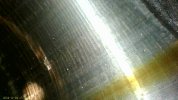
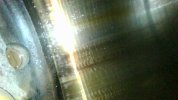
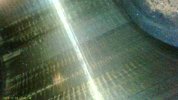
The airplane's engine instrumentation is extremely spartan, with only oil temperature and pressure. I have no way of monitoring cylinder head temps, so I have been avoiding steep climbs and prolonged WOT operation but always keep the power above 65% (and preferably 75%) until short final. I've avoided pattern work, continued with cross country flights waiting for the oil consumption to stabilize, but it's never gotten down to a level I'd consider acceptable. Looking at the following borescope images, I can see why.
After installing the first Millennium cylinder, oil consumption never exceeded 5 hours/qt, and now it's down to 3.5-4 hours/qt. Compressions measured at TDC are 75/80 or better on both cylinders, but I suspect rings' seal radically changes every 1/16 inch of stroke as the piston travels up or down the bore. Lots of oil pooling in the top end, lots of blowby out the breather.
Wondering if anyone here has encountered this 'washboarding' wear pattern, and if they were able to determine a cause. I think I heard Mike Busch briefly mention a bad batch of Superior cylinders on an older episode of the 'Ask the A&Ps' podcast, and I'm finding a few mentions of this type of wear on other forums and older Reddit posts. My first instinct is always to blame myself, I'm just not seeing where I screwed up. I've built a bunch of engines in my life and never had trouble like this. Is it really bad metallurgy or machining practices?
An interesting comparison: Being a cheapskate, I overhauled the rear cylinders on this same engine by restoring the crosshatch with a ball hone, lapping the valves, and installing new-old-stock Superior rings from an eBay parts liquidator. They were the same part numbers as the rings included in the new Millennium cylinder kit. The refreshed rear cylinders have no unusual wear, with the same ring gapping and break-in protocol.
The gruesome images (taken today, disregard the timestamps):


The airplane's engine instrumentation is extremely spartan, with only oil temperature and pressure. I have no way of monitoring cylinder head temps, so I have been avoiding steep climbs and prolonged WOT operation but always keep the power above 65% (and preferably 75%) until short final. I've avoided pattern work, continued with cross country flights waiting for the oil consumption to stabilize, but it's never gotten down to a level I'd consider acceptable. Looking at the following borescope images, I can see why.
After installing the first Millennium cylinder, oil consumption never exceeded 5 hours/qt, and now it's down to 3.5-4 hours/qt. Compressions measured at TDC are 75/80 or better on both cylinders, but I suspect rings' seal radically changes every 1/16 inch of stroke as the piston travels up or down the bore. Lots of oil pooling in the top end, lots of blowby out the breather.
Wondering if anyone here has encountered this 'washboarding' wear pattern, and if they were able to determine a cause. I think I heard Mike Busch briefly mention a bad batch of Superior cylinders on an older episode of the 'Ask the A&Ps' podcast, and I'm finding a few mentions of this type of wear on other forums and older Reddit posts. My first instinct is always to blame myself, I'm just not seeing where I screwed up. I've built a bunch of engines in my life and never had trouble like this. Is it really bad metallurgy or machining practices?
An interesting comparison: Being a cheapskate, I overhauled the rear cylinders on this same engine by restoring the crosshatch with a ball hone, lapping the valves, and installing new-old-stock Superior rings from an eBay parts liquidator. They were the same part numbers as the rings included in the new Millennium cylinder kit. The refreshed rear cylinders have no unusual wear, with the same ring gapping and break-in protocol.
The gruesome images (taken today, disregard the timestamps):