Lycoming cost

VAR cranks are start as a casting. I think you need to read up on how forged parts are made. They start as a casting... or do you think they use metal in its molten form? Minor nit to pick but the statement is still true: they are cast. I can use some MS Paint drawings if that would help visualize the process.

You wrote:
Even the cranks and cam are cast, not forged.

Apparently english must not be your first language. And your lack of comprehension is astounding.

I've been knee deep in quite a few motors. Even if I showed a logbook.photos.workorders you still wouldn't believe me so why bother? Not sure why some people think they are the gatekeepers.
Again, tell us which LYCOMING or CONTINENTAL aircraft engines you have ever worked on outside of the votech you got your A&P at.

Every time you get asked about prior experience the goal post start moving. And we know why.
Also ROTAX cranks are cast FWIW.

This thread is about lycoming. Again, lack of reading comprehension once again.
 
One of these days you might get it right. But there are two types of factory zero-time engines: a NEW engine where everything is new, and a REBUILT engine where used parts are permitted provided, they meet NEW specifications. Your lack of aviation mechanical knowledge continues to amaze me.
So was right as a new and rebuilt motor have new-tolerance parts.

You probably had to do a few google searches then realized that there is new and new.

ALso this


Did Lyc change the definition of new in the last few years?
 
Lycoming has THREE engine classifications.

A new engine is just that. All new parts that all meet new specifications and tolerances.

A "rebuilt" engine is a used engine rebuilt to new engine specs and tolerances.

An "overhauled" engine is a used engine overhauled to within service limits.

Lycoming does all three, but they also say this:

View attachment 150471

Your independent engine shop cannot legally call their engines "rebuilt" because of that. They're just overhaulers.

Here's an excerpt from the Lyc overhaul manual:

View attachment 150472

For instance, for the A-B engines, the tappet body outside diameter, when new, is between .6232" and .6240". A tappet being reused cannot be smaller than .6229" (the service limit). The rebuilt engine's tappets will be within the new specs (and most likely Lycoming will just use new tappets) and an overhauled engine can have the tappets worn as small as .6229".

So, a used .6229" OD tappet is as much as .0011" smaller than the largest new tappet. Sounds bad? Consider that a human hair is about .003" in diameter, nearly three times that .0011" difference. We are talking very small tolerances here. It's .0003" smaller than the smallest new tappet, a tolerance ten times smaller than that human hair.

I bought a lot of Lycoming overhauled engines. Most of them had recycled cases, some had recycled cranks and rods. Everything else was new. Everything they use gets NDI, Non-Destructive Inspection, of various types including eddy current, magnaflux, dye-penetrant and so on. Even new parts get the NDI< since one has to catch voids (bubbles in castings) and cold shuts (where the aluminum flowing into the mold gets bit too cool and when the leading edges meet at the far end of the mold, they fail to fuse together completely. The casting looks good but is weak. Eddy current catches that, since that poor joint won't carry the eddy current properly across the unfused area and an anomaly in the generated magnetic field triggers the eddy current failure detector.

Once in a whole we received a zero-time rebuilt engine rather than the overhauled we asked for. They were probably short of serviceable cores for overhaul. I even got a brand-new engine once, for overhauled price. No useable cores at all, probably.

You and doc must be on TEAMS googleing the heck trying to be more righter.


See, its not just me that knows this stuff. Try and keep up.
 
Again, tell us which LYCOMING or CONTINENTAL aircraft engines you have ever worked on outside of the votech you got your A&P at.

Every time you get asked about prior experience the goal post start moving. And we know why.

When you use an attack from authority it is a sign you have no actual rebuttal. Again, even if I did post workorders.photos.invoices you would claim X Y or Z. I'm not going to take the time to edit out the PID because some rando on the internet thinks they are the knowledge gatekeeper.

I've been on the net and in aviation a LLLLOOOONNNNGGGG time (I am eledgable for the Wright Brothers Master Pilot award in 6 years thank you very much) and I know that other people think they are THE AUTHORITY. They are not. I prove it again and again. I may not bat 100%, but I also don't act like I do (unlike others).
 
Most parts are sand cast, low quality and laughable tolerances which is why they require extensive machining.. Even the cranks and cam are cast, not forged
Name an engine casting, made by anyone at all, that does not require machining. No casting can be made precise enough to not need machining You obviously have never machined anything to do with any engine.

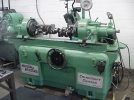
I have many thousands of hours, over 12 years, operating a crankshaft grinder and a Sunnen CK-10 cylinder resizer. I also have thousands of hours of lathe and mill time.


CK-10:
1772594095112.png

Storm Vulcan 10/15 crank grinder:
1772593935543.png

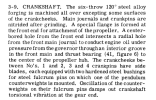
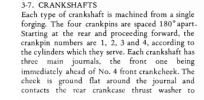
As far a crankshaft manufacture, we can look at the Lycoming O/IO-360 operator's manual for the description:

1772594324924.png

A forging. Honestly, where do you get your "knowledge?" And just in case try to claim that only the "larger" engines have forged cranks, let's check the little O-235:

1772594589312.png

Continental? Let's check the O-470:

1772594770616.png

A steel alloy forging.

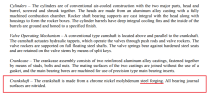
Maybe the O-200? Well, the overhaul manual for the C-75, C-85, C-90 and O-200 has this to say:

1772594999618.png
 
When you use an attack from authority it is a sign you have no actual rebuttal. Again, even if I did post workorders.photos.invoices you would claim X Y or Z. I'm not going to take the time to edit out the PID because some rando on the internet thinks they are the knowledge gatekeeper.

I've been on the net and in aviation a LLLLOOOONNNNGGGG time (I am eledgable for the Wright Brothers Master Pilot award in 6 years thank you very much) and I know that other people think they are THE AUTHORITY. They are not. I prove it again and again.
We are not talking pilot license here, we are talking about lycoming engine construction.

So tell us, which Lycoming engines have you actually worked on? O-320? O-540? What did you do to them? Have you ever actually disassembled and overhauled one?

No need for work orders, photos, etc. Just give us a brief rundown.

I may not bat 100%

You haven't even made it out of the locker room..............
 
Have you actually sat in a A350 cockpit yet?
Have you even started an A350 engine, or taxied one? Sitting in the seat of an aircraft being worked on in your employer's shop doesn't mean much.

I can claim having sat in the seat of the prototype Quest Kodiak. I even flew it for a few minutes. I also have a few hours flying time in the world's oldest airworthy Cessna 180. It was as old as I was.

1772595461131.jpeg

But none of that has anything to do with this discussion, which has to do with a bunch of stubbornly-held misconceptions.

1772595564774.png

Tom-D wasn't always right. One has to check the authority:

1772595713410.png

Check it yourself: https://www.lycoming.com/contact/faqs
 
Mods:

Can we sticky at least the last few pages of this thread and make it mandatory reading for non-bot newbies as “a typical day on PoA”?:D
 
So was right as a new and rebuilt motor have new-tolerance parts.You probably had to do a few google searches then realized that there is new and new.
Ha. The only person who needs to google is you, especially when using results from Tom-D. Too much.

But no, sadly, you're wrong again. You stated new engines had used parts, see below, which I replied to and explained the difference that only rebuilt engines do. While both type engines are zero-timed, new and rebuilt are not the same per Lycoming tech support.

Perhaps with all your years on the internet you might want to just read vs post as you just might learn something with this thread being a prime example.

pfarber said:
Also many parts, even on a new, $60k motor are not new.
 
Last edited:
As someone who has overhauled a few Lycoming's (two O-320s and an O-360), as well as gone to the Lycoming School and seen the entire process, the only hart truly cast is the case. The rotating parts are forged and nitrated, the gears are forged and the other rotating parts are machined. The tolerances are a lot tighter than they were when Lycoming got their start and that's due to advancements in technology. They are relatively simple to overhaul but there is so many years of R&D that's been thrown into them that they are leagues better than before. The price mostly comes from the liability, insurance and manufacture costs. Lycoming has several new machines that do amazing work. (I'd recommend getting a tour after you do the engine class, it is really neat in there.)
 
One of these days you might get it right. But there are two types of factory zero-time engines: a NEW engine where everything is new, and a REBUILT engine where used parts are permitted provided, they meet NEW specifications. Your lack of aviation mechanical knowledge continues to amaze me.
Was reading a post on another forum from someone who overhauls a number of engines for the local flight schools.

"Well. All I know is I went into a zero time factory engine and found a 10/10 crank not too long ago. That is not a friendly gesture...
spending the extra 10 to 15 for a zero time one might hope to assume it would be a nearly 100% likelihood that it could be field OH next time without the risk of needing a case, crank, or rods.

In light of the lead times over the past few years, I have a few flight schools that I have been doing engines for. Often the engines were 2000hr 0 times that I get to do.

I have (like I said) encountered 10/10 cranks and once a case DivCo told me was thin and this would be the "last time"...

You would think a 0 time would get pick of the litter components but that appears a warm fuzzy myth. They do always get new cylinders... hmmm... you can see those but the guts... not so much.

Are they good engines? Sure. Are they much more than a regular OH with erased history... probably not."


If one takes that as it was a true factory rebuilt, what does "new tolerances" actually mean? To me new tolerances means std/std. But is that not the case?
 
No longer a dog in the fight, I just never quite understood the status quo bootlicking/white knighting angle to these debates. It doesn't increase the membership, it has been shown to be an unwarranted expense completely decoupled from any objective safety standard, beyond people's low-rent placebo of "it's expensive therefore it must be safe".

So outside of the tired economies of scale argument, which is true as a partial component of the picture, the outsized nature to the expense just has to be the " feature" onto itself, for those who insist on defending it. A weird class vice-signaling of sorts.
 
Have YOU sat in an A350 cockpit yet?
About once a week depending of my shift rotation. The catering is still crap. a320 or a350 same basic snacks. 121's need to up the snackage game.

I will admit I haven't been in the -1000 yet :confused:
 
As someone who has overhauled a few Lycoming's (two O-320s and an O-360), as well as gone to the Lycoming School and seen the entire process, the only hart truly cast is the case. The rotating parts are forged and nitrated, the gears are forged and the other rotating parts are machined. The tolerances are a lot tighter than they were when Lycoming got their start and that's due to advancements in technology. They are relatively simple to overhaul but there is so many years of R&D that's been thrown into them that they are leagues better than before. The price mostly comes from the liability, insurance and manufacture costs. Lycoming has several new machines that do amazing work. (I'd recommend getting a tour after you do the engine class, it is really neat in there.)
Cranks are sand cast first. There is no way to forge a molten puddle of metal.

Price is mostly low/small production runs and regulations and liability. Although there are several cost threads in PoA if cost adjusted for inflation cylinders are not significantly overpriced (although that is an subjective number.... to some a $100 increase is significant, to others $500).

Even third party cylinder producers can't lower prices significantly. ECI had a massive AD.

I would think that without a new 'clean sheet' or STC'd cylinder to get rid of many of the legacy piston issues we're still gonna have the same issues.. because there is no profit it fixing the problems vs simply selling old designs. One good idea is from the Franklin engine... you can resleeve a piston (not just bore it oversize or chrome it... both have added expenses). Who's gonna dance with the FAA to get THAT STC?

Resleeving a cylinder would take it back to new tolerances with the need for new pistons for dealing with chrome.

Bottom line is that pt 91 aviation is a low volume, high liability, highly regulated space and unless you just jump into E/AB and car motors you are ALWAYS gonna be stuck with expensive engine repairs and top overhauls.
 
Resleeving a cylinder would take it back to new tolerances with the need for new pistons for dealing with chrome.
Typical aircraft engine cylinders have thin walls. Sleeves cannot be made .010" thick, so that cylinder would need to be bored out considerably to accommodate the typical sleeve thickness. That would remove so much material that the cylinder would fail almost instantly. So we never see sleeved aircraft cylinders.

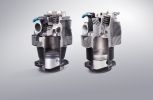
Look at the wall thickness:

1778862141741.png

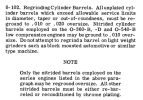
Aircraft cylinders are oversized to .020" max because of this. Most are limited to .010", or no oversizing at all. From Lycoming's overhaul manual:

1778862773329.png
 
About once a week depending of my shift rotation. The catering is still crap. a320 or a350 same basic snacks. 121's need to up the snackage game.

I will admit I haven't been in the -1000 yet
So you just sat in the cockpit, doing what? Have you ever flown an Airbus, any Airbus? Boeing? Catering doesn't have much to do with aircraft type. It depends on the airline. You get on a crappy airline, and you're gonna get crappy food, if any. Airplanes sitting in hangars, on aprons, etc. don't get catering. Catering arrives at the aircraft before departure... not in the hangar. The A350-1000 cockpit is the same as the -900.
 
Last edited:
A little of everything has contributed engine and part prices (New, Reman or OH) to go out of control : Unavailability of parts, Insurance liability, high costs of litigation, Corporate greed, tariffs, current state of FARs demands, unwillingness of the FAA to change, politics, shortage of APs, …..pilots, mechanics and investors feeling disenchanted and powerless before the FAA, politics..etc………..my opinion only……
 
The most aircraft ever sold in a year was right around 20,000 units. Now runs around 2000 units a year. That's model shop numbers, prototyping cell numbers, whatever you call it in your industry. And they aren't even all the same!

Might be better to be happy engines and their parts are available at all, since it would seem that the production of avgas engines by Lycoming borders on being a service to the fleet, and one which Textron might one day say, "why bother." They could just use the factory to make the four (five if there's a 206 NA still) types of engines to supply and rebuild their restarts and call it a day. Continental could just churn out 550s for the Cirrus and be done as well, though they do have a deeper pool of traveling machines (182s, Bonanzas, 210s for a little while longer, and Barons) to tap for new and rebuilt engines.

As far as "low tolerances" many steel components have tolerances in the 4-6 tenths range, which is in the precision machining realm. And since the runs are low, setup and teardown probably means that they use their full tolerance band; otherwise one might find an even more capable process with variation well inside the limits.
 
Air cooled engine expands and contracts with heat kind of like a balloon. Liquid cooled engines are far more thermally stable, so their internal clearances such as piston-to-cylinder wall dimension are much tighter than in air-cooled engine. So the looser tolerances are purposeful, something to think about.
 
Last edited:
Air cooled engine expands and contracts with heat kind of like a balloon. Liquid cooled engines are far more thermally stable, so their internal clearances such as piston-to-cylinder wall dimension are much tighter than in air-cooled engine. So the looser tolerances are purposeful, something to think about.
Tolerances in an aircraft engine refer to manufacturing tolerances, so that, for example, the biggest piston will fit in the smallest cylinder without problems. Same with crankshaft surfaces and their bearings, lifters and their bores, and so on.

Clearances are something else. Those are the designed-in spaces between the cylinder and piston, bearings and valve stems and so forth, to account for expansion and contraction. In an aircooled engine it's the cylinders and pistons that give the most trouble, with large clearances when cold allowing more blowby gases into the crankcase, contaminating the oil with all sorts of junk including water, and allowing more oil to get past the rings into the combustion chamber to get burned. That aluminum piston will expand considerably more than the cylinder will, aluminum having twice the rate of linear thermal expansion as the steel cylinder, and clearances can disappear and seizure occur if care is not taken at manufacture or overhaul.

Bearings don't experience as much clearance change with thermal changes, but the con rods being steel like the crankshaft minimize any change, while the bearings in the aluminum case will expand more than the crank, increasing the clearance a tiny bit when hot. When bearing clearances are too large, too much oil is thrown at the cylinder walls and the oil rings have more trouble controlling it, and oil consumption goes up.
 
Wrong again. Let me know where you see sandcasting anywhere in these videos:


There is no lack of such information out there. Where are you getting yours?
Then read this: https://www.faa.gov/sites/faa.gov/f...shaft_Special_Certification_Report_Sep_04.pdf

"Steel to specification AMS 6414 (also commonly referred to as Vacuum Arc Remelt SAE 4340) is melted in an electric arc vacuum furnace and
formed into large ingots at the steel mill."

Gee, what is an ingot?

"A steel ingot is a solid block of metal cast into a specific shape—such as a rectangular, square, or cylindrical mold—to make it easier to store, transport, or process later."

Many you'll need to read. A youtube search is you go to authority? HHAHAHAHAHAHAHAHHAHAHAHAHAHAHAHA
 
Tolerances in an aircraft engine refer to manufacturing tolerances, so that, for example, the biggest piston will fit in the smallest cylinder without problems. Same with crankshaft surfaces and their bearings, lifters and their bores, and so on.

Clearances are something else. Those are the designed-in spaces between the cylinder and piston, bearings and valve stems and so forth, to account for expansion and contraction. In an aircooled engine it's the cylinders and pistons that give the most trouble, with large clearances when cold allowing more blowby gases into the crankcase, contaminating the oil with all sorts of junk including water, and allowing more oil to get past the rings into the combustion chamber to get burned. That aluminum piston will expand considerably more than the cylinder will, aluminum having twice the rate of linear thermal expansion as the steel cylinder, and clearances can disappear and seizure occur if care is not taken at manufacture or overhaul.

Bearings don't experience as much clearance change with thermal changes, but the con rods being steel like the crankshaft minimize any change, while the bearings in the aluminum case will expand more than the crank, increasing the clearance a tiny bit when hot. When bearing clearances are too large, too much oil is thrown at the cylinder walls and the oil rings have more trouble controlling it, and oil consumption goes up.
Very nicely explained Dan Thomas, thank you.
 
"A steel ingot is a solid block of metal cast into a specific shape—such as a rectangular, square, or cylindrical mold—to make it easier to store, transport, or process later."
You might want to look up the definition of "Forged". Yes an ingot can be cast, but that doesn't mean that a crank FORGED from an ingot is cast. A cast crank would have a mold shaped like a crank, not a round.
Many you'll need to read. A youtube search is you go to authority? HHAHAHAHAHAHAHAHHAHAHAHAHAHAHAHA
Might follow your own advice.
 
Last edited:
Start pricing OEM NEW or OEM REMAN engines, NOT FREAKING SHORT BLOCKS, for run of the mill 3/4 ton and 1 ton pickups built in the last 5 and 10 years. Airplane stuff starts to look 1/2 reasonable in price.

Bought a Yamaha Grizzly 660... The starter clutch gearset is $300, muffler assembly with heatshield $500, tire on it are $120 a pop. The centrifugal clutch pack is $400, the clutch drum is $300. The fuel infected ones (Grizzly 700)? The fuel pump assembly in the tank is $500.

Reman automotive alternators from the stealerships ~$500.

Do I like paying a $1k for a damn starter on a Lycoming? Nope. How many times in 20 years have I? Once.

Not to mention the labor. Modern auto engines are so complex, and packed so tightly into the compartment, that any repair is a major operation. I replaced the alternator on my son's 2008 Honda CRV, and had to remove most of one side of the car just to access it. With auto repair shop rates at least as high as an independent A&P, good luck getting anything done for less than a few thousand bucks.
 
Not to mention the labor. Modern auto engines are so complex, and packed so tightly into the compartment, that any repair is a major operation. I replaced the alternator on my son's 2008 Honda CRV, and had to remove most of one side of the car just to access it. With auto repair shop rates at least as high as an independent A&P, good luck getting anything done for less than a few thousand bucks.
I still don't own anything with variable valve timing, variable displacement, anything turbo charged, hell none of my vehicles have tire pressure monitor systems.

Buddy just spent $1800 for 4 regular tires 50K mile tires and TPS sensors installed and balanced on a stock 2019 Tahoe! Same truck has needed 3 windshields at $700 a pop, (lotta interstate road chips and cracks). This has also needed a $5K transmission at 138K miles. (He bought this truck brand new)

I bought 4 65K mile band name 22560R16 (stock size 2005 Grand Marquis) mounted and balanced $538.11 in March 2025. Bought two windsshields for my cars at $220 a pop.
 
Then read this: https://www.faa.gov/sites/faa.gov/f...shaft_Special_Certification_Report_Sep_04.pdf

"Steel to specification AMS 6414 (also commonly referred to as Vacuum Arc Remelt SAE 4340) is melted in an electric arc vacuum furnace and
formed into large ingots at the steel mill."

Gee, what is an ingot?

"A steel ingot is a solid block of metal cast into a specific shape—such as a rectangular, square, or cylindrical mold—to make it easier to store, transport, or process later."

Many you'll need to read. A youtube search is you go to authority? HHAHAHAHAHAHAHAHHAHAHAHAHAHAHAHA
All steel starts out as an ingot, but it's not any specific shape. It is then reheated and passed through rollers to get round bar, square bar, angle, sheet, wire or whatever. None of it involves sandcasting. Another video:


Most people have no idea of the amount of processing metal goes through to get the final products we all use every day. Steel is iron with several added elements that might include carbon, vanadium, manganese, molybdenum, chromium, nickel, silicon and others, to get the desired strength and resilience. Rolling the ingots into various shapes involves the passing of the red-hot metal through many sets of rollers, giving it a gran structure that cast iron does not have. Grain adds ductility and resistance to cracking. Cast iron, which is what sandcasting involves, has no grain structure and is brittle.

Alloy steels have the above-mentioned elements in them, and carbon might reach 1% of the metal. Cast iron can be 4% carbon, necessary to give it rigidity. It has little other stuff in it.

The forging of round bar into crankshafts as we saw earlier changes the direction of the grain structure so that it follows the shape of the crank, making it strong enough for aircraft use. Cast iron cannot do that. I think I told you earlier that I have 12 years experience grinding crankshafts and resizing cylinders, and the cranks were both cast and forged. The cast cranks had a much higher failure rate than the forged types. Most of these cranks were in air compressors, and one of the manufacturers used the cast cranks to save money, but they gained a poor reputation doing it.

I have a copy of Machinery's Handbook that gives me all the details of various cast and forged steels as well as a wealth of other information. 3000 pages of it. What do you use to learn the stuff you "know?"

https://www.amazon.com/Machinerys-Handbook-Toolbox-Erik-Oberg/dp/0831137320/ref=sr_1_1?crid=3O9R7N1BLGLHG&dib=eyJ2IjoiMSJ9.zYxZApPa2bor2mXWT8eBI_xDDMDAU4A68no8bVNn8M0kpjQCgFrrods5qD4KaK4UY0BgX0kjE7TknbhES_d8IQCujNa_y7M2HuIC7QB61rY6l-hwoOsHn6qZJ211k0nkkw2Ej9G0Abnk7kHUyaYquiFqnWmcp74YuITLN1uwjA-cdtRguJpxxTbp7lNqTXLnBIf-AZgHjR1b3fisGNO_Lb53I4QGPRJlbHpgncyUNEA._lafXstkw59UEC-tj5IT2o6CiJfMoiD8gKy_RDkOquA&dib_tag=se&keywords=machinery's+handbook&qid=1779210784&sprefix=machinery's+handbook,aps,238&sr=8-1

From that FAA link you provided, an early excerpt:

1779211300698.png

The answers are all there. Did you even read that document?

4340 steel is 0.4% carbon, along with chromium and molybdenum. I have machined that stuff, and it's tough.
 
Last edited:
I still don't own anything with variable valve timing, variable displacement, anything turbo charged, hell none of my vehicles have tire pressure monitor systems.

Buddy just spent $1800 for 4 regular tires 50K mile tires and TPS sensors installed and balanced on a stock 2019 Tahoe! Same truck has needed 3 windshields at $700 a pop, (lotta interstate road chips and cracks). This has also needed a $5K transmission at 138K miles. (He bought this truck brand new)

I bought 4 65K mile band name 22560R16 (stock size 2005 Grand Marquis) mounted and balanced $538.11 in March 2025. Bought two windsshields for my cars at $220 a pop.

If saving money is your only criteria, then yeah OK. But cars built in the last 5-10 years have some pretty amazing safety features. Adaptive cruise and lane keeping are game changers.
 
Dan, overall your post is correct, but
All steel starts out as an ingot
Not any more. Sheet steel in cars, appliances and the like is continuous cast. Molten out of the ladle in to the caster. That's the predominant method for hot rolled coil. A lot of structural steel (and shapes like SBQ) is extruded. All of that is done to vastly improve productivity.
Cast iron, which is what sandcasting involves, has no grain structure and is brittle.
True, but there are cast steel parts, usually done for complex shapes that can't be machined. Iron is made into steel, but is not steel.

Having said all that, the posts by @Jim K do indeed show cranks being forged as they need to be for all the reasons you mentioned.
 
True, but there are cast steel parts, usually done for complex shapes that can't be machined. Iron is made into steel, but is not steel.
I have machined cast steel, too. The cylinders used on an English compressor found on heavy earthmoving equipment were cast steel, and they were really hard and resisted resizing. Hard but brittle, but as a cylinder the brittleness did not matter.
 
Not any more. Sheet steel in cars, appliances and the like is continuous cast. Molten out of the ladle in to the caster. That's the predominant method for hot rolled coil. A lot of structural steel (and shapes like SBQ) is extruded. All of that is done to vastly improve productivity.
And to reduce energy consumption, no doubt. I had not heard of that process, having left the machine shop for full-time aviation 44 34 years ago.
 
Last edited:
And to reduce energy consumption, no doubt. I had not heard of that process, having left the machine shop for full-time aviation 44 years ago.
Yep, one less heating process. The efficiency gains in steelmaking over the last 100 years have been incredible in both man hours/ton and energy/ton.
 
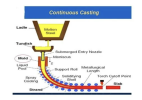
Actually been a while since I was running around steel mills. Forgot one step. Flat rolled mills cast slabs, those slabs go into the hot mill where they are rolled into sheet steel for cars, appliances and metal roofs etc. Long products mills do the same except billets and blooms instead of slabs. That's the product form that would go into cranks. The big productivity benefit is the shape is more easily worked in the downstream processes compared to an ingot. Very little steel is produced in ingot form any more, at least in the First World. Watching a hot mill roll a slab is an experience as the speed of the metal increases as it goes through each roller, like water through a nozzle. By the time it gets to final thickness, it's going at a pretty good clip.

If you want to nerd out, here's a basic illustration of continuous casting. Basically, only the outer skin of the slab is solid as the slab rolls out.Screenshot 2026-05-19 at 4.15.11 PM.png
 
Back
Top