Life Vest and Flotation Equipment

Nikhiln25

Pre-takeoff checklist
Joined
Jan 16, 2024
Messages
307
Display Name
nikhiln25
Given the successful recovery of the party on the plane that went down in Lake Michigan, thought I’d look into having some essentials on board even if I’m always within gliding distance. I’ve read in the past before that there are folded inflatable floating equipment that can be bought that is not too much weight, and I’d guess a life vest is surely not too much weight. What essentials are there to carry if ever needed to ditch?

And on that point, for us without a parachute, what is the best way to ditch? Land in the wind and stall right above the water? I’ve read that before but have never really given this any thought
 
A portable PLB, flares, signal mirror (old computer CD), PFDs. If the water is really cold, at best they are recovering your corpse.
 
Given the successful recovery of the party on the plane that went down in Lake Michigan, thought I’d look into having some essentials on board even if I’m always within gliding distance. I’ve read in the past before that there are folded inflatable floating equipment that can be bought that is not too much weight, and I’d guess a life vest is surely not too much weight. What essentials are there to carry if ever needed to ditch?
Talk to a seaplane guy about PFDs…better yet, talk to several to get broad experience as well as maybe identifying what “everyone” thinks is good equipment. When I did my seaplane rating, the instructor wore a standard life vest, but gave me an inflatable one.
And on that point, for us without a parachute, what is the best way to ditch? Land in the wind and stall right above the water? I’ve read that before but have never really given this any thought
Seems like the Airplane Flying Handbook used to have a section on ditching, but it doesn’t seem to now…I recall direction of swells being at least as important as wind direction.
 
I have crossed Lake Michigan more than 240 times in a single engine airplane. I always wear an inflatable PFD, the kind you pull over your head and inflate AFTER exiting the plane. (A full-size life preserver can trap you in the cockpit.) I had a six-person raft on the back seat but often wondered if I'd be able to get it out of the door before the airplane went under. The raft was tethered to the airplane, but if the plane sank it would break free, and otherwise would be reachable by following the tether. I have a handheld 2-way radio in a waterproof bag. And a large flare from my days in the Air Force.

I once asked a Coast Guard helicopter pilot about being rescued, and he said it would be at least 40 minutes from Traverse City to the middle of the lake, and without a signaling device they probably would not see me, even in the raft.

Look in your POH for any ditching advice, but generally, you do not want to land into the wind if that puts you 90 degrees to the swells. If it is flat water, great, but if there are swells you want to touch down as slowly as possible and parallel to the swells. This is the one time I would leave the landing gear up. If the cockpit goes entirely under water, anticipate great difficulty in opening a door, but you can equalize the pressure if you can open a storm window.
 
Get a raft, PFDs (CO2 inflatable), and at least one PLB.
 
I seem to recall that many years ago an airliner ditched somewhere around Africa. There were people who inflated the life jackets in the plane vs when outside, and they became trapped.

The scenario of an airliner ditching in Africa with passengers inflating life vests inside and becoming trapped describes the tragedy of Ethiopian Airlines Flight 961. The 1996 hijacking ended with a crash landing in the Indian Ocean near the Comoros Islands, and many passengers drowned because they inflated their life jackets inside the sinking aircraft.​
​
As the plane began to fill with water and sink, panicked passengers ignored or did not hear the captain's warnings not to inflate their life vests inside. The resulting buoyancy pinned them against the ceiling of the fuselage, trapping them in the rapidly sinking wreckage. ​
 
Float pilots wear inflatable life vests as standard equipment. Easy to buy and not uncomfortable to wear. We used to joke that with Alaska’s cold water, hypothermia would kill us before we’d be rescued so the vest was just to provide a body for the funeral.
 
If the water is really cold,
Bring a 40+ gallon trash bag (preferably orange) and pull it over your body, holding it tight arround your shoulders.
It will trap water in, acting like a crude wetsuit. Buys you enough time for SAR to find you still alive.
 
Like my avatar depicts, most of my flying is over the water to the Bahamas. I started flying there in a Cherokee 6 that had a little better glide ratio than a helicopter.

First thing is to mitigate as much risk as possible, so fly as high as you can and make adjustments to your flight path. A 5 minute leg "out of your way" may be the difference between bobbing in water for hours and getting picked up quickly. After that, it's all about safety equipment. Manually inflated life vests and an EPIRB/PLB are your best friends.

It's almost 10 minutes from 9500' until you are in the water. Activate the beacon as soon as you can.
 
I wear a set of suspenders,for short overwater flights. I wouldn’t fly over Lake Michigan without a raft,due to temperature of water and hypothermia.
 
Like my avatar depicts, most of my flying is over the water to the Bahamas. I started flying there in a Cherokee 6 that had a little better glide ratio than a helicopter.

First thing is to mitigate as much risk as possible, so fly as high as you can and make adjustments to your flight path. A 5 minute leg "out of your way" may be the difference between bobbing in water for hours and getting picked up quickly. After that, it's all about safety equipment. Manually inflated life vests and an EPIRB/PLB are your best friends.

It's almost 10 minutes from 9500' until you are in the water. Activate the beacon as soon as you can.
I never thought of the altitude vs time to communicate equation. In some circumstances where there aren't great places to land, extra time might not matter that much. But if you're actively talking with someone when you lose an engine, it would mean the search effort would probably start a lot faster than just being overdue, and potentially with a more accurate starting location. Thanks for that.
 
Bring a 40+ gallon trash bag (preferably orange) and pull it over your body, holding it tight arround your shoulders.
It will trap water in, acting like a crude wetsuit. Buys you enough time for SAR to find you still alive.
Many years ago, I read about a former Air Force pilot who was flying a light plane across the southern part of Lake Michigan at night, from Chicago toward Indiana or Michigan. He lost power and went into the drink, and had no flotation device. Remembering his training in sea survival school, he took off his pants and tied the ends of the legs together, then captured air in them and used them as a life preserver. I believe he came ashore near the US Steel plant in Gary, startling the employees when he crawled out of the lake.
 
Remembering his training in sea survival school, he took off his pants and tied the ends of the legs together, then captured air in them and used them as a life preserver.
I learned that trick in Boy Scouts. We had to float for 10 minutes or so after inflating the pants. They do need periodic reinflation, but it did kinda work.
 
A friend flew his C-206 from San Francisco to Honolulu. I asked if he had flotation gear or a survival suit. Nope. Tee shirt and jeans and some snacks.True story.
 
When I did my seaplane rating, the instructor wore a standard life vest,
You mean a life vest like you'd wear on a boat???? I'm not sure I'd go with anything that instructor told you. It might not be a big thing if you know you're upright and you just open the door and release your seatbelt. But if the seaplane flips or sinks nose down, you are going to have FIGHT to get out of the plane as the life vest is going to do it's thing and float you up into the plane. So that could be into the back of the plane or up into the seats/floor if the plane is flipped. Next time you're at a lake or a pool with one of those boat type life vests, put it on and try and swim to the bottom. That's going to be you trying to swim down to get out the door.

The whole reason airlines, and good CFIs, tell you not to inflate the vest until you're OUT of the plane is that you may need to swim DOWN to get out.

I had some helicopter type vests for years. They're the small pouch you wear around your waist that have the standar airline type vest that you pull out and put over your head. When those got a little old I asked around to see what was out there at the time, a lot of people seemed to like the Revere Comfortmax. Here's a link to Aircraft Spruce just so you can see them. But they are available from a number of vendors.
https://www.aircraftspruce.com/catalog/pspages/revere_comfortmax_vest_red.php?clickkey=5759
 
Bring a 40+ gallon trash bag (preferably orange) and pull it over your body, holding it tight arround your shoulders.
It will trap water in, acting like a crude wetsuit. Buys you enough time for SAR to find you still alive.

You go down in Great Lakes in winter you would be lucky to get the trash bag on and you’ll be unconscious in about 12 minutes. You will be using some of that time to get on a PFD with water freezing in your hair.
 
Last edited:
You go down in Great Lakes in winter
There are things you can control and electing to stay over land when the water is that cold should be one of them.

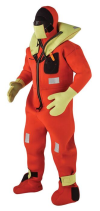
There's a reason serious outfits mandate the use of one of these for overwater flights when the water temperature is below 50F. ($600)
1757939899701.png
you would be lucky to get the trash bag on and you’ll be unconscious in about 12 minutes.
The bag will extend that time to 30+ minutes. With proper communication before you hit the water, it will give you a fighting chance. A lot better than without it.
You will be using some of that time to get on a PFD with water freezing in your hair.
That PFD should've already been on, ready to be inflated, the moment the pilot elected to fly over open water.

And, back to the planning aspect, at a minimum a wetsuit hood and gloves should be part of the ditching kit, for anyone doing this often enough in winter time.

Hit the water, inflate it, scream in pain, pull the trash bag out of the storage pouch attached to the PFD, pull over you and assume the HELP (Heat Escape Lessening Posture).
 
No flotation device for me.

I'll just use the person sitting next to me for a flotation device...
 
There are things you can control and electing to stay over land when the water is that cold should be one of them.

There's a reason serious outfits mandate the use of one of these for overwater flights when the water temperature is below 50F. ($600)
View attachment 145126

The bag will extend that time to 30+ minutes. With proper communication before you hit the water, it will give you a fighting chance. A lot better than without it.

That PFD should've already been on, ready to be inflated, the moment the pilot elected to fly over open water. As an example:

And, back to the planning aspect, at a minimum a wetsuit hood and gloves should be part of the ditching kit, for anyone doing this often enough in winter time.

Hit the water, inflate it, scream in pain, pull the trash bag out of the storage pouch attached to the PFD, pull over you and assume the HELP (Heat Escape Lessening Posture).
You do realize self inflating PFDs don’t work well in cold temps. As an example.
In Pennsylvania, a self-inflating PFD is not permitted during the mandatory cold weather wear season (November 1–April 30) on small boats, kayaks, canoes, and paddleboards. An inherently buoyant life jacket, which uses a permanent flotation material, is required during this period.
 
Last edited:
You do realize self inflating PFDs don’t work well in cold temps.
Except in aircraft use the life vest is not exposed to cold temperatures before use.
I've yet to see a pilot wear a permanently buoyant life jacket. That would be a sure way to drown.

As an example.
In Pennsylvania, a self-inflating PFD is not permitted during the mandatory cold weather wear season (November 1–April 30) on small boats, kayaks, canoes, and paddleboards.
Because they would be cold soaked and the inflator could be jammed with ice.
Different scenario than getting out of a dry (and well above freezing) aircraft.
 
You do realize self inflating PFDs don’t work well in cold temps. As an example.
In Pennsylvania, a self-inflating PFD is not permitted during the mandatory cold weather wear season (November 1–April 30) on small boats, kayaks, canoes, and paddleboards. An inherently buoyant life jacket, which uses a permanent flotation material, is required during this period.
That is why you should only use TSO'd life vests for aircraft as they are required to be fully functional between –40 to +60°C. And the placing of large trash bags in life vest pouches has been SOP for the offshore oil transport industry for decades depending on location.
 
PLB on your person. Give the rescuers a fighting chance to find you.

How long were the three men in the water? Seems way longer than 12 minutes.
 
I never thought of the altitude vs time to communicate equation. In some circumstances where there aren't great places to land, extra time might not matter that much. But if you're actively talking with someone when you lose an engine, it would mean the search effort would probably start a lot faster than just being overdue, and potentially with a more accurate starting location. Thanks for that.
If you listen to the ATC audio from the Cirrus incident mentioned in the original post, they were communicating and had (IIRC) a good 10 minutes talking to ATC who knew pretty well where they were. ATC was relaying info to the Coast Guard which 100% gave them a head start on recovery, but had it not been for ATC asking another GA pilot to attempt to locate and circle the ditched craft, I think it would have taken a lot longer to find them. The circling plane was (also IIRC) 1500' AGL and relaying info to ATC, but the minute the chute went under, he lost all visual and couldn't pick out the 3 people in PFDs. There were some clouds, but kept circling the same spot and the Coast Guard essentially was guided to the circling plane, not seeing them until they were basically on top of them.
 
Back
Top