I’m curious how you believe such personal interpretations you argue as fundamental basis conforms to your closed system effectiveness?
No idea where you came up with that definition of the “closed system” reference I’ve used, but it wasn’t me. The closed system I refer to is that every part that enters the system or every maintenance task performed in the system, there is someone who takes responsibility for that task or part.
As to eliminating any subjectiveness in maintenance you would need to start at the top and change the regulatory definition of airworthy for the simple fact the second half of that definition: in a condition for safe operation, is about as subjective as it gets.
Contrast with your adamant use of the same exact drive belt purchased anywhere other than from Cessna at amplified cost puts the entire system in peril?
Again, no. I believe I stated the reason behind Piper charging $300 for a Gates belt you can buy at NAPA for $15 was Piper’s Production Certificate requires them to check the belt conforms to the appropriate aircraft type design, ie., closed system. And that added cost is reflected in the Piper price. But if I were to buy that same belt at NAPA, I, as the installer, would conform the belt to the type design, ie., closed system, before I legally installed it on the aircraft as a minor alteration. And the reason for the alteration is it does not carry the Piper part number, ie., the type design. Got it now?
More specifically and to point, one AnP may refuse to make the alteration and other may not, or other may require a 337 …and others may call the FSDO for guidance or consult with other AnPs which I think we can agree just adds more randomness.
Not really. You’re missing the one key part: a mechanics personal limitation in accepting risk and liability. You can have all the databases you want of previous mx work, 337s, or whatever, but it still won’t change the fact that when a mechanic signs the book he owns that mx task forever. Which is similar to your declaration you would only market your V8 STC to foreign customers due to liability issues in the US. Some people simply accept risk better than others and that drives the “randomness” more than anything else which no database can prevent.
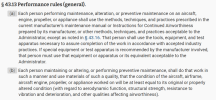
Same goes for vendors not including your suggested “relative technical data” for minor alterations. They don’t want the liability either, which the mechanic assumes at installation. Pasted below is the only regulatory guidance to a mechanic for any and all maintenance they will perform on an aircraft. Not very objective, is it? And then there are aircraft with no OEM maintenance manuals or ICAs as mentioned in (a) below. So your only option at that point is referencing something “acceptable to the Administrator” which is equally hyper-subjective but its regulatory.
So, in reality, you’ll find that subjectiveness is a wide-spread “feature” within aircraft maintenance. And the only way to curb all that subjectiveness would be to add 1000s of more rules to Part 43 to force all mechanics to perform mx in a specific objective manner. And you thought rec GA was bad now?
However, if your remark is that I don’t understand the how FAA works in the GA segment, I agree with you….. I thought it would be essentially the same with the bigger dollar and bigger companies I worked with in the jetliner world.
This has been my exact point. I never stated you didn’t have any experience, you just lacked understanding how things worked at that level. It’s the same reason I limit or decline any work at the Part 135 10 pax or 121 levels as it takes a different skill set and knowledge base to offer any effective advice or results.
After years of this from multiple levels and divisions and FAA leaders, there is no question it was systemic and intentional, and only could be resolved with us hiring insiders as “operational consultants” or hire attorneys to simply get these public servants to do their job that I pay them to do, and no FAA leader cared or saw concern…if not corruption, what would you call it?
I’d call it an Agency shift toward commercial operations oversight and the subsequent loss of funding to the private ops sector from that shift. Up until the mid-1980s the FAA had dozens of General Aviation District Offices to handle all requirements for GA aircraft from operational issues, to maintenance, to even certification requirements. For example, there were 5 GADOs in my state at that time, plus there were separate offices that handled air carrier requirements.
Then by 1990 or so all the GADOs were closed, along with the ACDOs (Air Carrier) and were replaced by a single FSDO, or multiple FSDOs depending on the state size. So in my state we went from 8 FAA district offices to a single FSDO to handle all FAA requirements. And that change had the biggest effect at the GA level and more importantly the private, recreational level.
Why? At the same mid-80s timeframe, the GA fleet imploded with Cessna stopping production, support shops closed by the dozens and so on. Plus at the same time the effects from Deregulation were starting to come into their own, and there were far more airline pax who beetched about their air service than Part 91 owners complained about their loss of a GADO. End result, congress prioritized funding the airline side and still does today. So end result on the Part 91 recreational side was you now had to perform all the certification/approval leg work yourself and hire DER/DARs for what the previous GADO could do all in-house for free. But again that wasn’t the FAAs call, that was strictly congress and where they sent the money.
And that is how the current STC process works. So either go with that benevolent flow or don’t. And with the ACOs now gone due to reorganization and funding changes, I’m sure that flow will change once again. Regardless, in the big picture, the FAA STC process is still the easiest and most flexible in the world, which even attracts dozens of applicants from overseas every year to get their STCs here. But, for the record, I have been there, got the T-shirt, made the movie, and the sequel. So, if you can’t handle the critiques and criticism, then simply don’t post. However, it still doesn’t change the fact people are navigating and completing that same STC process without issue on a regular basis.