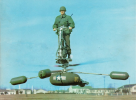
Joby operational demo flights

Lindberg

Final Approach
Joined
Sep 25, 2013
Messages
9,954
Location
North Texas
Display Name
Lindberg
Trial operations could launch this year in New York, North Carolina, Florida, Arizona, New Jersey, Oklahoma, Texas, Utah, Idaho and Florida, with the possibility of an expansion to California shortly thereafter. In the Bay Area, real estate developers are already leaning into the technology, planning roof top helipads so that tenants can access this new form of transportation, said JoeBen Bevirt, Joby’s founder and CEO.

 
Roof top helipads might be a little early I think. This is actually a case where I think regulators are ahead of the technology.
The battery tech in my opinion just has not had the breakthrough yet to make this really viable for large numbers of people. Both the energy density and the cost present significant issues today.
 
This is actually a case where I think regulators are ahead of the technology.
Not really. The current versions of eVTOLs that are at the certification phase, have met the mission parameters and regulatory requirements for what they were designed to do. In addition, those mission parameters, e.g., range, payload, noise signature, flight abilities, etc., have been verified over various locales in both domestic and foreign locations. But you are correct there are certain limitations which is why the next version of eVTOLs on the board or at prototype levels will be powered by hybrid systems that remove the current battery-based restrictions.
 
Just got back from the Verticon Conference held last week in Atlanta. E-Vtols will be here before you know it. GDOT and NCDOT are already months in working on a dedicated E-Vtol route between Atlanta and Charlotte.
 
Roof top helipads might be a little early I think. This is actually a case where I think regulators are ahead of the technology.
The battery tech in my opinion just has not had the breakthrough yet to make this really viable for large numbers of people. Both the energy density and the cost present significant issues today.
Seems viable if they can turn an hour-long commute into ten minutes for the price of an Uber Black.
 
Roof top helipads might be a little early I think. This is actually a case where I think regulators are ahead of the technology.
The battery tech in my opinion just has not had the breakthrough yet to make this really viable for large numbers of people. Both the energy density and the cost present significant issues today.
I saw posts like this before 2012, when Tesla S came out. We know what happened since.
 
And that is why I dont see it ever becoming viable. Have you seen anything FAA certified that is affordable?
It depends on what context you are comparing things: private, commercial, public. The endgame for eVTOLs is a publicly operated UAM transport system. So when you compare the cost per mile for a new subway route or the amount of subsidy paid for public bus routes in NYC, the definition of "affordable" takes on a new meaning when discussing eVTOLs and the FAA. And one of the biggest changes for both the FAA and EASA, is they have gone to basically 99% consensus standards vs prescriptive rules for new aircraft certifications which dramatically reduces the costs of certification.
 
I know neo-luddism is cool, but do people read articles anymore?
I don't think its that so much. Its more a change in the basic convention of transportation. No different than when aviation first started, or the use of engines without a propeller for commercial air transport. Aviation is the last major transport mode to be "electrified" and people are having a hard time accepting it.
 
@Bell206 @Lindberg

I think we are rapidly approaching a point where the limitation is not one of technology per se. It is a limit of the economics of the applied technology.
The goal/pitch of a lot of these eVTOL and related companies is that electric propulsion is significant cheaper to operate. Mostly by having a much simpler set of systems, that do NOT require an oil change every X hours along with the mechanic to oversee it.

So switching to hybrid, does not get to the proposed operational savings, but it may save on the capital side. I think at this point, hybrids likely has much lower recapitalization costs. A while back I compared and ran the numbers on two Pipistrel variants of the same plane. One with a Rotax and one with batteries. The Rotax, even with gas at $6 a gallon was much cheaper of the life of the plane.

I still am not convinced the financial numbers pencil out. But it will be definitely interesting to watch.

Tim
 
The goal/pitch of a lot of these eVTOL and related companies is that electric propulsion is significant cheaper to operate.
Based on your comments I believe you may not be familiar with the history and main drive behind the development of eVTOLs.
So, what do you think is the core reason behind the development of eVTOLs and eSTOLs?
 
I don't think its that so much. Its more a change in the basic convention of transportation. No different than when aviation first started, or the use of engines without a propeller for commercial air transport. Aviation is the last major transport mode to be "electrified" and people are having a hard time accepting it.
And here I am, can’t wait for viable electric STCs and infrastructure.
 
And here I am, can’t wait for viable electric STCs and infrastructure.
I think the first electric STCs for the legacy fleet, if a market materializes, will be a hybrid system as it can be installed in existing airframes and use the same systems with minimal modification, plus does not need the electric infrastructure. However, if you follow the changes that led to MOSAIC and other regulatory moves even at the ICAO level, I believe the industry will experience a shift similar to when aluminum aircraft became cheaper to produce than fabric aircraft.

So instead of developing an STC to electrify a 50-year-old Cessna, they will develop a new purpose built, composite version with a hybrid propulsion system that you can maintain and at a price equal to that old Cessna. But that is still years out until that technology matures to see it available at a large scale. However, dont be surprised if you see a 182 or PA28 show up emitting a weird noise up front as it taxis by in the meantime.
 
Last edited:
Hybrid is probably the most practical, especially with battery capacity/weight as it stands today. I don’t think fully electric will really be viable until they can give four hours range plus reserve, and recharge to 100% in 15 minutes. Not likely within my lifetime. And I just thought of a downside to electric: Unless there are multiple - four or more - batteries that are easily removed, it lacks the flexibility of fuel vs cabin load.
 
Hybrid is probably the most practical, especially with battery capacity/weight as it stands today. I don’t think fully electric will really be viable until they can give four hours range plus reserve, and recharge to 100% in 15 minutes. Not likely within my lifetime. And I just thought of a downside to electric: Unless there are multiple - four or more - batteries that are easily removed, it lacks the flexibility of fuel vs cabin load.
They already have batteries that can charge in 15 minutes.

Possibly coming soon:
5 minute charge time mentioned.
 
Based on your comments I believe you may not be familiar with the history and main drive behind the development of eVTOLs.
So, what do you think is the core reason behind the development of eVTOLs and eSTOLs?

Now I feel like I am back in school :D
Anyways, going on memory from what I have read in the past instead of a current web search.

Electric propulsion was mostly in academic land in the early 2000s with a focus on distributed propulsion. From what I recall, this lead to NASA blown lift wings.
The FAA has for a very long time had an urban mobility initiative, of which I am not aware of any actual regulatory progress until the past decade. Around a decade ago (I think), the FAA started to make a real effort and called it the advanced air mobility effort. This was a complete look at the how to handle a large number of short range "air taxis" for lack of a better description. The difference between this effort and previous ones was the FAA actually made real progress and has proposed (not sure if passed) actually regulatory changes to support this nascent industry. One other aspect that I think was critical was the change from a focus only on a single metro urban area to urban and regional transportation. A guess on my part, is the FAA made and followed through on this commitment for AAM based on the watching how much private venture funding was going into eVTOL/eSTOL aircraft.

As for eVTOL/eSTOL industry, the pitch in the PR pieces focus quiet, point to point and go anywhere flexibility. In the prospectus I have read, the focus has been on either one of two things. 1. Significantly lower operational costs, and often if an air taxi service they predict short range flights that match Uber/Lyft on price. 2. For cargo aspects, much lower operational costs by brining cargo closer to delivery point with little to no infrastructure/staffing requirements.

That is why I view eVTOL/sVTOL as technically viable. But I do not see the technology available yet for the meeting the economic vision. To me it is only a matter of time. It might be just a few years, or it could take decades. To have such an economic breakthrough will require some massive technical/process change. And there is a crap load money going into solving the economic issues, but predicting when this investment has a major break through, to me is a not possible.

Tim
 
I have no doubt the technology can be developed and flown. I just dont see it happening at a price point to make it competitive to other modes of transportation. Some of the early eVTOL manufacturers promised acquisition cost approximate to a large luxury SUV. A "New" Cessna 172 is over half a million, a Cirrus is a million.

Even if the aircraft can be mass produced and sold for reasonable value, how is the FAA going to regulate the commercial carrying of passengers. Look what Part 121/135 requires currently. What is going to be the acceptable risk level/crash rate?
 
The FAA has for a very long time had an urban mobility initiative, of which I am not aware of any actual regulatory progress until the past decade.
B+ for effort. In general, the FAA is only one portion of the UAM concept and didn’t really get involved until the early 2000’s when they developed the NextGen initiative. At its core, UAM is an urban planning concept that dates back decades with urban planners, NASA, and a few others involved.

The issue for long term city planners was the lack of transportation expansion options within high density urban areas, and it was decided a long time ago that up was the only viable expansion option in most cases. It wasn’t until the first commercial helicopters came on the scene that those urban planners actually had a means to move people vertically above the streets.

However, helicopters presented their own problems and by the late 70s regular scheduled service stopped and was replaced by a more on-demand model in select cities. The only place where helicopters did succeed in UAM was in Sao Paulo BR which have 400+ helicopters that operate scheduled and on-demand flights within the metro urban area.

In 1996, NASA did a real-world test in Atlanta to determine if street-level UAM ops were actually possible with helicopters, and if not, what type of aircraft or technology it would take to accomplish that. In the end, it was determined helicopters could not provide that service and that a new type of aircraft technology was required to perform the mission which NASA started designing in the early 2000s.

The breakthrough came in 2010 with the development of NASA’s distributed electric propulsion (DEP) technology. And with that, Joby, Archer, and many others started to develop eVTOL aircraft around DEP to create a viable, street-level, urban center based, transportation system to meet the requirements of long established UAM concept. So when those prototypes started to fly, the FAA and EASA moved to the next phase and developed multiple regulatory foundations to certify, operate, and manage this new class of powered-lift aircraft.

And as I mentioned earlier, the long-term endgame for eVTOLs and UAM ops is a public-based, urban transportation system that will provide the long-needed expansion outlet for city planners as the global city centers steadily increase in population. This is why you have seen $billions spent in investments by the top transportation related companies in the world, as this new aircraft design finally reaches fruition. And if you were to follow the UAM/eVTOL industry projections on market value and growth it gives the reasons why everyone wants a piece of this pie.

So, from an economic standpoint, once the technology and operational side mature, these eVTOLs and their future generations will be more on par with city buses, subways, and other similar public transport modes vs standalone aircraft taxi ops we see today. Pretty interesting stuff from what I’ve seen.

how is the FAA going to regulate the commercial carrying of passengers. Look what Part 121/135 requires currently.
Joby and Archer already have their Part 135 certificate and once they complete certification, they will finish up adding the eVTOLs to their OpsSpecs and start flying for hire just as any other operator. The big difference being, eVTOLs will be flying where no other 135 operator can.

 
Any minute now....

How many years have they been saying this?
 
How many years have they been saying this?
Depends on from when you want to count: 3 years, since the Joby production prototype flew and started the certification process; 1 year, since the first piloted Joby flight; or 6 days since the 1st flight of an FAA conformed Joby S4. The original commercial start date range was 2025-2026, but the FAA changed its eVTOL certification process between 2020-2022, so the new start date range is 2027-2028.
 
I have no doubt the technology can be developed and flown. I just dont see it happening at a price point to make it competitive to other modes of transportation. Some of the early eVTOL manufacturers promised acquisition cost approximate to a large luxury SUV. A "New" Cessna 172 is over half a million, a Cirrus is a million.

Even if the aircraft can be mass produced and sold for reasonable value, how is the FAA going to regulate the commercial carrying of passengers. Look what Part 121/135 requires currently. What is going to be the acceptable risk level/crash rate?
Politically the acceptable crash rate is zero.

Reality is obviously a non zero number but very low. Personally I think this along with airspace management will be the nail in the coffin even if the technology could be available yesterday.
 
Personally I think this along with airspace management will be the nail in the coffin even if the technology could be available yesterday.
Interestingly enough, the 1996 NASA test did in Atlanta, also was the first real-world test of a "revolutionary" new airspace management system that did in fact work in urban environment and at street level. So positive airspace control was possible for a UAM operation. That system's current rendition goes by the acronym, ADSB.
 
OK. I'm not going to go into full detail on how I know certain things; the typical internet "Source: Trust me Bro" I'm sure will get thrown out there, but let's just say in a past life I knew a thing or two on what's going on in the evtol and certification space w/ the FAA and the manufacturers.

The "priced as Uber Black" is a misdirection. Uber Black is 1 price for the whole vehicle, regardless of how many people you pile in. The target price by Joby stated, when you read the fine print, is EACH seat in the 4-seater aircraft will cost the same as Uber Black. In other words, if you and 4 friends pile in, its' 4x more than Uber Black. That's their target price; they will be nowhere near that without significant subsidies paid for by venture capital, kind of how Uber and Lyft were losing money hand over fist for years until they could build critical mass.

The certification process is moving along. The FAA is releasing a Heliport Design A/C at some point in the future, that's performance based and not geometrically based like the previous versions. They are testing actual performance data of evtol and other current rotary aircraft, and what they've found was the previous design criteria was woefully inadequate for the safety areas / wash areas. Actual performances were showing the wash is significantly greater than the formula currently in effect for determining the area needed based on the main rotory diameter. This new AC was supposed to be released in Nov/Dec of 2025. It's March 2026, and the current edition on the FAA website is still the 53090-2D, published 1/5/2023. In other words, they're behind schedule. Some of that was due not because of the evtol manufacturers, but the rotary aircraft manufacturers. As it turns out, helicopter manufacturers didn't/don't like the performance based testing, because if the results show what they are going to show, there's a whole lot of insurability potential issues on existing heliport/helipads.

The final thing is, and maybe this has been worked out in the last year since I had my data, the energy density of the batteries is not good enough for fully loaded VTOL operations. None of the manufacturers had this truly sorted out yet. VTOL takes either a reduced load capacity, or a reduced load capacity ;). Which obviously hurts the business plan to operate in dense urban environments. This means the heliports will need landing strips and not just a helipad. I don't know how this gets engineered out with modern day battery limitations. You can only add but so many rotors and reduce the MTOW but so much before they're not economically feasible.

I'm a skeptic as to the viability of EVTOLs as urban air mobility. It will be really cool to see, but from a business plan perspective, I have a hard time seeing how the #s will make it a profitable business, outside of areas that already have helicopter commuting services like NYC. Which, incidentally, is probably why Joby acquired Blade in 2025.

Additionally, if the business is to take off, the charging infrastructure has to be there. At some point micro nuclear reactors (the evolution of the SMR) may be viable for this, but as-is, the electrical needs for an electrified system are ridiculously high. The numbers I've seen (and these are probably wrong, but somewhat in the ballpark) Archer's bird has 142 kWh battery pack; Joby is at 235 kWh. Lillium is at 38kWh. Charging one or two doesn't take a ton of imagination to come up with. But to be economically feasible, you will need an awful lot of them charging somewhat in a home-base somewhere, because you aren't making any money when they're sitting on the ground. Airplanes can sit and wait for a gate turn around; even then turn around times are critical for making a profit. That "uber black" pricing starts to get eaten up awfully fast. Only way to minimize that is to have more aircraft flying than charging any given moment, and the only way to do that is to have either huge charging stations with significant power capabilities, or more aircraft so you have some in reserve. Ever been to a ski resort and stood in line to ride the lift? Now imagine that but the chairs are separated by 30 minutes or more instead of seconds...not really very efficient, is it?
 
Last edited:
I really don't care if the business numbers work yet. At some point they will. I'm happy to see the FAA removing regulatory obstacles and state governments making efforts to address infrastructure. Also happy to see several manufacturers with serious investors competing to put certified platforms in the air.

There will doubtless be crashes, business failures, and technical dead ends. It was at least 20 years between Kitty Hawk and viable commercial aviation. Jets and helicopters followed similar development timelines. It will happen when it happens.

I do know this. Last year I saw a single passenger eVTOL multi-copter in flight. It was cool. This year or next year I expect to see a multi-pax eVTOL in flight. And it will be even cooler.

IMG_20250507_220200~2.jpg
 
I really don't care if the business numbers work yet. At some point they will. I'm happy to see the FAA removing regulatory obstacles and state governments making efforts to address infrastructure. Also happy to see several manufacturers with serious investors competing to put certified platforms in the air.

There will doubtless be crashes, business failures, and technical dead ends. It was at least 20 years between Kitty Hawk and viable commercial aviation. Jets and helicopters followed similar development timelines. It will happen when it happens.

I do know this. Last year I saw a single passenger eVTOL multi-copter in flight. It was cool. This year or next year I expect to see a multi-pax eVTOL in flight. And it will be even cooler.

View attachment 150902
If the business numbers don't actually work, then the aircraft won't exist for very long. That's the problem.
 
It's March 2026, and the current edition on the FAA website is still the 53090-2D, published 1/5/2023. In other words, they're behind schedule.
Not sure if you are aware of this, but the FAA initially released an Engineering Brief in 2022 that will provide supplemental guidance to 53090-2D for vertiport construction specific to eVTOLs. And it was revised end of 2024 which still keeps helicopter requirements separate from eVTOLs.

VTOL takes either a reduced load capacity, or a reduced load capacity
To add, from what I've seen personally, the battery performance side does meet the initial operational requirements for the first 2-3 years of actual for-hire ops. However, beyond that, yes battery tech is not there which has driven the hybrid-side to develop systems that will correct that. That is what I have experience with and is also the reason you'll see a push to hybrid systems for the Gen2 eVTOLs which require no additional charging infrastructure.

If the business numbers don't actually work, then the aircraft won't exist for very long. That's the problem.
While I leave the business side to the experts, as I've stated in this thread and others, the Part 135 air taxi/Uber model is just the initial concept to mature the technology. Once that happens there are a multitude of plans to grow this industry well beyond that initial business plan concept. One doesn't bring in the capital investment from the top players in the global transportation industry to sell and operate a few dozen flying Ubers.
 
Not sure if you are aware of this, but the FAA initially released an Engineering Brief in 2022 that will provide supplemental guidance to 53090-2D for vertiport construction specific to eVTOLs. And it was revised end of 2024 which still keeps helicopter requirements separate from eVTOLs.


To add, from what I've seen personally, the battery performance side does meet the initial operational requirements for the first 2-3 years of actual for-hire ops. However, beyond that, yes battery tech is not there which has driven the hybrid-side to develop systems that will correct that. That is what I have experience with and is also the reason you'll see a push to hybrid systems for the Gen2 eVTOLs which require no additional charging infrastructure.


While I leave the business side to the experts, as I've stated in this thread and others, the Part 135 air taxi/Uber model is just the initial concept to mature the technology. Once that happens there are a multitude of plans to grow this industry well beyond that initial business plan concept. One doesn't bring in the capital investment from the top players in the global transportation industry to sell and operate a few dozen flying Ubers.
Fully aware of the interim EB and keeping it separate. There was a meeting at FAA HQ with FAA and miscellaneous evtol & rotary manufacturers about a year ago when the path forward was mapped out & shared about a year ago. I still have my notes from that meeting.
 
Back
Top