Instrument Approach's and Departures - Abnormal things to teach?

Arizonaflightlabs

Filing Flight Plan
Joined
Jul 20, 2026
Messages
4
Display Name
Arizona_Flight_Labs
Looking for the best approach's and departures to use for training students that are unique?

I would like to expand my library of training material and what better way then to ask those around the US for their favorite local approach and departure procedures!
 
This is right up my alley!

Of course, there's the famous KASE LOC/DME-E that uses a localizer back course for the missed approach guidance. I have flown this approach and missed approach multiple times in VMC for work and it's a little eery knowing that all those mountains are still around if it was IMC. Note the descent gradient as well.

1784774887127.png

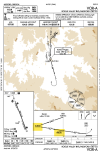
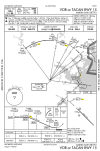
The KMFR VOR-A is a good one for descent planning. Arrival on the airway from the SW has an MEA of 8000. Meaning you need to lose 3400 feet in that procedure turn, far more than we're used to using. You have to think about how far out are you going to go for the PT? 1 minute probably won't be enough, and yet you still need to stay within 10 nm.

1784775037978.png

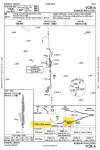
KRBG VOR-A. Ever seen a dual-altitude FAF? This is the only one I know of in the U.S.

1784775127559.png

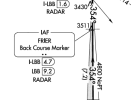
KLBB LOC BC RWY 35L has a "Back course marker". Also the only one I know of in the U.S.

1784775248163.png

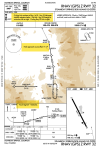
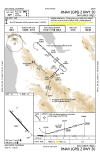
Of course, with the recent accident, the KSBS RNAV (GPS) Z RWY 32 is an excellent training scenario. It is currently NOTAMed NA but has a lot of great talking points about circling, NA at night, descent below the MDA, etc. I have also flown this one in VMC for work and it was quite different.

1784775410515.png

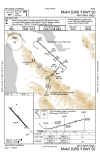
The 3F6 RNAV (GPS) RWY 36 uses a DME-only facility as the IF/IAF, with its square symbol. This is like a stump-the-chump kind of trivia question, because it has no bearing on flying it as it's an RNAV procedure. GTH used to be a VOR/DME, but the VOR portion was decommissioned, leaving the odd looking approach. And it has a turn at the FAF, which could catch pilots off guard.

1784775660788.png

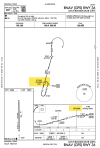
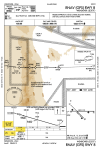
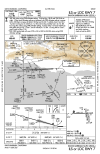
And last for this post is KENV RNAV (GPS) RWY 8, which is Cat A only, but is an LPV with a 5.68 deg descent angle. That is obviously almost double the normal 3.00 deg, requiring some thought on power settings and configuration.

1784775800515.png

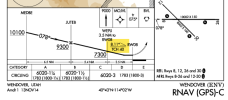
Okay, a little bonus, also at KENV, the RNAV (GPS)-C meets straight-in alignment but with a descent angle of 8.11 deg (!!), only circling minimums are published. But they are published for all Cats. So feel free to bring your 747 in here. At least the runway is nice and long.

1784775995184.png
 
This is right up my alley!

Of course, there's the famous KASE LOC/DME-E that uses a localizer back course for the missed approach guidance. I have flown this approach and missed approach multiple times in VMC for work and it's a little eery knowing that all those mountains are still around if it was IMC. Note the descent gradient as well.

View attachment 153677

The KMFR VOR-A is a good one for descent planning. Arrival on the airway from the SW has an MEA of 8000. Meaning you need to lose 3400 feet in that procedure turn, far more than we're used to using. You have to think about how far out are you going to go for the PT? 1 minute probably won't be enough, and yet you still need to stay within 10 nm.

View attachment 153678

KRBG VOR-A. Ever seen a dual-altitude FAF? This is the only one I know of in the U.S.

View attachment 153679

KLBB LOC BC RWY 35L has a "Back course marker". Also the only one I know of in the U.S.

View attachment 153680

Of course, with the recent accident, the KSBS RNAV (GPS) Z RWY 32 is an excellent training scenario. It is currently NOTAMed NA but has a lot of great talking points about circling, NA at night, descent below the MDA, etc. I have also flown this one in VMC for work and it was quite different.

View attachment 153681

The 3F6 RNAV (GPS) RWY 36 uses a DME-only facility as the IF/IAF, with its square symbol. This is like a stump-the-chump kind of trivia question, because it has no bearing on flying it as it's an RNAV procedure. GTH used to be a VOR/DME, but the VOR portion was decommissioned, leaving the odd looking approach. And it has a turn at the FAF, which could catch pilots off guard.

View attachment 153682

And last for this post is KENV RNAV (GPS) RWY 8, which is Cat A only, but is an LPV with a 5.68 deg descent angle. That is obviously almost double the normal 3.00 deg, requiring some thought on power settings and configuration.

View attachment 153683

Okay, a little bonus, also at KENV, the RNAV (GPS)-C meets straight-in alignment but with a descent angle of 8.11 deg (!!), only circling minimums are published. But they are published for all Cats. So feel free to bring your 747 in here. At least the runway is nice and long.

View attachment 153684
LBB LOC BC RWY 35L. Back Course Marker being the only one doesn’t surprise me. It makes no sense. FRIER is an IAF and a FAF. It is a DME FIX and a RADAR FIX. How the word Marker got thrown in there is beyond me. Do you see any logic behind it?

EDIT: The HI-LOC/DME BC RWY 35L, a (USAF) Approach, does show a Fan Marker at FRIER. I guess the artist at the FAA forgot to draw the Marker there.
 
Last edited:

Looking for the best approach's and departures to use for training students that are unique?

I would like to expand my library of training material and what better way then to ask those around the US for their favorite local approach and departure procedures!
Welcome. What is Arizona_Fight_Labs?
 
There are at least three lessons in this accident

1. - do not follow advisory glide slopes (glide paths) ie "+V" past mda on lnav approaches thinking you will be clear of obstacles - they don't provide that protection.

2. - there may be obstacles in this final segment if you don't see the grey shaded triangle or “Visual Segment – Obstacles" or “34:1 is not clear”

3. - and, don't descend past mda until you have at least one of the 9 required visual references (I might add "at least one solid and unwavering" visual reference").

 
Of course, there's the famous KASE LOC/DME-E that uses a localizer back course for the missed approach guidance. I have flown this approach and missed approach multiple times in VMC for work and it's a little eery knowing that all those mountains are still around if it was IMC.
One thing that most people don’t realize about this approach is that the missed approach can be flown at MDA without hitting anything.

Disclaimer: maybe not all the way to the edge of the protected airspace, but definitely in the space it takes for a normal missed approach. Also not a plan I recommend, but the terrain that seems to terrify people on the missed approach only really becomes a factor if you leave MDA for the runway and THEN go missed.
 
the terrain that seems to terrify people on the missed approach only really becomes a factor if you leave MDA for the runway and THEN go missed.
Sure. But it also seems to me that 2400’ to go to reach the ground leaves a lot more time for a change to take place requiring a missed below the MDA than when there’s only 500’ to go.
 
Sure. But it also seems to me that 2400’ to go to reach the ground leaves a lot more time for a change to take place requiring a missed below the MDA than when there’s only 500’ to go.
Also true, but the conversations I’ve participated in always seem to start with the premise of not seeing the runway.
 
Always fun as an academic exercise, but i tend to leave the unusual/unique to others. I discovered years ago that many pilots have enough trouble with common tasks. :D

I agree with you in general, but there are some unique approaches that bring up specific features that we often overlook, and have training value. A common training scenario (in a simulator) goes something like this:

me asking student: when are you going to go missed?
student: (looks at the chart), at the runway
me: but you won't see the runway, that's the whole point of a missed.
student: (looks at the chart again), I'll go missed when I get to the XYZ fix.
me: but you are flying a VOR approach and no GPS. How would you identify XYZ?
student: Not sure.. use foreflight?
me: That's not a legal way to identify the MAP.
student: Oh, it's got a DME value.
me: but we don't have a DME, do we?
student: I guess I should have started the timer.
 
One thing that most people don’t realize about this approach is that the missed approach can be flown at MDA without hitting anything.

Disclaimer: maybe not all the way to the edge of the protected airspace, but definitely in the space it takes for a normal missed approach. Also not a plan I recommend, but the terrain that seems to terrify people on the missed approach only really becomes a factor if you leave MDA for the runway and THEN go missed.

That's true, but that's also a great discussion scenario. "You descend below the MDA and are on short final when another airplane pulls out on the runway. You have to go missed. What do you do?"

On many, many approaches this is no big deal and isn't something we really need to consider. But on this one and others like it, it takes some real thought.
 
Looking for the best approach's and departures to use for training students that are unique?

I would like to expand my library of training material and what better way then to ask those around the US for their favorite local approach and departure procedures!

You may already know this. MTN VOR-15 is one-of-a-kind to keep a student busy with DME arcs.

MTN.png


RNAV-30 Y&Z at SQL are interesting to discuss the differences between nearly identical approaches. Only the minimums are different, so you can ask why anyone would choose the one with the higher minimum. This is a useful chart to bring up the importance of reviewing the missed approach notes on climb gradients. Also, runway is short, with a high minimum (900 ft). So if you see the runway at the MAP, there is little chance you are landing. I find students read out the Rwy length during the chart brief, but don't often use that information to make a decision.

09219RZ30.png09219RY30.png

ILS7 at SBA has a busy descent profile, especially if you do it with a ILS/DME receiver and no GPS. This is a good one to illustrate a situation where it may be best to stay at the higher altitude and intercept the glideslope early rather than go through all the step downs, and lead the discussion into false glideslopes etc..
00378IL7.png
 
You may already know this. MTN VOR-15 is one-of-a-kind to keep a student busy with DME arcs.

View attachment 153720


RNAV-30 Y&Z at SQL are interesting to discuss the differences between nearly identical approaches. Only the minimums are different, so you can ask why anyone would choose the one with the higher minimum. This is a useful chart to bring up the importance of reviewing the missed approach notes on climb gradients. Also, runway is short, with a high minimum (900 ft). So if you see the runway at the MAP, there is little chance you are landing. I find students read out the Rwy length during the chart brief, but don't often use that information to make a decision.

View attachment 153721View attachment 153722

ILS7 at SBA has a busy descent profile, especially if you do it with a ILS/DME receiver and no GPS. This is a good one to illustrate a situation where it may be best to stay at the higher altitude and intercept the glideslope early rather than go through all the step downs, and lead the discussion into false glideslopes etc..
View attachment 153723
A question to ask the student if intercepting the Glideslope early, is what do you do if it takes you below 2600 at GOYED. This can happen.
 
A question to ask the student if intercepting the Glideslope early, is what do you do if it takes you below 2600 at GOYED. This can happen.
Yep, this approach is good for that discussion - glideslope is advisory before the FAF so it would be up to the pilot to ensure that the step-downs are being adhered to.
 
That's true, but that's also a great discussion scenario. "You descend below the MDA and are on short final when another airplane pulls out on the runway. You have to go missed. What do you do?"

On many, many approaches this is no big deal and isn't something we really need to consider. But on this one and others like it, it takes some real thought.
Back in the late 80's we were empty in a GE powered Falcon 20 going into ASE and a Bonanza did not clear the runway in time. It was a nice clear calm Sunday morning around 8-8:30am, tower said to go around. We were on a SHORT final and went out over town and toward Independence Pass at max power. We thought we would get some calls about the noise that thing made but did not, bet we woke up some people thought. If we had lost an engine, it would have been very interesting.

What we should have done was say unable and land. The Bonanza was far enough down the runway we could have stopped before we got to it. We went in there quite a bit and the 20 could really stop. That one even had working TR's.

I am curious what the options are in such a case. Can the tower amend the landing clearance with a LAHSO? If you go ahead and land anyway, is that considered a pilot deviation?
 
I am curious what the options are in such a case. Can the tower amend the landing clearance with a LAHSO? If you go ahead and land anyway, is that considered a pilot deviation?
Tower cannot make up a LAHSO. They are a published procedure. If you are told to go around and don’t, it’s a pilot deviation. Given the circumstances, I doubt very much there would be any enforcement action.
 
I agree with you in general, but there are some unique approaches that bring up specific features that we often overlook, and have training value. A common training scenario (in a simulator) goes something like this:

me asking student: when are you going to go missed?
student: (looks at the chart), at the runway
me: but you won't see the runway, that's the whole point of a missed.
student: (looks at the chart again), I'll go missed when I get to the XYZ fix.
me: but you are flying a VOR approach and no GPS. How would you identify XYZ?
student: Not sure.. use foreflight?
me: That's not a legal way to identify the MAP.
student: Oh, it's got a DME value.
me: but we don't have a DME, do we?
student: I guess I should have started the timer.
Like you, I try to do nonprecision VLOC approaches realistically, which means no GPS. But I would place that example in the “trouble with common tasks” category. Although, I guess to some a basic VOR approach is “unique” these days.
 
I have one I’ve done. There are a few approaches where, if you follow the published missed instructions exactly, you will never get to the missed hold waypoint. There are two in my area, the FAY LOC BC 22 and the GSO ILS 23R.
 
I have one I’ve done. There are a few approaches where, if you follow the published missed instructions exactly, you will never get to the missed hold waypoint. There are two in my area, the FAY LOC BC 22 and the GSO ILS 23R.
There’s lotsa ones like that, can’t remember any in particular, where if you climb at a pretty good rate and are flying slow enough you’ll end up inside the radial and have to turn back to get on it.
 
There’s lotsa ones like that, can’t remember any in particular, where if you climb at a pretty good rate and are flying slow enough you’ll end up inside the radial and have to turn back to get on it.
It’s not even a “pretty good rate” in these two. Just a very normal missed climb in a light piston will have the turn well before reaching the radial. (As I recall, I did the GSO one in a sim and I wasn’t even at DER when I reached 1500’. It’s only 500’ above DA; 200’ if you are flying the LOC.)

I don’t think it was here but there was a pretty good argument going on one about whether you (a) continue to climb straight out until you cross the radial so the intercept heading works or (b) turn at the stated altitude to intercept the radial so the altitude works. I’m sure someone even suggested leveling off at 1500.

Neither is what the instructions say. Either requires a good helping of situational awareness.
 
The KMFR VOR-A is a good one for descent planning. Arrival on the airway from the SW has an MEA of 8000. Meaning you need to lose 3400 feet in that procedure turn, far more than we're used to using. You have to think about how far out are you going to go for the PT? 1 minute probably won't be enough, and yet you still need to stay within 10 nm.
For that I think you'd want to teach distance. Assuming GA and you're doing 100kts (or less)... At 500ft/min would take just under 17nm. So 8+ out and then the turn should get you down before OED.

Really strong winds could mess you up, but in theory whatever ground speed you gaining or loosing going outbound will be offset on the way back inbound, so hopefully a net 0 winds.
 
Always fun as an academic exercise, but i tend to leave the unusual/unique to others. I discovered years ago that many pilots have enough trouble with common tasks. :D
Waste of students time. Teach approaches that are in common use in students locality.
Throw in contact approaches or SVFR clearances. Don't muddy the water.
 
It’s not even a “pretty good rate” in these two. Just a very normal missed climb in a light piston will have the turn well before reaching the radial. (As I recall, I did the GSO one in a sim and I wasn’t even at DER when I reached 1500’. It’s only 500’ above DA; 200’ if you are flying the LOC.)
@RussR do you flight check missed approaches at the minimum TERPS gradient requirement (200 ft/mi, right?) or how do you evaluate them?
 
Waste of students time. Teach approaches that are in common use in students locality.
Throw in contact approaches or SVFR clearances. Don't muddy the water.

The problem, of course, is they learn to fly in the flatlands with all very straightforward approaches, are never even shown that there are unusual ones out there, and then they choose to fly into Steamboat and don't even know what they don't know to look at.
 
@RussR do you flight check missed approaches at the minimum TERPS gradient requirement (200 ft/mi, right?) or how do you evaluate them?

Yes, that's correct. We make our best attempt at a 200 ft/nm gradient. So, about 500 fpm in the King Air and 600 in the Challenger. Unless, of course, a higher CG is published, then we do the math.
 
Maybe not a specific approach procedure, but a potential real life scenario. You are in cruise flight either IMC or VFR on top when the engine starts losing power. Everywhere under you is low IFR. How will you survive?

Makes you think outside of the box, and also consider the risk of flying single engine over widespread IFR conditions. Really made me think about my personal minimums and risk tolerance.
 
The problem, of course, is they learn to fly in the flatlands with all very straightforward approaches, are never even shown that there are unusual ones out there, and then they choose to fly into Steamboat and don't even know what they don't know to look at.

Flatland pilots flying into Steamboat IFR better learn mountain flying first!
 
Last edited:
It’s not even a “pretty good rate” in these two. Just a very normal missed climb in a light piston will have the turn well before reaching the radial. (As I recall, I did the GSO one in a sim and I wasn’t even at DER when I reached 1500’. It’s only 500’ above DA; 200’ if you are flying the LOC.)

I don’t think it was here but there was a pretty good argument going on one about whether you (a) continue to climb straight out until you cross the radial so the intercept heading works or (b) turn at the stated altitude to intercept the radial so the altitude works. I’m sure someone even suggested leveling off at 1500.

Neither is what the instructions say. Either requires a good helping of situational awareness.
Intercept is kinda a key word here. The Missed Approach Procedures say turn to heading ‘and on’ the ### radial. They don’t say intercept. I suppose they construct the Approach to accommodate the fastest airplane that may fly it. That could be aircraft accelerating to 250 knots. They could fly thru the radial and have to turn to an intercept heading. Slower planes won’t, and they will have to decide when to change from the heading in the procedure and transition to the ‘and the ### radial.’ Requiring, as you said, situational awareness.
 
Maybe not a specific approach procedure, but a potential real life scenario. You are in cruise flight either IMC or VFR on top when the engine starts losing power. Everywhere under you is low IFR. How will you survive?
Except for “low,” sounds like one if my flights. Severe carb ice in the clouds over the Rockies. Survival was a combination of things that all came together. ATC assistance, a handheld GPS (GPSMap 396), knowledge of the area, managing not to panic, and a huge helping of luck. We managed to break out high enough, the ice cleared, and we landed at an airport, shaken and stirred, but safe.
 
Waste of students time. Teach approaches that are in common use in students locality.
Throw in contact approaches or SVFR clearances. Don't muddy the water.

For a beginning student, yes, stick to the local area. But unless the pilot has no intention of going anywhere, we would be doing a disservice by not teaching procedures used in other areas. Around here in the quiet midwest, students never fly a SID (or even ODP), and are led to believe that those are for the airlines only. Then they go to Chicago or the SF Bay area, and panic when a SID is assigned. Some receive their entire instrument training in an uncontrolled airport, and except for the IFR XC have not spoken to ATC. Then they go somewhere busy and get overwhelmed.
 
Intercept is kinda a key word here. The Missed Approach Procedures say turn to heading ‘and on’ the ### radial. They don’t say intercept. I suppose they construct the Approach to accommodate the fastest airplane that may fly it. That could be aircraft accelerating to 250 knots. They could fly thru the radial and have to turn to an intercept heading. Slower planes won’t, and they will have to decide when to change from the heading in the procedure and transition to the ‘and the ### radial.’ Requiring, as you said, situational awareness.
It’s not about speed. Missed approaches are constructed to accommodate a minimum climb gradient, and if you exceed that minimum climb gradient (which most do) it can result in an altitude-based turn far sooner than the procedure was designed for.
 
It’s not about speed. Missed approaches are constructed to accommodate a minimum climb gradient, and if you exceed that minimum climb gradient (which most do) it can result in an altitude-based turn far sooner than the procedure was designed for.
Radius of turn is a part of what we’re talking about here and speed affects that.
 
You are in cruise flight either IMC or VFR on top when the engine starts losing power. Everywhere under you is low IFR. How will you survive?
No guarantee you'll survive, but this is where new tech like Foreflights Emergency Glide Mode can at least get you into a valley where it can be flatter and potentially a better outcome after the eventual landing.

I actually used to surmise if in mountainous terrain it would be better to keep gliding down the slope as far as possible... which would then probably mean a longer ground slide and potentially more damage. Or, do you do a dive and pull up to basically stall/stop right as you reached the slope of the hill? Ah the things we ponder crossing those big peaks wondering what if...

Makes me think of the adage; IMC, night, mountains, pick two. I personally, pick only one.

That was a scenario that was thrown at me during my IFR checkride, one I had never prepared for. It was less a test of basic instrument skill, and more of the ability to think critically in an emergency. My solution, which impressed the examiner, was use the GPS to locate the nearest airport with an IAP, select the straight in GPS approach nearest us to help align with the runway. I had to wing the altitude and glideslope, obviously not going to be able to guarantee 3 degree glideslope or crossing altitudes. I kept the gear and flaps up to save energy, explaining I would rather gear up on the runway that come up short with the gear down. This was an "emergency after all. I think I even did some S turns to bleed a little altitude. We "broke out" at 200 feet, crossing the fence, would have made the runway.

Yeah it may have been a bit unorthodox and wasn't necessarily part of the PTS/ACS, but I knew the examiner well, and he knew me, had flown with me countless times before. As he put it, I know you can maintain a heading and altitude and track a VOR, I want to ensure you can survive in the real world.

I can't imagine adding mountainous terrain in the mix. With modern avionics with terrain depiction, you may stand a better chance than back in the day with paper chart and flying needles.
 
Intercept is kinda a key word here. The Missed Approach Procedures say turn to heading ‘and on’ the ### radial. They don’t say intercept. I suppose they construct the Approach to accommodate the fastest airplane that may fly it. That could be aircraft accelerating to 250 knots. They could fly thru the radial and have to turn to an intercept heading. Slower planes won’t, and they will have to decide when to change from the heading in the procedure and transition to the ‘and the ### radial.’ Requiring, as you said, situational awareness.

It’s not about speed. Missed approaches are constructed to accommodate a minimum climb gradient, and if you exceed that minimum climb gradient (which most do) it can result in an altitude-based turn far sooner than the procedure was designed for.

Radius of turn is a part of what we’re talking about here and speed affects that.

It's all of the above. However, the TERPS isn't very specific on how to design these things for non-RNAV procedures. In fact, there's pretty much no effective guidance. For RNAV it's very specific, involving calculations of turn radius based on category, altitude, assumed speed, etc. - because RNAV criteria is far more recent and was developed with modern tools (computers) in mind. Non-RNAV criteria is very old, and mostly works just fine, so there has been no big push to update it.

So what is a procedures designer to do? Account for the slowest aircraft? Account for the fastest aircraft? Account for the shallowest-climbing aircraft or the steeper-climbing aircraft? The procedure can really only be optimized for one of those cases. Add to that the previously mentioned lack of guidance, and a lot of "turn to heading XXX to intercept radial YYY" is done by the TLAR method ("that looks about right").

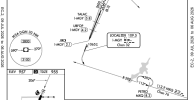
A favorite example of mine from where I used to instruct is the KMGY LOC RWY 20. The missed approach is "climb to 1600 ... then on heading 118 and MXQ R-292 ...". Problem is, of course, that heading 118 is only 6 degrees of intercept with R-292 (plus or minus some for whatever the station declination is for MXQ).

1785032237369.png

Since the MAP is 1.2 nm from the runway threshold and the MDA is 1320, a 172 with a headwind could easily be at 1600 for the turn before getting to the runway. Turning heading 118, with a headwind might easily result in a ground track of 112 (paralleling the radial) or even less, diverging from the radial and never intercepting it.

Whereas a faster, but slow-climbing aircraft with no headwind and a greater turn radius might be okay.

Now , I THINK that the MAP is likely within full-scale deflection of the MXQ R-292, so that's where situational awareness is necessary. If the needle's alive, fly what you need to, to make it center up. But again, the criteria isn't great and nowhere in the TERPS does it mention considering where full-scale deflection would be for something like this.

In my opinion, a heading of something like 140 would be much better.

But as with most other things, if nobody's elevating the issue, then everything must be just fine and it's not going to get changed on its own.

 
It's all of the above. However, the TERPS isn't very specific on how to design these things for non-RNAV procedures. In fact, there's pretty much no effective guidance. For RNAV it's very specific, involving calculations of turn radius based on category, altitude, assumed speed, etc. - because RNAV criteria is far more recent and was developed with modern tools (computers) in mind. Non-RNAV criteria is very old, and mostly works just fine, so there has been no big push to update it.

So what is a procedures designer to do? Account for the slowest aircraft? Account for the fastest aircraft? Account for the shallowest-climbing aircraft or the steeper-climbing aircraft? The procedure can really only be optimized for one of those cases. Add to that the previously mentioned lack of guidance, and a lot of "turn to heading XXX to intercept radial YYY" is done by the TLAR method ("that looks about right").

A favorite example of mine from where I used to instruct is the KMGY LOC RWY 20. The missed approach is "climb to 1600 ... then on heading 118 and MXQ R-292 ...". Problem is, of course, that heading 118 is only 6 degrees of intercept with R-292 (plus or minus some for whatever the station declination is for MXQ).

View attachment 153753

Since the MAP is 1.2 nm from the runway threshold and the MDA is 1320, a 172 with a headwind could easily be at 1600 for the turn before getting to the runway. Turning heading 118, with a headwind might easily result in a ground track of 112 (paralleling the radial) or even less, diverging from the radial and never intercepting it.

Whereas a faster, but slow-climbing aircraft with no headwind and a greater turn radius might be okay.

Now , I THINK that the MAP is likely within full-scale deflection of the MXQ R-292, so that's where situational awareness is necessary. If the needle's alive, fly what you need to, to make it center up. But again, the criteria isn't great and nowhere in the TERPS does it mention considering where full-scale deflection would be for something like this.

In my opinion, a heading of something like 140 would be much better.

But as with most other things, if nobody's elevating the issue, then everything must be just fine and it's not going to get changed on its own.
so… heartening back to my comment…
I don’t think it was here but there was a pretty good argument going on one about whether you (a) continue to climb straight out until you cross the radial so the intercept heading works or (b) turn at the stated altitude to intercept the radial so the altitude works. I’m sure someone even suggested leveling off at 1500.
from a TERPS standpoint, does it matter which you do?

I suspect from your description the design contemplates (a). I tried one of these GPS-coupled for the missed, and, as I recall, it did (b).
 
It's all of the above. However, the TERPS isn't very specific on how to design these things for non-RNAV procedures. In fact, there's pretty much no effective guidance. For RNAV it's very specific, involving calculations of turn radius based on category, altitude, assumed speed, etc. - because RNAV criteria is far more recent and was developed with modern tools (computers) in mind. Non-RNAV criteria is very old, and mostly works just fine, so there has been no big push to update it.

So what is a procedures designer to do? Account for the slowest aircraft? Account for the fastest aircraft? Account for the shallowest-climbing aircraft or the steeper-climbing aircraft? The procedure can really only be optimized for one of those cases. Add to that the previously mentioned lack of guidance, and a lot of "turn to heading XXX to intercept radial YYY" is done by the TLAR method ("that looks about right").

A favorite example of mine from where I used to instruct is the KMGY LOC RWY 20. The missed approach is "climb to 1600 ... then on heading 118 and MXQ R-292 ...". Problem is, of course, that heading 118 is only 6 degrees of intercept with R-292 (plus or minus some for whatever the station declination is for MXQ).

View attachment 153753

Since the MAP is 1.2 nm from the runway threshold and the MDA is 1320, a 172 with a headwind could easily be at 1600 for the turn before getting to the runway. Turning heading 118, with a headwind might easily result in a ground track of 112 (paralleling the radial) or even less, diverging from the radial and never intercepting it.

Whereas a faster, but slow-climbing aircraft with no headwind and a greater turn radius might be okay.

Now , I THINK that the MAP is likely within full-scale deflection of the MXQ R-292, so that's where situational awareness is necessary. If the needle's alive, fly what you need to, to make it center up. But again, the criteria isn't great and nowhere in the TERPS does it mention considering where full-scale deflection would be for something like this.

In my opinion, a heading of something like 140 would be much better.

But as with most other things, if nobody's elevating the issue, then everything must be just fine and it's not going to get changed on its own.
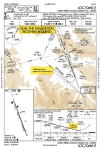
The dashed missed approach track line starts JIRDI on the Profile View, but not until the runway on the Plan View. I wonder if the guy building the approach had the runway on his mind when he did the Missed Approach Procedure.
 
so… heartening back to my comment…

from a TERPS standpoint, does it matter which you do?

I suspect from your description the design contemplates (a). I tried one of these GPS-coupled for the missed, and, as I recall, it did (b).

In practice, it doesn't matter. The protected area for a VOR-based missed approach is so large that you could almost do just about whatever you want.
 
Back
Top