Induction stove-tops; good or bad

JOhnH

Touchdown! Greaser!
Joined
May 20, 2009
Messages
15,163
Location
Florida
Display Name
Right Seater
Home Airfield
KOMN
We are considering replacing a 20 yr old glass stove-top with an induction stove-top. But my wife, who won't even be in the same room when a microwave is running, found out that induction stove-tops emit substantial electro-magnetic radiation. She read that even the user manuals warn you not to stand to close. WTF? How do you cook without standing close?

So with the same trepidation as asking if low-wings are better than high-wings, what do you think about standard electric stoves vs induction stoves?
 
I have induction and love it. Not sure where the radiation concern comes from. Nothing in my owners manual about where to stand. Suspect it's a bit over blown. You do have to get the right cookware to work with it. I just got a new set of everything. Heat is instant, off is instant. Boil water fast.
 
what do you think about standard electric stoves vs induction stoves?

Absolutely a high wing vs low wing discussion.
They generate a low frequency (tens to hundreds of kHz) electromagnetic field.
If you have metal on/in your hands/fingers, don't get them to close to the "burner", things might get hot. That's about the only danger of that electromagnetic radiation. In 5G fearmongering terms, this is 0.00005G.

Some pots and pans don't work well with induction stoves. Be prepared to replace a family herloom.
Also, slightly annoying, the sides of a pan stay cold. So any food that get there runs the risk of not cooking properly. Depending on the size of the burner, the edge of the pan might not heat up properly, either. Make sure the burner is larger than the pan you're using, otherwise your morning eggs might not be cooked at the edges.

Have you considered a replacement wife? ;)
I hear they're expensive.
 
We're in the process of building a house (well, lots of waiting at the moment), and we're going with an induction cooktop. From everything I've read the main negatives are that you have to switch to using ferrous pans (we mostly use cast iron anyway), and if you have a pacemaker that the electro-magnetic fields _might_ cause an issue in _some_ cases. I think that's mostly lawyer-speak, though.

The positives are that it's efficient, clean compared to gas (which I do love), fast, and relatively safe without any open flames or hot stovetops.
 
Have you considered a replacement wife? ;)
Yes, many times. But the one I have is an instrument rated pilot and a working (one day a week) Veterinarian. I really need to keep her.

From everything I've read the main negatives are that you have to switch to using ferrous pans (we mostly use cast iron anyway),
and if you have a pacemaker that the electro-magnetic fields _might_ cause an issue in _some_ cases.
I do have a Cochlear Implant, and I'm getting anoher (other side) this week.
All of my pans are Stainless Steel or Carbon Steel. I have some others that only get used in the regular electric oven.
 
All of my pans are Stainless Steel or Carbon Steel. I have some others that only get used in the regular electric oven.
Stainless doesn't necessarily mean "compatible with induction". In fact, it probably isn't, unless there is a slug of iron or carbon steel in the base clad in stainless.

You can easily tell whether a pan is induction-compatible by seeing if a magnet will stick to the bottom (the surface touching the stove, not the surface touching the food). Most new pans also have symbols on the bottom showing what cooking methods they're compatible with, and the induction symbol looks like a bunch of loops that look vaguely like a Spirograph.
All true. All of my pans compatible. Several years ago we threw out all of our ratty old non-stick stuff and replaced them with good SS. It was expensive, but I doubt I will ever have to replace any of them again.
 
But my wife, who won't even be in the same room when a microwave is running, found out that induction stove-tops emit substantial electro-magnetic radiation. She read that even the user manuals warn you not to stand to close. WTF? How do you cook without standing close?
Yes, WTF? I own an induction stove and my manual says nothing of the sort, nor have I ever heard of such a warning. That's ridiculous.

Your wife should probably read a physics book. There is EM radiation hitting and/or passing through her body constantly. There is a very important difference between "ionizing radiation" (think X-rays or nuclear bombs) and "non-ionizing radiation" (think microwaves, induction cooktops, WiFi, mobile phones, anything that emits light, etc.). One is worth worrying about, and the other is not, at least for things you find in the kitchen.
 
Some pots and pans don't work well with induction stoves. Be prepared to replace a family herloom.
Non-ferrous metal pans are unlikely to be heirlooms. They are the cheaper aluminum pans. Anything with ferrous metals will work so, cast iron, stainless steel, or carbon steel. Cast iron pans are inexpensive and work great. They are often the heirloom pans due to their longevity. As has already been mentioned, just see if a small magnet will stick to the pan. If it does, it will work.

Radiation isn't a concern. It's just magnetic fields.

The induction stovetop has many advantages including temperature control better than gas and nearly instant response to changes in temperature setting. It does that without any combustion gasses that need to be vented. The smooth top is easier to clean than a gas cooktop, too.

Disadvantages are cost, no ability to flame char vegetables, as there's no flame, and you'd need a flat-bottom wok as the bottom of the pan has to be in contact, or very close to, the cook surface.

A couple of excellent brands of compatible cookware are Made-In and All Clad. Both are commercial-kitchen quality and are available online.
 
We really like ours. Very quick to heat things. The interface bugs me sometimes because if you set anything down on the glass you’re likely to hit a button and activate something or at least cause the appliance to beep or boop.
 
Funny side story, we were having a party at the company apartment in Vietnam, so the boss went to the market to pick up some tabletop cookers. All of the instructions were in Chinese and we couldn't figure out how to turn them on. After about an hour, I suspected that they might be inductive, put an aluminum pan on one, and magically it started working.
 
We have two. Love 'em. I wouldn't consider non-induction.

True on the pans. We gave away a very nice set of Revere Ware that we had for 30 years. But just about any non-budget cookset sold today will be induction ready
 
Funny side story, we were having a party at the company apartment in Vietnam, so the boss went to the market to pick up some tabletop cookers. All of the instructions were in Chinese and we couldn't figure out how to turn them on. After about an hour, I suspected that they might be inductive, put an aluminum pan on one, and magically it started working.

An aluminum pan would magically STOP working.
 
I have one and like it. Not all stainless steel works. It has to be magnetic. Test with a magnet. (or just learn the codes and look at the bottom of the pan) If it doesn't stick at all it won't work and if it doesn't stick well it may not work well. I like cast iron and use Smithey. It's really expensive and really good. Easy to clean.
Here a site for stainless steel.
 
When remodeling the part-time home prior to making it a full-time home, we debated about what to replace the old coil electric cooktop with. Prior full-time home was gas, which we really liked, but running a new gas line was going to be a bit of a hassle. After some research, we decided on induction. Five years in, we like it a lot. 'Boost' mode to boil water is really nice. Cooking rice sometimes gets tricky, setting 1 is too low, setting 2 too high, so we use 2 and move the pan halfway off the cooking zone. I hardly notice the third nipple that appeared due to EMF.
 
The interface bugs me sometimes because if you set anything down on the glass you’re likely to hit a button and activate something or at least cause the appliance to beep or boop.
Far too many of them have the touch-sensitive fake button controls. I bought GE Cafe, in large part, because it had real knobs to turn to set power.

Not all stainless steel works. It has to be magnetic.
Not magnetic, ferrous. That means that it contains iron. It is not magnetic itself but magnets will stick to it.

Stainless steel is made up of iron and carbon so it is ferrous. A "stainless" pan that isn't ferrous is likely aluminum with a very thin coating of stainless steel.

Just take a small magnet, like a refrigerator magnet, to the store to test the pans. If you aren't looking to go as cheaply as possible, look at Made-In or All Clad. They make excellent ferrous cookware.
 
Checkout inviscook.com. mounts under the counter so you can just place a pan on a silicon mat on your countertop.
 
Does she use a wireless charger for her phone? Same principle.
 
Non-ferrous metal pans are unlikely to be heirlooms. They are the cheaper aluminum pans. Anything with ferrous metals will work so, cast iron, stainless steel, or carbon steel. Cast iron pans are inexpensive and work great. They are often the heirloom pans due to their longevity. As has already been mentioned, just see if a small magnet will stick to the pan. If it does, it will work.

Radiation isn't a concern. It's just magnetic fields.

The induction stovetop has many advantages including temperature control better than gas and nearly instant response to changes in temperature setting. It does that without any combustion gasses that need to be vented. The smooth top is easier to clean than a gas cooktop, too.

Disadvantages are cost, no ability to flame char vegetables, as there's no flame, and you'd need a flat-bottom wok as the bottom of the pan has to be in contact, or very close to, the cook surface.

A couple of excellent brands of compatible cookware are Made-In and All Clad. Both are commercial-kitchen quality and are available online.
I own 2 aluminum heirloom pots that I would not replace, but their quality is an outlier.
 
I think it was aluminum. Maybe it was stainless. Some kind of metal. At any rate, the thing didn't work until the pan was on it.
That's how induction works. It needs to sense there is a pan on it to turn on. It's a feature, not a bug. The "burner" heats the pan itself, not the cooking surface. The surface does get hot, but that's from conduction of heat out of the pan.

Also, Not all stainless steel is magnetic; the magnetic properties depend on the type of alloy and its chemical composition, with ferritic and martensitic grades being magnetic, while austenitic grades are typically non-magnetic. Not sure how relevant that is to cookware. but there it is.
 
The positives are that it's efficient, clean compared to gas
This is simply not true. It is inherently LESS efficient and LESS clean to use electricity for heating and cooking in a household environment.

The majority of our electricity here in the US is derived from fossil fuels; more than half is from natural gas (and increasing).

Now, think for just a moment about the efficiency of burning natural gas directly at the point of use. For a stove or clothes dryer, the efficiency at this point is exactly the same as electricity.

What differs is that with electricity the fuel is being burned tens or hundreds of miles distant, then used to boil water for steam (efficiency loss #1), which spins a turbine (efficiency loss #2), which powers a generator (efficiency loss #3) to create electricity. The electricity is then coverted to transmission voltage (efficiency loss #4), sent many miles at high voltage to a substation (efficiency loss #5), where it is converted to distribution voltage (efficiency loss #6). It then goes out the distribution feeder (efficiency loss #7) to yet another transformer to convert to household low voltage (efficiency loss #8), then through neighborhood overhead or buried LV wire/cable to your house's main panel (efficiency loss #9).

Now, if you live somewhere like the pacific northwest where your electricity comes from hydro dams, electric ovens/stoves are cleaner because the source is inherently cleaner. In most of the country this is not the case, however, and nowhere is it more efficient than direct fuel use.

 
This is simply not true. It is inherently LESS efficient and LESS clean to use electricity for heating and cooking in a household environment.

The majority of our electricity here in the US is derived from fossil fuels; more than half is from natural gas (and increasing).

Now, think for just a moment about the efficiency of burning natural gas directly at the point of use. For a stove or clothes dryer, the efficiency at this point is exactly the same as electricity.

What differs is that with electricity the fuel is being burned tens or hundreds of miles distant, then used to boil water for steam (efficiency loss #1), which spins a turbine (efficiency loss #2), which powers a generator (efficiency loss #3) to create electricity. The electricity is then coverted to transmission voltage (efficiency loss #4), sent many miles at high voltage to a substation (efficiency loss #5), where it is converted to distribution voltage (efficiency loss #6). It then goes out the distribution feeder (efficiency loss #7) to yet another transformer to convert to household low voltage (efficiency loss #8), then through neighborhood overhead or buried LV wire/cable to your house's main panel (efficiency loss #9).

Now, if you live somewhere like the pacific northwest where your electricity comes from hydro dams, electric ovens/stoves are cleaner because the source is inherently cleaner. In most of the country this is not the case, however, and nowhere is it more efficient than direct fuel use.
As you stated, it depends. :)

I get where you're going with it, but it's going to be vastly different for different areas. And you omitted things like trucking propane to my house, possibly trucking LP to a substation or costs associated with piping it there. What about heat loss when using direct flame? It's not simple to quantify. Although I bet there are groups that have, and to be honest, I'd like to see a full, honest comparison just for nerdiness's sake.

But, of course there are also costs with electrical generation, and yeah, you can make those arguments. The point I failed to make, I suppose, is compared to a traditional electric resistance-element stove, induction is far more efficient.

Personally I loved our gas stove, but having one less combustion source inside the home is a nice air quality improvement, IMO.
 
Also, Not all stainless steel is magnetic
Induction does not need magnetic pans. I can't imagine that anyone even makes magnetic pans. It needs pans made from ferrous metals, i.e. pans that contain iron.

Steel is an alloy of iron and carbon. Stainless steel typically has between 50% and 75% iron. If the pan is only clad in stainless steel, but uses a non-ferrous metal, such as aluminum, as the core, it might not work.

Aluminum will never work on induction as it contains no iron so is not ferrous.

If a magnet will stick to the pan it will work on an induction stove.
A magnet will not stick to austenitic grades of stainless. The iron content isn't the issue, it's the chromium and nickel content that give it the "stainless" properties. The definition of magnetic is that it's affected by a magnetic field, not that it's a magnet itself.

It's likely irrelevant to cookware, but it's why your kids pictures won't stick to a stainless refrigerator with a magnet. It's typically grade 304 stainless which is austenitic.
 
This is simply not true. It is inherently LESS efficient and LESS clean to use electricity for heating and cooking in a household environment.
Gas stoves waste 60% of their heat.
Induction wastes 5-10%.

Gas stoves a tremendous indoor air quality polluters.
Induction is not.

Gas stoves always require fossil fuels.
Induction can run on solar, wind, hydro or nuclear. Solar and wind are currently the cheapest forms of power available and every year become a larger and larger percentage of the power generated.
 
That's how induction works. It needs to sense there is a pan on it to turn on.
It doesn't need to sense anything. It's just not heating the surface via conduction, it's emitting an electromagnetic field that induces heat directly in the pan. If there's no ferrous metal pan there, it's not that it's "sensing" that fact and turning off the "burner", it's just sending the field into nothing.

This is simply not true. It is inherently LESS efficient and LESS clean to use electricity for heating and cooking in a household environment.
I agree with your post, but I think for those who aren't EEs or energy industry folks, "efficient" = cheap and "clean" = I can wipe a smooth surface with a cloth rather than taking burners apart to clean them.

Gas stoves waste 60% of their heat.
That depends. In the winter when you're heating the house anyway, it's not really wasted, it's just being used to heat the house instead of the food. ;)

Induction wastes 5-10%.
I'd be surprised if they're that efficient.

Induction can run on solar, wind, hydro or nuclear. Solar and wind are currently the cheapest forms of power available and every year become a larger and larger percentage of the power generated.
Kind of. Solar is cheapest (Wind less so due to turbine maintenance) for generation, but both solar and wind are inconsistent and thus depend on other sources for the base load. If you increase solar and wind to be 100% of generation, you also need utility-scale storage (batteries, pumped hydro, etc) which increases the cost enough to be more expensive than other sources again. We're getting there, though, slowly but surely.
 
It doesn't need to sense anything. It's just not heating the surface via conduction, it's emitting an electromagnetic field that induces heat directly in the pan. If there's no ferrous metal pan there, it's not that it's "sensing" that fact and turning off the "burner", it's just sending the field into nothing.

Incorrect. Induction stoves do sense the presence or absence of a pan and turn off the burner when one is not present.
 
It doesn't need to sense anything. It's just not heating the surface via conduction, it's emitting an electromagnetic field that induces heat directly in the pan. If there's no ferrous metal pan there, it's not that it's "sensing" that fact and turning off the "burner", it's just sending the field into nothing.
According to, at least, Whirlpool, their induction surfaces do detect the pan and only activate if one is present.

That depends. In the winter when you're heating the house anyway, it's not really wasted, it's just being used to heat the house instead of the food. ;)
Fair point. And I guess their waste is magnified in the summer when the AC is on. :-)

Kind of. Solar is cheapest (Wind less so due to turbine maintenance) for generation, but both solar and winare inconsistent and thus depend on other sources for the base load. If you increase solar and wind to be 100% of generation, you also need utility-scale storage (batteries, pumped hydro, etc) which increases the cost enough to be more expensive than other sources again. We're getting there, though, slowly but surely.
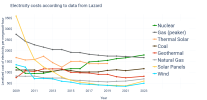
Solar and wind are the cheapest. Not "kind of". They simply are.

Loading is an issue, but not one that effects the price of their power. They do have the disadvantage of being variable. But, for this discussion, it's useful that solar power is produced during mostly the same hours as people cook. Wind, of course, is 24/7 and variable for other reasons. We still have many, many miles to go before production of variable renewable power outstrips demand during production hours. Hopefully we'll get there, but until then, it's an academic point at best and an attempt to minimize the very real value of renewables at worst.

1744125789591.png
 
Solar and wind are the cheapest. Not "kind of". They simply are.
Utility scale solar without storage? Yes.

Rooftop solar? Absolutely not.
Add storage to any renewable and the cost increases to well above gas turbine energy.

You cherry-picked one Lazard chart from that report. A full read of the data gives a more complete and accurate view.
 
Last edited:
Back
Top