IN DEFENSE OF THE 60+ HOUR PRIVATE CERTIFICATE

Who do you think is going to rent a plane to a student pilot for an overnight XC?

The school won't because they won't accept the lost teaching time slots. Nobody else will because their insurance will require a PPL and some minimum required flight time.
I belong to a club. Some people who own airplanes make those airplanes available to club members for monetary consideration. It's about who knows who, cooperation, and coordination. As stated insurance is a key factor, but like maintenance also something resolved by the club network.

I flew about 25 hours of solo cross country including about 8 hours at night under an endorsement before my practical. (It may have been easier to convince people, since I also had a Private-G and about 175 hours at the time.)
 
Last edited:
Who do you think is going to rent a plane to a student pilot for an overnight XC?

The school won't because they won't accept the lost teaching time slots. Nobody else will because their insurance will require a PPL and some minimum required flight time.
Not every student pilot is renting from a school. While that's the vast majority, yes, there are also clubs, partnerships, and sole owners. I've taught several aircraft owners for their Private. They most definitely wanted to fly more than the minimums, and I encouraged that. I would have no problem with them doing an overnight XC if the conditions were favorable.
 
Not every student pilot is renting from a school. While that's the vast majority, yes, there are also clubs, partnerships, and sole owners. I've taught several aircraft owners for their Private. They most definitely wanted to fly more than the minimums, and I encouraged that. I would have no problem with them doing an overnight XC if the conditions were favorable.
I could have rented the plane I used for training for an overnight cross-country as a student, but I always had work commitments that didn't allow that. And I was just renting the FBO plane! The FBO's policy was simply - if you're approved for solo by an instructor that we checked out in the plane, you can use the plane any way you and your instructor desire. If I didn't have to work, I could have even taken it for a multi-day trip as long as I scheduled it first. I had no clue just how lucky I was when I was training. :)

Honestly, the more I learn about training with a school, the happier I am I trained the way I did.
 
TL, DR

But your desired extra 20 hours, even with instrument time (required now), upset training and glider time WOULD NOT HAVE CHANGED ANY PART OF THE STORY YOU RELAYED.

And BTW, last time I checked, the average hours to PP checkride is over 60 hours and has been for years.

What needs to be taught is good ADM. And the people who can teach that are those that learned by experience, not a 200 hour CFI with limited XC experience.
 
Huh? If there are glider groups in all those places, someone should probably tell the SSA to update their map, which shows only Hartford and Osceola.
Apparently nothing in the Fox Valley, or here in central Wisconsin or northern Wisconsin. If glider training became a requirement, hopefully there would be more places to offer it.
 
Apparently nothing in the Fox Valley, or here in central Wisconsin or northern Wisconsin. If glider training became a requirement, hopefully there would be more places to offer it.
I sense an opportunity... C'mon down here and add Glider to your commercial and CFI certificates, and get yourself a 2-seat glider and a towplane!
 
I sense an opportunity... C'mon down here and add Glider to your commercial and CFI certificates, and get yourself a 2-seat glider and a towplane!
Hehehe... I am mostly retired and not seeking a new business. As I'm about to turn 80, I suspect insurance would be a major issue. (Did I say 80? How did that happen?!)
 
Huh? If there are glider groups in all those places, someone should probably tell the SSA to update their map, which shows only Hartford and Osceola.
SSA lists member clubs. Hartford and Osceola are Wisconsin Soaring Society [a SSA member]. Beloit and Oakbrook* (Whitewater) are commercial schools. Portage and Cumberland are equity clubs that have (or had) CFI-Gs.

In addition, unpowered Part 103s are based at KHXF and 5Y3 (Whitewater).

*I really dislike spell-wreck.
 
Last edited:
I don't entirely disagree that 40 hrs is a bit light, but I also think it depends on the person. I think the issue isn't the hours as much as the quality of training they received and the quality of the checkride. For example, I learned to fly from day 1 in Class B airspace. When I took my checkride I was fully capable of dealing with heavy traffic and ATC communications. Had I learned at a sleepy, uncontrolled airport, I would not have been well prepared for busy airspace. I can't speak for current checkrides, but my checkride only tested basic skills. I think the private pilot checkride really only tests for "good enough" not true proficiency. It is a "license to learn" after all. I do know some people who passed their checkrides who I honestly thought would (and should) fail, so I agree that many new pilots are not ready, but honestly another 20 hours of dual would not have fixed them. Raising the bar will not only eliminate bad pilots, but will eliminate good pilots with insufficient resources.
 
Hehehe... I am mostly retired and not seeking a new business. As I'm about to turn 80, I suspect insurance would be a major issue. (Did I say 80? How did that happen?!)
Well, I wonder if the glider insurance might not be a bit more lenient than airplane insurance. Worth a phone call maybe.

SSA lists member clubs. Hartford and Osceola are Wisconsin Soaring Society [a SSA member]. Beloit and Oakbrook* (Whitewater) are commercial schools. Portage and Cumberland are equity clubs that have (or had) CFI-Gs.

In addition, unpowered Part 103s are based at KHXF and 5Y3 (Whitewater).
Interesting. I always thought SSA was like EAA or AOPA and promoted soaring in general. Glad to hear there's more options out there!
 
Biggest '40 hours' joke I know is that after 40 hours and $10k+, a check ride and two written tests, a pilot still doesn't know how to fill a plane with gas :p
 
Biggest '40 hours' joke I know is that after 40 hours and $10k+, a check ride and two written tests, a pilot still doesn't know how to fill a plane with gas :p
This isn't surprising. My kids apparently never learned to fill my car with gas until long after they had licenses...
 
CFI/II’s should instill in their students that upon the completion of a certificate or rating, the knowledge and skill is just enough to pass the test, and just enough to kill you. Students should then take that knowledge and skill, realize it is just enough to kill you and use it as a license to learn how not to die or take others with you. If you aren’t learning something every flight, you are in a dangerous place of oblivion. I knew I was not ready for prime time after my PPL and my instrument. But I knew I had passed the very minimum requirements to keep learning in a controlled environment.

I don’t think hours matter much. 40/60/80/200/500. All are still a very dangerous place for a single pilot their own. Be humble, progress slowly.
 
Biggest '40 hours' joke I know is that after 40 hours and $10k+, a check ride and two written tests, a pilot still doesn't know how to fill a plane with gas :p

I’ve mostly taught at class C airports where the fbo pulls a truck around. For that reason I make it a point to have a lesson to fly to a nearby non-towered field with self serve fuel.
Serves a purposes of learning how to attack a non-towered airport, self fueling (which they may need on their solo x/c’s) and get some cheaper gas.


Sent from my iPhone using Tapatalk
I witnessed this in person!
 
I think the draft and huge number of washouts is not being taken into account. If the average instructor had the option of starting with 100 students, setting extremely high low time goal points to meet, and dismissing the students that didn’t make the cut and having 1, 2 , or maybe zero students make it to solo in the 10 hour time frame it would be a more accurate comparison.
I have never heard of draftees heading to pilot training.

They also had a several phase training. Initial training was in Cub/Champ type aircraft and aimed at just soloing. No XC, no night, no instrument, no radios.

Then they went to Primary training then to Basic and then to Advanced.

If all you want to do is to train to solo, it is not hard to solo someone in 10 hours.
 
Remember, in the past, you needed a LOT more hours to get your Instrument Rating. Then the FAA decided that it was safer to have lower time pilots with the rating and losing them to VFR into IMC mishaps.

IIRC it was 200 hours.
 
Remember, in the past, you needed a LOT more hours to get your Instrument Rating. Then the FAA decided that it was safer to have lower time pilots with the rating and losing them to VFR into IMC mishaps.

IIRC it was 200 hours.
Do they, or anyone, have statistics that show whether or not it worked?

It was 200 hours TT when I got my instrument rating, reduced to 125 when I was instructing. Now, of course, there’s no minimum beyond the Private certificate.
 
it was 200 TT before I started my instrument training, reduced to 125 TT before my instrument checkride, but, by then I had 200 hours. I didn't care.
 
Remember, in the past, you needed a LOT more hours to get your Instrument Rating. Then the FAA decided that it was safer to have lower time pilots with the rating and losing them to VFR into IMC mishaps.

IIRC it was 200 hours.
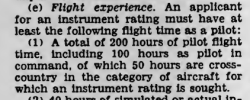
Yep. 200 hours. This is from 1973:

1750952769288.png
 
I learned at an untowered field with self serve fuel. One of the very first things I knew how to do was fuel the plane. I don't have issues with talking to ATC despite rarely being exposed in the airplane to ATC (radio comms are about the easiest and least expensive part of flying to master, especially with liveATC and youtube!), but I hate using full serve fuel. I have trust issues when it comes to people I don't know touching an airplane I am flying, I guess.

I honestly don't think extending the PPL curriculum would have any of the effects OP is hoping for, even adding in all those extra skills and requirements. I would argue that very few low-time pilot crashes are actually due to poor or lacking skills. I might be wrong, but I suspect that most are due to poor ADM - and while some aspects of ADM are trainable, a lot of them aren't. The trainable aspects of ADM are very easily covered in the existing timeframe by a semi-competent instructor or student, and so is teaching about personal minimums and their importance to cover the areas of ADM that must be developed over the next several hundred hours by the pilot themselves.
 
Yup…and I’m not seeing a 125-hour interim requirement in the historical regs on the FAA site. Did that ever exist, or was I smoking something that I need to report on my next medical application?
It was changed from 200 to 125 in 1985. If you want to find it, the Federal Register cite is 50 FR 19210. It remained at 125 until the big Part 61 rewrite in 1997.

Edit: I'm a 125'er. Rating in 1992.
 
Last edited:
It was changed from 200 to 125 in 1985. If you want to find it, the Federal Register cite is 50 FR 19210. It remained at 125 until the big Part 61 rewrite in 1997.

Edit: I'm a 125'er. Rating in 1992.
So apparently I’m only smoking something powerful enough to make me think I mighta been smoking something.
 
I’ve mostly taught at class C airports where the fbo pulls a truck around. For that reason I make it a point to have a lesson to fly to a nearby non-towered field with self serve fuel.
Serves a purposes of learning how to attack a non-towered airport, self fueling (which they may need on their solo x/c’s) and get some cheaper gas.


Sent from my iPhone using Tapatalk
My experience with fuel service:

I dipped the tanks and figured I needed 10 gal in right side, 15 in left. Called fuel truck (and even this is learned skill, what gas? what location?) and the fueler put 15gal in BOTH tanks... well, about a gallon over the right wing. He was watching the meter not the nozzle.

Never again will I ever trust anyone to put gas in.

Also the unwritten rules of pump ettique (if there is a line behind you for the pump, don't start the motor and spray everyone with rocks... at least turn the AC because prop blast. Also rewind your damn ground clamp lol if then even know how to use it also if you use the ladder PUT IT BACK and SECURE IT. Don't just lay it next to the pump :rolleyes:
 
Last edited:
Biggest '40 hours' joke I know is that after 40 hours and $10k+, a check ride and two written tests, a pilot still doesn't know how to fill a plane with gas :p
It was a long time, maybe 200 or 300 hours, after I got my ticket that I ever fueled my own plane. Maybe 500 or 1000 hours. Learned at a military airfield ( MCAS El Toro), did all my cross country’s and t/gs to Class C and D fields, flew under class B alot, in the early 90s there were not many self serve pumps, at least where I landed. Not till the 00’s did I start using them. That said, if you can gas a car, you can gas a plane. If you can dodge a wrench…
 
I never got fuel off the truck until long after getting my private ticket. The place I rented from required the planes to be parked with full tanks, and we had to use self-serve at the home field and if available when filling up elsewhere. I still would much rather use self-serve.
 
Biggest '40 hours' joke I know is that after 40 hours and $10k+, a check ride and two written tests, a pilot still doesn't know how to fill a plane with gas :p
It isn't just limited to single engine piston airplanes.

I started flying the Challenger 605 in September. In initial (simulator) type rating training, "how to fuel" wasn't covered in any practical sense, since of course there was no refueling of the simulator. When I started flying it, at first all of my flights started and ended at home station (*), where our flight line maintenance folks would take care of the fueling. So after several flights in it, I realized I had no idea how to set the fuel panel and other necessary details about how it all works, and asked one of the guys to delay the fueling on my next trip until I was there and could be trained.

* Yes, a flight without a landing at other than home station in a midsize jet seems weird, but we usually don't need to land to accomplish our mission.

It's like when my daughter was about 3, we were in a hotel. She uses the bathroom and comes out looking very troubled.

"What's wrong honey?"
"There's no soap!"
I go into the bathroom, sure enough there's the the bar of soap I had unwrapped earlier, next to the sink.
"It's right there, silly"
"Where?"
"That bar of soap right there."
"Bar soap? I don't know how to use bar soap!"

Which seems really ridiculous and still makes us laugh, but I paused a moment before responding, and realized that, actually, she probably didn't know how. All of the soap at our house is in the pump containers. So she may never HAVE used bar soap, and I never thought of it to teach her. It wasn't on my "child training syllabus". It was then that I realized MOST things are taught, not intuitive or obvious, and to blame the teacher (i.e. me) for lack of knowledge, not the student.

 
I will give an anecdotal response. I am a frugal pilot. That means I don’t want to spend money unnecessarily. If I am going to fly, I want to make it count. If I know I need 3.5 more hours of cross country time. I don’t mind some touch and goes today, but let’s do them in conjunction with a cross-country flight.

Having said that, at 32.5 hours, I had completed all of the necessary tasks for the private pilot rating with the exception of the 40 hour minimum. I started my checkride with 40.5 hours in my logbook. (Part 61, not a pilot mill)

With that kind of mentality, my first IFR training flight was the day I passed my ASEL checkride. Mind you, it isn’t that I never go for a $100 burrito (looking at you KAOO) but I don’t have enough money to do all kinds of joyride flying, so I want to spend my money wisely.

It is not impossible, with good training and a diligent, studious attitude, to get your ticket at 40 hours. Was I completely proficient? No. I now have my CSEL, instrument rating, and working on CFI. I would still say I’m not completely proficient. The day you think you have this thing we call flying completely figured out is the day it throws something at you that you’ve never seen before. Just look at the Miracle on the Hudson for that!

What the OP gets right is that there are far too many people trying to get the ticket CHEAP instead of inexpensive.
 
I was one of those unicorns that completes it at 40 hours (40.1; call it a longer taxi somewhere along the way; missed it by a hair :p). After soloing and XC, I went out to practice with a purpose each time. I had a handful of procedures I wanted to work on, and then do a min of 5 laps in the pattern. Or if it was a "landing" day, I'd go to 10+ laps in the pattern. My CFI took me up on heavy XW days (17kt limit in a Archer II), marginal VFR, and we landed at two class B airports during night training. I was finished with the ACS requirements and could hold well within the standards at roughly 36 hours; the remaining 4 were mostly some final checkride prep / mock checkrides, and more pattern work. Would another 20 hours make me a better pilot? Sure. Was it needed to pass all the requirements the FAA has in the ACS standards? Nope.

Rather than increasing hours, I personally think they should tighten up the ACS requirements. 10 degrees off heading is a huge amount, for example.

So rather than focusing on the 40 hours, the FAA should focus on the ACS requirements. That will naturally require more hours by most pilots (the average to meet current ACS is 60 hours, anyways) to be able to be safe within the airspace system, but for the few that pick things up very quickly, it doesn't somewhat penalize them to continue paying more for an already very expensive skill.

Edited to remove incorrect info
 
Last edited:
Back
Top