HP calc includes manifold pressure?

pfarber

Pattern Altitude
Joined
Jun 20, 2021
Messages
1,653
Display Name
pfarber
Using chat GPT to do some maths and it said this:

Using the standard (HP* torque)/5252 formula an IO-360 makes 95.2HP at 2700RPM
My engine of choice a 3.6 Pentastar would (with the standard formula) make 123HP at 2700RPM

I am not sure what models it used for either, but the dyno charts I found put the Pentastar at 160hp at the same RPM

BUT then is said this:

The difference is because aircraft HP ratings are usually at max continuous power with full manifold pressure, not just torque × RPM formula.
And
Aircraft engines often operate at higher manifold pressure than naturally aspirated automotive engines at sea level.

It then goes on to show that at 18in manifold pressure the IO-360 now generates 180-200hp

Is ChatGPT saying the the intakes are better on IO-360? Full manifold pressure would be wide open throttle(WOT).

I can alter the RPMS of the car motor using ignition timing and injector timing (leaving the throttle WOT). That would increase MP.

Or is it purely a displacement issue (5.9 vs 3.6)?

Or is there something else I am not considering?
 
A normally aspirated engine at sea level on a ISA day, the max theoretical manifold pressure is 29.92 inches of manifold pressure at WOT. Then there are flow losses between the carb or intake and the cylinder. So at WOT the actual MP will be less than about 28 inches max.
 
Yes I understand that. But chat-GPT is telling me that there is some weird 18in ABS manifold pressure that aviation engines are tested/run at.

The long intake runners and multiple turns would decrease MP compared to the short straight intake on the Pentastar.

Basically I am not understanding why Chat-GPT says that aiplane engines have a magical MP bonus score applied. The intakes are horrific.

I've not seen 'manifold corrected hp formula' for non-turbo'd engines. There is no boost, everyone gets what the throttle body allows and the intakes will support.
 
I used to work with a human ChatGPT. You could as him ANYTHING and he would make up a plausible sounding answer in just a few seconds.

Hp / Torque as a function of RPM and manifold pressure - this is why dynamometers exist and why you can expect to spend some big bucks to get your engine tuned.
Spark advance, mixture, volumetric efficiency (intake and exhaust side) all make a significant difference.
 
Basically I am not understanding why Chat-GPT says...
ChatGPT is wrong? I'm shocked. Shocked, I say.

But you didn't say what value if any it was using for torque.
I used to work with a human ChatGPT. You could as him ANYTHING and he would make up a plausible sounding answer in just a few seconds.
I had a boss like that. He was a really smart guy, but he seemed to be incapable of saying, "I don't know." Caused a lot of trouble when people asked him about other engineer's projects (like mine!) that he wasn't directly involved with.
 
Chat gpt gives you an answer. It might not be the right answer. But it's an answer.
 
AI language models are going to give you an answer. It’s hard for some to believe, but it is often (almost always) not 100% correct. It is based on probabilities and gives word combos that are most likely to be right. Just the nature of the beast.

Anyone can do this experiment - get in depth with Chat GPT and ask it questions in your area of expertise. Ask for references. Odds are that you will find errors, and even a few references that have nothing or little to do about the subject matter.
 
Using chat GPT to do some maths and it said this:

Using the standard (HP* torque)/5252 formula an IO-360 makes 95.2HP at 2700RPM
My engine of choice a 3.6 Pentastar would (with the standard formula) make 123HP at 2700RPM

I am not sure what models it used for either, but the dyno charts I found put the Pentastar at 160hp at the same RPM

BUT then is said this:

The difference is because aircraft HP ratings are usually at max continuous power with full manifold pressure, not just torque × RPM formula.
And
Aircraft engines often operate at higher manifold pressure than naturally aspirated automotive engines at sea level.

It then goes on to show that at 18in manifold pressure the IO-360 now generates 180-200hp

Is ChatGPT saying the the intakes are better on IO-360? Full manifold pressure would be wide open throttle(WOT).

I can alter the RPMS of the car motor using ignition timing and injector timing (leaving the throttle WOT). That would increase MP.

Or is it purely a displacement issue (5.9 vs 3.6)?

Or is there something else I am not considering?

At 29.92" manifold pressure, assuming stoichiometric combustion, and 28% thermal efficiency, a O-360 engine at 2700 RPM should produce 180 HP (or roughly 0.5 HP per cubic inch). This can be derived mathematically. I can post it if you would like.

18" MP in an O-360 will produce about 110 HP, not 180-200hp, at least not at 2700 RPM.

I don't know the 3.6L Pentastar engine, but 3.6L is equal to 220 cubic inches, which is smaller than the O-360. With all things being equal, at 2700 RPM it should produce 105 HP. But since auto engine can have higher thermal efficiencies, your 123HP sounds about right to me.
 
I used to work with a human ChatGPT. You could as him ANYTHING and he would make up a plausible sounding answer in just a few seconds.
Those people are the best.
The answer seems plausible, but once you've worked with them for a while you know they have no ****ing clue what they're talking about.
The issue is that GPT has total conviction in all of its answers. And it takes almost as much time to figure out what it's wrong on as it does to just go research the right answer to begin with.
If you have 5 separate sessions of GPT, you can end up with 5 conflicting answers depending on the precise wording you used in your question. Godspeed in figuring out which one is right.

And given that GPT 5 had a hard time counting how many Rs are in the word "strawberry", I'm not sure I'd rely on it for engine testing and design (unless you're going to exercise "trust but verify" at every step of the answer).
 
Then ask why the answers you just got were wrong.

It’s a weird mess. It’s like it wants to kiss a** sometimes, like talking with a brown-nosing employee.

If you ask the right question in a certain way, it will explain why it did a thing.

It also has a memory, if you’re logged in (and maybe even if you’re not). It has gotten “edgy” with my son after a few months, almost like HAL. A smart a** attitude.

I got a pop-up last week asking me what kind of “voice” I wanted it to have - funny, formal, scientific, etc.
 
Lord help you if you try to refine an image after the first one. It’s all jacked up and makes it worse, lol!

Or submit something in writing and ask for improvements. Then resubmit whatever it edited. You’ll get some of what it didn’t originally like edited back in.. It just HAS to give you an answer.
 
If you can measure torque and RPM, manifold pressure is irrelevant.
 
It’s also fun to do the ai round robin—> Claude to ChatGPT to perplexity etc. (check each other’s answers for example)

I once had ChatGPT draw a map for me (think Lewis and Clark path) and it mixed up north south east and west! I asked why everything was backward and it apologized and “fixed” it

Except of course it was now screwed up in new ways.

I will say it sometimes is helpful like list all airports in Illinois with rental car and within half hour of a national park. Of course it’s driving time estimates are a crapshoot too
 
Hp / Torque as a function of RPM and manifold pressure - this is why dynamometers exist and why you can expect to spend some big bucks to get your engine tuned.
Spark advance, mixture, volumetric efficiency (intake and exhaust side) all make a significant difference.
This. What matters is reality; put the engine on a test stand, see what torque it produces at various RPM's. Then you can use the subsequent torque curve and math to determine HP.

Then the nice people who make the engine can test and see how the torque declines per drop in pressure altitude. Then you can determine your HP at a specific RPM at a specific altitude.
 
I want to know why people expect 'Language Models' to be able to do Math.
Doing the math isn't the problem, its where they are getting the numbers from that is the problem. GPT never gave a specific reference of where this 18in manifold pressure came from, but the equation was correct when applied.

The closest it came was referencing some 'Lycoming training material'
 
I would skip the AI and look for a dyno chart. I may be thinking along the same lines. Are you wondering how well it would work turning a propeller without a reduction drive?
 
  • Like
Reactions: WDD
Using chat GPT to do some maths
There's your first mistake.

Using the standard (HP* torque)/5252 formula an IO-360 makes 95.2HP at 2700RPM
I wonder where it got the torque value. I don't think I've ever seen one published.

Yes, MP affects HP, but it's not part of that equation. The 5252 comes from 33,000 ft*lb (one HP) divided by 6.283 (2π) radians per revolution.

The difference is because aircraft HP ratings are usually at max continuous power with full manifold pressure, not just torque × RPM formula.
Yes - Sea level MP at MCP is what the HP rating will be. That doesn't mean torque * HP is going to be wrong either though.

Aircraft engines often operate at higher manifold pressure than naturally aspirated automotive engines at sea level.
Only turbocharged ones.

It then goes on to show that at 18in manifold pressure the IO-360 now generates 180-200hp
Nope. At 18" MP it'll be down to about 60%, or 120hp.

Is ChatGPT saying the the intakes are better on IO-360? Full manifold pressure would be wide open throttle(WOT).

Or is there something else I am not considering?
No, ChatGPT is saying "I DON'T KNOW MATH AND I'M JUST REGURGITATING STUFF I SAW AROUND THE INTERNET BASED ON PROBABILITIES OF CERTAIN WORDS AND NUMBERS APPEARING AFTER EACH OTHER WHY DO YOU KEEP ASKING ME FOR FAAAAAAAAAAAAAAAAaaaaaaaaaaaacts....."

Doing the math isn't the problem, its where they are getting the numbers from that is the problem. GPT never gave a specific reference of where this 18in manifold pressure came from
ChatGPT may not have a body, but it definitely has an ass, and that's where it pulled the number from.
 
No, ChatGPT is saying "I DON'T KNOW MATH AND I'M JUST REGURGITATING STUFF I SAW AROUND THE INTERNET BASED ON PROBABILITIES OF CERTAIN WORDS AND NUMBERS APPEARING AFTER EACH OTHER WHY DO YOU KEEP ASKING ME FOR FAAAAAAAAAAAAAAAAaaaaaaaaaaaacts....."

ChatGPT may not have a body, but it definitely has an ass, and that's where it pulled the number from.

Can we make these quotes a sticky? :biggrin:

Reality is reality, math is math. AI and social media are not reality.

Forgive my geekness coming out again and repeating a bit here: You have to have a real world observed torque curve recorded to determine performance. HP for a piston engine is a dependent variable. It is based on torque. Torque will vary depending on RPM, hence HP isn't linear/straight line. The engine performs differently at different RPMs, therefore, you need a torque curve taken from observation/from a dyno. The engine performance will change due to a lot of things, including air pressure. So if you want to know how your performs at a set of conditions, get a torque curve at those conditions from a test stand.

Want to know how it performs at different altitudes? You can do some modeling, but you need to do a real world test at different air pressures.
 
The 5252 comes from 33,000 ft*lb (one HP) divided by 6.283 (2π) radians per revolution.
To be more precise, 33,000 lb-ft is not one HP. 33,000 lb-ft per minute (or 550 lb-ft/sec) is one HP. But yes, the 5252 comes from dividing by 2π to convert from linear to rotational velocity.
 
Fun geek fact: An F35 at full after burner standing still right before take off produces zero power/zero horse power. Power requires force through some distance at some amount of time. No movement, no distance, no power generated.
 
Fun geek fact: An F35 at full after burner standing still right before take off produces zero power/zero horse power. Power requires force through some distance at some amount of time. No movement, no distance, no power generated.
Tons of air and gases are being moved at considerable velocity, so work is indeed being done.
 
Mistake #1 was made in the first post:

Using chat GPT to do some maths and it said this:

Using the standard (HP* torque)/5252 formula an IO-360 makes 95.2HP at 2700RPM
HP x torque/5252 is useless. The real formula is RPM x torque/5252. That mistake is why your numbers say that the I0-360 makes only 95.2 HP at 2700 RPM.

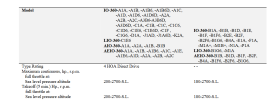
Unless, of course, you are determined to argue with Lycoming's numbers on their Type Certificate Data Sheet for the IO-360:

1766176841035.png

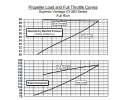
They don't publish a torque chart for the engine, since the torque will vary with propeller type and pitch changes. The nearest thing is the propeller loading chart, which gives no numbers for torque or loading; it's just a curve. And such a chart is difficult to find unless we consult the Superior IO-360 clone engines:

1766177399407.png

If we want to know the torque output of the IO-360 at 180 HP and 2700 RPM, we have to work the numbers backward. We get about 350 foot-pounds. If one thinks that they can run a four-cylinder auto engine--or even a six---at 2700 RPM and get 350 foot-pounds out of it as a direct-drive conversion, they have another think coming. It's been tried, and the engine is always far too heavy for its output. What torque do the LS engines generate at 2700?
 
GPT is likely using online formulas maybe/maybe not in context. These #'s don't likely reference if engine has variable timing or other efficiency components.

if you are looking for a simple gouge, take a look at a HP vs fuel flow dyno chart for that engine, and make a simple table or graph. it won't be 100% accurate, as you are not likely to have exact mixture set or prop load.or many altitude data points, but close enough ...it's basically a BSFC chart. Trouble is such graphs are normally done only at one or 2 density altitudes so you have to do some math and all engines don't have linear power bands (such as RPMs more efficient than others) so lack of multiple data points decrease your accuracy somewhat.

when programming the ECM on our experimental V8 we could add a table to directly display % of max power or HP based on RPM, FF , MAP, IAT, ambient pres, based in real time data...so you could see RPM as well as HP. Wasn't really helpful after test flight program so removed it from digital display. it was helpful in figuring out how high in altitude engine could maintain max sea level HP at different max power settings (engines are essentially an air pump)... the V8 was rated to 500 HP in cars but flat rated to 220HP for our c172. You can select different max power settings in software, up to 220HP for c172 models, and because of its extra displacement, it could hold max power well above sea level....it allowed us to see the DA where power began falling off, much like a turbo charged engine SL ceiling. funny enough, a buddy just took his commercial check ride in it last week, and this HP question came up in oral.
 
If one thinks that they can run a four-cylinder auto engine--or even a six---at 2700 RPM and get 350 foot-pounds out of it as a direct-drive conversion, they have another think coming. It's been tried, and the engine is always far too heavy for its output. What torque do the LS engines generate at 2700?

Fun fact- the 455 Buick V8 weighed about 25 lbs more than a small block Chevy and the 1970 Stage 1 version made 510 ft-lbs of torque at 2800 rpm. Too heavy aviation wise, but fun to think about.
 
Wonder if theres an aluminum block for the Buick 455?
 
No, ChatGPT is saying "I DON'T KNOW MATH AND I'M JUST REGURGITATING STUFF I SAW AROUND THE INTERNET BASED ON PROBABILITIES OF CERTAIN WORDS AND NUMBERS APPEARING AFTER EACH OTHER WHY DO YOU KEEP ASKING ME FOR FAAAAAAAAAAAAAAAAaaaaaaaaaaaacts....."
Not sure if you are trying to be funny (lpt: its really not) but all of your caps lock rant is missing the point.

The MATH is 100% correct. The issue is that it pulled in some 'facts' (and it did reference Lycoming 'training materials') that could not be sourced.

I never heard of this MP modifier so I really didn't believe it should be there, but if going by HP=(RPM*Torque)/5252 it seems that the Pentastar engine 3.6L is a close match to an O-320 and not an O-360 in the HP range IF you limit the Pentastar to < 3000RPM which might negate the need for a PSRU.

For a Pentastar to match an O-360 the PSRU is required:

ParameterO-360Pentastar + gearbox
Engine RPM27004200+
Piston speed~10 m/s~23 m/s
Continuous power180 hp~150–170 hp (realistic)
TBO expectation2000 hrsHundreds (typical)

Mistake #1 was made in the first post:


HP x torque/5252 is useless. The real formula is RPM x torque/5252. That mistake is why your numbers say that the I0-360 makes only 95.2 HP at 2700 RPM.

Unless, of course, you are determined to argue with Lycoming's numbers on their Type Certificate Data Sheet for the IO-360:

View attachment 148263

They don't publish a torque chart for the engine, since the torque will vary with propeller type and pitch changes. The nearest thing is the propeller loading chart, which gives no numbers for torque or loading; it's just a curve. And such a chart is difficult to find unless we consult the Superior IO-360 clone engines:

View attachment 148264

If we want to know the torque output of the IO-360 at 180 HP and 2700 RPM, we have to work the numbers backward. We get about 350 foot-pounds. If one thinks that they can run a four-cylinder auto engine--or even a six---at 2700 RPM and get 350 foot-pounds out of it as a direct-drive conversion, they have another think coming. It's been tried, and the engine is always far too heavy for its output. What torque do the LS engines generate at 2700?
Mistyping a formula was my fault, not GPTs. The numbers still made sense even though I don't type good.

I was not blindly following GPTs finds... I asked a question about this mystery 18 in of MP that it used in some replies. It never cited a source other than 'Lycoming training material' so it got that 18in MP from somewhere.. just didn't apply it correctly.

GPT's redeeming quality is that it understands language so I can enter a butchered question and it can interpret what I want. Also the math is 100% correct, just the variables in the formulas were wrong.

I am in the 'AI is not very I' camp... its simply searching whats out there and its up to users to actually determine the validity. That's why I asked the question here as Homebuilders have more insight into car 'moter than a run of the mill AnP.
 
Using chat GPT to do some maths and it said this:

Using the standard (HP* torque)/5252 formula an IO-360 makes 95.2HP at 2700RPM

Mistyping a formula was my fault, not GPTs. The numbers still made sense even though I don't type good.
So it made sense to you that the IO-360 produces only 95.2 HP at 2700 RPM? In spite of everything Lycoming says about that engine, and the FAA has certified as documented by dyno testing?


Well, ok then.
 
Is the Pentastar tbo extrapolated from piston speed compared to the widely accepted TBO of the Lycoming? I think that with a good PSRU and a tuned ECU the Pentastar might be a good candidate. 300 takeoff horsepower and a big prop seem very possible. The only thing I dont like about the Pentastar are the long cam chains and (sometimes) problematic tensioners.

This is why I'm leaning towards the GM LV1 4.3l. An off-the-shelf airboat PSRU and an aftermarket ECU (mainly so it isnt upset about the absence of the VSS input) should help simplify the conversion a bit.
 
So it made sense to you that the IO-360 produces only 95.2 HP at 2700 RPM? In spite of everything Lycoming says about that engine, and the FAA has certified as documented by dyno testing?


Well, ok then.
This is the the third time: the formula is correct. the math is correct. the data is wrong. I didn't source the data, but i do realize that it is not correct.

I have no idea what torque curve GPT used but when you use the HP formula with the numbers it provided the result is what i posted.

I cannot find a dyno chart (in the few minutes i did search) for an io-360.
 
just for giggles solving for 180hp @ 2700 is 350ft/lbs

a 3.6l Pentastar produces 260ft/lbs @2700 rpm for 133hp. I could use it as an o-320 replacement with a slight RPM bump.

it becomes an io-360 replacement @ 4300rpm with PSRU.

the very interesting find is that with just 6psi of boost i get 200hp at 2700rpm.
 
This is the the third time: the formula is correct. the math is correct. the data is wrong. I didn't source the data, but i do realize that it is not correct.

I have no idea what torque curve GPT used but when you use the HP formula with the numbers it provided the result is what i posted.

I cannot find a dyno chart (in the few minutes i did search) for an io-360.
GPT didn't use torque curve and do math. It regurgitated garbage it found from an unknown source.
 
So many variables that the only thing tou can trust is a dynamometer report from a known source. AI is nonsense...for now. At least until Skynet becomes self aware ..
 
  • Haha
Reactions: WDD
The good news is that you can buy or borrow a car with the 3.6 Pentastar, preferably with a manual transmission. Find a long, steep grade and see how it does at full throttle and (loaded by grade, cargo and gear selection) 2700 rpm. Watch the temperature gage and see how it does. Thats like putting a direct drive propeller on it without attaching it to your airplane. Might do just fine, might get hot. I think it will do fine with a psru as long as you regularly inspect cam chain tension, but as a direct drive engine, youre better off with an O-200.

If its 325 pounds running, plus 65-75 for a psru, its a good alternative for an O-540. Spit balling, with no qualifications expressed or implied, one could expect 300 horsepower for takeoff and climb, with 200 continuous. Watch the oil, compression and cam chain tensioners and even if its a 1000 hours before it needs total replacement, you're still 20% of the price and fuss of an O-360 or 540.
 
GPT didn't use torque curve and do math. It regurgitated garbage it found from an unknown source.
Ok, you're 100% wrong and here's the real answer:

18inHg on a standard day is ~11,000ft. An IO-360 at ~11,000ft produces ~55% of rated HP which is ~93HP depending on model.

So the data/math/torque/hp IS correct.

The variables are correct.
The math is correct.
The formula is correct.

The only thing INCORRECT are your posts.
 
Last edited:
Back
Top