HP calc includes manifold pressure?

The good news is that you can buy or borrow a car with the 3.6 Pentastar, preferably with a manual transmission. Find a long, steep grade and see how it does at full throttle and (loaded by grade, cargo and gear selection) 2700 rpm. Watch the temperature gage and see how it does. Thats like putting a direct drive propeller on it without attaching it to your airplane. Might do just fine, might get hot. I think it will do fine with a psru as long as you regularly inspect cam chain tension, but as a direct drive engine, youre better off with an O-200.

If its 325 pounds running, plus 65-75 for a psru, its a good alternative for an O-540. Spit balling, with no qualifications expressed or implied, one could expect 300 horsepower for takeoff and climb, with 200 continuous. Watch the oil, compression and cam chain tensioners and even if its a 1000 hours before it needs total replacement, you're still 20% of the price and fuss of an O-360 or 540.
Your test scenario wouldn't be valid. Most vehicles with a Pentastar are at least 4000lbs, have a massive flat plate drag coefficient and cooling optimized for stop/start/low speed traffic. Wheel HP is not the same as at the crank HP and the ECU is not optimized for performance, but emissions.

PSRU's are not 65lbs (some may be) but most are in the 30lb range. An O-540 @ 300hp is way to much HP for my EAB that has a Vne of 220mph. 200HP would give a 170-180kt cruise and while the car motor weight is higher than a IO-360 I am willing to give up useful load.

The Pentastar may not be the perfect motor, but there are 10,000,000 of them made, parts are cheap, is all aluminum, and has a lower end that will easily handle 400hp+

My thoughts going foraward is that direct drive is not ideal. I still need to mitigate torsional vibration, raise the thrust line and possibly incorporate variable pitch... all of which are virtually impossible to do with a direct drive setup on a car motor.

Running at 4300-4400 rpm keeps the piston speed low 11.9m/s compared to an IO-360 piston speed of 10m/s. Bearing speeds for the Pentastar are almost double (mains are 14m/s) but still in the continious duty range.
 
Using the standard (HP* torque)/5252 formula an IO-360 makes 95.2HP at 2700RPM
So you are saying that the formula shown above, the one given in post #1, is correct? That HP x torque/5252 equals HP?? That makes no mathematical sense at all. And you don't see it. It does not include RPM, see?? And without RPM, you cannot get HP. And there was no 11,000' altitude mentioned in the post.
This is the the third time: the formula is correct. the math is correct. the data is wrong.
It's still wrong, even the third time around.
a 3.6l Pentastar produces 260ft/lbs @2700 rpm for 133hp. I could use it as an o-320 replacement with a slight RPM bump.

it becomes an io-360 replacement @ 4300rpm with PSRU.
The problem with increasing RPM on direct-drive applications is the loss of HP to increased propeller drag. There have been numerous proofs of that. Continental developed their small engines and increased the HP by increasing the engine redline, and they kept this up until the O-200, which redlined at 2750 RPM. But that engine, supposedly producing 100 HP, is outperformed by it's ancestor the C-90, which generates its 90 HP at 2475 RPM. I have flown both of them, in airplanes that give them the same power-to-weight ratio, and the C-90 will run circles around the O-200. Some propeller makers use 85 HP as a baseline for props for homebuilts on the O-200. It just doesn't produce 100 HP worth of thrust due to the much higher drag losses.

The VW is another that is typically run up to 3500 RPM or so to get the HP, but it needs a much smaller prop that doesn't produce good takeoff acceleration. You get what you pay for.

The PSRU fixes that, but now you are designing something that has to resist the same old factor that has failed so many attempts: torsional vibration. It regularly blows PSRUs to bits when they're designed by folks that are naive.

It's not cheap or easy to convert auto engines to flight. An awful lot of homebuilders have tried and eventually gave up and just installed a legacy aircraft engine.
 
Your test scenario wouldn't be valid. Most vehicles with a Pentastar are at least 4000lbs, have a massive flat plate drag coefficient and cooling optimized for stop/start/low speed traffic. Wheel HP is not the same as at the crank HP and the ECU is not optimized for performance, but emissions.
The scenario was to load the engine to its max, and it does just that. If it overheats, the vehicle was poorly designed. It does not matter what the drag or driveline losses are; the point is to get the engine to redline with full throttle.
 
I may be wrong, but my understanding of dyno testing is that its done at WOT, with the load changing for different rpms.
 
Here's a good explanation of how the data is gathered. Throttle position creates too many variables so typically the test is WOT and different RPMs are achieved by modulating the load, either hydraulically or electrically.

 
I've learned a bit by reading some airboat forums. Their goals and limits are somewhat similar to ours and some guys like direct drive while others insist on reduction drives. One glaring difference is our requirement to save weight as much as possible.

Another member here pointed out that the Helio Courier prototype used a C-90 with a belt drive to swing a yuuge prop, with adequate results.
 
So you are saying that the formula shown above, the one given in post #1, is correct? That HP x torque/5252 equals HP??
Oh you sweet summer child.

You REALLY, REALLY REALLY REALLY need to read, like every word of my posts. 'cause well... post #32

"Mistyping a formula was my fault, not GPTs."

Are we done yet? :deadhorse:

Evidently not :rolleyes:

The PSRU fixes that, but now you are designing something that has to resist the same old factor that has failed so many attempts: torsional vibration.

I won't list the number of PSRUs used in airplanes as I don't have the much time, or care to educate people on something that can easily be googled.

But for starters: Almost ALL inline and radial engines from WWII (yes, they had PRSUs). On BOTH sides of the conflict.

ROTAX engines. Diamond DA-40NG.... the list goes on.

I also find it HILARIOUS, that such a obviously intelligent and wise contributor couldn't figure out the correlation of 18in MP and 93HP (or whatetever) was. You're welcome.
 
Fun fact- the 455 Buick V8 weighed about 25 lbs more than a small block Chevy and the 1970 Stage 1 version made 510 ft-lbs of torque at 2800 rpm. Too heavy aviation wise, but fun to think about.
the Cadillac 472/500 cid engine series were not much different. Thin wall high nickel content blocks, something like 525ft/lbs of torque at 2800rpm stock. Aluminum intake drops it an additional 50 pounds (welded mandrel bent tubing can drop it more). Aluminum heads are now available, and with a bit of cutting off accessory mounts, bell housings, etc they can be finished out remarkably light for the displacement and power.
 
I asked google a question yesterday and it gave me an ai answer that was clearly wrong. I clicked the “explore AI” or whatever button and the screen refreshed with the correct and completely contradictory answer.
 
the Cadillac 472/500 cid engine series were not much different. Thin wall high nickel content blocks, something like 525ft/lbs of torque at 2800rpm stock. Aluminum intake drops it an additional 50 pounds (welded mandrel bent tubing can drop it more). Aluminum heads are now available, and with a bit of cutting off accessory mounts, bell housings, etc they can be finished out remarkably light for the displacement and power.

But its not about just HP @ 2700RPM. Thrust line would be super low and there would be no way support a prop without additional bearing support and flange.

There is nothing wrong with a PSRU or a motor spinning over 2700RPM. Yes, you have to design it properly. E/AB history should not be measuring stick as you have random people putting random parts together.
 
I asked google a question yesterday and it gave me an ai answer that was clearly wrong. I clicked the “explore AI” or whatever button and the screen refreshed with the correct and completely contradictory answer.
you mean like any internet search result?

LLM is NOT AI. What it does is allow more natural search queries. When I use GPT I use my mic and simply ask for what I want.... kinda like on Star Trek when Geordi or Data start to interface with the ships computer.

I'm old enough to remember when you had to add logical operators to queries to filter out the results. Now I just ask for what I want. That's not AI. That a language model.
 
But its not about just HP @ 2700RPM. Thrust line would be super low and there would be no way support a prop without additional bearing support and flange.

There is nothing wrong with a PSRU or a motor spinning over 2700RPM. Yes, you have to design it properly.
There are reduction units available for them also, but the airboat guys had a couple decades of good service using them with props bolted straight to the flexplate flanges before the race for more power led to the reduction units. I would bet a beer that the gyroscopic loads from a prop are higher in an airboat in wave and chop than in an airplane. The stock crankshafts can take a lot
 
you mean like any internet search result?

LLM is NOT AI. What it does is allow more natural search queries. When I use GPT I use my mic and simply ask for what I want.... kinda like on Star Trek when Geordi or Data start to interface with the ships computer.

I'm old enough to remember when you had to add logical operators to queries to filter out the results. Now I just ask for what I want. That's not AI. That a language model.
It seems AI should know....
I asked Chat GPT if LLM was AI…
And probably got this:
1766884317538.png
 
Let's go line by line

Using chat GPT to do some maths and it said this:

Using the standard (HP* torque)/5252 formula an IO-360 makes 95.2HP at 2700RPM
My engine of choice a 3.6 Pentastar would (with the standard formula) make 123HP at 2700RPM

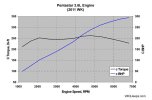
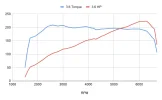
I am not sure what models it used for either, but the dyno charts I found put the Pentastar at 160hp at the same RPM

BUT then is said this:

The difference is because aircraft HP ratings are usually at max continuous power with full manifold pressure, not just torque × RPM formula.
And
Aircraft engines often operate at higher manifold pressure than naturally aspirated automotive engines at sea level.

It then goes on to show that at 18in manifold pressure the IO-360 now generates 180-200hp

Is ChatGPT saying the the intakes are better on IO-360? Full manifold pressure would be wide open throttle(WOT).

I can alter the RPMS of the car motor using ignition timing and injector timing (leaving the throttle WOT). That would increase MP.

Or is it purely a displacement issue (5.9 vs 3.6)?

Or is there something else I am not considering?


Using chat GPT to do some maths and it said this:

Asking a language model to do math was a mistake.

Using the standard (HP* torque)/5252 formula an IO-360 makes 95.2HP at 2700RPM

The IO-360 is rated at a minimum of 145HP. That means a (minimum) torque of 280 (assuming the HP rating of 145 was achieved at 2700 RPM). Your language model hallucinated these data.

However, I have had difficulty finding information on the variants making only 145 HP. Most of my results are for the 180 HP variants. Using 180 HP at 2700 RPM leads to a torque value of 350.

My engine of choice a 3.6 Pentastar would (with the standard formula) make 123HP at 2700RPM

According to pentastars.com, "The 3.6 liter Pentastar engine is rated at 305 horsepower and 270 lb.-ft. of torque... 90% of torque is available from 1,800 to 6,350 rpm..." That lines up pretty well with with a HP figure around 125 at 2700. Using 90% as a hard bottom, 243ft-lbs would make 124 HP.

I am not sure what models it used for either, but the dyno charts I found put the Pentastar at 160hp at the same RPM

222179d1372487253t-pentastar-v6-3_6_liter_pentastar_graph_01-2108870031.jpgchart-png-565951365.webp

Both charts indicate HP figures below 150 below 3000 RPM.


BUT then is said this:
:heli:
The difference is because aircraft HP ratings are usually at max continuous power with full manifold pressure, not just torque × RPM formula.

I'm not certain what it means. Engines are dyno'd, whether they're for a plane or a car. Dyno runs are made with a fully open throttle and are started at some RPM well below redline. The dyno itself is controlled to adjust engine RPM up to the engine's redline.

To my knowledge, there is no technical definition of "full manifold pressure." That could mean anything. Engines not supercharged are limited to whatever the ambient pressure happens to be when and where they are.

:heli:
Aircraft engines often operate at higher manifold pressure than naturally aspirated automotive engines at sea level.

As Aloysius T. McKeever once said, "Your [AI is] having hallucinations again." Natural aspiration is natural aspiration, whether in a car or in a plane. Manifold pressure is limited to ambient pressure in the absence of supercharging.

It then goes on to show that at 18in manifold pressure the IO-360 now generates 180-200hp

As Aloysius T. McKeever once said, "Your [AI is] having hallucinations again." Lower manifold pressure reduces power. How much power was this engine making at sea-level pressure (29.92) for it to make 180 at only 18?

Is ChatGPT saying the the intakes are better on IO-360? Full manifold pressure would be wide open throttle(WOT).

As Aloysius T. McKeever once said, "Your [AI is] having hallucinations again."

I can alter the RPMS of the car motor using ignition timing and injector timing (leaving the throttle WOT). That would increase MP.

RPM has no bearing on MP. MP pressure can only affect (effect?) RPM by being so low as to reduce engine power below what is necessary for the requested RPM.

Or is it purely a displacement issue (5.9 vs 3.6)?

What is 'it?'

Or is there something else I am not considering?

You're not considering that an AI language model is bad at math and lied to you to keep you happy.

P.S. https://www.pentastars.com/engines/tech.php source of quote from pentastars.com
 
I have zero faith in AI for anything more crucial than generating memes. I still think the best pre-aircraft test for a potential auto conversion is to find said engine in an auto with a manual transmission and drive a route that will approximate an aircraft type load. Ideally you would have installed aftermarket water temperature gages as well as egt gages.

It seems that a common problem is adequate cooling because auto engines and radiators weren't designed for peak horsepower to be used continuously. Imagine a takeoff and climb to altitude as a being a long, steep onramp in a mini-van full of bricks, towing a ski-boat at full throttle and you can imagine how well the cooling system holds up.

The good news is that custom alloy radiators arent very exotic anymore, and electric fans dont add much weight but can make a big difference when the air is hot, slow or thin.
 
RPM has no bearing on MP. MP pressure can only affect (effect?) RPM by being so low as to reduce engine power below what is necessary for the requested RPM.
RPM does have an effect on MP, and more so at lower throttle settings. Remember, "manifold pressure sucks." Higher RPM at a low throttle setting = lower MP.

Of course, in this discussion, that's nothing more than a sidebar.

You're not considering that an AI language model is bad at math and lied to you to keep you happy.
I'm shocked. Shocked, I tell you! :rolleyes:

AI is *usually* wrong. If it gives you links to where it got its information, you have a starting point for finding the right answer for yourself.
 
Back
Top