Hangars proximity to runway

Axelaxe

Filing Flight Plan
Joined
Mar 15, 2022
Messages
14
Display Name
Axelaxe
I recently got a bunch of help from the forum on building my first hangar at our farm strip.

The next questions is where to place the hangar in relation to the grass runway. I currently have it placed 60 feet from the strip (see pink in image, ignore the number)
The building is 60 x 60 feet and 17 feet tall.

I am concerned about mechanical turbulence affecting aircraft, and if I should move the hangar further away from the field?
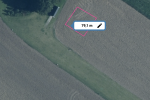

Skärmavbild 2025-05-09 kl. 11.17.57.png
 
Look at 3W3 airport - the homes/hangars seem to be about 100-120 ft away from the runway.
 
9B8 we have a ~60’ taxiway and then a 60’ setback to the structures.
Are you private or public use? I have had a plane come through my backyard once. Turbulence could be an issue but being at the end of the runway you could land long.
 
You could call a local airport manager and ask if he/she knows of the regulations they face. You can also get google earth images of private airpark home developments and see how far they put their structures. And call a development and ask what their policies are.

If you don't have zoning laws to deal with, you could probably do what you want. But you're asking a good question about real reasons for distance to runway. I'd wager that 60' is too close, but that's just a gut feel swag.

FAA setbacks are much farther, usually starting at 250 feet from runway centerline. Being a private strip not receiving FAA funding you aren't subject to those.

I don't think you'd ever regret having more space from the runway than less.

I just Google mapped a few I'm aware of.

A friend's strip is 60 feet from edge of runway, 100 feet from centerline.

Another friend's airpark is 200 feet from edge, 250 from centerline.

A different airpark I know, 160 feet from edge, 200 from centerline.
 
At least a few feet further than this. Certainly not enough if you're going to park a plane in front of it while flight prepping.

Screenshot 2025-05-09 at 10.03.31 AM.pngScreenshot 2025-05-09 at 10.03.39 AM.png
 
At least a few feet further than this. Certainly not enough if you're going to park a plane in front of it while flight prepping.

View attachment 140880View attachment 140881
Believe it or not, according to google earth the first (blue) hangar is 90 feet from the center line, the second (white) hangar is 115 feet from centerline, and the hangars on the right are 120 feet.

I think I'd be shooting for 125 minimum.

Subtract 30 feet from each number for distance to edge of runway, so first hangar is what 60 feet from edge would look like. The back of the pickup truck is also about 60 feet off the edge.

At my air park, the closest house / hangar (also the most recently built) is 175 feet from the centerline. The fuel farm is only 110 feet.
 
Last edited:
I would def be concerned about turbulence if the wind is coming from the upper part of the photo.
Can you get a wind rose for your location? That will guide your decision pretty easily.
 
FAR Part 77 provides design guidance for airport airspace. Private operations are not bound by Part 77, but the regs provide good design guidelines, often called imaginary surfaces.

For example, the runway primary surface area is 125' width on each side of centerline, for runway with visual approaches. There are also transition zones on each side of the runway, and approach surfaces off each end of the runway. As well as other imaginary surfaces that extend higher and in lateral directions.

Generally recommended to keep these areas clear of obstructions (towers, hangars, fences, structures, etc) for safe aviating.
 
Thanks! Great input!

I have found some references (for example: https://www.experimentalaircraft.info/flight-planning/low-level-turbulence.php)

That gives the horizontal turbulence to ”up to 10 times the height of the obstruction. ”

The would mean up to 170 feet from the building.

What’s interesting is that the trees behind are at least 30 feet high, the turbulence from the trees thus already reach the runway (300 feet in worst case wind scenario) ”shadowing” the hangars placement, meaning that the placement of the hangar might not even matter.

My thinking is therefore to move the hangar closer to the trees, to minimize its impact.

It needs to be said that we very seldomly get winds from the direction.
 
There are a few older, privately owned, grass runway, airparks in the area that we use as alternates if needed. Using Google Maps scale, the "tightest" one has seven hangars facing eight across a well maintained 200 foot undifferentiated grass surface. The second has 32 hangars or other structures facing one another. None is closer than 125 feet from the center line, with a few at 200 feet and most in-between.
 
We allow them up to the rear property line setback which I think is 35'. Mine's further back because I have a taxiway on one side of my lot and the hangar faces there so I can have my living room windows look out at the runway.
 
Question: what is the reason for having all of that wasted space behind the hangar?
 
250 seems to be the FAA minimum from centerline.

There is one hangar at my field that has a maintenance operation. When the built the current runway, they had to shorten the building by about 15 - 20 feet for clearance. Even though, due to the slope, the hangar roof is nearly or actually lower than the runway surface.
 
another site with wind rose and
historic weather data

It gets data from all over the world.
You need to set the ‘iem site’ info to tge correct state
and then pick the airport.

 
Back
Top