Foreflight - major layoffs

Honestly, I was a bit shocked to learn that there are 3900 people working at Foreflight. Not that it isn't a great product, but it is hard for me to believe that it really requires that many people. It is largely a wrapper for content that is already produced by the government for free.
 
Not to be "obvious". This is NOT good.
Not fair to the employees, not fair to the customers.
If there is a silver lining, maybe some folks will re-hone (or learn) some old time skills.
 
So, is it possible to port a FF logbook to iFly or GP?
iFly does not have a built in log book. They do recommend using My Flight Book though. It is the app I use, but I also back it all up on an old fashioned pilots logbook.

 
To start with it’s JeppForeflight, 4 entities across at least three continents. HR, Legal, Compliance, and first line management is at least a quarter of the headcount.

Ah yes. That's a valid point about Jepp.
 
Honestly, I was a bit shocked to learn that there are 3900 people working at Foreflight. Not that it isn't a great product, but it is hard for me to believe that it really requires that many people. It is largely a wrapper for content that is already produced by the government for free.

Does suggest some bloat had set in.
 
Purpose of a company is to make value, which is measured in profits.
The purpose of a company is to deliver value to its customers, which is measured by profit.
As it was said elsewhere, there are many reasons for starting a company, but regardless of the why, the company needs to turn a profit. It doesn't have to be a huge profit, but it needs to be enough to make the effort worthwhile.

The difference is really the time horizon. A person who founds a family company usually wants to have something that they can build over time, and when it's time to retire either sell it off or transfer it to their kids. That's one end of the spectrum.

PE is the other end. They don't care about long term profits. They're looking to increase profit margins as quickly as possible to make the company attractive to buy so that they can make a quick buck or two million.

PE, IME, takes existing products and services and squeezes all the life out of them. They'll do lots of M&A and/or cutting staff and other costs to make it look like the company's profits are skyrocketing. Then they sell the shell if they can, and it quickly falls apart. But what happens pretty much immediately is that the best employees jump ship - They know what's coming. Those that are left must attempt to keep things moving without the top performers, and morale drops through the floor. It just sucks to watch it happen. :(

There's a whole bunch of observational bias in this. I'll bet you deal with successful PE portfolio companies every day and either don't know it or don't think about it.
Naah, I got out of that rat race. Current company is a subsidiary of a local family owned company; last company the owner's office was a couple doors down from mine. I've seen enough of PE that I'll not be hanging around anywhere that they show up.

Honestly, I was a bit shocked to learn that there are 3900 people working at Foreflight.
No. There are a lot of people working at *Jeppesen* ForeFlight, and ForeFlight is just a small fraction thereof. Even so, ForeFlight is now a worldwide product and has several offices worldwide.

So, is it possible to port a FF logbook to iFly or GP?
Yes. You can do a CSV export from ForeFlight, change the columns as necessary, and re-import into just about whatever.

ForeFlight Web has an option where you can have them automatically email you a monthly CSV export of your entire logbook for backup/security purposes, which I do take advantage of and IMO everyone should.

You do lose signatures, photos, track logs, and such that likely are not supported by others anyway.

 
I can’t believe how instantly many of you react. Very knee jerk, not surprised I guess.

ForeFlight is so far ahead of Garmin Pilot. I have subscriptions for both for work. I also use GP to upload new databases and that process is way more complicated than it should be and that’s their proprietary gear.

The overall feel of the app just isn’t the same and not as intuitive as FF, their KMZ/KML support for external layers is terrible as also however that doesn’t apply to many folks.

I guess for recreational use it’s apples and oranges but otherwise FF is solid.

They have a well matured program, I can honestly see why the workforce doesn’t need to be as big to support it, that said, it is sad for those in the crosshairs but that’s just the way it goes, for the most part we are all expendable.
 
I love FF. Really do. And not going to knee-jerk. But if I fall out of love with them for some reason, seriously is there a way to migrate my logbook into something else or am I going to have to do the manual thing like when I moved from paper to FF?
 
I love FF. Really do. And not going to knee-jerk. But if I fall out of love with them for some reason, seriously is there a way to migrate my logbook into something else or am I going to have to do the manual thing like when I moved from paper to FF?

Answered two posts above yours in post 90. Yes, there is an export function. FF states it must be done on the web.

 
Here come all the doom and gloom. Could be true, could be nothing.
This is the pattern for PE owned companies. The moment they acquire, the divorce is being planned. Squeeze out as much costs as you can, stop investing, and just maximize a “shadow” EBIDA so the books look good for sale before your customers leave.
 
This is the pattern for PE owned companies. The moment they acquire, the divorce is being planned. Squeeze out as much costs as you can, stop investing, and just maximize a “shadow” EBIDA so the books look good for sale before your customers leave.
If this were always the way, why would anyone ever buy a former portfolio company?
 
If this were always the way, why would anyone ever buy a former portfolio company?

It’s easy for someone to rail on PE when they know little about a company’s ownership history.

Caterpillar was once owned by PE, as was Hilton Hotels and Nabisco, among many others.

Thoma Bravo, the owners of JeppFF, actually has a reputation for “good” outcomes. Not that most of those protesting PE would take the time to research their portfolio.
 
Purpose of a company is to make value, which is measured in profits.

No. The purpose of a company is to deliver value to it's owners.

One of the founders of Hewlett-Packard (don't recall which) once explained it this way (paraphrasing):

Profit to a company is like food to the body. Food is necessary for life, and it's enjoyable and something we all desire, but it's not the purpose of life. Similarly, profit is necessary for a company to survive, and it's desirable, and we must ensure it continues, but profit itself is not the purpose of the company. The purpose is to meet a customer need. Whenever a company sacrifices satisfying the customer in favor of greater profits, the company will inevitably fail.
That's a lot of words to say that meeting a customer need is what allows you to create profits.

Firms exist because people invest capital in them. They do this for a return.
 
That’s what this front line rat never understood. If upper management wants to cut labor cost why not thin the middle management. One thing every company I’ve been with had in common was a bloated middle management.

Well, speaking as someone who has hired middle managers, I got tired of managing everything myself. Ten years of 70 hour weeks took their toll.
 
Well, speaking as someone who has hired middle managers, I got tired of managing everything myself. Ten years of 70 hour weeks took their toll.
Well having been a middle manager I can also attest to their usefulness but like most things the old saying “too much of a good thing” is real.
 
Well having been a middle manager I can also attest to their usefulness but like most things the old saying “too much of a good thing” is real.
Sometimes it's too much of a bad thing lol.

Middle management... can't live with 'em, can't live without 'em.
 
Sometimes it's too much of a bad thing lol.

Middle management... can't live with 'em, can't live without 'em.
Yeah … when you’re talking to an individual and they disclose their full time job is management of one other person… well. It’s time for some redundancy notices to roll out.
 
One of the founders of Hewlett-Packard (don't recall which) once explained it this way (paraphrasing):

Profit to a company is like food to the body. Food is necessary for life, and it's enjoyable and something we all desire, but it's not the purpose of life. Similarly, profit is necessary for a company to survive, and it's desirable, and we must ensure it continues, but profit itself is not the purpose of the company. The purpose is to meet a customer need. Whenever a company sacrifices satisfying the customer in favor of greater profits, the company will inevitably fail.
I especially like that definition because if you just search and replace "profit" for "income", or "revenue" then it applies equally well to non-profit companies.

"Income to a company is like food to the body. Food is necessary for life, and it's enjoyable and something we all desire, but it's not the purpose of life. Similarly, income is necessary for a company to survive, and it's desirable, and we must ensure it continues, but income itself is not the purpose of the company. The purpose is to meet a customer need. Whenever a company sacrifices satisfying the customer in favor of greater revenue, the company will inevitably fail."
 
Well having been a middle manager I can also attest to their usefulness but like most things the old saying “too much of a good thing” is real.

I can agree. I will also add that “middle managers” who only perform people managing things like performance reviews and work oversight but don’t also maintain their own portfolio of work are not very useful in most companies.
 
With small and medium sized companies, it is fairly easy to identify bloat. If the top level manager or owner knows the business well, productivity of individuals and teams is obvious. When you are personally paying everyone's salary, you pay attention to what you are getting in return.

I have a list in my mind of the first 10% of staff to cut if the bottom line isn't where it should be.

In large organizations, it gets much harder. Businesses can grow to the point where they become nearly unmanageable. Financial outcomes become separate from organizational structure, which removes the manager's incentive to make hard choices. It gets easier to hide non-performers than downsize.

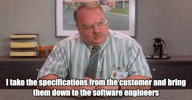
Then you gotta bring in the Bobs.

John-C.jpeg
 
Whenever a company sacrifices satisfying the customer in favor of greater profits, the company will inevitably fail.
Yes, if a company sacrifices customers, they will loose profits in the long run, company will loose value, and fail.

The only way to create value is to provide a product or service that a customer wants and can and will pay for. If you pursue profits, you have to deliver for the customer. If you pursue the customer first and profits second, you can fail.

Think of the value of the company, what it's worth based on current and future growth, potential earnings, etc. A lot of AI companies today are valued nicely because of their investment and thus potential of future value. This despite not showing a traditional profit (revenue - expenses) yet.
 
Last edited:
That’s what this front line rat never understood. If upper management wants to cut labor cost why not thin the middle management. One thing every company I’ve been with had in common was a bloated middle management.
or take a look a their c-suite pay. Probably biggest savings can be had there.
 
A lot of AI companies today are valued nicely because of their investment and thus potential of future value. This despite not showing a traditional profit (revenue - expenses) yet.
Plus speculation causing a massive bubble. If markets were rational the total value of the AI companies would be something like the total value of the future market. Instead each individual company is valued at something like the total value of the future market. Whomever invents the first effective sorting hat for stocks will be a billionaire many times over.
 
With small and medium sized companies, it is fairly easy to identify bloat. If the top level manager or owner knows the business well, productivity of individuals and teams is obvious. When you are personally paying everyone's salary, you pay attention to what you are getting in return.

I have a list in my mind of the first 10% of staff to cut if the bottom line isn't where it should be.

In large organizations, it gets much harder. Businesses can grow to the point where they become nearly unmanageable. Financial outcomes become separate from organizational structure, which removes the manager's incentive to make hard choices. It gets easier to hide non-performers than downsize.

Then you gotta bring in the Bobs.

View attachment 149060
If you haven't seen the movie Blackberry it was fantastic. Echo's a lot of what you said including a "Bob" character. Hopefully it's not foreshadowing for foreflight.
 
or take a look a their c-suite pay. Probably biggest savings can be had there.

Not in most companies. Many executive pay packages include deferred compensation based on business unit or company performance and those triggers aren’t always met. Other components can be variable comp, and indirect comp in the form of benefits since most executive salary is subject to HCE tests/limits. Then, there’s only so many executives you can trim.

The annual total comp for my team of 18 exceeds my CEOs entire annual comp package. We (F100 company) have ~40K employees, including just a couple hundred executives, ranging from the junior assistant VPs to the CEO.
 
Well having been a middle manager I can also attest to their usefulness but like most things the old saying “too much of a good thing” is real.
I'm happy to have navigated a 44 year engineering career without ever have been "promoted" into any kind of management. Good thing, I'm pretty good with the nuts and bolts but would have been a terrible manager.
 
The annual total comp for my team of 18 exceeds my CEOs entire annual comp package. We (F100 company) have ~40K employees, including just a couple hundred executives, ranging from the junior assistant VPs to the CEO.

Ok, so you could trim one CEO and keep 18 people who work. Nice.

:cheerswine:
 
Well, speaking as someone who has hired middle managers, I got tired of managing everything myself. Ten years of 70 hour weeks took their toll.
There can be redundancy at any level, and at some places it's at a different levels than others. I got laid off when a previous employer decided to eliminate a layer of managers. Then they discovered my previous boss had no idea how to do my job, and if my reports had been able to do it, they'd have had my job in the first place. It took them seven months to replace me with someone less qualified for more money. Sometimes middle management isn't so bad.
 
Yes, if a company sacrifices customers, they will loose profits in the long run, company will loose value, and fail.

The only way to create value is to provide a product or service that a customer wants and can and will pay for. If you pursue profits, you have to deliver for the customer. If you pursue the customer first and profits second, you can fail.

Think of the value of the company, what it's worth based on current and future growth, potential earnings, etc. A lot of AI companies today are valued nicely because of their investment and thus potential of future value. This despite not showing a traditional profit (revenue - expenses) yet.
Herb Kelleher when he ran Southwest said the following

If you treat your Employees right they will treat the Customers right
A Customer treated right will be a returning Customer
Returning Customers will be what treat the Shareholders right.
 
Back
Top