"Fat" and "Thin" runways

RussR

Final Approach
Joined
Jan 12, 2011
Messages
5,214
Location
Oklahoma City, OK
Display Name
Russ
Home Airfield
OKC
The thread about narrow runways got me thinking about the ratio of length to width. Most narrow runways, of course, are also short, and most wide runways are also long. But there are some exceptions.

One in this corner of the world is Sayre, OK, which is 130 ft wide, but only 4276 ft long. Since most 5000 ft runways are somewhere around 75 or 100 ft wide, final approach to Sayre "looks weird".

If you take the length divided by the width, that gives a "thinness" ratio of 32.9, where larger numbers are "thinner" and smaller numbers are "fatter". (I thought about doing the width divided by the length, but that gives numbers like 0.0304, which don't seem as friendly to deal with.)

I'm wondering what a normal range would be. OKC's normal-size runways are 9801 x 150, which is 65.34, so much thinner than Sayre, about "twice as thin". Another nearby small airport is 4001 x 60, which at 66.7, while much shorter than OKC is pretty much the same ratio. PWA is 7201x150, or a ratio of 48, so definitely fatter than OKC.

So for anybody who's willing to play along, what are some long/narrow or short/wide runways you know of? Do the math and see where it fits. Anybody know of a 20 ft wide runway that's really long, or a 300 ft wide really short runway?

I think we should restrict this to paved runways, I know some of those grass runways can be really really wide - but I'm mostly interested in the visual illusions caused by paved runways.

And I'm fully expecting a lot of comments about "girth".
 
Last edited:
Girth changes the feel of the whole aporoach, all the way to the landing.

Surely does! My home airport is 60' wide and Florence (FLO) at 150' seems to cause me to round out a bit high. The good news is that with 6K' of runway there's plenty of time to fly it down and search for the ground ... :biggrin:
 
Last edited:
Spruce Creek Airpark. 4,000 x 175.

Before flying there I noted the length but not the width. On final I kept thinking that something was wrong with approach.
 
6I4 Boone Co, Indiana
120 (3,600 x 30)
Like landing on a 1.5 lane road
 
6P3 Waunakee WI
74 (2223 x 30 feet)

Landed there a bunch when training back in the 80's in a 152.
 
Castle Airport (KMER) in central California - 11,800x150 - 78! It used to be 300 feet wide but it’s been restriped to 150 so they don’t have to maintain the asphalt all the way to the edge. It was a B-52 base up until 1994. Oh, it also has a 500 foot overrun at each end.
 
Easy, Centennial CO, 10,000x100. Weirdest sight picture ever for guys used to landing on 7-8k long runways x 250. "I'm high I'm high, oh ****, just broke the plane" :)
 
The thread about narrow runways got me thinking about the ratio of length to width. Most narrow runways, of course, are also short, and most wide runways are also long. But there are some exceptions.

One in this corner of the world is Sayre, OK, which is 130 ft wide, but only 4276 ft long. Since most 5000 ft runways are somewhere around 75 or 100 ft wide, final approach to Sayre "looks weird".

If you take the length divided by the width, that gives a "thinness" ratio of 32.9, where larger numbers are "thinner" and smaller numbers are "fatter". (I thought about doing the width divided by the length, but that gives numbers like 0.0304, which don't seem as friendly to deal with.)

I'm wondering what a normal range would be. OKC's normal-size runways are 9801 x 150, which is 65.34, so much thinner than Sayre, about "twice as thin". Another nearby small airport is 4001 x 60, which at 66.7, while much shorter than OKC is pretty much the same ratio. PWA is 7201x150, or a ratio of 48, so definitely fatter than OKC.

So for anybody who's willing to play along, what are some long/narrow or short/wide runways you know of? Do the math and see where it fits. Anybody know of a 20 ft wide runway that's really long, or a 300 ft wide really short runway?

I think we should restrict this to paved runways, I know some of those grass runways can be really really wide - but I'm mostly interested in the visual illusions caused by paved runways.

And I'm fully expecting a lot of comments about "girth".
17/35 at RBD is 3800' x 150'. It's always looked fat to me. It's wider and shorter than 13/31 (7136' x 100'). I'm sure there's a reason.
 
Easy, Centennial CO, 10,000x100. Weirdest sight picture ever for guys used to landing on 7-8k long runways x 250. "I'm high I'm high, oh ****, just broke the plane" :)
That clean 100 score seemed pretty normal to me. As does the parallel at 93 (7001x75).

Funny though - I always use it as an example of why I say, "don’t look at the far end of the runway in the flare" when I fly with someone who has landing issues.
 
Last edited:
ancient history so my memory is very fuzzy, but I was thinking KANP was skinny so I'ooked it up
2505/48=52.187. Looking on google maps it doesn't look to be updated so maybe it's the same today as it was when I was there in the PA-23-150 back in the early 1990's?
Maybe it was just because I was still training in the twin or maybe because the building are so close to the runway that the site picture stood out to me...

The other one I can think of was 83FL. Also a long time ago for me so maybe the dimensions are different now, but today it's reported as being 3150/60 = 52.5

So I suppose neither of my examples are really all that unusually skinny.

I can't think of any unusually fat runways, but I do recall flying into one like that someplace....
 
Castle Airport (KMER) in central California - 11,800x150 - 78! It used to be 300 feet wide but it’s been restriped to 150 so they don’t have to maintain the asphalt all the way to the edge. It was a B-52 base up until 1994. Oh, it also has a 500 foot overrun at each end.
Edwards AFB is the same way - 300 ft wide but striped for 150, although we did maintain the full width. I was told it was more for visual references than anything else.
 
17/35 at RBD is 3800' x 150'. It's always looked fat to me. It's wider and shorter than 13/31 (7136' x 100'). I'm sure there's a reason.
Yes! I've been there and forgot about it. It is definitely a strange-looking runway on final.
 
Maryville, MO, 78Y, is 3050 x 25 ft., for a ratio of 122.

That's the stated dimensions, but looking it, it's even thinner! Since the northern 550 feet is grass (and wider), if you only use the paved part it's about 2500 x 14 = 178.6!
 
Looks like we have some early contenders for the prize.

Thinnest (higher score is thinner):
1. 78Y RW 17/35 - 2500 x 14 = 178.6
2. 6I4 RW 18/36 - 3600 x 30 = 120
3. APA RW 17L/35R - 10,001 x 100 = 100

Fattest (lower score is fatter):
1. 7FL6 RW 06/24 - 4002 x 176 = 22.7
2. RBD RW 17/35 - 3800 x 150 = 25.3
 
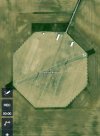
Private field not far away. 3/4 of a mile by 3/4 of a mile.
Owner hates crosswinds.
Cool! But I assume it's grass, or that's a lot of pavement.

Is it actually landable in any direction by "normal" airplanes? That must be a lot of work to maintain.
 
Grass, landable in any direction used to be called an "Airdrome". The windsock was often in the center, and landing aircraft passed near the windsock. The definition has become fuzzy with that word useable for any landing facility.

Lindy landed at the Paris Airdrome.
 
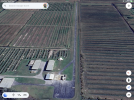
FD30 - Southeastern Aerial Crop Service - 2600x14 - 185.7 There is grass on either side of the asphalt, but those guys don’t use it.
IMG_1588.pngIMG_1590.png
 
Private field not far away. 3/4 of a mile by 3/4 of a mile.
Owner hates crosswinds.
One of the prettiest private airpark developments that I have ever seen is an approximately 3:4 ratio grass oval with a two lane access road / taxiway at grass height surrounding it. Ground level lights are outside this oval. All of the homes are set back from the oval on roads / taxiways that lead to the oval.
 
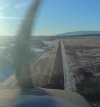
1N1 will keep you on your toes; especially with x-wind. 4830' x 30', ratio 161.
 

Attachments

  • 1N1.jpg
    1N1.jpg
    37 KB · Views: 10
Right, no runway needs to be longer than 1200 ft.
That was not my meaning. I'd need half that much in a Cub or twice as much in an Arrow.
1N1 will keep you on your toes; especially with x-wind. 4830' x 30', ratio 161.
Perhaps I am wrong. But I interpreted this to mean that the "runway aspect ratio" would keep a landing pilot on their toes. But the pilot only needs the amount of runway they need. The amount of superfluous asphalt between taxiways C and Z seems irrelevant to me.
 
11/29 at KCBE is 150x3000 for ratio 20. 5/23 there is just as wide but 5047 long. Ferrying home a Starduster with a (unknown to me) cracked landing gear I explored both edges of the runway. But I partially blame the downwind landing Cirrus I followed when I couldn't see a windsock and radio problems kept me from being able to hear the AWOS.
 
That clean 100 score seemed pretty normal to me. As does the parallel at 93 (7001x75).

Funny though - I always use it as an example of why I say, "don’t look at the far end of the runway in the flare" when I fly with someone who has landing issues.

Now that I occasionally flare airplanes again, I just close my eyes and hope for the best. They all tell me "I bet you'll do better next time" :)
 
Grass, landable in any direction used to be called an "Airdrome". The windsock was often in the center, and landing aircraft passed near the windsock. The definition has become fuzzy with that word useable for any landing facility.

Lindy landed at the Paris Airdrome.
While early airfields were grass and generally large (because airplane ground handling was crude with only tail skids and often no wheel brakes), that has nothing to do with the term. Aerodrome is the combination of Aero (in the air) and -drome, which is the Greek for course. It got used just like hippodrome for horse tracks, etc... In fact, in most senses -drome implies directionality.

It just fell out of favor for terms like airfield (still commonly the omnidirectional patches of grass) around WWI. The term runway comes from about the same time but was primarily for tracks for launching airships, etc... without wheels. By the time WWII came around, the sense is how we use it today.
1747033455760.png
 
UPDATE

Thinnest (higher score is thinner):
1. FD30 RW 9/27 - 2600 x 14 = 185.7
2. 78Y RW 17/35 - 2500 x 14 = 178.6
3. 1N1 RW 9/27 - 4830 x 30 = 161

Honorable mention (since it's the only "big airport" in this list so far)
5. APA RW 17L/35R - 10,001 x 100 = 100

Fattest (lower score is fatter):
1. CBE RW 11/29 - 3000 x 150 = 20*
2. 7FL6 RW 06/24 - 4002 x 176 = 22.7
3. RBD RW 17/35 - 3800 x 150 = 25.3

* CBE has about 500 feet of overruns which raises its "apparent" aspect ratio to 23.3
 
Grant County International (KMWH), officially 13,503 x 200 (67.5/1) but with the paved overruns measured on Google Earth, it's 15,500 x 200 (77.5/1). High but not close to other numbers posted here. It was a Space Shuttle alternate landing site.
 
I just remembered something... Did any of you ever fly out of X41 Tampa Bay exec?
Back in the late 1990's there was a little paved RC Club field more or less in-line with the runway and just a little East of it. That was an odd perspective but I can imagine some folks setting up for the wrong runway.
 
Cool! But I assume it's grass, or that's a lot of pavement.

Is it actually landable in any direction by "normal" airplanes? That must be a lot of work to maintain.
It's just a big square, pasture. He keeps it well maintained, and you can land in any direction.
Silly, sad story about it. He bought the property to operate a WWI era Nieuport 28 replica with a skid, not a tail wheel. Spent 9 years building the Nieuport, and flying ultralights off it while working on his dream plane.
Had a heart attack, lost his medical and ended up selling the Nieuport to some outfit in California?.
He is still flying ultralights off his patch.
 
Man, you guys sure know how to tempt a data nerd. And I already had the NFDC facilities files...

Highest aspect ratio in the data is "runway" 14/32 at Duval County Ranch Co., 28TA, near Freer, TX: 10,280x34 for an aspect ratio of 302.4! However, looking more closely at it, it appears to be more of a road than a runway. It connects to US 59 at the north end and there's a big sign arch over it at the threshold. There's a couple of what could be hangars a ways down, and then it looks like maybe there's another sign arch farther south. It's also marked as "Lloyd Bentsen Hwy" so I must say: Road, I've landed on runways. I know runways. Runways are friends of mine. Road, you're no Runway.

So, the highest aspect ratio runway that I can verify is still a runway is 7/25 at 99V Crawford County, CO which is listed as 4,900x20 for an aspect ratio of 245. This one is even weirder, though - It appears that the 20' width is only at the west end, and after a ways it widens out and the majority of the runway is more like 35' wide.

The one with the highest ratio that is the same width all the way along appears to be a glider-only runway 8G/26G at KBDU in Boulder, CO; 4,100x20 for a ratio of 205.

As far as I can tell, the fattest paved runway is at Buckingham Field, formerly Buckingham Army Air Field, FL59. The runways from the old Army airfield are gone, and the gigantic ramp now makes up the runways. Thus, runway 6/24 at 2,726x400 has an aspect ratio of 6.82 and is the fattest runway! https://www.google.com/maps/place/Buckingham+Field-Fl59/@26.638028,-81.7148815,897m/data=!3m1!1e3!4m6!3m5!1s0x88db6de0d59ace7d:0xe73fb60f5d3ca68a!8m2!3d26.6433658!4d-81.7088623!16s/m/04185b3?entry=ttu&g_ep=EgoyMDI1MDUxNS4wIKXMDSoASAFQAw==
 
Last edited:
I have a couple of entries into thicc/thin conversation, both are in western Washington.

Apex (8W5) is not only thin (88.96 2491 x 28 ft), you can't see the departure end of the rwy due to the, wait for it, apex in the field. The prohibited area just off the departure end of 35 and the noise abatement procedures make for an interesting ride in the "heat" of the summer.
Copalis State (S16) is on a beach which makes the width a weird view on final. Officially it is 3560 x 150 ft (23.73), but visually it is much thicker. Especially at low tide.

I highly recommend both.
 
Man, you guys sure know how to tempt a data nerd. And I already had the NFDC facilities files...

Highest aspect ratio in the data is "runway" 14/32 at Duval County Ranch Co., 28TA, near Freer, TX: 10,280x34 for an aspect ratio of 302.4! However, looking more closely at it, it appears to be more of a road than a runway. It connects to US 59 at the north end and there's a big sign arch over it at the threshold. There's a couple of what could be hangars a ways down, and then it looks like maybe there's another sign arch farther south. It's also marked as "Lloyd Bentsen Hwy" so I must say: Road, I've landed on runways. I know runways. Runways are friends of mine. Road, you're no Runway.

So, the highest aspect ratio runway that I can verify is still a runway is 7/25 at 99V Crawford County, CO which is listed as 4,900x20 for an aspect ratio of 245. This one is even weirder, though - It appears that the 20' width is only at the west end, and after a ways it widens out and the majority of the runway is more like 35' wide.

The one with the highest ratio that is the same width all the way along appears to be a glider-only runway 8G/26G at KBDU in Boulder, CO; 4,100x20 for a ratio of 205.

As far as I can tell, the fattest paved runway is at Buckingham Field, formerly Buckingham Army Air Field, FL59. The runways from the old Army airfield are gone, and the gigantic ramp now makes up the runways. Thus, runway 6/24 at 2,726x400 has an aspect ratio of 6.82 and is the fattest runway! https://www.google.com/maps/place/Buckingham+Field-Fl59/@26.638028,-81.7148815,897m/data=!3m1!1e3!4m6!3m5!1s0x88db6de0d59ace7d:0xe73fb60f5d3ca68a!8m2!3d26.6433658!4d-81.7088623!16s/m/04185b3?entry=ttu&g_ep=EgoyMDI1MDUxNS4wIKXMDSoASAFQAw==
That is exactly the kind of analysis I was hoping you'd come on to provide!
 
Back
Top