EVB RNAV 7

Richard Pinkowski

Filing Flight Plan
Joined
Oct 3, 2019
Messages
4
Display Name
DecathlonRich
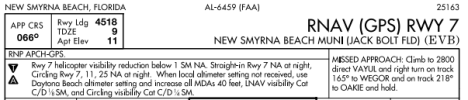
The following NOTAM is published for the RNAV 7 in New Smyrna Beach (EVB):
​
IAP NEW SMYRNA BEACH MUNI (JACK BOLT FLD), NEW SMYRNA BEACH, FL. RNAV (GPS) RWY 7, ORIG-C... CHANGE NOTE TO READ: STRAIGHT-IN RWY 7 NA AT NIGHT, CIRCLING RWY 7, 11, 20, 25 NA AT NIGHT. 2506101318-2706101318EST​
​
While flying in last night I asked for this approach and received a lot of apprehension from approach control. As such I simply cancelled and flew the approach VFR. I do not interpret this NOTAM as NA at night, I simply interpret this as Straight in and Circling NA at night. For example, flying in from the south and doing the turn at NINPE is not a straight in and, as such, not prohibited by the NOTAM.

Correct?
 

Attachments

If you're not using either the straight-in or circling minimums, what are you doing? Where you circling to 2, 20, or 29?
 
The following NOTAM is published for the RNAV 7 in New Smyrna Beach (EVB):
​
IAP NEW SMYRNA BEACH MUNI (JACK BOLT FLD), NEW SMYRNA BEACH, FL. RNAV (GPS) RWY 7, ORIG-C... CHANGE NOTE TO READ: STRAIGHT-IN RWY 7 NA AT NIGHT, CIRCLING RWY 7, 11, 20, 25 NA AT NIGHT. 2506101318-2706101318EST​
To be clear, the only thing different between that NOTAM and the published procedure is that RWY 20 has been added to the list of rwys that are NA for circling at night.
1763665300014.png
 
I do not interpret this NOTAM as NA at night, I simply interpret this as Straight in and Circling NA at night. For example, flying in from the south and doing the turn at NINPE is not a straight in and, as such, not prohibited by the NOTAM.
I interpret pretty much every (normal) IAP as a straight-in approach, unless you circle to land at the end. As opposed to entering the traffic pattern and flying a base-to-final approach. (Excluding weird ones like the river approaches to DCA, etc.)
 
IAP NEW SMYRNA BEACH MUNI (JACK BOLT FLD), NEW SMYRNA BEACH, FL. RNAV (GPS) RWY 7, ORIG-C... CHANGE NOTE TO READ: STRAIGHT-IN RWY 7 NA AT NIGHT, CIRCLING RWY 7, 11, 20, 25 NA AT NIGHT. 2506101318-2706101318EST​
​
I do not interpret this NOTAM as NA at night,
And yet, that is exactly what it means for rwys 7, 11, 20, and 25. It does not restrict circling to 2 or 29.
 
The following NOTAM is published for the RNAV 7 in New Smyrna Beach (EVB):
​
IAP NEW SMYRNA BEACH MUNI (JACK BOLT FLD), NEW SMYRNA BEACH, FL. RNAV (GPS) RWY 7, ORIG-C... CHANGE NOTE TO READ: STRAIGHT-IN RWY 7 NA AT NIGHT, CIRCLING RWY 7, 11, 20, 25 NA AT NIGHT. 2506101318-2706101318EST​
​
While flying in last night I asked for this approach and received a lot of apprehension from approach control. As such I simply cancelled and flew the approach VFR. I do not interpret this NOTAM as NA at night, I simply interpret this as Straight in and Circling NA at night. For example, flying in from the south and doing the turn at NINPE is not a straight in and, as such, not prohibited by the NOTAM.

Correct?
It’s about landing, not the Initial and Intermediate Approach Segments. The Original prohibited Rwys 7, 11 and 25. The Notam added 20 to that list. You can still Circle to 2 and 29.
 
Neither. I'm beginning the approach with a HILPT @ the IAF NINPE.
You are confusing this with getting Cleared for the Approach Straight in which means you don’t have to do a PT. Doing the Approach Straight in and landing straight in are different things
 
The following NOTAM is published for the RNAV 7 in New Smyrna Beach (EVB):
​
IAP NEW SMYRNA BEACH MUNI (JACK BOLT FLD), NEW SMYRNA BEACH, FL. RNAV (GPS) RWY 7, ORIG-C... CHANGE NOTE TO READ: STRAIGHT-IN RWY 7 NA AT NIGHT, CIRCLING RWY 7, 11, 20, 25 NA AT NIGHT. 2506101318-2706101318EST​
​
While flying in last night I asked for this approach and received a lot of apprehension from approach control. As such I simply cancelled and flew the approach VFR. I do not interpret this NOTAM as NA at night, I simply interpret this as Straight in and Circling NA at night. For example, flying in from the south and doing the turn at NINPE is not a straight in and, as such, not prohibited by the NOTAM.

Correct?

I think you have a serious misunderstanding of how instrument approaches work. Straight-in versus circling has nothing to do with how you approach the IAF. If you fly this approach and land without turning after the FAF, you are straight in and use the appropriate minimums. If you circle or enter the pattern, then you are circling, and you use those minimums.

The way this NOTAM reads is exactly what is says, No straight-in to 7 at night, no circling to 7,11,20, or 25 at night. That means you can only use this approach to circle to 2 or 29 at night.

Honestly the FAA should just NOTAM this approach NA at night all together to make things simple. There is obviously an obstruction or survey issue, and they probably just overlooked the 2 other runways not listed.
 
I interpret pretty much every (normal) IAP as a straight-in approach, unless you circle to land at the end. As opposed to entering the traffic pattern and flying a base-to-final approach. (Excluding weird ones like the river approaches to DCA, etc.)
It's not so much as to whether you land straight in or circle, but which line in the approach minima you are using. Some approaches have only circiling minima even when you are flying straight in. Some don't have circling minima but do have straight in (of various flavors sometimes ILS vs LOC or LPV, LNAV/VNAV, LNAV).
 
It's not so much as to whether you land straight in or circle, but which line in the approach minima you are using.
Well, the question the OP asked was essentially, "What does straight-in NA at night mean?" 1763668326870.png

Specifically, what makes the approach "straight in" such that it becomes NA? I don't think that has anything to do with minima.
 
Well, the question the OP asked was essentially, "What does straight-in NA at night mean?" View attachment 147358

Specifically, what makes the approach "straight in" such that it becomes NA? I don't think that has anything to do with minima.
It has everything to do with the minima. You don't have to circle if the straight in is NA, it just means that you can't use the MDA/Vis from the straight in minima line.
 
It has everything to do with the minima. You don't have to circle if the straight in is NA, it just means that you can't use the MDA/Vis from the straight in minima line.
OK, but the OP was arguing that he's "not flying straight in" because he's making the procedure turn at NINPE:
For example, flying in from the south and doing the turn at NINPE is not a straight in and, as such, not prohibited by the NOTAM.
 
The following NOTAM is published for the RNAV 7 in New Smyrna Beach (EVB):
​
IAP NEW SMYRNA BEACH MUNI (JACK BOLT FLD), NEW SMYRNA BEACH, FL. RNAV (GPS) RWY 7, ORIG-C... CHANGE NOTE TO READ: STRAIGHT-IN RWY 7 NA AT NIGHT, CIRCLING RWY 7, 11, 20, 25 NA AT NIGHT. 2506101318-2706101318EST​
​
While flying in last night I asked for this approach and received a lot of apprehension from approach control. As such I simply cancelled and flew the approach VFR. I do not interpret this NOTAM as NA at night, I simply interpret this as Straight in and Circling NA at night. For example, flying in from the south and doing the turn at NINPE is not a straight in and, as such, not prohibited by the NOTAM.

Correct?
So in your vocabulary, straight in means not performing a procedure turn, while circling means performing a procedure turn, and the FAA wants to require procedure turns only at night and only to certain runways? Does that seem logical?
 
I thought I understood this, but the more I dig the less it makes sense. Can't land straight on 7 (straight in NA at night) but also can't use circling mins (runway 7 plus some others NA circling at night.) So there's no circumstance where I can land on 7.
So as written, I can fly the approach, but only land on 2, 20 and 29 circle to land mins? Not sure why I would fly that approach at all if there's a ceiling to penetrate.
 
The following NOTAM is published for the RNAV 7 in New Smyrna Beach (EVB):
​
IAP NEW SMYRNA BEACH MUNI (JACK BOLT FLD), NEW SMYRNA BEACH, FL. RNAV (GPS) RWY 7, ORIG-C... CHANGE NOTE TO READ: STRAIGHT-IN RWY 7 NA AT NIGHT, CIRCLING RWY 7, 11, 20, 25 NA AT NIGHT. 2506101318-2706101318EST​
​
While flying in last night I asked for this approach and received a lot of apprehension from approach control. As such I simply cancelled and flew the approach VFR. I do not interpret this NOTAM as NA at night, I simply interpret this as Straight in and Circling NA at night. For example, flying in from the south and doing the turn at NINPE is not a straight in and, as such, not prohibited by the NOTAM.

Correct?
No. If it meant what you think it does, it would say, “straight-in RNAV approach N/A” or something to that effect. It would be an approach-referenced note, not a runway-referenced note.
 
I thought I understood this, but the more I dig the less it makes sense. Can't land straight on 7 (straight in NA at night) but also can't use circling mins (runway 7 plus some others NA circling at night.) So there's no circumstance where I can land on 7.
So as written, I can fly the approach, but only land on 2, 20 and 29 circle to land mins? Not sure why I would fly that approach at all if there's a ceiling to penetrate.
The NA at night restrictions are because of unlighted obstructions within the protected area. This approach has limited practicality at night due to those obstructions.
 
I thought I understood this, but the more I dig the less it makes sense. Can't land straight on 7 (straight in NA at night) but also can't use circling mins (runway 7 plus some others NA circling at night.) So there's no circumstance where I can land on 7.
So as written, I can fly the approach, but only land on 2, 20 and 29 circle to land mins? Not sure why I would fly that approach at all if there's a ceiling to penetrate.
So you could get down beneath it and land. Same reason to do any Approach.
 
For example, flying in from the south and doing the turn at NINPE is not a straight in and, as such, not prohibited by the NOTAM.

Correct?
No. There are "Straight-in approaches" and "Circling approaches". Then there is the often-used vernacular referring to not making a procedure turn. NOTAMS wouldn't refer to that sort of av-slang. IMO.
 
The NA at night restrictions are because of unlighted obstructions within the protected area. This approach has limited practicality at night due to those obstructions.
Rwy 2 has no lighting so not much practicality there. 29 has lights and a PAPI. There is an RNAV (GPS) RWY 29. But it takes you out over the ocean. Mins 500-1 or 1 3/8. The Cat A Circling Mins for the Rwy 7 Approach are 500-1. So there is some usefulness depending on the direction you arriving from and willingness to fly over water or not.
 
It's not so much as to whether you land straight in or circle, but which line in the approach minima you are using. Some approaches have only circiling minima even when you are flying straight in. Some don't have circling minima but do have straight in (of various flavors sometimes ILS vs LOC or LPV, LNAV/VNAV, LNAV).

Rwy 2 has no lighting so not much practicality there. 29 has lights and a PAPI. There is an RNAV (GPS) RWY 29. But it takes you out over the ocean. Mins 500-1 or 1 3/8. The Cat A Circling Mins for the Rwy 7 Approach are 500-1. So there is some usefulness depending on the direction you arriving from and willingness to fly over water or not.
Thanks for the replies everyone. 5500 hrs and 38 years in the rearview mirror and I am still humbled at times. This was an easy flight, no weather, but challenges seem to find their way into the cockpit.

The reality of the situation is that I am flying into a strange airport at night and I will never do so without lateral guidance and, preferably, vertical guidance as well. Generally this applies to day time approaches as well regardless of weather but this rule gets bent frequently. EVB was departing 2, landing 7. I pick up ATIS 60 miles out which, at my speed, was <20 minutes. I had expected and previously briefed RNAV 2 but decided to take 7 which was the advertised landing runway. Quickly scanning the notes and NOTAMS I was left scratching my head while ATC (DAB) was giving me vectors for the visual 7. At 15 miles out and doing 3 miles / minute over the ground I could not see the airport in the sea of lights so, as is my normal procedure, I plan to set up for a 5 mile final (assuming we are VMC), as such I ask for the RNAV 7 via the HILPT at the IAF. Realizing that I may have misinterpreted the NOTAM and note I simply cancelled IFR and setup outside the RNAV 7 FAF and flew the approach as published. Certainly safer than the visual without any guidance. The alternative would be to fly the RNAV 7 and circle to land 2, but that seems pointless and may not have been granted (and I was still not sure that I hadn't missed something in the notes and NOTAMS).
 
Quickly scanning the notes and NOTAMS I was left scratching my head...
Me too, since there are no sectors restricted from circling, all six circling approaches use the same protected area. Four of them, though, are "NA". So, I guess, the airport is semi-surrounded by tall, unlit palmetto palms in the circling visual area? :dunno:
 
You do understand that the reason for the note is that the final approach course isn’t protected like it should be, right?
Nope, not at all. Definitely do not understand anything about the notes or NOTAMS.
They are landing 7, giving visual approaches to 7, I can fly the RNAV 7 to circling minimums and then circle to 2, but I can't continue and land on 7. Does anyone here understand this?

I suppose this is too much for my simple noggin to comprehend. If I were IMC and needed to really fly the approach I would have had a conversation with approach to discuss my options and / or divert to DAB. I've got Miami Bravo on my tail, Orlando Bravo off my left wing, SpaceX trying to launch a rocket off of my right wing, surrounded by restricted areas, immersed in the world's busiest training ground, and an airplane to fly. Trying to decipher confusing NOTAMS, notes, and planning an approach without much notice makes for a busy time.

There are times in the cockpit, regardless of the automation, that there is too much to try to weed through with a 100% conviction that I've got it all.
 
Nope, not at all. Definitely do not understand anything about the notes or NOTAMS.
Ok. So this particular note means that if you fly the approach as published there are obstructions that are not properly accounted for, and can be a hazard on a straight-in to runway 7 or a circle to land to the runways listed in the note.

By canceling IFR and flying the final approach segment “as published,” you chose to fly what would be an uncertifiable approach, thereby decreasing safety when you thought you were increasing it.
 
Last edited:
Does anyone here understand this?
It is based on the TERPS requirements which are what keeps our approaches safe to fly.

There are multiple levels of understanding. You don't have to understand, or even know, TERPS to safely fly IFR. You only have to understand the rules and comply with them.

I have some understanding of typical TERPS requirements but not enough to know the specific requirements that are causing the limits to that approach. From what I understand, the circling limitations are likely due to unlighted obstructions which penetrate the protected area. During daylight hours, TERPS allows those to be avoided visually. At night, it does not. The limitation on the straight-in to 7 may be due to descent gradient being too steep from the circling MDA to the touchdown zone at the published visibility minimums. Someone with more specific knowledge of TERPS could give a more specific answer.

I think the main confusion was in reading the straight-in restriction as applying to the holding pattern/course reversal. I think it's been cleared up that the restriction is based on the straight-in or circling MDA and visibility minimums.
 
There are only two unlit obstruction NOTAMs. Both are miles away from the airport. Hard to understand how an obstruction that would require a circle to a different runway would not be NOTAMed for night VFR flight
 
There are only two unlit obstruction NOTAMs. Both are miles away from the airport. Hard to understand how an obstruction that would require a circle to a different runway would not be NOTAMed for night VFR flight
NOTAMS are normally for temporary conditions. By the time an obstruction becomes a note in an app approach it’s assumed to be permanent.
 
There are only two unlit obstruction NOTAMs. Both are miles away from the airport. Hard to understand how an obstruction that would require a circle to a different runway would not be NOTAMed for night VFR flight
Yet the restriction exists. Either find a TERPS expert, who can look up the details, or talk to the airport manager.

Curiosity is good. The more you learn, the better you understand the environment in which we fly. What we can't do is assume that we know better than the TERPS and disregard published restrictions. Not understanding the reason for a restriction does not mean that the restriction is not valid.

If the restriction is unneeded, the airport manager would be the person to start the process of having it removed.
 
Curiosity is good. The more you learn, the better you understand the environment in which we fly. What we can't do is assume that we know better than the TERPS and disregard published restrictions. Not understanding the reason for a restriction does not mean that the restriction is not valid.
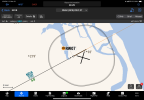
Since you quoted me, that's why I engage on threads like this even though I'm far from an expert. Obviously would comply, but like to understand the reason why. The "obstruction" that showed up on Smart Charts above is the Tower. Doubt that's unlit at night :). Maybe I'll fly down there as I'm only about 40 miles north and see if I can see something that might explain it.
I do appreciate when those that know their stuff participate and put up with endless questions from guys like me.
 
Hello all, figured I'd speak up here. As many of you know, I was a TERPS specialist for about 10 years.

- The Straight-in/circling remark has nothing to do with whether you do a HILPT or not.

- "NA at night" for either straight or circling mostly has to do with unlit obstacles (almost always trees, although it can be anything - even traffic on nearby roads, and no, headlights do not count as "obstruction lights") near the extended centerline for the respective runway. NOT throughout the entire circling area. This is why you see individual runways called out. In this example, runways 7, 11, 20 and 25 have some unlit obstacles along their extended centerlines. Runways 2 and 29 do not.

- This protected area along centerline extends out 10,000 feet from the threshold for circling runways and out to the DA point or VDP for the straight-in runway. It also gets wider as you get further from threshold (so, like a funnel down to the runway). It rises at a 20:1 slope from the runway. Details in the 8260.3G as quoted previously.

- These are not unaccounted-for obstacles, they are absolutely accounted for, that's why the procedure is NA at night. They are simply not being removed or lit for whatever reason, but that's usually a local-government/airport owner/land-use issue.

- In the example approach, there appear to be trees off the ends of several of the runways, and on the other ones the road itself (or obstructions along it) may be the offending obstacles. For the two runways that ARE allowed at night, runway 2 has a large displaced threshold, which likely means that no obstacles penetrate this visual surface, and runway 29 seems to have a good distance between it and the road/trees.

- Now, Runway 2 has no lights. While I was in TERPS, the policy on this changed a couple of times whether we should put the note "NA at night" for a runway without lights or not, the discussion mostly being around 1) there not being anything in the 8260.3 that says "prohibit landing at night to unlit runways" and 2) it might not be necessary anyway, if the pilot can't see it, they aren't going to land there, and 3) if the pilot does want to land on an unlit runway, that's a pilot issue, not a TERPS issue. I can't tell you what the current policy is, but from this NOTAM, it appears that the current policy is to not prohibit landing at night just because a runway is unlit.

- So in effect, at night this procedure is only usable for circling to runway 29. That doesn't make it completely useless or pointless, just of very limited usefulness. It's easy to construct a scenario where someone might want to do exactly that.

- "Unlit obstruction" NOTAMS are for those obstacles that are normally lit but the light is temporarily out of service. It's not for the dozens/hundreds of trees that surround many airports.

- If you want to cancel and proceed VFR, that is fine but you are unprotected by TERPS. We are allowed much more latitude operating VFR than IFR, because the burden of safety switches from the government to the individual. Your source for obstacle information then becomes the AFD portion of the Chart Supp, which for this airport lists multiple obstacles for multiple runways. However, if you stay on the PAPI (for those runways that have one) you should clear all obstacles (it's a certification requirement for PAPIs and VASIs (and the other rare VGSI types)).
 
Last edited:
@RussR Thanks - really have a better understanding now. Appreciate you taking the time.
 
Ok, another question…

I was kinda under the impression RNAV 7 landing 7 is a straight in. RNAV 7 landing anything other than 7 is circling.

I’ve seen VOR A with nothing but circling mins, which jives in my tiny brain… not really lined up with anything.

Is RNAV 7 circling 7 a thing? Apparently NOTAMed out, but still.

While typically you would land straight-in on runway 7 if you flew that approach, you are permitted to descend down to the Circling MDA, and then maneuver to land on runway 7. The most likely way of doing this would be to overfly the runway at the Circling MDA, then make a modified traffic pattern back around to line up for final again for runway 7. As long as you stay within the protected circling area for your category, you're okay. Obviously the number of scenarios where this would make sense is pretty small, but it's an option. I don't know, you start your descent late (or don't descend quickly enough) and find you're going to be too close to the runway and too high once you do see it, so instead of making a missed approach, you just descend to the Circling MDA and almost literally "circle" back to land.

Perhaps not the most recommended solution, but a legal option.
 
- Now, Runway 2 has no lights. While I was in TERPS, the policy on this changed a couple of times whether we should put the note "NA at night" for a runway without lights or not, the discussion mostly being around 1) there not being anything in the 8260.3 that says "prohibit landing at night to unlit runways" and 2) it might not be necessary anyway, if the pilot can't see it, they aren't going to land there, and 3) if the pilot does want to land on an unlit runway, that's a pilot issue, not a TERPS issue. I can't tell you what the current policy is, but from this NOTAM, it appears that the current policy is to not prohibit landing at night just because a runway is unlit.
- So in effect, at night this procedure is only usable for circling to runway 29. That doesn't make it completely useless or pointless, just of very limited usefulness. It's easy to construct a scenario where someone might want to do exactly that.

I'm not sure if it applies or is relevant, but I know our airport has a new RNAV/GPS approach NOTAMed NA at night because the runway lights have not been officially flight checked and commissioned, despite the runway being lit for decades. Our existing approaches are grandfathered, but they will not remove the NA at night for the new approach until the flight check is paid for and completed.
 
Is RNAV 7 circling 7 a thing? Apparently NOTAMed out, but still.
Like Russ said, it’s a strange case, but I’ve done it once. NDB approach, I think it was Watertown, Wisconsin. It had snowed overnight, everything was white, including the plowed runway. I was below the clouds in good visibility, but was almost over the airport before I could pick out the runway. Circling mins were the same as straight-in, so I circled to the same runway.

It was actually my second attempt at the approach, since I couldn’t spot the runway the first time, and when I got below the clouds I used a sectional chart to figure out exactly where to look for the runway.
 
Back
Top