Departing IFR At Uncontrolled Airport - When To Turn With No Instructions

First, comply with 14 CFR 91.126 & .127.

If you are filing an airway then join the airway. If point-to-point, direct to the first fix which shouldn't be significantly different unless that first fix is in the opposite direction of your route of flight. i.e. don't backtrack.
 
I found this post and group after a web search for the following question.

You are departing a nontowered airport with no DP, so diverse departure procedures apply. ATC clears you as filed. You takeoff, climb past 400’ above DER and turn …

A) -D-> your first fix, or
B) to an intercept of the course from the airport you just departed from to that first fix

I cannot find the answer in the IFH, IPH or the AIM. Reason I care is because I used the method I always used and got barked at by the first controller I checked in with.
Where was that?
 
First, comply with 14 CFR 91.126 & .127.

If you are filing an airway then join the airway. If point-to-point, direct to the first fix which shouldn't be significantly different unless that first fix is in the opposite direction of your route of flight. i.e. don't backtrack.
Commonly practiced. But this is the only guidance I can find. Am I reading correctly that when one files KABC -D-> DEFGH -D-> IJKLM (etc) that we should be flying the route that is directly between KABC & DEFGH?

91.181 Course to be flown.

Unless otherwise authorized by ATC, no person may operate an aircraft within controlled airspace under IFR except as follows:

(a) On an ATS route, along the centerline of that airway.

(b) On any other route, along the direct course between the navigational aids or fixes defining that route. However, this section does not prohibit maneuvering the aircraft to pass well clear of other air traffic or the maneuvering of the aircraft in VFR conditions to clear the intended flight path both before and during climb or descent.
 
Ok. I was wondering if it was in a Surface Area. What did you file and what was the Clearance you got?
IIRC it was pretty simple: KVDI AHN KBNA, and the clearance was a simple “as filed”. I was reprimanded for intercepting the course between KVDI to AHN. The controller was pretty irate and said he hated it when pilots did that. I couldn’t remember the reg at the time and have been frustrated by the lack of guidance in the handbooks & AIM.
 
Commonly practiced. But this is the only guidance I can find. Am I reading correctly that when one files KABC -D-> DEFGH -D-> IJKLM (etc) that we should be flying the route that is directly between KABC & DEFGH?
You'll need to be more specific.

On course means on coarse. Join your route or proceed to the first fix. A controller will not expect a turn away from your course.

i.e. First fix is 5nm west of the airport, second fix is 40nm east. They will not expect you to turn to the west, cross the first fix then make a nearly 180 degree turn to fly back to the east. They will expect you to climb to 400', comply with any traffic pattern procedures that apply, then proceed direct to the fix 40nm east of the airport. If, instead, you filed an airway between those two fixes, turn to join the airway on your way to the fix to the east.

What exactly happened when the controller complained?
If the plane was cleared via that fix 5 west it must go to it. Pilots can’t just ignore the clearance and make up their own shortcuts.
 
If the plane was cleared via that fix 5 west it must go to it. Pilots can’t just ignore the clearance and make up their own shortcuts.
Sure, but he was cleared "on course". ATC isn't going to be expecting him to go in the direction of his course, not the opposite direction.

Should be no reason to file over a fix on the opposite side of your departure airport unless you're filing an airways. In that case, after an "on course" clearance, ATC will expect you to join the airway, not backtrack to the fix.

He left out the details so it's impossible to tell the context.
It was elsewhere in this thread but I’ll put it here to.

The course was simple: KVDI AHN KBNA. After leaving the pattern using the proper methods I turned to intercept the KVDI-AHN leg then called center. After radar contact he asked where I was going and I told him. He grew pretty irate, told me to go direct AHN then added that he hated when pilots did “that”. That being intercepting the course when he was expecting me to fly direct AHN after leaving the pattern.

There was no “enter controlled airspace on heading x°” or “radar contact proceed direct AHN”, just the simple cleared as filed when I called for clearance in the ground.
 
Sure, but he was cleared "on course". ATC isn't going to be expecting him to go in the direction of his course, not the opposite direction.

Should be no reason to file over a fix on the opposite side of your departure airport unless you're filing an airways. In that case, after an "on course" clearance, ATC will expect you to join the airway, not backtrack to the fix.

He left out the details so it's impossible to tell the context.
I don’t see where he said he was cleared on course, just that he was cleared as filed. Yeah, I hope he can come back with exactly what he filed and exactly what his clearance was. But he wasn’t sure of the airport it happened at, so…
 
I have been in a few discussions on the subject but so far have never seen any guidance mandating a turn at precisely 400 AGL, not even from those who insisted it was some kind of requirement.
The recommendation is not TO turn, but Do Not Turn Until you reached at least 400ft. (Assuming no other tall obstacles.)

AIM 5-2-9(e)(1) "Unless specified otherwise, required obstacle clearance for all departures, including diverse, is based on the pilot crossing the departure end of the runway at least 35 feet above the departure end of runway elevation, climbing to 400 feet above the departure end of runway elevation before making the initial turn..."

Same wording in FAA-H-8083-16B; Chapter 1 Departure Procedures, but I don't see it in latest versions of FAA-H-8083.
 
Last edited:
The recommendation is not TO turn, but Do Not Turn Until you reached at least 400ft. (Assuming no other tall obstacles.)

AIM 5-2-9(e)(1) "Unless specified otherwise, required obstacle clearance for all departures, including diverse, is based on the pilot crossing the departure end of the runway at least 35 feet above the departure end of runway elevation, climbing to 400 feet above the departure end of runway elevation before making the initial turn..."
Yeah. I think what @OngoingFreedom did was treat the airport as if it was Fix. Look at (b) in his post #44 above. After doing his initial maneuvering after departure I think he maneuvered over to get on a ‘centerline’ between the airport and the first fix.
 
The course was simple: KVDI AHN KBNA.
There was no “enter controlled airspace on heading x°” or “radar contact proceed direct AHN”, just the simple cleared as filed when I called for clearance in the ground.
He was expecting a track in the directly of AHN. Your intercept heading would have looked very different than that.

He shouldn't have snapped at you like that. What you did is a reasonable interpretation of your filed route. If he needed to ensure that you went direct AHN then he should have included that in your clearance. Your filed route, though, was "direct" which doesn't really include a "from" point. There's no real reason to navigate pack to the point-to-point route in this case. Maybe if it were necessary for terrain or airspace avoidance. In mountainous terrain your route would likely have been on an airway and then an intercept heading would have been appropriate and expected.
I get that, and it seems that most others interpret it as you do. I don’t see any guidance that the departure airport is not nor cannot be a “From” fix. Destination airports are often treated as a “To” fix so why is there a difference? At the moment that will have to sit as a rhetorical question.

Maybe I’ll have to dig into the 7110.65.
 
If the plane was cleared via that fix 5 west it must go to it. Pilots can’t just ignore the clearance and make up their own shortcuts.
I agree. He may have a good reason for that fix being first if that's how he filed, so who is ATC to second guess it and "expect" something different?
EDIT: But be careful what you ask for.
 
I could understand if you were turning back to KVDI and then proceed to KAHN. That would be unexpected. But intercepting the course between the two is common. He didn’t give you “proceed direct Athens” you should be intercepting the course in between. Sounds like a controller overreacting to me.
 
It was elsewhere in this thread but I’ll put it here to.

The course was simple: KVDI AHN KBNA. After leaving the pattern using the proper methods I turned to intercept the KVDI-AHN leg then called center. After radar contact he asked where I was going and I told him. He grew pretty irate, told me to go direct AHN then added that he hated when pilots did “that”. That being intercepting the course when he was expecting me to fly direct AHN after leaving the pattern.

There was no “enter controlled airspace on heading x°” or “radar contact proceed direct AHN”, just the simple cleared as filed when I called for clearance in the ground.
I’m looking at the route and I’m completely confused.

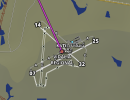
A normal traffic pattern is going to keep someone within 1-1.5 miles from the edges of the runway used. Even with the multiple runways at VDI, that’s a pretty finite distance from the center of the runway complex. Even in the worst case - a takeoff on 25 and flying a left downwind/base departure instead of making a right turn, I don’t see any significant difference between a typical 30° intercept of the direct line to AHN from the center of the runway complex and direct AHN from one of the pattern legs. “Where are you going?” makes no sense to me unless at the time you checked in, you were heading in a completely different direction.

I’m missing something. I wonder what the ADS-B track would show.

1762087533520.png
 
Last edited:
KVDI AHN KBNA is a random RNAV point to point route. Random RNAV point to point routes are defined by the course between the points and are not direct-to (aka RNAV random impromptu) routes which are either assigned by ATC or requested by the pilot. The altitude assigned by ATC for a RNAV point to point route must be at or above the MIA including +/- 4 NM either side of the center line of the route. If ATC wants you on a direct route, they can assign it, but if you are cleared as filed, then you fly the filed route and maneuvering after departure to join the center line of the route is compliant with the clearance and 91.177 and 91.181. The controller should re-read 7110.65 4-4-1 (c.) and refresh his knowledge of the regulations.
 
KVDI AHN KBNA is a random RNAV point to point route. Random RNAV point to point routes are defined by the course between the points and are not direct-to (aka RNAV random impromptu) routes which are either assigned by ATC or requested by the pilot. The altitude assigned by ATC for a RNAV point to point route must be at or above the MIA including +/- 4 NM either side of the center line of the route. If ATC wants you on a direct route, they can assign it, but if you are cleared as filed, then you fly the filed route and maneuvering after departure to join the center line of the route is compliant with the clearance and 91.177 and 91.181. The controller should re-read 7110.65 4-4-1 (c.) and refresh his knowledge of the regulations.
..which, aside from being spatially almost irrelevant no matter how one reads it, is one of the reasons I don't understand the post saying the controller complained about intercepting that point-to-point route or the "where are you going?" question, unless @OngoingFreedom was pointed somewhere weird.

I'm using ONYON as a reference because it is 4 NM NE of VDI, well outside the "normal" traffic pattern, so it's kind of a worst case scenario.

• The point to point course would put the aircraft on a 342° course; Direct from ONYON on a 340° course, a whole 2° at it's worst.​
• A 30° intercept to the point to point course would be 312° which closes with the point-to-point course a whole 7 NM north of VDI, with the airplane obviously moving in that direction.​
​
No matter how I look at it, there's a piece of this missing. It might be the controller; it might be the pilot; or it might be our typically poor albeit honest recollection of events after the fact.
 
KVDI AHN KBNA is a random RNAV point to point route. Random RNAV point to point routes are defined by the course between the points and are not direct-to (aka RNAV random impromptu) routes which are either assigned by ATC or requested by the pilot. The altitude assigned by ATC for a RNAV point to point route must be at or above the MIA including +/- 4 NM either side of the center line of the route. If ATC wants you on a direct route, they can assign it, but if you are cleared as filed, then you fly the filed route and maneuvering after departure to join the center line of the route is compliant with the clearance and 91.177 and 91.181. The controller should re-read 7110.65 4-4-1 (c.) and refresh his knowledge of the regulations.
KVDI is not an element of the Route. It is the Departure Aerodrome. Box 13 7233-4. Route is box 15. The Route in this scenario begins at AHN.
 
I agree. He may have a good reason for that fix being first if that's how he filed, so who is ATC to second guess it and "expect" something different?
EDIT: But be careful what you ask for.
Be very careful…
 
I could understand if you were turning back to KVDI and then proceed to KAHN. That would be unexpected. But intercepting the course between the two is common. He didn’t give you “proceed direct Athens” you should be intercepting the course in between. Sounds like a controller overreacting to me.
I don’t think he should be intercepting a course between the departure airport and the first fix on the route but let’s set that aside for a bit. If going with the you should do that camp, then where should you intercept? Say about halfway between KVDI and AHN? Closer? Farther? It sounds like this Controller has maybe seen pilots return to a point over KVDI to begin that ‘leg’ of the flight. Maybe even seen some do it from the North and treat it as ‘fly over’ waypoint. I’ll forgive him if he’d seen it just one time to many and the straw finally broke the camels back.
 
I don’t think he should be intercepting a course between the departure airport and the first fix on the route but let’s set that aside for a bit. If going with the you should do that camp, then where should you intercept? Say about halfway between KVDI and AHN? Closer? Farther? It sounds like this Controller has maybe seen pilots return to a point over KVDI to begin that ‘leg’ of the flight. Maybe even seen some do it from the North and treat it as ‘fly over’ waypoint. I’ll forgive him if he’d seen it just one time to many and the straw finally broke the camels back.
Even more reason to think something is missing.
 
I don’t think he should be intercepting a course between the departure airport and the first fix on the route but let’s set that aside for a bit. If going with the you should do that camp, then where should you intercept? Say about halfway between KVDI and AHN? Closer? Farther? It sounds like this Controller has maybe seen pilots return to a point over KVDI to begin that ‘leg’ of the flight. Maybe even seen some do it from the North and treat it as ‘fly over’ waypoint. I’ll forgive him if he’d seen it just one time to many and the straw finally broke the camels back.
There’s no specific distance or angle to intercept along a direct route with no fix in between.

I don’t think the controller expected or wanted him to go back to KVDI and then continue. Don’t think he even wanted him intercepting a course in between. I believe the opposite. He wanted him direct KAHN from where he established radar contact.
 
ATC clears you as filed.

I don’t see any guidance that the departure airport is not nor cannot be a “From” fix.
Because the PIC has responsibility for obstacle clearance and can choose when to proceed to the first fix. Hint: It ain't necessarily "When entering controlled airspace." You should be on a published route, though, within 25 NM (46 in designated mountainous areas) because the diverse area ends there. If not, hopefully you did your homework beyond that point.
Destination airports are often treated as a “To” fix so why is there a difference?
Personally, I never considered myself obligated to go direct to the landing site from anyplace. Lost comm procedures were designed long before there was a means even to do it. So, I would say the last fix you put in the route box is the place you plan to turn toward the IAF you will use.
 
I get that, and it seems that most others interpret it as you do. I don’t see any guidance that the departure airport is not nor cannot be a “From” fix. Destination airports are often treated as a “To” fix so why is there a difference? At the moment that will have to sit as a rhetorical question.

Maybe I’ll have to dig into the 7110.65.
I'm not sure you'll find anything. IFR flying isn't computer code with a precise definition for everything. Some things, yes. Everything, no.

The controller saw a ground track that was nowhere near direct to AHN. That is what got his attention. He was expecting you to takeoff then turn direct to the fix to which you filed via direct. He did not expect you to turn to intercept the course from the airport reference point to AHN. If you were filed/cleared via an airway he would have expected the intercept.

You quoted the regulation about the courses to be flown that that did not define the starting point. Is the starting point the ARP or is it your present position when you turn direct to the fix? I don't think you'll find that defined anywhere.

You said that the controller said something like, "I hate it when pilots do that", which indicates to me that he understood your explanation but it was different than he had expected.
 
You said that the controller said something like, "I hate it when pilots do that", which indicates to me that he understood your explanation but it was different than he had expected.
I'm thinking AHN slipped by him and the controller was miffed at himself that he missed it. Probably thought the pilot wanted direct BNA.
 
There’s no specific distance or angle to intercept along a direct route with no fix in between.

I don’t think the controller expected or wanted him to go back to KVDI and then continue. Don’t think he even wanted him intercepting a course in between. I believe the opposite. He wanted him direct KAHN from where he established radar contact.
Pilot doesn’t need to be Radar Identified to start his turns. I wonder where he was when the Controller first got a Radar return and identified him. Was it low enough that he was able to watch the whole ‘journey.’ Or did he first show up already on his way back towards the airport, or even past it, if that’s what he did. @OngoingFreedom ? What exactly did you do?
 
I took off from either 7 or 25 (I think it was Rwy 7), exited the pattern then turned to a 30-45° intercept to the course from KVDI-AHN which would have happened around five miles or so from the departure airport.

He expected me to proceed direct AHN (approx 340° if off 7) and my intercept would have been closer to 300° (again if off 7).
 
KVDI AHN KBNA is a random RNAV point to point route. Random RNAV point to point routes are defined by the course between the points and are not direct-to (aka RNAV random impromptu) routes which are either assigned by ATC or requested by the pilot. The altitude assigned by ATC for a RNAV point to point route must be at or above the MIA including +/- 4 NM either side of the center line of the route. If ATC wants you on a direct route, they can assign it, but if you are cleared as filed, then you fly the filed route and maneuvering after departure to join the center line of the route is compliant with the clearance and 91.177 and 91.181. The controller should re-read 7110.65 4-4-1 (c.) and refresh his knowledge of the regulations.
Thanks for the bible point out, I’ll look it up.
 
Pilot doesn’t need to be Radar Identified to start his turns. I wonder where he was when the Controller first got a Radar return and identified him. Was it low enough that he was able to watch the whole ‘journey.’ Or did he first show up already on his way back towards the airport, or even past it, if that’s what he did. @OngoingFreedom ? What exactly did you do?
The airplane I was flying is pretty high performance so it usually doesn’t take long to show up on radar. He could see me within about a minute or two after departure and before I finished the intercept.
 
I don’t think the controller expected or wanted him to go back to KVDI and then continue. Don’t think he even wanted him intercepting a course in between. I believe the opposite. He wanted him direct KAHN from where he established radar contact.
Bottom line, we don't know where he was or the direction he was going when radar contact was made or whether the controller said anything at that point other than "radar contact X miles from Vedalia. Where are you going?"

I can definitely agree with you that the controller was not expecting him to go back to the airport before proceeding enroute. I would expect that to generate a "what the heck?"

This kind of strikes me as similar to "resume own navigation" after receiving vectors. Plenty of people argue about that one. No controller would expect a 90° turn to return to the course but apparently there are those who think that's the way to do it (I recall at least one of the Opposing Bases podcasts talking about it) I'd definitely expect a "WTH" for that. But there may be wiggle room between whether you go direct to the next waypoint or do a normal 30° interception wherever that may lead you, but that distinction is often inconsequential.
 
Pilot doesn’t need to be Radar Identified to start his turns. I wonder where he was when the Controller first got a Radar return and identified him. Was it low enough that he was able to watch the whole ‘journey.’ Or did he first show up already on his way back towards the airport, or even past it, if that’s what he did. @OngoingFreedom ? What exactly did you do?
Didn’t say he had to be in radar to turn. Just saying that after radar, obviously the controller didn’t like the direction he was going.

Honestly it seems the controller wasn’t enough hands on. With no “when entering controlled airspace, fly heading..” and no “radar contact, fly heading..” don’t complain when things don’t go as expected. Personally, out of habit I always sent the aircraft direct their next fix when I got radar. Resolves any confusion on where the aircraft is going.
 
The airplane I was flying is pretty high performance so it usually doesn’t take long to show up on radar. He could see me within about a minute or two after departure and before I finished the intercept.
Ok. So you did do the intercept thing and not the go back to overhead the airport thing. About where you planning on the intercept to happen? How close to KVDI and at about what angle?
 
Ok. So you did do the intercept thing and not the go back to overhead the airport thing. About where you planning on the intercept to happen? How close to KVDI and at about what angle?
I believe I departed on the left 45° method and turned to intercept after passing 2,000’ AGL. Definitely less than five miles.

I don’t remember the intercept angle but it would have been 30-45°. Had I continued the intercept I would have been 5-10 miles from the airport.
 
I believe I departed on the left 45° method and turned to intercept after passing 2,000’ AGL. Definitely less than five miles.

I don’t remember the intercept angle but it would have been 30-45°. Had I continued the intercept I would have been 5-10 miles from the airport.
Sounds like a Rwy 7 departure. Anyway, welcome to POA. I found it the same way you did, searching for something and it came up in the results.
 
Plenty of people argue about that one. No controller would expect a 90° turn to return to the course but apparently there are those who think that's the way to do it
This could really start a good debate!! :D Personally, it depends upon how far off my course and how far to the next Wpt. 99% of the time the Wpt is quite a ways away, so I don't even bother to hit Direct. I just put it in the heading mode and sort of slowly drift back towards my "Magenta Line."

For some of you out there reading this, I know that's hard to hear, but NO, I don't actually fly ONLY on the Magenta Line. :cool: And WHY? you might ask? No particular reason, but as I just said, I don't HAVE to be going from one Wpt to another Wpt. So slowly heading a degree or two toward my original course is not going to change my time, so why not. Guess it's something I picked up from the RNAV days when you couldn't just hit "Direct" and have a new line. (Assuming you're not low in the mountains, etc.)
 
I found this post and group after a web search for the following question.

You are departing a nontowered airport with no DP, so diverse departure procedures apply. ATC clears you as filed. You takeoff, climb past 400’ above DER and turn …

A) -D-> your first fix, or
B) to an intercept of the course from the airport you just departed from to that first fix

I cannot find the answer in the IFH, IPH or the AIM. Reason I care is because I used the method I always used and got barked at by the first controller I checked in with.
Theoretically, if you consider the departure airport as part of the "route", then 91.181(b) says you should intercept the course.

However, I have not met a single controller who actually expects that. They are expecting you to take off in whatever direction, climb to at least 400 feet (assuming no ODP), and then make a turn direct to the first fix on the route.

..which, aside from being spatially almost irrelevant no matter how one reads it, is one of the reasons I don't understand the post saying the controller complained about intercepting that point-to-point route or the "where are you going?" question, unless @OngoingFreedom was pointed somewhere weird.

I'm using ONYON as a reference because it is 4 NM NE of VDI, well outside the "normal" traffic pattern, so it's kind of a worst case scenario.

• The point to point course would put the aircraft on a 342° course; Direct from ONYON on a 340° course, a whole 2° at it's worst.​
• A 30° intercept to the point to point course would be 312° which closes with the point-to-point course a whole 7 NM north of VDI, with the airplane obviously moving in that direction.​
​
No matter how I look at it, there's a piece of this missing. It might be the controller; it might be the pilot; or it might be our typically poor albeit honest recollection of events after the fact.
I think it's the controller not liking aircraft to be making unexpected 30º turns, and is just as simple as that.

One of the few times I've ever had to exercise captain authority in terms of shutting down my FO was in this sort of scenario, only it was even worse to me: First fix on route was "XYZ", ATC had us on a departure vector, ATC asked us what our course to XYZ was, and then said "resume own navigation". FO wanted to go back to the course from the airport to XYZ even though the controller asked what our course to XYZ was, so he'd obviously (to me, anyway) be expecting us to turn to the course we just gave him. But, FO was a VERY experienced instructor, with more than double (closer to triple!) my total logged time just in dual given, so he was used to the "book" answer, when the real world answer is different.

This is one of those things that really drives me nuts about the FAA - There's often a reg or AIM procedure that made sense back in the VOR days that just doesn't make sense today, and nobody does it any more, but their docs still say that it's how you're supposed to do things. They need an overhaul. It's been nearly 30 years.
 
ATC had us on a departure vector, ATC asked us what our course to XYZ was, and then said "resume own navigation". FO wanted to go back to the course from the airport to XYZ even though the controller asked what our course to XYZ was...
Asked "was", not "is". I agree with the FO. Controller should have said "Cleared direct XYZ, resume own navigation." IMO.
 
Back
Top