
hindsight2020
Final Approach
20/20 hindsight is not helpful at the time that the decision has to be made.


20/20 hindsight is not helpful at the time that the decision has to be made.
At least he didn’t use your middle name like your mom does.

I don’t think Adsb would have made a difference.

Oh there’s still helo flights. It’s just more restrictive on which type of helo flights can enter. Also when those helo flights are in the area depicted, no other civ fixed wing can’t be in the area as well.
The check pilot for one. If you're 150 feet high and heading under a landing path I'd be telling the pilot to get their altitude down. ATC for another. Hey PAT25 emergency decent to 200 and halt forward motion.Who ignored it?

JFK goes down to 1, or at least they did when my flight to Paris was delayed until 2am a few weeks ago.I highly doubt ORD tower goes down to one controller at night but I could ask. There are at least 3 controllers there that I trained many years ago
How do you know he wasn’t?The check pilot for one. If you're 150 feet high and heading under a landing path I'd be telling the pilot to get their altitude down.
ATC verified visual separation with the helicopter 8 seconds before impact.ATC for another. Hey PAT25 emergency decent to 200 and halt forward motion.
Radio communication was interrupted.If I got caught doing that here I'd be getting a phone number to call.
You seem to be on a mission to prove what ? … that everything worked as designed and we should move on as there is nothing to see here ??How do you know he wasn’t?
ATC verified visual separation with the helicopter 8 seconds before impact.
Radio communication was interrupted.
And ATC let them get away with the same near miss just over 24hrs prior to the crash.How do you know he wasn’t?
ATC verified visual separation with the helicopter 8 seconds before impact.
Radio communication was interrupted.

No, only pointing out that @Albany Tom probanly can’t read minds as well as he says.
If it was the same crew the day before, I agree wholeheartedly, they shouldn’t have been allowed to be there.And ATC let them get away with the same near miss just over 24hrs prior to the crash.
I posted the YouTube link to the ATC audio and tracks.
Had they been treated like any other entity they would have been given a number and at very least not allowed to “try again” the very next day.
Yes, thank you. Corrected.Are you confusing your Toms, perhaps?

If it was the same crew the day before, I agree wholeheartedly, they shouldn’t have been allowed to be there.
No matter how many times you claim it, your video doesn’t depict a near miss. 500 ft vertical is standard separation in that situation. Also, PAT11 was adhering to the route and altitudes depicted. Again, this only shows how RAs don’t jive with standard NAS procedures.And ATC let them get away with the same near miss just over 24hrs prior to the crash.
I posted the YouTube link to the ATC audio and tracks.
Had they been treated like any other entity they would have been given a number and at very least not allowed to “try again” the very next day.
No matter how many times you claim it, your video doesn’t depict a near miss. 500 ft vertical is standard separation in that situation. Also, PAT11 was adhering to the route and altitudes depicted. Again, this only shows how RAs don’t jive with standard NAS procedures.
PAT doesn’t get a pass from ATC either. If they violated something, ATC would be on them. You make it like they’re the only users of these routes and get special treatment. Minus presidential transport, PAT has no more priority than police, FBI, CIA or whatever other government organization that uses these routes. It’s just another Army Aviation Battalion.

When checking in with ATC, 300 is their limit. However, we as pilots should be verifying within 75' on every flight.Where in the world is a 300' error in altimeter reading allowed? Especially at the low end of the scale?
I'm starting to understand why @Roller voted for Dan Gryder's petition to become FAA administrator.If you just want to jump in and declare you have it all figured out, nobody is going to take you seriously, and some are going to mock you.
That doesn't really mean anything though. 33 is significantly shorter, so when they ran their performance calculations, they likely knew what LDA would be required and either knew they wouldn't have it at night, or they may have a restriction against doing circling approaches at night, or who knows what.An RJ on final for 01 in front of the mishap aircraft was asked if they would accept a visual for 33, and the reply was "unable." ATC immediately cleared them to land on 01.
Maybe no factor bigger than the fact that you can't tell whether those landing lights are on an RJ or a 737 at night. They'd have likely had a better chance of picking out the correct aircraft during the day.Maybe we’d be better off to lose “Maintain Visual Separation” at night.
We can’t do it imc.
Much harder to miss a target in day vmc.
Seems like the big impediment to visibility in this case was simple darkness.
This one is odd to me. It appears that the RJ is rolling uncontrollably to the left after the chopper hits them from the right and there's an explosion, indicating the chopper probably hit a fuel tank. I would think that in most scenarios, getting hit from the right would cause you to roll to the right.
I watched the video twice. What part of the route did they break? If you have a problem with 500 ft separation, then file a complaint to the FAA.I fly in the NAS a good amount, I don’t get RAs on short final, that is not normal, not even in some of the 3rd world places I fly.
PAT is practically the only users of that route, who else is cleared in the inner ring and gets to play on that river like that?
If you watched that video of the ATC tracks & audio
just a day prior to the crash and thought that was OK, I honestly think we are so far apart on what constitutes OK I don’t think we will find a middle ground

I have some questions that you're the most likely person to know the answers to. Ward reads the comments by the Coast Guard pilot, and they touch on specifics I'm curious about. In a way, I'm asking you to pass judgement on the helo crew's actions, and if you don't want to do that, I understand.WC’s take on the accident with a quote from former CG pilot who’s flown the route. Not much different than what’s already been speculated.

I can say without hesitation that something should be changed.This is entertaining and somewhat informative, but until the facts are known and a root cause investigation is completed, those of you essentially saying you think something should be stopped or changed are way jumping the gun; it’s not even 48 hours later. You sound more uninformed about the post-incident process than the media types. Have fun, but a soap-box is unnecessary for most of your audience on POA.

This case is so fraught with political implications that I doubt it’ll be settled that quickly.I can say without hesitation that something should be changed.
I just don't know what yet. Give it a year and I bet they'll tell us...

Do you have any idea the size of Black Hawk rotor blades?The helicopter is apparently intact after collision, with tail and body clearly visible and connected, so the rotor or skids could be the suspect part that hit. The jet looks like a possible failure of the left wing and the flash would seem to be from that source, since the helicopter can be seen afterward. Reports are the jet was in three sections. I had wondered at first if the helicopter fuel tanks were suspected as the source of the fire flash.
View attachment 137674
The rotor blades of a Black Hawk helicopter are about 24 feet long and have a chord of 1.73 feet. The main rotor diameter is 53 feet and 8 inches.
Explanation
Additional details
- The main rotor blades of a Black Hawk helicopter are made of titanium strips and Nomex honeycomb material.
- The blades are tilted at an angle to create lift when they rotate at high speeds.
- The blades have nitrogen-filled sensors to detect cracks.
- The main rotor blades are fully articulated.
- The main rotor blades of a Black Hawk helicopter have a tip speed of 725 feet per second.
- The main rotor blades of a Black Hawk helicopter have a negative blade twist of 18 degrees.
- The main rotor blades of a Black Hawk helicopter have a tip swept aft 20 degrees.
So....where did they go if the helo is intact? .....and the the wingspan of a CRJ 700 is 76 feet 3 inchesAccording to the net, the diameter of the Black Hawk's rotor disc is 53 feet, 8 inches.
I see that too, but admittedly this doesn't really matter because the magnitude of the tragedy outweighs my silly speculation. The helicopter's rotor appeared to impact and separate the left wing and fracture the RJ fuselage aft of the wings. The helo continued forward with the fuselage mostly intact, you can see the rotating beacon flash as it descends into the river. I think the left wing was hit because the aircraft was turning and it was lower than the right wing.The helicopter is apparently intact after collision, with tail and body clearly visible and connected, so the rotor or skids could be the suspect part that hit. The jet looks like a possible failure of the left wing and the flash would seem to be from that source, since the helicopter can be seen afterward. And the timing of the impact is past the centerline of the jet. Reports are the jet was in three sections. One wing looks like it is missing a section as it rolls over. I had wondered at first if the helicopter fuel tanks were suspected as the source of the fire flash.
View attachment 137674
My post was just a reply to this question asked by another poster. I was affirming that the RWY 33 offset offer by ATC is a discretionary action, refused by that particular crew that was landing ahead of the mishap aircraft:That doesn't really mean anything though. 33 is significantly shorter, so when they ran their performance calculations, they likely knew what LDA would be required and either knew they wouldn't have it at night, or they may have a restriction against doing circling approaches at night, or who knows what.
The accident crew, OTOH, may have realized that they'd be fine. I don't know very many pilots who won't go out of their way to help out ATC, and most air carrier ops are fairly black and white about what is allowed. I'm assuming that PSA does not have a restriction on circling to a new runway in night VMC, and that the crew knew their numbers and knew they could make the landing on 33, so they took it.
This one is odd to me. It appears that the RJ is rolling uncontrollably to the left after the chopper hits them from the right and there's an explosion, indicating the chopper probably hit a fuel tank. I would think that in most scenarios, getting hit from the right would cause you to roll to the right.
Scary ride for everyone aboard, though, looks like they got hit, did a complete roll plus another quarter in the few seconds before they hit the water.
Well first the NVG thing. As attached in the article, a good chance they were wearing them along with the attached HUD. There isn’t a regulatory policy on their use in Army Aviation though. Units I was in, they were only required by SOP for terrain flight (at or below 200 ft) or at all times on deployment because it’s dark as crap in the desert. Zipping over tree tops or the desert at NOE is hard enough with NVGs, without them would be suicide. I also knew guys that always wore them even on VFR XCs at several thousand feet up. Their prerogative and does have a safety benefit in the event of an off field unplanned landing. In the clouds, pretty much everyone flipped them up because they’re just a distraction in that environment.I have some questions that you're the most likely person to know the answers to. Ward reads the comments by the Coast Guard pilot, and they touch on specifics I'm curious about. In a way, I'm asking you to pass judgement on the helo crew's actions, and if you don't want to do that, I understand.
One, it's probably the helo crews discretion to be on the goggles in an urban environment. What's your take? During normal clear nighttime ops at DCA, no other aircraft in the proximity to DCA has them on, and they see just fine. Is it bad judgement to use them in that context, considering the need to clearly discern the situation around the airport? Next, the comment about washout is something I've wondered about since the mishap occurred. It seems to me NVGs would be an impediment when used in that bright urban setting, reducing the clarity needed to pick out traffic, especially when multiple aircraft on final approaching the helo head on have landing lights on.
Considering the lineup of landing traffic approaching DCA from the south, it seems critical that ATC would provide specific information on the target aircraft to the helo, as in "Traffic at your 12 o'clock, three miles, an RJ on approach to RWY 33." Instead, there was the clearly inadequate "Do you have him in sight?" or similar verbiage. As a rotary wing pilot with ATC experience, can you comment on the failure to use standard callout language? Would you request further clarification from ATC? If you're looking at the stack of lights lined up on the river ahead, is it incumbent upon the helo pilot to make sure which aircraft he sees?
Thanks.
From what I've seen reported he was high for at least a minute, likely more. If the check pilot was dumb enough not to say "my controls" if he didn't react in 10 seconds he wasn't doing his job.How do you know he wasn’t?
ATC verified visual separation with the helicopter 8 seconds before impact.
Radio communication was interrupted.

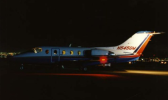
Thanks for the answers. The comments from your friend about NVGs in that environment are exactly what I was thinking just hours after the crash.Well first the NVG thing. As attached in the article...
In the second, more detailed video, taken from a different angle, the tail logo lighting appears to be illuminated after the collision and until the aircraft strikes the water.Did we discuss Logo Lights?
(Would they help? was the angle of impact such that they'd have been noticed in this event? Are they available for such aircraft? Cost? Annoying to pilot?)
Didn't read the whole thread...search box shows no recent hits for "Logo", "Logo lights"
Random internet image:
View attachment 137675
I saw a better copy of the video just a bit ago. Helo squeaked under the plane and sheared off the *left* wing. Aircraft rolls left 450 degrees on its way into the water. Looked like the roll rate wasn't constant, as if the crew tried to stop the roll, realized they couldn't, and then tried to get it all the way around similar to Alaska 261. There just wasn't nearly enough room for them to do anything. What a sickening ride, for a handful of seconds...If an object with wings gets hit from underside of the right wing with enough force to shear that wing off, I imagine enough inertia is imparted on the body to roll it left? At least for a moment before aerodynamic forces intervene......which might take too long to happen at a couple hundred feet.
Did we discuss Logo Lights?
(Would they help? was the angle of impact such that they'd have been noticed in this event? Are they available for such aircraft? Cost? Annoying to pilot?)
Didn't read the whole thread...search box shows no recent hits for "Logo", "Logo lights"
Random internet image:
View attachment 137675
I’ve been saying this for years. Move all the jets to Dulles and make DCA the mega heliport for all the helicopters around the capitol. Every agency under the sun around there has helicopters. Just put them all at DCA and make it a dedicated rotard base.The simplest solution is to close DCA to fixed wing traffic of any kind.
There would not have been any data available from ADSB that would have changed the outcome.

And it also appears that when PAT11 crossed under the first Southwest aircraft on approach, there was no issue with 6-500 ft separation. Looked like going under Brickyard he has even a bit more separation.I watched the video twice. What part of the route did they break? If you have a problem with 500 ft separation, then file a complaint to the FAA.
As far as not flying within 500 ft vertical from VFRs I don’t know what to tell ya. I’ve flown a few hundred feet below aircraft on final in 3rd world countries. Not long ago at work I was cruising out of CHA at 5,500 ft. Approach took a regional jet right over the top of me at 6,000 ft. Regional jet told approach they were responding to an RA on me. Approach nonchalantly replied “well that’s standard separation.”
These are several vids on YT that show an airliner responding to RAs when indeed ATC had required separation. Then in the remarks you have the usual comments from the uninformed about how dangerous it was. Then the current / former controllers chime in and say “well, don’t know what he’s complaining about. That’s standard separation.” Or “Visual separation…completely legal.”
Now if there needs to be changes in rules / policy, well that’s a conversation that can take place. But, don’t tell me an aircrew (PAT11) is in the wrong when they’re just adhering to the route that’s published.
Whatever comes of this, it’ll more likely be a knee jerk reaction than a measured response.I think one thing that may come out of this is to change these procedures to no night operation on the rotor routes, or holding DCA traffic in the event of an emergency PAT night flight.