Cost of Annual: Total for both Inspection and Repairs

How much spend on Annual?

  • $1000

    Votes: 6 10.5%
  • $2000

    Votes: 8 14.0%
  • $3000

    Votes: 14 24.6%
  • $4000

    Votes: 5 8.8%
  • $5000 or more

    Votes: 16 28.1%
  • PTSD won’t let me comment on this

    Votes: 8 14.0%

  • Total voters
    57
I always wonder if GA, particularly the old fleet, would benefit from some sort of ABCD check system.
Another option could be for each TC aircraft owner to make a required yearly mx record entry that the aircraft is maintained in accordance with Block 6 of the AWC. My bet the overall condition of the aircraft would improve across a larger base as people tend to look at things differently when their name is specifically attached.

Or do we give people a break and it's 2 and 4. do an "annual" every 2 years, and do a deeper look every 4.
Unfortunately, a "2 and 4" cycle would cause the aircraft to no longer meet ICAO Annex 8 requirements and they would have restrictions on them similar to the TCCA Owner Mx aircraft. The annual inspection every year in addition to physically inspecting aircraft also technically "renews" the AWC each yearly cycle.
 
Flight training isn't ownership training. You can rent airplanes and leave all of the maintenance and (hopefully few) repairs up to the owner.
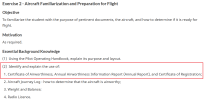
In that Canadian Flight Instructor Guide, the link to which I posted earlier, we have this:

1740788422771.png

The student is told that those documents are all about, and who is responsible for all of them and for the airworthiness of the airplane. Some of this stuff should be right in the regulations themselves to force the necessary education.
 
In that Canadian Flight Instructor Guide, the link to which I posted earlier, we have this:

View attachment 138594

The student is told that those documents are all about, and who is responsible for all of them and for the airworthiness of the airplane. Some of this stuff should be right in the regulations themselves to force the necessary education.
I knew what all those red-highlighted docs were by the time I did my practical, but the understanding of it was just a textbook definition learned from PHAK/FARs. Completely superficial.
The first time I ever flew the plane the CFI pointed those docs out to me (minus the annual entry in mx logs). Being honest, that was also the last time I ever looked at them :)

ALL that stuff hits different when you're an owner responsible for the plane. Then you start to care about those things and understand in substantial detail what things like annual inspections are, what satisfying an AD means, what the registration is/how you get one, etc. It's hard to make that stuff "stick" for a renter because it's not directly relevant in physically operating the aircraft.

(also, in the modern day I wish they'd do away with the requirement of having to keep things like airworthiness cert/registration onboard the aircraft or your car for that matter... it seems pointless in the digital era)
 
Some of this stuff should be right in the regulations themselves to force the necessary education.
Technically they are down here. Except most are expecting someone to hand them an itemized list vs being told simply you’re “primarily responsible for maintaining that aircraft in an airworthy condition” as in Part 91.403. At some point a person needs to take the initiative to fulfill what is regulatorily required of them and dig into the volumes of guidance. And its no different than what an A&P must do with only Part 43.13 to guide them.

ALL that stuff hits different when you're an owner responsible for the plane.
Except even as a renter you are still an “operator” of the aircraft which most regulations address equally as an owner. Being a renter does not reduce your responsibility as stated in 91.7 or by extension in 91.403. So there should be no difference when you get “hit” by becoming an owner except who will pay for it now.;)

I wish they'd do away with the requirement of having to keep things like airworthiness cert/registration onboard the aircraft
Unfortunately, those documents are an ICAO requirement for member nations. Same reason you still need a radio license in your N-reg aircraft if you fly outside the US.
 
Last edited:
Another option could be for each TC aircraft owner to make a required yearly mx record entry that the aircraft is maintained in accordance with Block 6 of the AWC. My bet the overall condition of the aircraft would improve across a larger base as people tend to look at things differently when their name is specifically attached.


Unfortunately, a "2 and 4" cycle would cause the aircraft to no longer meet ICAO Annex 8 requirements and they would have restrictions on them similar to the TCCA Owner Mx aircraft. The annual inspection every year in addition to physically inspecting aircraft also technically "renews" the AWC each yearly cycle.
that's fair, but I'd give it up. I'd rather just have my IA swing by the hangar and fix things as I find it, and it's convenient for him, vs having to hit the inspection checklist. Since my plane is new to me (even though he's looked after it for a few owners), there are some things I'm investing in, as I suspect many owners do (step retraction cable getting worn, 5 year prop AD this year, seat uppgrade to sliding seats, do the normal annual, and take care of a few other little squawks. i'm guessing i'll be paying my IA $5k for labor, plus what I pay the prop shop, parts, etc.

In future years, I think it'll be closer to inspection, oil change, $1,000 in squawks and an upgrade every year, but we'll see. I would expect my long run to be $5k/year if nothing comes up. I could cut a couple grand off if i had time to help with the inspection.
 
that's fair, but I'd give it up.
I guess so long as you’re good with your data plate being permanently marked, no option to export or fly it out of the US, and the protentional for lost hull value, it might work for you. At least that’s how the TCCA owner mx aircraft ended up. It was a similar issue with the Primary Non-Commercial movement here that ended up being one of the reasons PN-C never went through.

I'd rather just have my IA swing by the hangar and fix things as I find it,
Technically, that’s how the system is supposed to work vs waiting till inspection to fix things. But if you find yourself too busy to assist at inspection times, perhaps look into regularly "inspecting" your aircraft on your time to keep on top of any issues? The FAA was actually a big fan of this and at one time had a number of guidance docs to assist an owner with maintaining their aircraft.

Unfortunately, over time owners shifted away from such work and the guidance was dropped or consolidated. However, some still exist as listed below. Its merely one way to manage your mx costs by keeping your aircraft in tip top shape throughout the year which tends to keep your annual costs reasonable with minimal to no surprises.
AC 20-106
FAA-H-8083-19A

 
I guess so long as you’re good with your data plate being permanently marked, no option to export or fly it out of the US, and the protentional for lost hull value, it might work for you. At least that’s how the TCCA owner mx aircraft ended up. It was a similar issue with the Primary Non-Commercial movement here that ended up being one of the reasons PN-C never went through.


Technically, that’s how the system is supposed to work vs waiting till inspection to fix things. But if you find yourself too busy to assist at inspection times, perhaps look into regularly "inspecting" your aircraft on your time to keep on top of any issues? The FAA was actually a big fan of this and at one time had a number of guidance docs to assist an owner with maintaining their aircraft.

Unfortunately, over time owners shifted away from such work and the guidance was dropped or consolidated. However, some still exist as listed below. Its merely one way to manage your mx costs by keeping your aircraft in tip top shape throughout the year which tends to keep your annual costs reasonable with minimal to no surprises.
AC 20-106
FAA-H-8083-19A

I certainly do get airworthy things addressed as they come up, but save the stuff that we’re getting ahead of for the annual.

This is a good doc by the way, thank you!

I’d take the hit to hull value to just maintain the plane as needed vs the faa schedule. My time is more expensive than my IAs as well, so me pulling inspection panels for him doesn’t make it more efficient. I let him specialize and drown him in gratitude and prompt payment


Sent from my iPhone using Tapatalk
 
The Tech must perform the inspections to determine if the aircraft meets

at least the MINIMUM standards for Airworthiness.

The Owner can insist on more in- depth checks at any time and schedule.

There is plenty of guidance available to do this if desired.

Some do and some don’t.

But many owners don't know enough to ask for more in depth. They hear two prices and take the cheaper one.
 
The standard annual on my Bonanza runs between 23-30 hours, depending on what's due this year. Mutiply by hourly rate, then add repairs.
 
Technically, that’s how the system is supposed to work vs waiting till inspection to fix things. But if you find yourself too busy to assist at inspection times, perhaps look into regularly "inspecting" your aircraft on your time to keep on top of any issues? The FAA was actually a big fan of this and at one time had a number of guidance docs to assist an owner with maintaining their aircraft.

Unfortunately, over time owners shifted away from such work and the guidance was dropped or consolidated. However, some still exist as listed below. Its merely one way to manage your mx costs by keeping your aircraft in tip top shape throughout the year which tends to keep your annual costs reasonable with minimal to no surprises.
AC 20-106
FAA-H-8083-19A
There are things that need to be fixed now and those that can wait. It makes sense to lump the ones that can wait into the annual since the airplane will be opened up anyway.
 
There are things that need to be fixed now and those that can wait.
Except thats not how the rule is written. Regardless, aircraft that are actually maintained 365 days of the year vs only when "needed" are in overall better shape and require considerly less work at annual time. ;)
 
Except thats not how the rule is written. Regardless, aircraft that are actually maintained 365 days of the year vs only when "needed" are in overall better shape and require considerly less work at annual time. ;)
They're also constantly in and out of the shop. ;)
 
They're also constantly in and out of the shop.
Not really. You'll find in most cases once you get an aircraft back up to par by maintaining it on a regular preventive basis, the trips to the mx shop decrease, especially with the Part 91 recreational side of the business. However, it only works if the owner does their part as referenced in various guidance like AC 20-106 mentioned above. Unfortunately, a majority of owners do not for whatever reason and simply prefer to complain how expensive their annuals are.
 
Not really. You'll find in most cases once you get an aircraft back up to par by maintaining it on a regular preventive basis, the trips to the mx shop decrease, especially with the Part 91 recreational side of the business. However, it only works if the owner does their part as referenced in various guidance like AC 20-106 mentioned above. Unfortunately, a majority of owners do not for whatever reason and simply prefer to complain how expensive their annuals are.
I'm continually surprised at the dirty conditions I see under the cowlings of friends' airplanes and photos posted here. Cleaning is free, it just takes a little effort.

It can also prevent expensive repairs or even failures, just by becoming familiar with what's under the cowling and being alert.
 
Not really. You'll find in most cases once you get an aircraft back up to par by maintaining it on a regular preventive basis, the trips to the mx shop decrease, especially with the Part 91 recreational side of the business. However, it only works if the owner does their part as referenced in various guidance like AC 20-106 mentioned above. Unfortunately, a majority of owners do not for whatever reason and simply prefer to complain how expensive their annuals are.
I was joking. The "do everything at annual" crowd is in the shop once a year. The "do everything as it happens" crowd is, by definition, going to be in and out of the shop more frequently. ;)
 
Not all issues are airworthiness issues. And can be deferred.

Yes, airworthiness needs to be addressed now.
 
Since I’m keeping the plane for at least 10 years, if there is something that is not quite right, I’ve decided to speed up going broke by fixing it now and enjoy it while I have the plane.

Next on the list - wonky baggage door latch that is hard to catch and lock the door. I also think the door seal is where I’m getting a damp baggage area carpet after a heavy rain.
If on a Cessna, AircraftDoorSeals.com has a great replacement. Follow the instruction EXACTLY and say goodbye to leaks.
 
  • Like
Reactions: WDD
Next on the list - wonky baggage door latch that is hard to catch and lock the door. I also think the door seal is where I’m getting a damp baggage area carpet after a heavy rain.
You’ll find for the most part, these type disc can be fixed under your PPC as preventative mx. One task I had my owner-assist customers perform was for them to inspect their aircraft per 43 Appx D and AC 20-106 above, note all their “issues” and develop a plan to fix them. You can make a similar list and every weekend, or whatever schedule works, fix one of the issues like your door seal. Once you get in the groove you might be surprised what you’ll learn along the way.

Not all issues are airworthiness issues. And can be deferred.
Except that’s the point of the exercise you continue the miss. Its not that you can defer them, it’s the fact you should fix them before the annual regardless if an airworthy item or not. No different than regularly cleaning the aircraft, inside and outside, as noted in the post above and which also usually gets deferred till annual time. Simply boils down to what type of owner you want to be.
 
Well, I have a new data point for you. Ugh.

1997 Mooney M20R. Annual Inspection cost is $3,120 plus a few parts like the oil sample kit and filter and various fees.

This was an "easy" annual. There were only two items that were semi-big: Getting a mag out for service (they said it had "a miss" on that one that we had not observed, and it had 400+ hours on it). That was nearly $2600 including R&R and troubleshooting ($1879 to the mag shop); and replacing one of our batteries ($1184 for a new Concorde, $1388 with R&R).

Other maintenance included blowing out the pitot system, adding some heat shielding to the cabin heater duct (not sure why this was never an issue before), lubing throttle cable, new pushrod seals on one cylinder, ICAs for speed brakes, new spark plugs, new main tires and tubes.

Total: $8928 to the mx shop, $836 to the avionics shop, $374 to the tire company because our shop always charges a fortune for theirs.

No wonder GA is shrinking. :(
 
Except that’s the point of the exercise you continue the miss. Its not that you can defer them, it’s the fact you should fix them before the annual regardless if an airworthy item or not. No different than regularly cleaning the aircraft, inside and outside, as noted in the post above and which also usually gets deferred till annual time. Simply boils down to what type of owner you want to be.

And you keep missing the point that there are things that CAN be deferred to annual without causing any issues.
 
Back
Top