
Can a private pilot fly a MOSAIC LSA without a medical?

MountainDude

Cleared for Takeoff
PoA Supporter
Joined
Jul 29, 2011
Messages
1,466
Display Name
MountainDude
Home Airfield
KPDX
Just curious.

The pilot:
- Private pilot
- Has had third class medical for 15 years
- Will follow the LSA limitations (under 10K feet, daytime VFR, one passenger...).
The plane:
- C182 that qualifies as an LSA under MOSAIC (stall speed at GW and 40 flaps is 50 KCAS)

The only unclear part is the endorsement required for entering class C and D; not sure how to get one?
 
What is the clean stall of the 182?
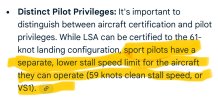
MOSAIC uses clean stall for legacy aircraft. 59 knots or lower.
Are you sure? I read it's the CAS in landing configuration, which is full flaps.
 
What is the clean stall of the 182?
MOSAIC uses clean stall for legacy aircraft. 59 knots or lower.
Either way it looks like my model is fine. Full forward CG is 59 KCAS, full rear CG is 56 KCAS. Both at GW.
 
No.

After MOSAIC goes into effect in three weeks, the answer changes to yes.

Ron Wanttaja
Thank you. Do you have more info about the endorsement needed for entering class C and D?
 
Thanks. That's still fine with my plane.
 
“MOSAIC LSA” is a non-term from a pilot standpoint. The single most important MOSAIC thing from a conceptual perspective for pilots is that “LSA” appears nowhere in Part 61.

Instead, Part 61 sport pilot rules describe three things:
  1. The aircraft sport pilots and those exercising sport pilot are permitted to fly as PIC. Limiting it to airplanes, those are airplanes with up to 4 seats, and a Vs1 (clean stall speed) of 59 KCAS or less, and which do not require a type rating.
  2. Limitations on sport pilots to fly certain airplanes without additional training and endorsement, such as controllable pitch props and retracts.
  3. Limitations of operational privileges for those exercising sport privileges, such as flying at night. The Rule gives us a chart to follow for that.
“LSA” OTOH, is now an aircraft certification category niched between experimental and full Part 23 certification.

Sounds like being picky, but I’ve seen lots of misinformation from failure to understand that. I thought it was localized, but I recently received an email from my FSDO pointing out that no, a 172 does not have to be recertified as an LSA for sport privileges to apply, suggesting the confusion is more widespread than I thought,
 
The only unclear part is the endorsement required for entering class C and D; not sure how to get one?
Not needed.

61.303 (2) ii "You do not have to hold any of the endorsements required by this subpart, but you must comply with the limitations in § 61.315."

61.316 (A) A maximum stalling speed or minimum steady flight speed without the use of lift-enhancing devices (VS1) of not more than 45 knots CAS, except for airplanes, which must have a VS1 speed of not more than 59 knots CAS at the aircraft's maximum certificated takeoff weight and most critical center of gravity.
Thank you.
Which is the most critical center of gravity, forward or aft?
 
Which is the most critical center of gravity, forward or aft?
Don't know fer a fact, but I would think that with a forward CG, you have more back stick, more down force from the tail, so you would need a little more speed to generate the lift to counteract the down from the tail. Or, a canard would be the other way around.
 
Thank you.
Which is the most critical center of gravity, forward or aft?
From my RC days, where often you'd just eyeball CG based on guessing at center of lift, the saying was "a plane that's nose heavy is hard to fly. A plane that's tail heavy flies once."

But the big caveat with that is that CG could be WAY off with those, and if it's too nose heavy, the worst thing that happens with RC is you can't lift the aircraft off the ground or that it climbs poorly to nill. So now that I've been flying aircraft I'm in, and sometimes from short fields, I kinda want it to be within spec.

Back to RC, if it's way too tail heavy, you can't keep the nose down enough to keep the angle of attack down to avoid stalling except at potentially high speeds, because of lack of elevator authority. That can kind of be spooky to fly, you have to keep the speed up and kind of fly it into the ground to land. Don't know if the same physics applies to full size, but absolutely don't want to find out myself. I kinda suspect worst case would be similar outcome to the former F-14 pilot that accidentally took off with gust lock on elevator. Not good....but again, don't know if CG for a light single could be so far off to behave like that with all the original parts still attached and not over gross. No idea.
 
Since there's discussion on this, I'm curious what thoughts people have on this part of the rule. In other words, what distinction is the FAA trying to make?

"If you hold a sport pilot certificate, you may act as pilot in command of an aircraft that, since its original certification, meets the following requirements"

It would appear the rule is saying that if sometime during an aircraft's history it did not meet the requirements, but currently does meet the requirements, it is still not Light Sport Pilot eligible. If I'm correctly understanding this, why would the FAA make that distinction?
 
Back to RC, if it's way too tail heavy, you can't keep the nose down enough to keep the angle of attack down to avoid stalling except at potentially high speeds, because of lack of elevator authority. That can kind of be spooky to fly, you have to keep the speed up and kind of fly it into the ground to land. Don't know if the same physics applies to full size
A tail heavy aircraft is unstable. Top unstable and it's uncontrollable. Too nose heavy and you may not have enough elevator authority to flare.
It would appear the rule is saying that if sometime during an aircraft's history it did not meet the requirements, but currently does meet the requirements, it is still not Light Sport Pilot eligible. If I'm correctly understanding this, why would the FAA make that distinction?
The FAA didn't want people to be able to simply declare a lower gross weight to make the plane SP legal.
 
The FAA didn't want people to be able to simply declare a lower gross weight to make the plane SP legal.

Sorry, I'm not understanding? This requirement would preclude any GW declaration: "... except for airplanes, which must have a VS1 speed of not more than 59 knots CAS at the aircraft's maximum certificated takeoff weight and most critical center of gravity."

Are you saying to preclude something like an STC that lowers max gross and thus lowers Vs1 making a previous non-conforming aircraft a conforming aircraft? I guess I could see that, but given that scenario if an aircraft conforms and is operated legally with a modified max gross weight, what difference does it make and why would the FAA care?
 
Last edited:
Are you saying to preclude something like an STC that lowers max gross and thus lowers Vs1 making a previous non-conforming aircraft a conforming aircraft? I guess I could see that, but given that scenario if an aircraft conforms and is operated legally with a modified max gross weight, what difference does it make and why would the FAA care?
I can't say for sure what the FAA was thinking, but that's the way they wrote the original SP rule. I suspect politics played a part, to limit the number of legacy LSA compliant aircraft available and thus support the new LSA manufacturers.
 
Are you saying to preclude something like an STC that lowers max gross and thus lowers Vs1 making a previous non-conforming aircraft a conforming aircraft? I
In the original version where the max takeoff weight was limited, that was exactly the reason. You couldn't turn a Cessna 150 into a nudge-nudge-wink-wink LSA.

I assume there is a bit of inertia, but it also precludes things like slapping on vortex generators and claiming that the stall speed is low enough. Or an STC that removes seats from your Antonov An-2 and flying it under the Sport Pilot rules. I would think that they are trying to limit how much you can game the system.
 
It would appear the rule is saying that if sometime during an aircraft's history it did not meet the requirements, but currently does meet the requirements, it is still not Light Sport Pilot eligible. If I'm correctly understanding this, why would the FAA make that distinction?
Oh, yeah. It’s been bloody inconvenient. For instance, there are Champs (and probably others) that have STCs available that can raise the gross weight to slightly above the current SP limit. But even if the STC is removed and it’s returned to its original state and gross weight, it’s still not legal for a Sport Pilot to fly. Not until later this month anyway. But once the new rules go into effect, SP eligible airplanes become something of a target rich environment.
 
Oh, yeah. It’s been bloody inconvenient. For instance, there are Champs (and probably others) that have STCs available that can raise the gross weight to slightly above the current SP limit. But even if the STC is removed and it’s returned to its original state and gross weight, it’s still not legal for a Sport Pilot to fly. Not until later this month anyway. But once the new rules go into effect, SP eligible airplanes become something of a target rich environment.

That scenario is exactly what I was concerned about in the MOSAIC NPRM. I own a C172N with the Air Plains GW increase STC. That STC came with an increase in Vs1 that would have put my C172N over the NPRM 54 KCAS limit by 1 KT. With the new rule Vs1 increase to 59 KCAS it would appear to be a moot point. But I'm still left wondering why "since it's original certification"...
 
In the original version where the max takeoff weight was limited, that was exactly the reason. You couldn't turn a Cessna 150 into a nudge-nudge-wink-wink LSA.

I assume there is a bit of inertia, but it also precludes things like slapping on vortex generators and claiming that the stall speed is low enough. Or an STC that removes seats from your Antonov An-2 and flying it under the Sport Pilot rules. I would think that they are trying to limit how much you can game the system.

Makes sense if the soon to be old LSA rule had similar wording. I just figured it wouldn't be financially viable of even practical to create an STC making a C150 LSA compliant under the old rule and that's why such an STC was never seen.
 
But I'm still left wondering why "since it's original certification"...
The FAA does that kind of things in other places, too... for example, the transponder and ADS-B exemption for aircraft that were "not originally certificated with an engine driven electrical system," which prevents you from removing the alternator and calling it exempt.
Makes sense if the soon to be old LSA rule had similar wording. I just figured it wouldn't be financially viable of even practical to create an STC making a C150 LSA compliant under the old rule and that's why such an STC was never seen.
The old rule has the same wording, otherwise there definitely works have been such STCs... and lots of sport pilots flying safely but illegally over the reduced gross weight limit.
 
Just curious.

The pilot:
- Private pilot
- Has had third class medical for 15 years
- Will follow the LSA limitations (under 10K feet, daytime VFR, one passenger...).
The plane:
- C182 that qualifies as an LSA under MOSAIC (stall speed at GW and 40 flaps is 50 KCAS)

The only unclear part is the endorsement required for entering class C and D; not sure how to get one?
Excuse the slight over thinking here....

Yes IF you qualify for Sport Pilot with the new MOSAIC. That is, yes as a PPL you can fly as Sport without a 3rd class medical or Basic Med as long as you have a driver's license AND you haven't had a 3rd class medical denied or revoked.
 
Hi everyone, I have a similar 2 part question. I am a private pilots without a current medical. My lapsed about a year ago and I never tried to renew because shortly before it lapsed I found out I had kidney cancer. They removed my kidney and thought they got it all. Later that summer (shortly after my medical lapsed in may) I found out it had spread to one lymphnode further away. Since then we switched my treatment and I am still doing immunotherapy infusions (not chemo or radiation) and I take a low dose chemo pill every day. Since the new treatment, the one lymphnode has shrunk. I have and still feel completely normal, like I did before I was ever diagnosed. I am not limited at all in any capacity physically or mentally. I am 43 years old and have the same capabilities as any other 43 year old. My cancer is considered incurable and I am considered terminal even though I feel perfectly fine. Sorry for the novel but here is the question, would I be allowed to fly under the new Mosaic rules as a sport pilot with my PPL and DL? Also, am I limited to the same restrictions as a sport pilot? Also, if I wanted to purchase an RV-10 would I be allowed to fly it under the new rules (I think the stall speed may be an issue). I sold my Cherokee 6/260 when I got sick and would love to start flying again while I am healthy, down the road if my cancer takes a turn, I of course would ground myself. Thanks for your time reading this and for any advice or comments.
 
Hi everyone, I have a similar 2 part question. I am a private pilots without a current medical. My lapsed about a year ago and I never tried to renew because shortly before it lapsed I found out I had kidney cancer. They removed my kidney and thought they got it all. Later that summer (shortly after my medical lapsed in may) I found out it had spread to one lymphnode further away. Since then we switched my treatment and I am still doing immunotherapy infusions (not chemo or radiation) and I take a low dose chemo pill every day. Since the new treatment, the one lymphnode has shrunk. I have and still feel completely normal, like I did before I was ever diagnosed. I am not limited at all in any capacity physically or mentally. I am 43 years old and have the same capabilities as any other 43 year old. My cancer is considered incurable and I am considered terminal even though I feel perfectly fine. Sorry for the novel but here is the question, would I be allowed to fly under the new Mosaic rules as a sport pilot with my PPL and DL? Also, am I limited to the same restrictions as a sport pilot? Also, if I wanted to purchase an RV-10 would I be allowed to fly it under the new rules (I think the stall speed may be an issue). I sold my Cherokee 6/260 when I got sick and would love to start flying again while I am healthy, down the road if my cancer takes a turn, I of course would ground myself. Thanks for your time reading this and for any advice or comments.
Oh, and for those who aren't familiar with immunotherapy, it is nothing like chemo or radiation infusions. I do it once every 4 weeks, it only takes 30 minutes and I walk in and out a feel normal the whole time, no throwing up or anything like you hear about chemotherapy. Also, they just recently came out with it in a shot instead of infusion which I will be starting soon so it will only be like 5 minutes when I go in every 4 weeks starting soon. I only put this for those who may not understand the difference and think everyone with cancer has to do the chemo or radiation you see in movies or TV. Thanks again!
 
A person using a U.S. driver's license to meet the requirements of paragraph (c) while exercising sport pilot privileges must--
(i) Comply with each restriction and limitation imposed by that person's U.S. driver's license and any judicial or administrative order applying to the operation of a motor vehicle;
(ii) Have been found eligible for the issuance of at least a third-class airman medical certificate at the time of his or her most recent application (if the person has applied for a medical certificate);
(iii) Not have had his or her most recently issued medical certificate (if the person has held a medical certificate) suspended or revoked or most recent Authorization for a Special Issuance of a Medical Certificate withdrawn; and
(iv) Not know or have reason to know of any medical condition that would make that person unable to operate an aircraft meeting the performance limits and design requirements of Sec. 61.316 in a safe manner.
 
Just a theoretical. When I got my 3rd class medical and PPL eons ago, it had a no night flight restriction. The 3rd class expired (not revoked, denied renewal or other disastrous event) and I been using Sport Pilot Privileges since.

Since my DL has no night driving restrictions, could I fly at night? I have zero desire to fly at night.

I think this was answered in another thread but can’t find it.
To fly as a SP at night, you need either a class 3 or basicmed, even though you don't need those to fly during the daytime.
 
That scenario is exactly what I was concerned about in the MOSAIC NPRM. I own a C172N with the Air Plains GW increase STC. That STC came with an increase in Vs1 that would have put my C172N over the NPRM 54 KCAS limit by 1 KT. With the new rule Vs1 increase to 59 KCAS it would appear to be a moot point. But I'm still left wondering why "since it's original certification"...
It's simply to prevent folks from modifying on paper an aircraft that doesn't fit the rule.
 
Just a theoretical. When I got my 3rd class medical and PPL eons ago, it had a no night flight restriction. The 3rd class expired (not revoked, denied renewal or other disastrous event) and I been using Sport Pilot Privileges since.

Since my DL has no night driving restrictions, could I fly at night? I have zero desire to fly at night.

I think this was answered in another thread but can’t find it.
You would have to comply with BasicMed, and presumably discuss the condition with the doctor signing the CMEC. You would also need to consider whether flying at night with the condition would constitute a violation of 61.53(b).
 
To fly as a SP at night, you need either a class 3 or basicmed, even though you don't need those to fly during the daytime.
Yes, but he's not a sport pilot. He's a private pilot.

@X3 Skier, this one comes up all the time in MOSAIC seminars.

1. From a medical standpoint, flying at night for someone holding a sport pilot certificate requires at least BasicMed. 61.329(b).​
2. Since you already hold a private certificate, if you have an FAA medical or BasicMed, the sport pilot rules are irrelevant. You are a private pilot with an appropriate medical.​
 
Last edited:
Yes, but he's not a sport pilot. He's a private pilot.

@X3 Skier, this one comes up all the time in MOSAIC seminars.

1. From a medical standpoint, flying at night for someone holding a sport pilot certificate requires at least BasicMed. 61.329(b).​
2. Since you already hold a private certificate, if you have an FAA medical or BasicMed, the sport pilot rules are irrelevant. You are a private pilot with an appropriate medical.​
I believe #1 should read, "flying at night for someone flying with sport pilot privileges requires at least BasicMed" - regardless of the type of certificate they hold. 61.303, 61.315, 61.329.

If you're a 10K hour ATP (or @X3 Skier, or me) who does not hold a current medical certificate don't meet the requirements of BasicMed, you're not legal to fly at night.
 
Back
Top