C172 down at KMYF?

flyingcheesehead

Taxi to Parking
Joined
Feb 23, 2005
Messages
28,184
Location
UQACY, WI
Display Name
iMooniac
Home Airfield
KUES/KMKE
Just got an alert on one of my apps, looks like it happened about 5:18 PM PDT/0018Z. N734ZK and N75733 on short final very close to each other for the parallels. You hear "4ZK going around" and about four seconds later on the other tower frequency the controller tells a Citation to go missed because of an accident at the airport. Looking at the ADS-B replay, N75733 appears to go around, while N734ZK does not. After a moment another plane checks in and says "Looks like there's a fire at the airport?"
 
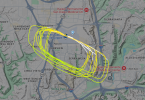
Rather untidy (inconsistent) flight paths, which could indicate highly variable winds along with an inexperienced student.
As I return to flight from various medical issues, I'm quite happy to have an experienced instructor, rather than one with fewer hours than I have.
Recognition of a developing situation before it becomes difficult to manage takes experience.

1788864760117.png
 
Fatalities, tragic. Yahoo News

edit. Report from a friend on site- "Student and instructor third attempt at landing 28L, 40º, crosswind 13-16 knots, stall/spin into the hold short line for 28L"

Just can't get how one stall spins a 172. They are just such a benign flying aircraft yet here we are.
 
Rather untidy (inconsistent) flight paths, which could indicate highly variable winds along with an inexperienced student.
As I return to flight from various medical issues, I'm quite happy to have an experienced instructor, rather than one with fewer hours than I have.
Recognition of a developing situation before it becomes difficult to manage takes experience.

View attachment 154855
I'd mostly agree about the flight paths, but sometimes at towered airports, other aircraft, ATC requests, etc... can cause pattern tracks that are widely divergent, which, when combined with a new student trying to figure things out, can end up looking like that.
 
Just can't get how one stall spins a 172. They are just such a benign flying aircraft yet here we are.
Getting it to stall is easy. Keeping it stalled is hard if you have any altitude. They didn't. If they spun, it was really flat. Looks from the photos it just pancaked in.
 
I'd mostly agree about the flight paths, but sometimes at towered airports, other aircraft, ATC requests, etc... can cause pattern tracks that are widely divergent, which, when combined with a new student trying to figure things out, can end up looking like that.
All I'm seeing is turning crosswind/base at slightly different points. The downwind tracks are pretty consistent and if they were having issues with the crosswinds, the fact that things are pretty square to the runway heading looks like they had the WCA nailed. Often with such things, you'll see the plane drifting toward the runway, followed by an overly tight downind-base-final turn. Not seeing that here.
 
1977 C172N so max flaps 30 degrees.
Go around should be a piece of cake even with full flaps.
 
1977 C172N so max flaps 30 degrees.
Go around should be a piece of cake even with full flaps.
Having just done this (sans the unhappy ending), don't underestimate the amount of push needed on the yoke at flaps 30, if you are trimmed for landing. Mishandling that would lead to a quick stall, and with little altitude in which to recover.
 
1977 C172N so max flaps 30 degrees.
Go around should be a piece of cake even with full flaps.
They have 40 degree flaps (at least some do). I used to fly a 172N regularly before I bought my Navion. Perusing online listings of 1977 172Ns show 40 degrees on the flap indicator/handle.
 
They have 40 degree flaps (at least some do). I used to fly a 172N regularly before I bought my Navion. Perusing online listings of 1977 172Ns show 40 degrees on the flap indicator/handle.
On one of our flight school planes we've blocked off the 40° setting. The other has it, but I just don't use it. I used it when I owned one, because I liked to "chop and drop" to avoid a water hazard at the runway end.
Going around with flaps 30 requires a good push; flaps 40 may be too much for some to handle, but in the winds at Montgomery I doubt anyone would use more than twenty.
I wouldn't.
I believe that's a mod that gets you a 100 pounds more gross weight. They didn't come from the factory that way throughout the production (1977-1980) of the N model.
 
Just can't get how one stall spins a 172. They are just such a benign flying aircraft yet here we are.
About 6% of Cessna 172 accidents (1998-2021) involve the pilot stalling...this does not include cases with a loss of engine power. In contrast, the rate for the Cessna 210 is about 2%. However, the pilots involved in 210 accidents have about six times the flight experience as the 172 pilots.

Ron Wanttaja
 
I am going to go out on a limb and say this: we need to reconsider the mantra that “you can never go wrong by going around.”

A go-around from 300 feet is one thing. A go-around after the airplane has already transitioned into the landing is something very different. At that point, adding full power, managing pitch and trim changes, retracting flaps appropriately, and transitioning back to a climb can create risks of its own. We continue to see accidents in which a very late go-around ends in a stall/spin, sometimes even with a CFI on board.

Simply saying “more training” does not address the underlying message we are giving pilots. Perhaps the better guidance is that below some point in the landing, the default should change from “go around if anything doesn’t look right” to “commit to the landing unless continuing has become genuinely unsafe.” There comes a point very late in the landing where accepting an ugly landing may be safer than trying to turn it back into a takeoff.
 
I am going to go out on a limb and say this: we need to reconsider the mantra that “you can never go wrong by going around.”
I agree with you if the aircraft is on fire or in immediate danger of a catastrophic structural failure.

Situations like an unstabilized approach should never come into question - a go-around should be the first choice.
Yes, a 172 trimmed for landing with full flaps WILL try to kill you if you apply full throttle for a go-around. You fix that by ensuring CFIs know about it (instead of being puppy mill CFIs that were only taught full-stop landings) and training students properly, ensuring that they are fully aware of the pitch-up characteristic.

A go-around doesn't mean shoving the throttle full open without thinking about it. Add enough power to arrest the descent and maybe climb a bit, breathe, retract some flaps, breathe, trim down, add some power.
 
I am going to go out on a limb and say this: we need to reconsider the mantra that “you can never go wrong by going around.”
I've been saying this for a long time. Go arounds aren't free.

I teach my students that going around isn't an option, so they need to plan on making it work from downwind until they're down and stopped. Sure, I teach in gliders, where going around really isn't an option, but it's the same way I was taught in airplanes.

A go around should be an abnormal thing, not the default. Of course it shouldn't result in a crash either.
 
Just can't get how one stall spins a 172. They are just such a benign flying aircraft yet here we are.
I did it on an early flight lesson many years ago (Didn't really realize it at the time). Initiating a power on stall without enough right rudder and around it went, about a half turn.

The 172 is really hard to *keep* spinning, but this was a very low-altitude go-around. It's not as hard to get into trouble in that situation.

1977 C172N so max flaps 30 degrees.
Go around should be a piece of cake even with full flaps.
40 degrees on the N, the change to 30 was with the P.
 
Just can't get how one stall spins a 172. They are just such a benign flying aircraft yet here we are.
Lots of up trim, adding power resulting in a pitch up plus yaw. Not used to compensating yaw with rudder. Wing dips. Try to correct with ailerons which stalls it more while adding more yaw.

Read elsewhere advice about making an approach as a student with full up trim. Dangerous advice but I have a feeling some instructors and school might actually use it as it was taught to me for “best glide” setting.

It is not that benign I think.
 
I've been saying this for a long time. Go arounds aren't free.

I teach my students that going around isn't an option, so they need to plan on making it work from downwind until they're down and stopped. Sure, I teach in gliders, where going around really isn't an option, but it's the same way I was taught in airplanes.

A go around should be an abnormal thing, not the default. Of course it shouldn't result in a crash either.

Yes, go arounds should be for abnormal situations - like an airplane that pulled up onto the runway in front of you, or you spot a deer standing on the runway. 10 knots too fast isn't one of them, unless you are in a landing competition.
 
Yes, go arounds should be for abnormal situations - like an airplane that pulled up onto the runway in front of you, or you spot a deer standing on the runway. 10 knots too fast isn't one of them, unless you are in a landing competition.
Well perhaps unless you're flying a Citation into Porterville or a 767 into Miami etc. If you're not stabilized by being too fast, go around.
 
I am going to go out on a limb and say this: we need to reconsider the mantra that “you can never go wrong by going around.”

A go-around from 300 feet is one thing. A go-around after the airplane has already transitioned into the landing is something very different. At that point, adding full power, managing pitch and trim changes, retracting flaps appropriately, and transitioning back to a climb can create risks of its own. We continue to see accidents in which a very late go-around ends in a stall/spin, sometimes even with a CFI on board.

Simply saying “more training” does not address the underlying message we are giving pilots. Perhaps the better guidance is that below some point in the landing, the default should change from “go around if anything doesn’t look right” to “commit to the landing unless continuing has become genuinely unsafe.” There comes a point very late in the landing where accepting an ugly landing may be safer than trying to turn it back into a takeoff.
That's probably because we're shortcutting the first 2-5 hours with really rushed initial training that leaves students with very little actual knowledge of how to control the aircraft. That should be taught thoroughly at a safe altitude first thing. It's Law of Primacy stuff.

A reason a lot of older instructors I know restrict solo students to full stop landings at first, too. It's easy to get in a rush and miss something important.
 
This is a timely discussion because I had to do a go around the other day in my traveler. I hadn't flown in a while and I was practicing touch and go's and on one of my landings I started a PIO which is the first time that happened to me. On the second oscillation I hit full throttle and off I went. It was a none event but I can see how you can get into problems if you don't practice go-arounds. There's a lot happening in a small amount of time and I remember thinking "airspeed, pitch and flaps" The flaps are unique in that you flip the switch forward and they move to zero. So I realized I need more practice because it doesn't take much to stall from a go around especially if you don't practice.
 
This is a timely discussion because I had to do a go around the other day in my traveler. I hadn't flown in a while and I was practicing touch and go's and on one of my landings I started a PIO which is the first time that happened to me. On the second oscillation I hit full throttle and off I went. It was a none event but I can see how you can get into problems if you don't practice go-arounds. There's a lot happening in a small amount of time and I remember thinking "airspeed, pitch and flaps" The flaps are unique in that you flip the switch forward and they move to zero. So I realized I need more practice because it doesn't take much to stall from a go around especially if you don't practice.
What's the purpose in practicing touch and goes?
 
They have 40 degree flaps (at least some do). I used to fly a 172N regularly before I bought my Navion. Perusing online listings of 1977 172Ns show 40 degrees on the flap indicator/handle.
My father owned a 172N, N739CN, which I got to fly quite frequently while he had it. IIRC, you didn't go to flaps 40 until you were committed to landing. The POH recommends 40 degrees for short field landings, other than that, flaps are at the discretion of the pilot.
 
My father owned a 172N, N739CN, which I got to fly quite frequently while he had it. IIRC, you didn't go to flaps 40 until you were committed to landing. The POH recommends 40 degrees for short field landings, other than that, flaps are at the discretion of the pilot.
Maybe a good technique, but it's still possible to go around with 40 degrees of flaps - It just likes to pitch up. I'm an "all the flaps all the time" guy.
 
What's the purpose in practicing touch and goes?
Well, there’s more landings per hour. Is it the ‘purpose’, probably not. I was raised on T&G’s during my training. Did some Stop n Go’s but can’t remember ever landing and taxi’ing back. But I was raised on long runways. I can see an advantage. It requires you to learn to accomplish more tasks per approach and learn the discipline to get them done. I can certainly respect though, the train of thought that say’s don’t overload the student early on. However, I’ll put forth the proposition that the pilot raised on T&G’s might have the ‘primacy/muscle memory’ built in to more successfully accomplish a last second deer on the runway type of go around.
 
Last edited:
What's the purpose in practicing touch and goes?
My airplane has no shock-absorbing features in the landing gear (tires only), so the last few feet to the runway has to be done carefully.
As I lack depth perception, I am dependent on nailing the sight picture for landings. Touch-and-Goes are the best process for this; plant the plane on the asphalt, ensure it's stable, then power-up and go around again.

The airport I moved to a year ago doesn't allow touch-and-goes, but there are several nearby airports where I can go to practice.

As my airplane is a huge drag bucket, I almost never have to do a go-around due to an overshoot. There have been times where I've gotten into a PIO situation after a too-hard arrival. Best solution is to power up and take it around again. If it's a long runway (my current home field is not), I might put on a burst of power, stabilize, and try it again.

Ron Wanttaja
 
Just can't get how one stall spins a 172. They are just such a benign flying aircraft yet here we are.
There was a video on Channel 10 news of what happened. The plane literally stopped before it spun left and down. I did spin training in a 172, you have to force it to spin. They had flat ground underneath, weather was fine. I have to wonder if this wasn't intentional.
 
Getting it to stall is easy. Keeping it stalled is hard if you have any altitude. They didn't. If they spun, it was really flat. Looks from the photos it just pancaked in.
They had very high AOA from the video. Have know idea why. Even have thought the control pilot's seat released to get that aircraft in that position. It is a 172, might be the easist aircraft to fly. I do wonder if this was intentional?
 
There was a video on Channel 10 news of what happened. The plane literally stopped before it spun left and down. I did spin training in a 172, you have to force it to spin. They had flat ground underneath, weather was fine. I have to wonder if this wasn't intentional.
There are far more-certain ways to commit suicide in a small aircraft than a stall at low altitude. As I previously posted, about 6% of all Cessna 172 accidents involve a stall with a fully-functional aircraft (e.g., engine is running). No one is killed in more than half of those cases (54%).

As for "you have to force a 172 to spin." Nope. It's one thing to be at altitude, with an instructor watching like a hawk as you slow to stall speed with the ball centered, then jam on the rudder with the break. It's another to be climbing out, inadvertently slowing down, with a bit of skid. The airplane can and will bite in those situations, even a nominal pussycat like the 172.

And I'm speaking from experience.

I've told this story before, but I spun out on my first flight with a passenger after getting my Private. I was 17, young, dumb and full of (myself), and I was taking a buddy up for a ride in the CAP Citabria. When flying solo, I had a habit of wrenching one wing down and pulling back hard to make a very tight turn. "Hey, Rick...do you want to see how to turn REALLY tightly?"

"Sure!"

I bopped the left wing down and hauled back hard on the stick. The plane suddenly rolled to the RIGHT (over the top), inverted. The nose dropped, and we went into a spin. The North Dakota prairie filled the windshield, spinning gaily.

My instructor (fortunately!) had given me a bit of spin training not that much earlier. I shoved the stick forward, applied opposite rudder, and pulled out.

"Uh...Ron, that wasn't just a tight turn, was it?"

Fortunately, we were at altitude, so no danger. But I had been flying that particular maneuver *in the pattern*...solo, of course.

The Citabria was, of course, aerobatic, but it was licensed under the old CAR 3, where all Standard category planes had to demonstrate spin resistance, and, in fact, recover from spins themselves.

But if I'd done that at low altitude, that would have been it.

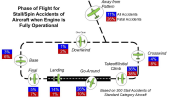
I've posted this diagram countless times, but it illustrates the point well. I found that four times as many inadvertent stalls occurred on takeoff and initial climb than in the classic "base to final turn" scenario. Again, note that this is NOT after an engine failure...the engine is running full bore.
1789252117028.png

Stalls can sneak up on you if you get distracted....and all a spin takes is a bit of a skid at the break.

Ron Wanttaja

 
Have you seen the video? Reportedly this was a "training flight" which means there was a CFI onboard. Reports are it was a a""go around?" How hard is that, especially with a CFI onboard? They had level ground below. Why keep the nose so high to make the aircratt stop flying. We are not talking about a 737 here. They had plenty of room to set it down and not have to pay the insurance deductible.
 
There are far more-certain ways to commit suicide in a small aircraft than a stall at low altitude. As I previously posted, about 6% of all Cessna 172 accidents involve a stall with a fully-functional aircraft (e.g., engine is running). No one is killed in more than half of those cases (54%).

As for "you have to force a 172 to spin." Nope. It's one thing to be at altitude, with an instructor watching like a hawk as you slow to stall speed with the ball centered, then jam on the rudder with the break. It's another to be climbing out, inadvertently slowing down, with a bit of skid. The airplane can and will bite in those situations, even a nominal pussycat like the 172.

And I'm speaking from experience.

I've told this story before, but I spun out on my first flight with a passenger after getting my Private. I was 17, young, dumb and full of (myself), and I was taking a buddy up for a ride in the CAP Citabria. When flying solo, I had a habit of wrenching one wing down and pulling back hard to make a very tight turn. "Hey, Rick...do you want to see how to turn REALLY tightly?"

"Sure!"

I bopped the left wing down and hauled back hard on the stick. The plane suddenly rolled to the RIGHT (over the top), inverted. The nose dropped, and we went into a spin. The North Dakota prairie filled the windshield, spinning gaily.

My instructor (fortunately!) had given me a bit of spin training not that much earlier. I shoved the stick forward, applied opposite rudder, and pulled out.

"Uh...Ron, that wasn't just a tight turn, was it?"

Fortunately, we were at altitude, so no danger. But I had been flying that particular maneuver *in the pattern*...solo, of course.

The Citabria was, of course, aerobatic, but it was licensed under the old CAR 3, where all Standard category planes had to demonstrate spin resistance, and, in fact, recover from spins themselves.

But if I'd done that at low altitude, that would have been it.

I've posted this diagram countless times, but it illustrates the point well. I found that four times as many inadvertent stalls occurred on takeoff and initial climb than in the classic "base to final turn" scenario. Again, note that this is NOT after an engine failure...the engine is running full bore.
View attachment 154950

Stalls can sneak up on you if you get distracted....and all a spin takes is a bit of a skid at the break.

Ron Wanttaja
Those are eye opening statistics.
 
On one of our flight school planes we've blocked off the 40° setting. The other has it, but I just don't use it. I used it when I owned one, because I liked to "chop and drop" to avoid a water hazard at the runway end.
Going around with flaps 30 requires a good push; flaps 40 may be too much for some to handle, but in the winds at Montgomery I doubt anyone would use more than twenty.
I wouldn't.
Your right, I've done them too and it can be done. WIth 40 degrees in and full power it takes a surprisingly firm steady forward push on the yoke to prevent the nose from pitching up and preventing flying airspeed from deteriorating. The main thing is to be patient however and allow a definitive positive climb rate to be established as well as gaining some altitude before gradually retracting the flaps. This is a maneuver that can be practiced at safe altitudes in a practice area and it's probably a good idea to do so if one plans to use 40 degrees (at times).
 
Back
Top