Buying someone else's EAB

Thanks for the input. In 1999/2000 I worked full time at an FAA repair station doing A&P work under supervision but I dont think I could track anyone down to verify that. I'll see how much of my experience would count towards a license.
 
Thanks for the input. In 1999/2000 I worked full time at an FAA repair station doing A&P work under supervision but I dont think I could track anyone down to verify that. I'll see how much of my experience would count towards a license.

None, unfortunately. You have to keep a log showing what you worked on.
 
Thanks for the input. In 1999/2000 I worked full time at an FAA repair station doing A&P work under supervision but I dont think I could track anyone down to verify that. I'll see how much of my experience would count towards a license.
What do you fly?
 
None, unfortunately. You have to keep a log showing what you worked on.

I think this varies by FSDO. Mine was willing to accept an IA's attestation of my work, which was summarized by category, not detailed by specific work items. For OP, pay stubs from that repair station + IA attestation may suffice to cover both topics (if the IA will corroborate) and time (vetted by the stubs)
 
EAB planes may go up in value now that you can do a condition inspection if you get the Repairman Certificate even if you didn't build the plane.
Hold up... taking a 16 hours class now gives you the knowledge and experience to determine airworthiness of an aircraft build by another person of unknown knowledge and experience?

I'd jump in to the condition inspection game yesterday if I didn't have to deal with owners that would rather worry about costs more than things falling off/breaking.
 
Its simply because half the definition of airworthy is subjective to the person making that determination.
I disagree. For a certificated AC it must meet the type certificate and manufactures specifications. Wear items that don't have specific tolerances can be subjective (and I really hate those). Even something like a leak has levels of acceptability. Is it weeping? seeping? dripping? How often?

E/ABs have no such rules (nor do SLSA) as they are build to 'community consensus'... but things like bolts and rivets wiring etc are either installed according to approved/acceptable/consensus documentation or they are not. The 43-13 give a lot of guidance in this area as many times its the only acceptable/consensus (and manual of last resort) available (although the part manufacturer would most likely have more authoritative documentation).
 
2 different things

It's a 16 hour class to work on a plane you own.

The 15 day class is to work on other peoples planes.
Thanks for the correction.. still working through the new rules.

I hope they spend an hour or two on liability. Why would anyone want the liability of signing off an E/AB for a few hundred dollars?

Do you have a link to any of the 15 day courses with a day by day syllabus?

FWIW I think the MOSAIC repairman rules are short sighted. An AnP needs 1800-ish hours of training. The FAA thinks that the same knolwdge can be gained in 16 or 80 hours? Every AnP I talk to has the same experience. The class starts with 20-50 students, and after 18 months MAYBE 3-6 actually get the certificate. I started with a full class of 25, 6 finished the course, 5 got certs and 3 actually got jobs. But hey, 16 hours is all they really needed.
 
Last edited:
Thanks for the input. In 1999/2000 I worked full time at an FAA repair station doing A&P work under supervision but I dont think I could track anyone down to verify that. I'll see how much of my experience would count towards a license.
If they are still in business they would have the work orders on file.

Not sure how eager they are to do the work to find it.
 
Thanks for the correction.. still working through the new rules.

I hope they spend an hour or two on liability. Why would anyone want the liability of signing off an E/AB for a few hundred dollars?

Do you have a link to any of the 15 day courses with a day by day syllabus?

FWIW I think the MOSAIC repairman rules are short sighted. An AnP needs 1800-ish hours of training. The FAA thinks that the same knolwdge can be gained in 16 or 80 hours?
The courses are around how to INSPECT so you can perform a Condition Inspection. The assumption <must be> that you already know which end of the wrench to hold if you're doing work other than inspecting. And remember - ANYONE can do work on an EAB. So this doesn't really change the qualifications required to work on one. Just to inspect one... Whether 16 or 80 hours is adequate for that is a trivial exercise I'll leave to the reader... ;-)
 
I disagree. For a certificated AC it must meet the type certificate and manufactures specifications.
Its simple. The definition of airworthiness is: conforms to its type design... which is the objective part; and, it is in a condition for safe flight... the subjective side. So unless the type design specifies leak rates, wear limits, etc. it is an objective opinion by the person performing the check, inspection or whatever. And in my experience rarely do those opinions agree 100% of the time between two people.

E/ABs have no such rules (nor do SLSA) as they are build to 'community consensus'... but things like bolts and rivets wiring etc are either installed according to approved/acceptable/consensus documentation or they are not.
Not quite. E/AB have no standards to follow, nor does Part 43 apply. LSA do have specific consensus standards which can be more restrictive than the FARs and Part 43 does apply. E/AB is the wild west and until MOSAIC the only sheriffs around were the original builder repairman and the occasional A&P. Now with the inclusion of LSRI/M repairman in the mix there are more potential sheriffs provided they want to get involved in E/AB. But with the expanded definition of LSA I believe there will be a shift more toward LSA than to E/AB.
 
I have a general rule. Disregard comments about E-AB made by guys who haven’t built one.

E-AB has raised the bar in design snd execution of GA airplanes. We can do what archaic regs and restrictions have stifled. Better systems, better materials. Are there some shabby examples? Sure, just like there are in the certificated side, but there are some great builds out there. A buyer needs to know what to look for. That’s universal to certificated and E-AB.

My own E-AB had a thorough inspection by two very qualified FAA guys. They suggested I improve a few details but I got the AW cert. All E-ABs are inspected, so the notion that there are no standards is incorrect.
 
Hold up... taking a 16 hours class now gives you the knowledge and experience to determine airworthiness of an aircraft build by another person of unknown knowledge and experience?

FWIW I think the MOSAIC repairman rules are short sighted. An AnP needs 1800-ish hours of training. The FAA thinks that the same knolwdge can be gained in 16 or 80 hours?

The 16 hour LSR-I class only covers inspecting. As I recall from when I took it a few years ago, a large portion of the time is spent on things covered in AC 43.13 - inspecting fasteners, rivets, cables, various hardware, fabric, aluminum skins, steel frames, etc.

No certificate of any kind is requited to perform any maintenance, repair, or modification of any E-AB or E-LSA; the only time a certificate of any kind is required is for condition and/or 100 hour inspections. Today, performing the condition inspection on an E-AB requires either the repairman cert for that specific airplane (which only the builder can get), or an A&P - no IA required. As of October when MOSAIC goes into effect, a Light Sport Repairman - Inspection cert holder can perform the condition inspection on an E-LSA or and E-AB that they own. So today I can inspect the E-LSA that I own; after October I can inspect an E-AB that someone else built but I own; I can't inspect an E-AB that I don't own without the LSR-M certificate or an A&P.

If we're being pedantic, then: either way, the inspection doesn't determine airworthiness, since airworthiness is determined by conformance to the type certificate, which doesn't exist for Experimental. All you can do is determine if it's in a condition for safe operation. Some people love to point that out. I'm not one of those people, I only do so here pre-emptively.

Not quite. E/AB have no standards to follow, nor does Part 43 apply.
Part 43 does not apply, but the Operating Limitations require the condition inspection to be done "in accordance with the scope and detail of appendix D to part 43".
 
The FAA has brainwashed guys into thinking only pros are qualified to address aircraft maintenance and repairs. I’ve known some pros I wouldn’t let pet my dog, let alone work on my airplanes. If we treated ourselves like the FAA prescribes treating airplanes, we’d have to go to a doctor for a bandaid or to remove a sliver.
 
Part 43 does not apply, but the Operating Limitations require the condition inspection to be done "in accordance with the scope and detail of appendix D to part 43".
True. Except you wont violate Part 43 if you don’t follow it. Rather you violate Part 21. For comparison, if you don’t follow the defined inspection for an S-LSA, you could violate Part 43 in addition to other possible rules simply because of the increased standards an S-LSA must comply with vs an E/AB.
 
Preemptive Pedantry, gotta love it.
I also don’t kvetch when someone refers to the inspection… done annually… on an Experimental as the “annual inspection”, but there certainly are people who fixate on that kind of stuff. Often the same ones who complain about “BFR”.
 
Language is a dynamic art. You know what they meant. You’re the one with a problem.
 
The FAA has brainwashed guys into thinking only pros are qualified to address aircraft maintenance and repairs. I’ve known some pros I wouldn’t let pet my dog, let alone work on my airplanes. If we treated ourselves like the FAA prescribes treating airplanes, we’d have to go to a doctor for a bandaid or to remove a sliver.

And on the flip side I’ve witnessed some “creative” owner maintenance that would make me question ever getting in their pride and joy.
 
Language is a dynamic art. You know what they meant. You’re the one with a problem.
Who is? Not I. Call it an annual, call it a BFR, I couldn’t care less. After all, it’s a condition inspection that’s done annually… and a flight review that’s required, you know, biennially. Hell, I’ll even correctly interpret someone’s meaning when they say “biannual” instead of “biennial”. I’ve just lost count of the number of times I’ve seen someone start griping about someone else using a term that doesn’t suit them.

I kind of assumed that would have been clear from my post, but either you misunderstood me or I misinterpreted your post. Either way I think we’re in strident agreement.
 
Call it an annual, call it a BFR, I couldn’t care less. After all, it’s a condition inspection that’s done annually… and a flight review that’s required, you know, biennially. Hell, I’ll even correctly interpret someone’s meaning when they say “biannual” instead of “biennial”. I’ve just lost count of the number of times I’ve seen someone start griping about someone else using a term that doesn’t suit them.
1756249868006.jpeg
 
@Capt. Geoffrey Thorpe
ceasar.jpeg
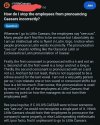
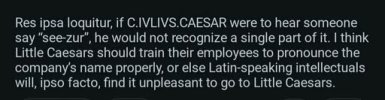
Completely ignoring the fact that no Roman, Caesar or otherwise, would recognize the dish served by that fast "food-adjacent" establishment.

And ... honestly ... what "intellectuals" hang out at a LC?

"But Dave, don't you see, most high-end "wood-fired" pizzas utilize an arrogant, overly-resilient Durham wheat crust. Caesar's crust, through its grease-induced collapse, practices a form of culinary nihilism. It accepts its fate. It does not pretend to be artisanal. It becomes one with the commodity Cheddar and single slice of bulk Pepperoni, offering a total surrender to the primal urge for caloric density."
 
Who is? Not I. Call it an annual, call it a BFR, I couldn’t care less. After all, it’s a condition inspection that’s done annually… and a flight review that’s required, you know, biennially. Hell, I’ll even correctly interpret someone’s meaning when they say “biannual” instead of “biennial”. I’ve just lost count of the number of times I’ve seen someone start griping about someone else using a term that doesn’t suit them.

I kind of assumed that would have been clear from my post, but either you misunderstood me or I misinterpreted your post. Either way I think we’re in strident agreement.
Well, language police aside, the words do matter. It can be hard to communicate effectively without some commonality. Having been through the old logging PIC arguments, I always felt that much of the misunderstanding was related to a failure to recognize the distinction between "certificate, "rating," and "endorsement." That one still happens, although much less frequently.

Biennial or biannual in connection with flight reviews? Nah, no one really cares, although if we really want to be technical, they are not really "required, you know, biennially." ;)
 
Last edited:
From 25 years ago? A CRS is only required to keep work orders on file for 2 years (14 CFR Part 145.219).
Pt 91 is only required to have it for 12 months (or until repeated) yet I'm told that an AC without logs is not worth much. A CRS is not going to dump records after two years. In 10 years when that lawsuit comes around they will need something to defend themselves. The FAA is not in the business to protect you from civil liability.

The CRS I work with/for has records going back well past 2 years if they are contract motors. No one is throwing stuff away at 2 years... I can't believe you actually think that.

Repeat after me: The FAA is not in the business to protect you from civil liability.
 
Pt 91 is only required to have it for 12 months (or until repeated) yet I'm told that an AC without logs is not worth much. A CRS is not going to dump records after two years. In 10 years when that lawsuit comes around they will need something to defend themselves. The FAA is not in the business to protect you from civil liability.
This is not a matter of the FAA trying to protect anyone, this is regulatory.

CRS's use different systems for record retainment. One example before everything went digital was having a "live file" in which records were kept the required duration then moved to an inactive file for another set duration. When that ended the files went to the incinerator.

Today there is a better chance of finding older records due to electronic record keeping.
The CRS I work with/for has records going back well past 2 years if they are contract motors. No one is throwing stuff away at 2 years... I can't believe you actually think that.
I can't believe you don't know the difference between contractual and regulatory. Not surprised.
Repeat after me: The FAA is not in the business to protect you from civil liability.
Repeat after me: Learn how a CRS does their record keeping.
 
Who is? Not I. Call it an annual, call it a BFR, I couldn’t care less. After all, it’s a condition inspection that’s done annually… and a flight review that’s required, you know, biennially. Hell, I’ll even correctly interpret someone’s meaning when they say “biannual” instead of “biennial”. I’ve just lost count of the number of times I’ve seen someone start griping about someone else using a term that doesn’t suit them.

I kind of assumed that would have been clear from my post, but either you misunderstood me or I misinterpreted your post. Either way I think we’re in strident agreement.
but it does matter because if you look at the operating limitations of a EAB you will see limit 15 in there and it says:

The inspections must be recorded in the aircraft
maintenance records showing the following, or a similarly
worded, statement: “I certify that this aircraft has been
inspected on [insert date] per the [insert either: scope and
detail of part 43, appendix D; or manufacturer’s inspection
procedures] and was found to be in a condition for safe
operation.”

i have discussed this with my POI and he agrees that wording it as an annual inspection does not meet the requirement of the operating limitations issued to the aircraft and therefore it is not in compliance.
 
but it does matter because if you look at the operating limitations of a EAB you will see limit 15 in there and it says:
...
Sigh. Really, you need to read the thread. Yes, there is specific wording that should (maybe must) be used in the logbook when you record the inspection. But if you jump back a few posts, what I said was that I don't get wrapped around the axle and feel the need to correct someone every time they refer to the condition inspection on an EAB as an "annual". Or when they refer to a flight review as a "BFR". While not technically correct, the intent and meaning are quite clear. I don't feel the need to try and look like the smartest guy in the room then any more than I do by correcting people's posts for spelling, punctuation, capitalization, or grammar.

Now, when it comes down to recording those things in a log book, then yes, of course it (theoretically) matters that the prescribed wording is used.

 
The inspections must be recorded in the aircraft
maintenance records showing the following, or a similarly
worded, statement: “I certify that this aircraft has been
inspected on [insert date] per the [insert either: scope and
detail of part 43, appendix D; or manufacturer’s inspection
procedures] and was found to be in a condition for safe
operation.”

i have discussed this with my POI and he agrees that wording it as an annual inspection does not meet the requirement of the operating limitations issued to the aircraft and therefore it is not in compliance.
What does "similarly worded" mean? An annual inspection is similar to a condition inspection, after all. I wonder if anybody has actually gotten trouble with the FAA because they called an experimental condition an "annual" in the logbook?
 
What does "similarly worded" mean? An annual inspection is similar to a condition inspection, after all. I wonder if anybody has actually gotten trouble with the FAA because they called an experimental condition an "annual" in the logbook?
1785780863798.png
 
Now, when it comes down to recording those things in a log book, then yes, of course it (theoretically) matters that the prescribed wording is used.
Not theoretically but in black and white. The lead in paragraph to Limitation 15 mentioned above specifically states "conditional inspection." And 91.409 specifically states an "annual inspection" as they are two different inspections per the guidance. However, theres nothing wrong with entering "annual condition inspection" so long as "condition" is used for your E/AB. Unfortunately, this is one of those unforced errors that only gives an open invitation for some people to dig deeper.
 
Not theoretically but in black and white.
No. Theoretically. Really. The required wording is indeed quite clear. The theoretical part is that anyone at the FAA will care... ever. That's what I meant.

Please understand, I'm not saying it shouldn't be done properly, nor am I saying that I don't strive to do it completely, accurately, and contemporaneously. I don't do it because I think the FAA or anyone else would care in the slightest - other than maybe a buyer. I do it because it's the right way to do it, and I want to do it the right way.
 
No. Theoretically. Really. The required wording is indeed quite clear. The theoretical part is that anyone at the FAA will care... ever. That's what I meant.
Fair enough. However, lack of care by the FAA wont change what the rules or guidance state and following that "theory" simply provides an easy target should it become noticed. For example, hangar fairies tend to caught when something completely unrelated happens which involves a review of the mx records. And in the case of a missing Condition term in your E/AB annual inspection sign off only provides a similar red flag moment that should not be there in the 1st place.
 
Yeah, I worked in jet engine certification for two decades. That is my job description. Kicking back reports that said "FAR" for regulations and used a previous name for our company, etc.
My father has a framed letter in his home office. A major client had sent a terse letter explaining that they were no longer "Dewey, Cheatam, and Howe." They "were now DCH-International, and expected correspondence to reflect the change."

This letter was printed on "Dewey, Cheatam, and Howe" embossed letterhead.
 
Sigh. Really, you need to read the thread. Yes, there is specific wording that should (maybe must) be used in the logbook when you record the inspection. But if you jump back a few posts, what I said was that I don't get wrapped around the axle and feel the need to correct someone every time they refer to the condition inspection on an EAB as an "annual". Or when they refer to a flight review as a "BFR". While not technically correct, the intent and meaning are quite clear. I don't feel the need to try and look like the smartest guy in the room then any more than I do by correcting people's posts for spelling, punctuation, capitalization, or grammar.

Now, when it comes down to recording those things in a log book, then yes, of course it (theoretically) matters that the prescribed wording is used.
the thing is, education of those that do it wrong, and perpetuate the wrong use, is the key to getting people to do it right.
 
Back
Top