ATC and T routes

iamtheari

Administrator
Management Council Member
Joined
Mar 15, 2016
Messages
5,585
Display Name
Ari
I mostly file GPS direct except for the mountains, where lack of pressurization and turbos keeps my flying below 15,000 and ideally below 12,000. I have found a few good routes over the Colorado Plateau using Victor airways, and Center is usually quick with a shortcut since they know the minimum IFR altitude and where they can keep me at my preferred altitudes of 9,000-12,000. But I have filed T airways a couple of times and, both times, Center seemed to be completely unaware of the airways or even what they were.

Is the GPS airway rollout just going that slowly, am I the only person actually filing those routes, or is something else going on?
 
Same here. Usually cleared on a Victor airway but often it is amended to direct after a short period (flatlands).
 
I’ve filed T-Routes in the northeast. Potomac Approach seems to like them for going around the DC area. Those have been cleared as filed with no changes other than shortcuts. But attempt on routes other than those have, so far for me, gotten amendments either before or after departure.
 
I’ve filed T-Routes in the northeast. Potomac Approach seems to like them for going around the DC area. Those have been cleared as filed with no changes other than shortcuts. But attempt on routes other than those have, so far for me, gotten amendments either before or after departure.
I get cleared as filed, but when I check in with the controller covering the area I get the radio equivalent of a blank stare. Today they asked “I don’t know what that is, can you tell me the bearing from the VOR?” I just told him the Victor airway that matched the Tango one. It didn’t make a big difference in this case. But in some places, like around Rock Springs, Wyoming, the MEA can be very different between the two.
 
I get cleared as filed, but when I check in with the controller covering the area I get the radio equivalent of a blank stare. Today they asked “I don’t know what that is, can you tell me the bearing from the VOR?”
That’s why I mentioned the lack of amendments vs receiving them. Here’s an example of a cleared and flown as filed T-Route.KLHZ HOUKY T295 GRACO CIDOB ETX KABE. The only change was a shortcut from PHL after CIDOB.

“Busy” may be the difference. T routes are in theory designed to follow real ATC paths, but the need for them in areas like DC is somewhat different than Wyoming where, as you say, it may be more for the ability to have lower MEAs.
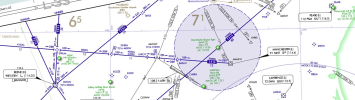
There seem to be two types of T routes. One to go around rocks at lower altitudes than a VOR-based airway would require (either due to not needing a VOR or simply not needing to be able to receive the VOR signal). The other to go around busy places with less talking than vectors would require. For a bizarre example of the latter, look at T286 or T331 south of FONIA. I have no idea what necessitated those routes and I doubt anyone has filed them since they were charted.

I suppose it's possible that I'm the first person who ever filed the T route I did this weekend, which is why ATC wasn't familiar with it. It's a pretty desolate area and most people flying there go VFR or a lot higher than I can. One time, I asked if they had any PIREPs for icing ahead of me and Center just said "nobody ever flies there."
 
I’ve filed T-Routes in the northeast. Potomac Approach seems to like them for going around the DC area. Those have been cleared as filed with no changes other than shortcuts. But attempt on routes other than those have, so far for me, gotten amendments either before or after departure.

My experience also. And sometimes amendments both before take off and in flight. :D
 
But I have filed T airways a couple of times and, both times, Center seemed to be completely unaware of the airways or even what they were.

Is the GPS airway rollout just going that slowly, am I the only person actually filing those routes, or is something else going on?
I'm guessing a lack of use. (Try asking for a contact approach or a cruise clearance sometime.) I use pretty much exactly one T route, T265 around C90. It's the shortest, easiest way to go east from here without going feet wet. Controllers are very well acquainted with that one.

OTOH, there are some really bizarre routes in less populated areas of the country, like...
For a bizarre example of the latter, look at T286 or T331 south of FONIA.
... that one. I mean, Victor airways aren't exactly straight, but they're at least reasonably going towards places airplanes might go. I guess that makes sense, because back in the bad old days before /G and /I, everyone followed them. But these T routes are often just weird and don't seem to exist for any particular reason, so I'm guessing that many of them are just never used.
 
edit.. "Today they asked “I don’t know what that is, can you tell me the bearing from the VOR?” ... edit
And just which VOR would you like a bearing from? As you can see, there are 4 locations here were the VORs are decommissioned and gone. Some older airways are gone and didn't even get T routes to replace them. EEN (KYENN), MHT (MANCH), LWM (LWRNC) and PSM (PEASE) are TACAN/DME only. The VHF frequency is for tuning the DME portion only that is used on some LOC/ILS approaches to those airports.
1740251953892.png
 
And just which VOR would you like a bearing from?
Whichever one you want. I read that request as, “I don't know what that is, can you tell me the bearing from the a VOR?”

That kind of thing can also apply to VFR. I was heading to a private airfield in the NC mountains and asked for flight following. "We don't know where that is." So I gave them the ID for a public airport about 10 NM away. When I got closer, I told the controller who was working me, "I'm heading to a private airfield; I'll call you to terminate when I have it in sight."
 
Whichever one you want. I read that request as, “I don't know what that is, can you tell me the bearing from the a VOR?”
My point was... there may not be a VOR within receivable range. A lot of the old V-Airways are gone... some overlayed by T-Routes... some no longer exist.
 
My point was... there may not be a VOR within receivable range. A lot of the old V-Airways are gone... some overlayed by T-Routes... some no longer exist.
i know about the decommissioning of VORs and Victor airways. I guess I didn’t get your point because I would never expect ATC to ask me about a VOR position if there were none in range. I’ve heard, “what’s your on course heading” too many times :D
 
In this case, I had filed to a VOR and then the T route, so it was clear what he was asking for. I looked at the en route chart and saw the Victor airway before I saw the radial.
 
In this case, I had filed to a VOR and then the T route, so it was clear what he was asking for. I looked at the en route chart and saw the Victor airway before I saw the radial.
That might be part of the confusion. It seems like sometimes they put T routes *just* off to the side of V airways, or have an intersection that's near, but not colocated with the VOR. If you file just V123->VOR->T456 the system may choke on it because it doesn't know where you want to enter T456. Something like V123->VOR->INTRS->T456 may allow it to work.

Why they aren't making it easier to switch between the airway types, I do not know.
T317 north of JNC includes the VOR, at least if you ask Garmin Pilot. Of course, Garmin Pilot also helps me plan a route that includes a SID or STAR and then errors out when trying to generate a briefing or file it because some other part of their system doesn’t recognize the procedure that it put into the flight plan for me. But with the IFR low chart showing a MCA for the airway at the VOR, I’m fairly confident I didn’t file an invalid route this time. :)
 
T317 north of JNC includes the VOR, at least if you ask Garmin Pilot. Of course, Garmin Pilot also helps me plan a route that includes a SID or STAR and then errors out when trying to generate a briefing or file it because some other part of their system doesn’t recognize the procedure that it put into the flight plan for me. But with the IFR low chart showing a MCA for the airway at the VOR, I’m fairly confident I didn’t file an invalid route this time. :)
Just curious, what was your route?

Edit: Wow. After looking further, T317 *almost* exactly duplicates V187 all the way from FETIK near Riverton, WY down to AWASH near Albuquerque. The only difference I could find is that HERRM intersection appears to be on the V airway but not the T airway.

Going the other direction, T317 and V187 are with each other north to Billings and Great Falls, then west *almost* all the way to Ellensburg, WA where the situation I was talking about earlier comes up: The T airway goes to MERFF, which is about 0.8nm north of the Ellensburg VOR (ELN). Then V187 looks like it is going to rejoin T317 but it abruptly ends at THICK where they appear to come back together.

The other oddity I noticed on this airway: Sometimes the V187 MEA is lower than the T317 MEA. I thought T-airway MEAs only had to keep you out of terrain, whereas V airway MEAs also had to guarantee VOR signal reception. So how can the T airway have a higher MEA? :dunno: @RussR
 
Last edited:
Just curious, what was your route?

Edit: Wow. After looking further, T317 *almost* exactly duplicates V187 all the way from FETIK near Riverton, WY down to AWASH near Albuquerque. The only difference I could find is that HERRM intersection appears to be on the V airway but not the T airway.

Going the other direction, T317 and V187 are with each other north to Billings and Great Falls, then west *almost* all the way to Ellensburg, WA where the situation I was talking about earlier comes up: The T airway goes to MERFF, which is about 0.8nm north of the Ellensburg VOR (ELN). Then V187 looks like it is going to rejoin T317 but it abruptly ends at THICK where they appear to come back together.

The other oddity I noticed on this airway: Sometimes the V187 MEA is lower than the T317 MEA. I thought T-airway MEAs only had to keep you out of terrain, whereas V airway MEAs also had to guarantee VOR signal reception. So how can the T airway have a higher MEA? :dunno: @RussR
Dunno, but maybe it’s an ATC thing. Like they don’t want airplanes lower on those segments so they requested higher MEA’s. And the Terps dudes said Ok. Don’t change that RNAV is an authorized substitute in this case so ya can use the Victor Airway numbers to keep yourself off the rocks, including MOCAs beyond 22 miles.
 
The other oddity I noticed on this airway: Sometimes the V187 MEA is lower than the T317 MEA. I thought T-airway MEAs only had to keep you out of terrain, whereas V airway MEAs also had to guarantee VOR signal reception. So how can the T airway have a higher MEA? :dunno: @RussR
T-Routes MEAs are designed to ensure 2-way communications.
 
Last edited:
Just curious, what was your route?

Edit: Wow. After looking further, T317 *almost* exactly duplicates V187 all the way from FETIK near Riverton, WY down to AWASH near Albuquerque. The only difference I could find is that HERRM intersection appears to be on the V airway but not the T airway.

Going the other direction, T317 and V187 are with each other north to Billings and Great Falls, then west *almost* all the way to Ellensburg, WA where the situation I was talking about earlier comes up: The T airway goes to MERFF, which is about 0.8nm north of the Ellensburg VOR (ELN). Then V187 looks like it is going to rejoin T317 but it abruptly ends at THICK where they appear to come back together.

The other oddity I noticed on this airway: Sometimes the V187 MEA is lower than the T317 MEA. I thought T-airway MEAs only had to keep you out of terrain, whereas V airway MEAs also had to guarantee VOR signal reception. So how can the T airway have a higher MEA? :dunno: @RussR
The route I filed was KGJT JNC T317 OCS T298 CZI. So I was only on T317 from JNC to OCS. The MEA bought me cruising altitudes at least 1,000 feet lower than on V187, but a MOCA usually 100-300 feet higher. Then T298 gave me a more direct line to where I was going than staying on T317.

I kind of threw this route together on short notice to divert around a worse icing forecast on my preferred route, JNC V26 DDY V298 GCC. I picked T317 over V187 because of the lower MEA on this short stretch between JNC and OCS. It's not a big difference and I ended up higher anyhow, but at least there was a chance of flying it without supplemental oxygen.
 
Wouldn’t Victor Airways be the same?

EDIT: Found it. https://www.pilotsofamerica.com/community/threads/ifr-mea-question.107762/
I haven’t looked to see if things have changed since then.
The latest TERPS suggests that it's a requirement for both GNSS and VOR routes. But I have seen it mentioned only with respect to GNSS routes in FAA publications such as the IPH.

My WAG is that a communications requirement was not originally part of the requirement for Victors (when comm capability was more iffy anyway). If there is a TERPS Victor comm requirement, it's only going to apply to Victor airways created after the requirement was added. How many of those are there?

I'm sure @RussR will be along at some point to correct me.

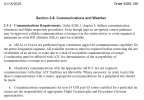
The FAAO 8260.19K requires communication at the MEA for all enroute routes. Here's the pertinent extract. I can't speak to the history of the requirement.

1740411887282.png
 
The FAAO 8260.19K requires communication at the MEA for all enroute routes. Here's the pertinent extract. I can't speak to the history of the requirement.
Russ,

Any idea why an MEA would be higher on a T route than a V?
 
Russ,

Any idea why an MEA would be higher on a T route than a V?
Well okay, I guess I have some idea.

If you're talking something like TESSY to JNC with T MEA 10100 and V MEA of 10000 or MANCA to RIZAL T - 11200 and V - 10900, those are close enough in value that without any further information, I'd chalk it up to "when was the airway first developed, what tools were in use at the time, and what criteria on rounding was in use."

Airways are reviewed every 4 years for safety, but don't need amending that often. So there are some V airways out there that were developed decades ago, and done using literal pen on paper maps, straightedges, protractors, etc. So "what's the highest terrain in this segment" often had a lot to do with how accurate your line was, and how thick your pen was. Squint one way or the other and the MEA goes up or down a hundred feet or so. There's 2000 feet of clearance in the mountains for a few reasons, but that's one of them.

In addition, in the past we were allowed to "round down" on airways. So if the obstacle + 2000 (mountainous) = 10049, we could round down to 10000. Nowadays (at least the last 20 years) there is no rounding down for obstacles, so that same segment would be 10100.

And then there's the application of mountainous ROC (Required Obstacle Clearance) reduction from 2000 to 1700 (western US) or 1500 (eastern US) if certain criteria are met, some of which are subjective and some of which rely on tools that have evolved over the years.

If you have an example of the T MEA being significantly higher than the V MEA (say, more than 500 feet or so), I'd be interested in looking into it further.
 
If you're talking something like TESSY to JNC with T MEA 10100 and V MEA of 10000 or MANCA to RIZAL T - 11200 and V - 10900, those are close enough in value that without any further information, I'd chalk it up to "when was the airway first developed, what tools were in use at the time, and what criteria on rounding was in use."

Airways are reviewed every 4 years for safety, but don't need amending that often. So there are some V airways out there that were developed decades ago, and done using literal pen on paper maps, straightedges, protractors, etc. So "what's the highest terrain in this segment" often had a lot to do with how accurate your line was, and how thick your pen was. Squint one way or the other and the MEA goes up or down a hundred feet or so. There's 2000 feet of clearance in the mountains for a few reasons, but that's one of them.

In addition, in the past we were allowed to "round down" on airways. So if the obstacle + 2000 (mountainous) = 10049, we could round down to 10000. Nowadays (at least the last 20 years) there is no rounding down for obstacles, so that same segment would be 10100.

And then there's the application of mountainous ROC (Required Obstacle Clearance) reduction from 2000 to 1700 (western US) or 1500 (eastern US) if certain criteria are met, some of which are subjective and some of which rely on tools that have evolved over the years.
Ahhhh, that all makes sense. Interesting!
If you have an example of the T MEA being significantly higher than the V MEA (say, more than 500 feet or so), I'd be interested in looking into it further.
It does look like the vast majority of them are within 300 feet, or at least have some reasonably obvious reason why they aren't. It seems like the V airway has more crossing altitudes where the T airway will just have a short segment with a higher MEA instead (example: BACUN to DATES, V airway has 4000 Eastbound MEA and a 4500 crossing restriction at DATES, whereas the T airway just has a 4500 MEA on that segment).

Nearby, NIALS to FEBUS has a 500 foot difference (4900G on T317 vs 4400 on V187) but I think that's the highest I've seen.
 
Back
Top