Army’s Future Tiltrotor

All this is going to go away (manned, slow, and risky) and replaced with swarms of drones with multiple roles, from long range weapons and fuel carrying, to short range surveillance, support, and explosive drones.
 
Army’s Future Tiltrotor


Comments

Tilt rotor aircraft offer the promise of hauling troops farther, faster and being somewhat less vulnerable to ground fire enroute. However, that comes with a higher cost in dollars, training complexity, LZ size requirements, etc. The Marines love how a MEU can be deployed farther & faster off the boat using the Osprey. Obviously, nobody likes the fatal crashes that have come as we learn operational lessons in utilizing a new technology. Adding in the ability to more easily add mission systems seems smart, but the devil is in the details.
 
All this is going to go away (manned, slow, and risky) and replaced with swarms of drones with multiple roles, from long range weapons and fuel carrying, to short range surveillance, support, and explosive drones.
None of the roles you mentioned include troop transport.
 
It’s too late now but I agree with this guy. I’m also starting to believe that large scale air assaults in heavily contested airspace have become antiquated.

 
Last edited:
None of the roles you mentioned include troop transport.
There will not be a need for troops on the front line. They will be way behind controlling the drones.
 
All this is going to go away (manned, slow, and risky) and replaced with swarms of drones with multiple roles, from long range weapons and fuel carrying, to short range surveillance, support, and explosive drones.
Tiltrotors can do things helicopters can't... and helicopters can do things tiltrotors can't. Same with eVTOLs, drones, and so on. And that goes for both the civilian and military worlds. Its also the reason the 60 year old B-52 is still a front line bomber and they still use C46s and DC-3s on the civilian side. Back in the late 40s they thought all conventional military equipment was to become obsolete with the nuclear age, but it didn't. There is no one solution especially on the aviation side.
 
@Bell206 nailed it. Army is going to still need the Blackhawk (or similar) even with the Bonanza V Tailed tilt rotor.
 
The US military is retooling to fight the Chinese in the Pacific. Range and speed are key there. Tiltrotors will be able to make some island hops that helicopters cannot.
 
That depends on your expected lifetime. China is going to bring these technologies up in the next 10-20 years. We better keep up.
We are. Drones are the answer for a lot of situations, but we're many decades away from fully autonomous warfare.
 
Forget Russian S300/400 ADA. Forget MANPADs. Those systems are dangerous enough. Warfare is progressing so rapidly with AI kamikaze drones just in the last few years that I think a flight of V-280s in a peer level war would be suicide. If you look at the stuff Palmer Luckey and the boys at Anduril are putting out, then Chinese companies in turn, manned aircraft aren’t going to survive. We had it relatively easy getting “boots on the ground” in OIF / OEF. Those days are long gone.


Last edited:
I've seen the Anduril systems first hand. They're not ready for war.
 
Forget Russian S300/400 ADA. Forget MANPADs. Those systems are dangerous enough. Warfare is progressing so rapidly with AI kamikaze drones just in the last few years that I think a flight of V-280s in a peer level war would be suicide. If you look at the stuff Palmer Luckey and the boys at Anduril are putting out, then Chinese companies in turn, manned aircraft aren’t going to survive. We had it relatively easy getting “boots on the ground” in OIF / OEF. Those days are long gone.


I thought tanks were obsolete too, but the Ukrainians seem to keep on using them. Same for fighter jets. Sometimes I think the only things that are obsolete in modern war are horses. Swords maybe.
 
Going into Vietnam everyone knew dog fights were obsolete. Go fast point missile and shoot. That didn’t work out.

As far as horses go, after 911 we went into Afghanistan. Some Army Special Forces moved around - yep, on horses.

1747059848641.png
 
Last edited:
I thought tanks were obsolete too, but the Ukrainians seem to keep on using them. Same for fighter jets. Sometimes I think the only things that are obsolete in modern war are horses. Swords maybe.
Well it’s all about ASE and I’m sure the Army will equip them with a better ASE suite than Black Hawks. I still think we’ve approached a time where old school tactics of NOE and basic IR jammers just won’t cut it.

They’re gonna have to fight their way in through a myriad of high end ADA (S300/400), EW, defensive air, MANPADs. By the time this thing enters service, the Chinese will have swarms of kamikaze drones to contend with. And even if they get through all that, they’ll have traditional SAFIRE from infantry waiting for them. Not to mention, long range arty has gotten crazy accurate in the last 15-20 years. We’ve never seen this degree of threat in Army Aviation and this aircraft isn’t going to be a game changer over helicopter survivability. Better yes, but no game changer.
 
Last edited:
Going into Vietnam everyone knew dog fights were obsolete. Go fast point missile and shoot. That didn’t work out.

As far as horses go, after 911 we went into Afghanistan. Some Army Special Forces moved around - yep, on horses.

View attachment 140960
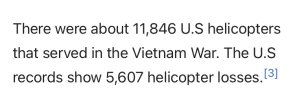
And that was the type of tactic that works well in unconventional guerrilla warfare. Those guys did more in 6 months than the rest of us did in the next 15 years. Problem is, that ain't gonna work in China. We had complete control of the air there. If we go into the China theater , our losses will be far worse than Vietnam…and that was bad.

IMG_0194.jpeg
 
And that was the type of tactic that works well in unconventional guerrilla warfare. Those guys did more in 6 months than the rest of us did in the next 15 years. Problem is, that ain't gonna work in China. We had complete control of the air there. If we go into the China theater , our losses will be far worse than Vietnam…and that was bad.

View attachment 140961
A non-trivial percentage of those losses were accidents. When a crash is designated as a combat loss, the books are closed quickly and no investigation or messy paperwork is involved. Nobody had the time for that. And it was more compassionate to inform next of kin that their loved one died of combat related causes.
 
I thought tanks were obsolete too, but the Ukrainians seem to keep on using them. Same for fighter jets. Sometimes I think the only things that are obsolete in modern war are horses. Swords maybe.
Not quite as obsolete as they might seem. The Brits had the last bayonet charge only 14 years ago in Afghanistan, and shortly after the war began, Green Berets led a cavalry charge.
 
And that was the type of tactic that works well in unconventional guerrilla warfare. Those guys did more in 6 months than the rest of us did in the next 15 years. Problem is, that ain't gonna work in China. We had complete control of the air there. If we go into the China theater , our losses will be far worse than Vietnam…and that was bad.

That assumes their actual combat capabilities are as good as their claimed capabilities.
 
I thought tanks were obsolete too, but the Ukrainians seem to keep on using them. Same for fighter jets. Sometimes I think the only things that are obsolete in modern war are horses. Swords maybe.

Tanks and fighters are still used, but much differently than previously envisioned.

Tanks stay behind the lines, under cover, and are brought forward as singletons for short engagements. Tanks that stay anywhere near the front line are quickly spotted by thermal ISR drones and killed by loitering munitions.

Fighters are same. Anything that gets near the FEBA dies quickly from multiple SAM layers. Both sides hang back and lob glide bombs from 30 miles behind their own lines.
 
Well it’s all about ASE and I’m sure the Army will equip them with a better ASE suite than Black Hawks. I still think we’ve approached a time where old school tactics of NOE and basic IR jammers just won’t cut it.

They’re gonna have to fight their way in through a myriad of high end ADA (S300/400), EW, defensive air, MANPADs. By the time this thing enters service, the Chinese will have swarms of kamikaze drones to contend with. And even if they get through all that, they’ll have traditional SAFIRE from infantry waiting for them. Not to mention, long range arty has gotten crazy accurate in the last 15-20 years. We’ve never seen this degree of threat in Army Aviation and this aircraft isn’t going to be a game changer over helicopter survivability. Better yes, but no game changer.

It is possible that tiltrotor range and speed improve survivability by spreading the battlefield out. In Ukraine, both sides have an incredible density of ISR and precision fires along the line of contact, but the rear areas are just too vast to protect. Ukraine is taking advantage of that to hammer Russian rear area logistics with drones that are often just LSA aircraft packed with explosives.

Old school tactical air assault with a brigade of the 101st in one massive formation ... yeah, that ain't gonna happen. Anywhere within artillery, MLRS, or loitering munitions range and that LZ is going to be a mess.

But swarming drones and loitering munitions have range limitations, and it takes time to position platforms and operators in the right spot. As long as they and their operators are finite resources, they cannot be preemptively placed everywhere.

So the "theory" is that you go around or behind the battle lines and operate a hundred plus miles in the rear. Hopefully the landing platforms get in unopposed and get the hell out before the killing platforms can react. Then the ground forces disperse and use their own smart munitions, drones, etc. to raise havoc.

I say theory because everything is changing faster than anyone can understand it, and nobody really knows how warfare is going to evolve in the next few years.
 
Last edited:
There is no one solution especially on the aviation side.

So we found out when Robert McNamara tried ramming the F-111 down everyone's throat - though they did use it to go after Muammar Gaddafi. I hope he (McNamara) is rotting in hell for what did to us in Vietnam.

The US military is retooling to fight the Chinese in the Pacific. Range and speed are key there. Tiltrotors will be able to make some island hops that helicopters cannot.

This going to be a war without a shot fired.. but, I do believe that neither side wants this.
 
So we found out when Robert McNamara tried ramming the F-111 down everyone's throat - though they did use it to go after Muammar Gaddafi. I hope he (McNamara) is rotting in hell for what did to us in Vietnam.

There is no one solution especially on the aviation side.

That is a lesson that DoD never seems to learn. Hence the F-35 and parking the A-10s.
 
101st gets it first.

What is the round trip operating radius fully loaded?

For guys who draw big arrows on maps, this has some interesting possibilities.
 
What I wonder about is MV-75 armament.

Speed and (lack of) altitude.

I have some limited operational experience with the V-22. IMO they are unsuitable for assault roles. The transition from approach to landing is very deliberate. If you mismanage it and get into vortex ring state, you flip over and die. I would not want to do it under fire. Presumably the Army will keep some Blackhawks and Chinooks for that role.
 
I have some limited operational experience with the V-22. IMO they are unsuitable for assault roles. The transition from approach to landing is very deliberate. If you mismanage it and get into vortex ring state, you flip over and die. I would not want to do it under fire. Presumably the Army will keep some Blackhawks and Chinooks for that role.
Army cancelled the improved 901 engine for the Black Hawks and Apaches. It was intended as a life extension for those airframes, which will be around for years to come. Maybe not smart. As far as the venerable CH-47, don't forget the Bin Laden raid where the good old Hook came to the rescue. The B-52 of Army Aviation.

As far as the characteristics of the tilt rotor, I agree with your assessment. The vortex ring effect is a real problem in the night assault where there is a high degree of crap and confusion. Just avoiding obstacles and other rapidly maneuvering aircraft in close proximity in a swirling dust cloud viewed through goggles is enough without the other stressors such as your aircraft threatening to kill you. That would be the last straw.

I can see one mission like loading up drone teams in the MV-47 cargo bay, flying to the enemy's back yard, and letting them out to do their thing. The future of war appears to be Ukraine/Russia drones combined with a lot of stand-off operations, as you say. Tanks doing long distance shooting, etc.
 
Last edited:
Army cancelled the improved 901 engine for the Black Hawks and Apaches. It was intended as a life extension for those airframes, which will be around for years to come. Maybe not smart. As far as the venerable CH-47, don't forget the Bin Laden raid where the good old Hook came to the rescue. The B-52 of Army Aviation.

As far as the characteristics of the tilt rotor, I agree with your assessment. The vortex ring effect is a real problem in the night assault where there is a high degree of crap and confusion. Just avoiding obstacles and other rapidly maneuvering aircraft in close proximity in a swirling dust cloud viewed through goggles is enough without the other stressors such as your aircraft threatening to kill you. That would be the last straw.

I can see one mission like loading up drone teams in the MV-47 cargo bay, flying to the enemy's back yard, and letting them out to do their thing. The future of war appears to be Ukraine/Russia drones combined with a lot of stand-off operations, as you say. Tanks doing long distance shooting, etc.
I’ve always said the weak link with tilt rotors is having an engine that far out from the longitudinal axis. You take out that pod and they’re done. You take out the engine on a CH-53, UH-60, etc, and they can either hover or land straight ahead. It’s survivable. Of course a typical helicopter has an Achilles heel with the tail rotor though. The Somalis took advantage of that.
 
I’ve always said the weak link with tilt rotors is having an engine that far out from the longitudinal axis. You take out that pod and they’re done. You take out the engine on a CH-53, UH-60, etc, and they can either hover or land straight ahead. It’s survivable. Of course a typical helicopter has an Achilles heel with the tail rotor though. The Somalis took advantage of that.
Another potential vulnerability: clutch(es). A simple engine failure where it still stays attached in the pod should not bring down the aircraft. I hope the new design is overbuilt compared to the V-22. I would like to know the real story on that but it may never be public knowledge.
 
I’ve always said the weak link with tilt rotors is having an engine that far out from the longitudinal axis.
Another potential vulnerability: clutch(es).
While I agree the tiltrotor is a niche aircraft, I have to admit the 280 appears to have corrected some of the issues with the 22 of which there is only a basic comparison. And short of one of the 280s engine nacelle assys being knocked off along with the proprotor, it supposedly will have an increased survivability over the 22 when it comes to OEI ops. Also given the engines no longer rotate as in the 22, nor does the wing, it greatly simplifies the drivetrain to include the clutch system. As to why the 22 clutches had hard engagements, its my understanding they still do not know what the root cause is. So most of the mitigative clutch fixes were based on a guess which has seemed to have worked for now. But just like the Corvair, I doubt the 22 or possibly tiltrotors in general will ever out run that stigma even though if you dig into the accident data, pilot error dominates the causes vs the clutches.
 
So most of the mitigative clutch fixes were based on a guess which has seemed to have worked for now. But just like the Corvair, I doubt the 22 or possibly tiltrotors in general will ever out run that stigma even though if you dig into the accident data, pilot error dominates the causes vs the clutches.
The old joke in my office was that 'engineering judgement' was a euphemism for guess. Sometimes it's the best you can do.
 
It is in the field. That doesn't mean it's any good or actually does what's claimed in testing vs real world engagements. One of the Anduril systems I was impressed with, another one was hot garbage. Also true for a lot of other systems. Syria in particular became one big proving ground for systems testing. Some of the ones claimed to be ready for real-world engagements turned out to be dumpster fires.
 
This aircraft isn’t even starting service for another 5 years. There’s no telling what the drone threat will be 5 years from now. As fast as things are progressing, unless it has a red force field button, it’s gonna be vulnerable to drones.

People look at how well RW aviation did in OIF / OEF. There was no real ADA / drone threat in both theaters. There were MANPADs but most were obsolete and our ASE systems for the most part defeated them. It was like Somalia; small arms & light weapons fire.

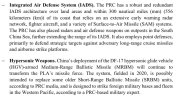
These aircraft aren’t even close to being stealthy and their movements to the Chinese theater would be closely monitored. They’d be sitting ducks for a hypersonic missile launch while sitting on the ramp in Okinawa / Philippines. China has also past us with GPS denial weapons. Good chance these aircraft would have to go it alone across wide open ocean with no GPS aided nav.

Basically if war with China breaks out it won’t be a walk in the park like we’ve had in the past. Like I said, it’ll be in a highly contested airspace where we haven’t seen this type of RW aviation threat before.

IMG_0223.jpeg
 
This aircraft isn’t even starting service for another 5 years. There’s no telling what the drone threat will be 5 years from now. As fast as things are progressing, unless it has a red force field button, it’s gonna be vulnerable to drones.

People look at how well RW aviation did in OIF / OEF. There was no real ADA / drone threat in both theaters. There were MANPADs but most were obsolete and our ASE systems for the most part defeated them. It was like Somalia; small arms & light weapons fire.

These aircraft aren’t even close to being stealthy and their movements to the Chinese theater would be closely monitored. They’d be sitting ducks for a hypersonic missile launch while sitting on the ramp in Okinawa / Philippines. China has also past us with GPS denial weapons. Good chance these aircraft would have to go it alone across wide open ocean with no GPS aided nav.

Basically if war with China breaks out it won’t be a walk in the park like we’ve had in the past. Like I said, it’ll be in a highly contested airspace where we haven’t seen this type of RW aviation threat before.

View attachment 141125

Agreed with all, but one could argue that range and speed make tiltrotors less vulnerable than helicopters, because they can be based farther back and under more layers of counter-missile protection. That has been a trend of the war in Ukraine. All Russian air and logistics assets are at least 50-75km to the rear or they get hammered by MLRS. They also resort to old fashioned protection measures like dispersion, individual revetments, netting, and decoys. Hypersonic missiles are limited, expensive assets. If you spread out and harden such that the Chinese cannot take out more than one aircraft with a single warhead, the vulnerability becomes operationally acceptable.
 
Agreed with all, but one could argue that range and speed make tiltrotors less vulnerable than helicopters, because they can be based farther back and under more layers of counter-missile protection. That has been a trend of the war in Ukraine. All Russian air and logistics assets are at least 50-75km to the rear or they get hammered by MLRS. They also resort to old fashioned protection measures like dispersion, individual revetments, netting, and decoys. Hypersonic missiles are limited, expensive assets. If you spread out and harden such that the Chinese cannot take out more than one aircraft with a single warhead, the vulnerability becomes operationally acceptable.
Yeah the speed and range will help but at some point, they become helicopters on approach, landing and departing. Different than say an attacking FW where “speed is life.” They’re in and out.

The Valor is gonna have to slug it out in the trenches so to speak and I just hope it packs a punch. I’d like to believe it’ll still retain human gunners but I’m sure it’ll have some sort of automated defense systems. Most likely like the Osprey, a belly gun. It better be bristling with “Flying Fortress” type of armament is all I got to say. ;)
 
Back
Top