Another 0200 carb ice thread

JSTootell

Filing Flight Plan
Joined
Aug 27, 2024
Messages
29
Location
Riverside, CA
Display Name
JSTootell
Home Airfield
KRIR
I don't think I can count how many hours I have spent now reading posts about carb ice, and I still feel like I'm just not sure what to do.

What you say? Talk to my CFI? He's in his 70's, has thousands of hours on who knows how many planes in the past 40 years, thinks it's crazy that I have even experienced it. He believes me, but thinks it's crazy.

Ask a mechanic? The mechanic thinks it's crazy too. He said he has tried to get carb ice, and hasn't experienced it. But I have, TWICE, in only a few months time. He flies a bit of everything from C150's (he uses my C150 to instruct) to a DC3.

So, what the hell? I've read the POH, and it doesn't agree with the pilots of the Internet. But my plane doesn't behave like the pilots of the Internet nor what the POH says.

Before I explain what happened, this is my question (TL;DR): do I just put on full carb heat every 20 or so minutes for a minute or so, and just make it a routine like swapping tanks? POH says to play with partial carb heat, but that's where the internet pilots disagree. Also, why does everyone (including the POH) say that the power will return, when I'm sucking hot manifold air? Or is it just an exaggeration and I'm just looking for a smooth engine, but not full power. I was taught that I check the carb heat during run up to make sure it works by looking for an RPM drop, but the Internet says that's a sign of carb ice. But since no one around me seema to get carb ice, maybe they all learned wrong too?

My two scenarios. I'm a low hour, new PPL (150ish hours in 3 years since I started training). Both occured in southern California.

So, here I am, I'm on my way home from a desert airport on a hot, dry day. I was going to go for a bike ride, but I forgot to bring tie down straps and wasn't sure where they were on this nearly abandoned WWII era field, so I canceled my plans and left because the winds were just too high. Warm fall, desert, windy day. Humidity was probably as close to 0% as physically possible. So I'm cruising at 8500', full throttle, leaned, and the engine starts stuttering. Uh, that's not right. I flew this plane from Northern Washington state to southern California over three days, and not a single hiccup. Now the engine is dying. I pitch for best glide, declare to ATC as I'm already on flight following, and do an emergency landing at an uncontrolled almost right below me. Probably the best landing I've had since my check ride, which was nice since I didn't think I had a go around option and the runway was short (we learn slips for a reason, and they paid off on short final). I do a runup before shutdown and everything seems normal. I go through and check the tanks for fuel and water, nothing. Call my CFI friend and ask him for thoughts. I decide to do another runup and if it checks out, I'll fly it home, the flight was uneventful. We talk about the potential for carb ice, but it still seems crazy. I did use carb heat and all as I was gliding, but didn't want to risk something happening as I was about to fly over a 6000' mountain, which is why I turned to a small, desert field.

About a month later I fly to Utah and back overnight for the long solo XC for CPL (eventually). Zero issues.

Couple months later, I'm cruising at 8500' again, leaned at full throttle. Beautiful, clear skies, typical southern California winter day. I just got over a 5000' mountain, and it starts to get rough again. I pull carb heat and it runs worse, but I leave the heat on. This is one of the places where the POH and pilots don't match my plane. The word is to pull carb heat until the engine smooths out and regains power, but that NEVER happens in my plane. You pull carb heat, and you are losing a couple hundred RPM period and that power isn't coming back. After a minute or so I try to put the carb heat back in, and the engine stumbles hard, so I pull it back out. I can't remember what I did with the mixture and throttle at the time though. I turn 180° towards home and let ATC (again on FF) know I'm returning to base with a rough engine, but not declaring. Convenient timing, someone else started squawking 7700 and NORDO at the same time, so I was lower priority. But ATC was playing big brother with me with handoffs getting a warning. I make it back home 20ish minutes later uneventful, with no more symptoms after I put the carb heat back in.

My CFI and mechanic believe me, but think it's crazy that I have this experience.
 
I'd be curious to see what the skew t said the humidity was like at 8500' in winter. If there's no moisture and the plane didn't respond to carb heat (assuming your carb heat works... do you have a carb temp gauge?)... are you sure it was carb ice? Are the fuel caps, vent, and interconnect ok? What was the OAT up there? Could a slug of water have frozen in the gascolator or carb?
 
I wrote a post here two years ago about an instance I had that I thought was carb ice and turned out to be a magneto going out. It was intermittent as well although much tighter spacing than your situation. I have definitely experienced carb ice once - and like you, I'm told it's rare. It was after dark here on the Cape in the fall. Low cloud deck, doing IFR maneuvers. I was climbing after a practice stall and the engine started to slowly lose power and run rough. Instructor suggested I pull heat as if he'd done it a thousand times. After that everything was textbook. Engine ran a little rough as the hot air was introduced and then smoothed out after a few seconds. Nothing like what you're describing in the second instance. Why don't you take a read of my situation here and compare to what you've experienced.

Edit after reading Gary's post reminded me: The club I'm in has a Vashon Ranger VR7. We've found she's VERY susceptible to carb ice especially while taxiing. DO NOT listen to anyone who tells you it's not a thing to be concerned about. There are more than a handful of aviation crashes and deaths that are attributed to carb ice. Mainly because they can't find a cause after they piece the plane back together.
 
I'd be curious to see what the skew t said the humidity was like at 8500' in winter. If there's no moisture and the plane didn't respond to carb heat (assuming your carb heat works... do you have a carb temp gauge?)... are you sure it was carb ice? Are the fuel caps, vent, and interconnect ok? What was the OAT up there? Could a slug of water have frozen in the gascolator or carb?
It did respond to carb heat. Just not as I am lead to believe on my reading. But since so few around me have experience, it could have been normal.

Could be moisture? Just feels unlikely to me. But, that's a big part of why it's rare where I am.

I'm not sure it was carb ice, just explains all the symptoms.

I can't remember the OAT, I did look, but forgot.

No carb temp gauge.
 
I wrote a post here two years ago about an instance I had that I thought was carb ice and turned out to be a magneto going out. It was intermittent as well although much tighter spacing than your situation. I have definitely experienced carb ice once - and like you, I'm told it's rare. It was after dark here on the Cape in the fall. Low cloud deck, doing IFR maneuvers. I was climbing after a practice stall and the engine started to slowly lose power and run rough. Instructor suggested I pull heat as if he'd done it a thousand times. After that everything was textbook. Engine ran a little rough as the hot air was introduced and then smoothed out after a few seconds. Nothing like what you're describing in the second instance. Why don't you take a read of my situation here and compare to what you've experienced.

Edit after reading Gary's post reminded me: The club I'm in has a Vashon Ranger VR7. We've found she's VERY susceptible to carb ice especially while taxiing. DO NOT listen to anyone who tells you it's not a thing to be concerned about. There are more than a handful of aviation crashes and deaths that are attributed to carb ice. Mainly because they can't find a cause after they piece the plane back together.
I'm definitely taking it seriously, just trying to figure out what I'm missing. I'll consider that magneto issue though.
 
Couple months later, I'm cruising at 8500' again, leaned at full throttle. Beautiful, clear skies, typical southern California winter day. I just got over a 5000' mountain, and it starts to get rough again. I pull carb heat and it runs worse, but I leave the heat on. This is one of the places where the POH and pilots don't match my plane. The word is to pull carb heat until the engine smooths out and regains power, but that NEVER happens in my plane. You pull carb heat, and you are losing a couple hundred RPM period and that power isn't coming back. After a minute or so I try to put the carb heat back in, and the engine stumbles hard, so I pull it back out. I can't remember what I did with the mixture and throttle at the time though.
That sounds like either mixture issues, or weak spark from bad plugs or mags. When were those mags last off the engine for internal inspection? 500 hours is the usual interval, but there are a lot of mags out there being run until they fail. And fail they will, at altitude where the air is less dense and does not adequately insulate the mag's internal components against internal arcing to ground. If that spark goes to ground in there, it doesn't get to the spark plug. Mags on airplanes that can reach high altitudes are pressurized off the turbo to prevent that.
What you say? Talk to my CFI? He's in his 70's, has thousands of hours on who knows how many planes in the past 40 years, thinks it's crazy that I have even experienced it. He believes me, but thinks it's crazy.
If he has spent all those hours in SoCal, maybe he really never has experienced carb ice. But most of the rest of the country sure does.
I wrote a post here two years ago about an instance I had that I thought was carb ice and turned out to be a magneto going out. It was intermittent as well although much tighter spacing than your situation.
That there, as I posted above.

Way too many pilots are not being taught to check the temperature and dewpoint on the METARs before flying. That's what will alert you to the possibility of carb ice. Let's see. My old hometown, this moment:

METAR CYKA 022300Z 10011KT 40SM FEW040 SCT080 OVC170 06/03 A3019 RMK SF1AC4AC4 SF TR SLP240=

Temp 6°C, dewpoint 3°C. A three-degree spread. That's carb ice country right now. Even worse is Vancouver, right on the coast:

METAR CYVR 022300Z 06008KT 3SM -RA BR OVC014 08/08 A3023 RMK SC8 SLP240=

Temp and dewpoint the same. Guaranteed carb ice.

But Calgary? Not much risk:

METAR CYYC 030000Z 28015KT 40SM SCT180 SCT220 BKN250 08/M08 A3000 RMK AC3CI1CI3 SLP196=

A 16-degree spread between temp and dewpoint.

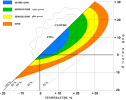
So we can plot those on the typical carb ice chart and it will tell us what the icing risk is:

1770077093491.png

Get the picture?
 
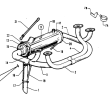
Another item that occasionally shows up on 150’s is the Carb Inlet Duct
at the front baffle. The routing results in the bottom of duct forming a half loop. The inlet on the baffle is horizontal ; the Scoop is for Cabin Heat.
Water and other things can enter and remain at the bottom of the loop.
The trapped water can do 2 things:

1. Rust out the internal wire of the duct that will cause it to collapse.
During run up it gives the illusion that Carb Heat is working really well
but it’s due to restricted airflow.

2. When Carb Heat is activated at higher power in flight the water is moved
into contact with the Muffler. It then turns to steam and the engine dies.
Scary till it recovers.
 
I have had it happen when I first start the engine and idle a little high. It would get ruff and them smooth out without carb heat because I didn't know to use it even on the ground.
Thought something was wrong, discussed it with my mechanic.
I sent the mag out for inspection and that didn't fix it.
I have had it happen in cruise shortly after take off when the engine is not all the way warmed up.
Have had it happen during decent in clear sky's.
Happens every time in decent through clouds.
It happened on a climb out after a practice instrument approach. Got both my piper CFII and I attention.

I learned to fly in a S model 172, so no carb heat training.

What made it worse early on for me was after I got my PPL I started flying with 40 year pilot Captain who fly's pipers and said to me they never make ice. He provided me lot's of training after I got my PPL but we never focused on carb heat. He did not think I needed carb heat much. Well after plenty of hours with me in my 172 during instrument training approach's when it did it and carb heat stopped it he is a believer now. He fly's my 172 just for fun and now he uses it just I like do.
I have proven many times that the plane needs carb heat any time out of the green and my fingers are on it the carb heat knob on every climb out and it's always on in the pattern. My wife knows what it is, carb ice. She hates it so I stay ahead of it.
 
Last edited:
Also, why does everyone (including the POH) say that the power will return, when I'm sucking hot manifold air? Or is it just an exaggeration and I'm just looking for a smooth engine, but not full power. I was taught that I check the carb heat during run up to make sure it works by looking for an RPM drop, but the Internet says that's a sign of carb ice.
You might have a misunderstanding right here.

When you check the carb heat during runup, you want the RPM to drop and then NOT rise. You want the RPM to drop because that shows the carb heat is working (the hotter air enriches the mixture), and you want the RPM to stay lower because if the RPM rises after you apply carb heat, it means you had carb ice.

If the same thing is happening in flight (carb heat lowers rpm and it never comes back up), it may indicate that your problem is not actually carb ice.
 
When you check the carb heat during runup, you want the RPM to drop and then NOT rise. You want the RPM to drop because that shows the carb heat is working (the hotter air enriches the mixture)
That is an important point. After applying carb heat in the air, you should lean the mixture.
 
16-degree spread between temp and dewpoint.
It was 25/02 on my last instance. I always check the spread before flight, even though I only fly on near perfect days (which is most days here).

Though looking at the METAR to a field closer to where I was at the moment it happened it was 21/08. I'm guessing I just have bad timing.

18/09 last night when I departed a field that I flew into, then left. Ran perfect for over 2 hours on an XC, and then some night landings before heading home.

150 is a carb ice magnet.
So everyone says, just not in my area, except for me.

Matches up with my luck in all things.
Carb Inlet Duct
I'll check this out.
You might have a misunderstanding right here.
Sounds like I had it right to begin with then, I was just questioning it because I thought maybe I had it wrong.
 
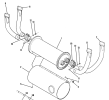
The O-470's in 182 are prone to carb ice for the fact they hang out well below the engine and thus the body of the carb can get incredibly cold. The design of the Lycoming engine has the carb more 'connected' to the oil pan and thus picks up all that ambient heat which keeps the body of the carb warm and has much lower carb ice concerns. The 'carb heat' air path is to go around the muffler, pickup the warm air, and then shove it down the carb throat. It's unfiltered air.

I've always wondered, couldn't you just redirect that hot air coming off the muffler shroud and have it blow on the BODY of the carb? Wouldn't that then keep the carb its components warm enough to prevent that ice from forming in the first place? Much like the way the Lycoming engine behaves with it being snugged up to the oil pan? I'm just talking ideas here, and I'm sure there is a reason it won't work, but it seems that the plumbing is there, its just a matter of taking a path from off the muffler and direct it to the carb body itself versus going through the carb. Warming it from the outside in vs the inside out. Keep a cool intake air charge. I could imagine a real simple tube into a plenum that splits the air around the carb where it exits out the back to atmosphere.

I've even read in a few places that some 182's don't have this problem because their engine creates enough ambient heat in the area of the carb (for whatever reason) that it keeps it warm enough so that ice doesn't form. Good idea ??
 
I've always wondered, couldn't you just redirect that hot air coming off the muffler shroud and have it blow on the BODY of the carb? Wouldn't that then keep the carb its components warm enough to prevent that ice from forming in the first place? Much like the way the Lycoming engine behaves with it being snugged up to the oil pa
Heating the carb body that way is liable to cause vapor lock in it by getting the gasoline in the bowl too hot. It has a low boiling point.

The Lyc's sump-mounted carb does get some heat from the hot oil, but it's also insulated by the carb gasket, slowing down that heat transfer. In cooler weather, the mass of cold air going through the carb chills the carb throat and carb ice becomes much more likely. There's an old myth that carbs on Lycs don't ice up. Don't believe it. I've had Lycs ice up many times, even on nice clear summer mornings.

The Lycs in Cessnas will ice up more easily that those in the Low-wing Pipers, and it appears to be due to the exhaust system design. In the Cessna 172 there is one muffler at the front and four exhaust risers that feed into it. In the Piper, there is a crossover tube at the front, four risers at the sides and the muffler at the back. Those two crossover tubes radiate a lot of heat. And they're not shrouded. The carb is surrounded on all four sides by radiant heat.

The basic PA-28 system:

1770144305209.png
The carb sits in the middle of all that.

Cessna 172:

1770144461503.png

The carb sits behind the muffler. No crossover tubing to radiate heat onto it.
 
The vapor lock point is noted for sure. Is this not ever an issue with regular carb heat? I'm wondering, what is the hottest air that could come from carb heat, while at any flying speed? I would think it has a somewhat capped top end and if so, what would that be? We have a carb temp gauge, so couldn't you, in theory, just manage that temp the same way you manage any other engine temp? I mean, we do now already with carb heat. If the heat delivery is just a different method, why does it matter?

The pics you share somewhat support the argument that, by increasing the carb body heat, carb ice becomes harder to establish, so my thinking is somewhat on track. Perhaps blasting ALL the hot air at the carb is too much. But couldn't we control that with smaller diameter ducting? Maybe direct it in such a way that the heat is concentrated at the throat, but well away from the bowl? If the Piper benefits from ambient temp by virtue of its exhaust path, then could one design some heat shielding to keep that area a little warmer?

Interesting stuff to consider, IMO.
 
Lotta good info just above. Mostly all covered what I've learned over the years. One area that may not have been mentioned is that when the carb heat is applied, AND there is currently ice in the intake the engine WILL run rougher for a while. This is due to the carb ice melting and causing the engine to misfire. So - as the engine goes rough on application of carb heat, don't push the carb heat back in and think it's solved. Leave the carb heat on for a while, insure all the induction icing is gone through the engine, and once the engine runs smoother, but at lower RPM can push the carb heat back in (off). The Conti carb engines all seem to be more ice prone than the lycs flown in similar ways and similar conditions. Just that the Conti carb is more isolated from sources of heat in the cowl and how the heating is routed.
 
The O-470's in 182 are prone to carb ice for the fact they hang out well below the engine and thus the body of the carb can get incredibly cold. The design of the Lycoming engine has the carb more 'connected' to the oil pan and thus picks up all that ambient heat which keeps the body of the carb warm and has much lower carb ice concerns. The 'carb heat' air path is to go around the muffler, pickup the warm air, and then shove it down the carb throat. It's unfiltered air.

I've always wondered, couldn't you just redirect that hot air coming off the muffler shroud and have it blow on the BODY of the carb? Wouldn't that then keep the carb its components warm enough to prevent that ice from forming in the first place? Much like the way the Lycoming engine behaves with it being snugged up to the oil pan? I'm just talking ideas here, and I'm sure there is a reason it won't work, but it seems that the plumbing is there, its just a matter of taking a path from off the muffler and direct it to the carb body itself versus going through the carb. Warming it from the outside in vs the inside out. Keep a cool intake air charge. I could imagine a real simple tube into a plenum that splits the air around the carb where it exits out the back to atmosphere.

I've even read in a few places that some 182's don't have this problem because their engine creates enough ambient heat in the area of the carb (for whatever reason) that it keeps it warm enough so that ice doesn't form. Good idea ??
This is what i have often heard. Conti O-470 are most likely to have carb ice, followed by the O-200.
 
If you are really thinking carb ice. Look at


STC’d for Marvel carbs on list
 
Every plane I've flown has a great indicator for carb ice, it's the tach. Dan's description and diagram post above are exactly right. Here in the NE, in the summer, is often perfect weather for carb ice. PA-28's are less likely to get carb ice than 182/172's from what I understand, but you CAN get carb ice in a PA-28 in cruise. I've had it happen twice. Easy way is to be at 75% or so power just below a nice solid overcast layer.

A cub can get carb ice with no visible clouds nearby, and cruising at full power. You watch the tach. If you're not at the RPM you should be for the density altitude you're at, then there's a good chance you have carb ice. So put in carb heat and see what happens. Leave it in until you get the RPM back.

Even in a PA-28, if the conditions are right as per a diagram like the one above or if I don't know, and I'm in a descent, I'm using carb heat.

Maybe just me, but I don't see a need or have ever wished that I've had a carb ice detector, other than the tach.
Slight vibration tells me carb ice is forming.
Like you said,I don’t need a ice detector…
 
Last edited:
How easily does your mixture knob move? Is it possible that it enrichened itself somewhat due to vibration at altitude?
 
The vapor lock point is noted for sure. Is this not ever an issue with regular carb heat? I'm wondering, what is the hottest air that could come from carb heat, while at any flying speed? I would think it has a somewhat capped top end and if so, what would that be? We have a carb temp gauge, so couldn't you, in theory, just manage that temp the same way you manage any other engine temp? I mean, we do now already with carb heat. If the heat delivery is just a different method, why does it matter?
Managing carb temp with lots of heat available is asking for trouble. We have pilots who cannot manage the mixture control, and more that can't manage the carb heat because they don't know what causes carb ice.

Moreover, and more importantly, any heat expands the air going through the carb, meaning less oxygen per cubic foot for combustion. This enriches the mixture when you pull carb heat, but even if you lean it some, you still get less power because there is simply less oxygen to combine with the fuel to make the bang that makes the engine go.

Cars used to have constant carb ice problems until the manufacturers started ducting some exhaust gases through channels in the intake manifold to warm the carb body, and they also used heated air from around the exhaust manifold, controlled by a thermostatically-controlled valve in the air cleaner housing. It kept the air going into the carb at about 70°F. BUT: car engines don't have to perform at 100% power for takeoff and 76% power for cruise. They seldom get anywhere near those numbers, so they don't miss the power reduction caused by carb heat. The automatic system made it much easier for drivers: they didn't need training in carb ice detection and management. Pilots are operating in a much different environment and are expected to think about this stuff. Fuel injection made things much easier, too.
The pics you share somewhat support the argument that, by increasing the carb body heat, carb ice becomes harder to establish, so my thinking is somewhat on track. Perhaps blasting ALL the hot air at the carb is too much. But couldn't we control that with smaller diameter ducting? Maybe direct it in such a way that the heat is concentrated at the throat, but well away from the bowl? If the Piper benefits from ambient temp by virtue of its exhaust path, then could one design some heat shielding to keep that area a little warmer?
As above, it will cost power that most light airplanes can't afford to lose. That is why your ideas have not been incorporated. They're old ideas, after all.
This is what i have often heard. Conti O-470 are most likely to have carb ice, followed by the O-200.
All the carbed Continentals are ice-makers except for the C145/O-300. That engine has its carb mounted on the oil sump like Lycoming does, making it a little less ice-prone. Note the little less about that. It's not ice-proof.

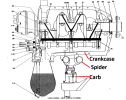
My A-65 made ice all the time. That engine, along with the A-75, A-80, C-85, C-90 and O-200, mounted their carbs on an intake manifold called a "spider" that isolated the carb from the crankcase. Like this:

1770167944859.png
 
Not to rule out carb ice, but here's another thought. Several years ago, a hangar neighbor was having issues with his C150, rough running, intermittent loss of rpms, etc. After many rounds of troubleshooting, they changed the installed Brackett air filter back to the old-style paper element filter and that solved the problem. There have been other reports in various forums about issues with over-oiled filter elements, etc., causing problems. Do you have a Brackett filter installed? Just something else to consider. And, this is in no way meant to be a condemnation of Brackett air filters, I've flown many different aircraft with that mod, all trouble-free.
 
Last edited:
Had my first real experience of carb ice last fall, on a cool humid morning, a C150 with an O-200. This occurred on the ground, during taxi. The temp and dew point were within a few degrees - prime conditions for ice. (Did a high-speed taxi on the runway just to confirm to myself [and a worried passenger] that the engine really was running properly, before taking off.) Have never had anything like that occur at altitude / in cruise.
 
Doing a Cowl -off maint run in cold weather with O-200’s , O-470’s and some

others can be “ Interesting”. Warm air blowing down on the Intake Pipes

is replaced by cold air blowing in from the front. The cold pipes result in

some vaporization being lost and fuel “puddling” in the system. This gives

low power, mag drops and erratic shut down. Scary until you run with cowl

on.
 
I do have a bit of C150 time under my belt. Never experienced carb ice, but I'm not saying it can't happen.

What DID happen to me once was a loss of power/RPM that didn't react to carb heat being applied, and which had the behavior of carb heat being on all the time.
Come to find out something had loosened up inside the carb heat box and hot air was being fed to the engine in the "cold" position. So it might be worth making sure everything is in good shape in that area.
 
Not to rule out carb ice, but here's another thought. Several years ago, a hangar neighbor was having issues with his C150, rough running, intermittent loss of rpms, etc. After many rounds of troubleshooting, they changed the installed Brackett air filter back to the old-style paper element filter and that solved the problem. There have been other reports in various forums about issues with over-oiled filter elements, etc., causing problems. Do you have a Brackett filter installed? Just something else to consider. And, this is in no way meant to be a condemnation of Brackett air filters, I've flown many different aircraft with that mod, all trouble-free.
The Brackett filters come pre-oiled and the instructions are explicit: DO not clean and re-oil. The oil Brackett uses is a silicone oil, not just motor oil.

The old paper filters that came with these airplanes were cleanable and reusable. The paper was sandwiched between two layers of fairly fine screen to protect the paper. After washing and drying they were re-oiled. Some folks kept up that practice with the Bracketts, and it doesn't work. Brackett's oil is really thick, and anything else will run off, leaving the filter dry and dust can get through it.

Now, talking about filters and airboxes reminds me of a common O-200 rough-running scenario. That carburetor is mounted on an intake manifold sometimes called a "spider" as I noted earlier. The O-200 is also mounted on much softer engine shockmounts than its predecessors were, letting the engine move quite a bit more. The cylinders firing cause the engine to twist back and forth around the crankshaft axis, and since the carb is mounted well below that, it gets violently shaken, sloshing fuel out of the bowl vent and into the carb throat, flooding the engine and making it run real rough occasionally. Loses lots of RPM too. So to fix that, Continental put Lock-O-Seal washers on the spider mounting studs, above and below the spider, and castellated nuts are installed FINGER TIGHT and cotter-pinned. They want that carb so be able to swing back and forth a bit. The intake tubes are connected to the spider and cylinder intake elbows via short lengths of rubber hose, so the flexibility is maintained but dampened. The carb's mass makes it move a lot less than the engine.

We had a 150 that was doing this regularly, and I found that the overhauler had not installed those washers, and the spider was bolted tight to the crankcase. One I installed the washers and did everything else according to the overhaul manual, it ran beautifully.
 
Back
Top