Angle, or Vx/Vy on takeoff?

A newbie student has not developed the "feel" for the airplane, and won't for some time. Airspeed is safety, and the numbers do not lie. If I was to climb into some sort of airplane I have never flown before, I would want to know Vs, Vx and Vy, at a minimum. The "feel" would do me no good at all. Might get me killed.

That's what the instructor is there for. The original post was in reference to dual instruction. I let students explore the full range of flight envelope with me on board rather than encounter it for the first time when they are solo.
 
These threads make me feel like a bad / lazy pilot. I just rotate at 80, pitch up and make sure the plane keeps going up.
I don't think I ever pitch for Vanythingspecific. I glance at the ASI to make sure I don't get slow on climb out but that's about it.
For what it's worth, the late John Deakin agrees with you, Bryan. I do, too.

John's "Pelican's Perch" column is a treasure chest of well-written and helpful information for us piston pilots. In article no. 85 he wrote:

"One more shot at aviation mythology: VX and VY are speeds for specific purposes in certification. They are not for everyday use, and should never be used unless there is a specific problem that requires them. I cannot recall ever using either in the real world."

Somewhere along the way, overly eager instructors and examiners thought to themselves: "if these speeds exist, we should test applicants for them", when on most of our flights (when there are no trees at the end of a short runway) neither one is particularly useful.

In another article, John submits:

"My pet peeve in climbs is using too low an airspeed. One famous training organization insists on using 95 knots to 1,000 feet AGL in a Bonanza, most of the twin operators push for a climb at or near the blue line, and virtually all the transport operators use a V2+10 climb with all engines operating. I think it’s stupid to climb that slowly in any airplane (including jets, just so I offend everyone here!) once actual obstacles are cleared."

This article is a very good read. In real life, John is right: there are few situations that require Vx or Vy, and climbing instead at a shallower angle and slightly faster airspeed helps with forward visibility and engine cooling. As in instructor, I dread short field take-offs because if the engine fails at Vx close to the ground, a stall/spin accident is a likely result: high-angle of attack and rapidly slowing airspeed will get me to a stall in a few seconds; and all that right rudder that kept the ball centered and prevented yaw while the engine WAS running now instead creates yaw to take me and my student from a mere stall into a deadly spin. No thank you - I'll keep my pitch angle more shallow unless a steep initial climb is absolutely required.

As for the Flight Director question: I do like the TOGA indication as a very initial reference. In my aircraft, pitch defaults to 7 degrees up (but I can lower that, e.g. when taking off from a high density altitude airport), and of course wings level. It's not perfect for anything in particular, except it's a safe attitude for the very initial climb (or transition to climb after an approach) to keep me wings level and away from the ground. Especially on a go-around when we are in the soup, think about what the alternatives are: vertical speed? Indicated airspeed? With the massive power and configuration changes during a go-around, my energy state may be too low to achieve my desired vertical speed (read: stall). And if I go for IAS climb speed, there's the risk of descending into the ground while accelerating to that speed. TOGA's purpose is to prevent those outcomes, and the specific pitch angle depends on the aircraft and on the performance of the day.

Regards,
Martin
 
You guys all have your answers. I use whatever makes sense for the location, the load, and the weather.

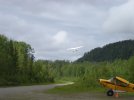
1000’ strip. 100’ trees. Big hill requires a turn. DSCN1672.jpegPlenty of margin for a good performing airplane. A bit of a handful in a 35mph crossing wind, but doable. Build speed in ground effect and zoom over the trees. Penetration speed is your friend when you know you’re about to get bucked.
 
Tried that in a dual g5 cockpit once. Ran out of post it notes, suction cups and hands…

The master switch works best!
My G5 and G3X Touch have independent backup batteries. Just for you! :)

No, that would be pitching AT Vy, which would result in accelerating beyond Vy. And most people that I see do this end up pitching too high, slowing below the target speed, then pitching too low, accelerating beyond the target speed, ultimately chasing a speed and never stabilizing.
How do you pitch for Vy? Break it down to the absolute basics for someone who has never flown a plane before. Some part of that explanation is going to involve rotating the plane to pitch up to some angle, which may vary with conditions and may be by reference to anything from a screw on the cowl to an aerobatic protractor or whatever those star things are called out on the wing of @Ed Haywood's dream plane. I can't imagine an instructor telling a new student to rotate at Vr and then pull back until the plane reaches Vy, or to apply no pressure to the yoke until the plane reaches Vy on the ground.

In the student pilot's very first takeoff, it might well be something like "I'll have you rotate to a pitch of 10 degrees nose up. From here, the explanation of this being approximate, depending on conditions, being a pitch that will result in the plane accelerating to Vy while the student gets ready to use pitch to maintain Vy, finding sight references to use in the next takeoff since the student is 9 inches taller than the instructor, and so on...that all gets lost in the wash of primacy vs. recency. Do you have any questions? Okay, smoothly push that throttle all the way forward, double-check the oil pressure, and when the airspeed reaches 50 knots start to apply back pressure until we're about 10 degrees nose up."
 
Ok, but you’re going to have to learn something different when it’s 200 and 1/2 and you line up for departure….


The PFD is the artificial horizon. What you see on the instrument represents exactly what you would see out the windscreen and why the horizon line extends fully across a PFD.

If you have to be able to fly the plane well visually before relying on a PFD.
 
How do you pitch for Vy? Break it down to the absolute basics for someone who has never flown a plane before. Some part of that explanation is going to involve rotating the plane to pitch up to some angle, which may vary with conditions and may be by reference to anything from a screw on the cowl to an aerobatic protractor or whatever those star things are called out on the wing of @Ed Haywood's dream plane. I can't imagine an instructor telling a new student to rotate at Vr and then pull back until the plane reaches Vy, or to apply no pressure to the yoke until the plane reaches Vy on the ground.

In the student pilot's very first takeoff, it might well be something like "I'll have you rotate to a pitch of 10 degrees nose up. From here, the explanation of this being approximate, depending on conditions, being a pitch that will result in the plane accelerating to Vy while the student gets ready to use pitch to maintain Vy, finding sight references to use in the next takeoff since the student is 9 inches taller than the instructor, and so on...that all gets lost in the wash of primacy vs. recency. Do you have any questions? Okay, smoothly push that throttle all the way forward, double-check the oil pressure, and when the airspeed reaches 50 knots start to apply back pressure until we're about 10 degrees nose up."
You establish a pitch attitude that, based on weight, altitude, and temperature, should give you Vy. If it doesn’t, you make an appropriate adjustment.

If an instructor is telling a student to rotate via reference to an attitude indicator on his first lesson, that instructor should be flogged. At that point, the instructor should be guiding the rotation to “here”, and maintain it until the student figures out the visual reference. After the student has that figured out, the discussion about “the picture will be slightly different when…” can occur. If and when the student questions the method before that, it needs to be explained.

In the specific case of the OP, he stated that his instructor told him to do something that was “better,” with no explanation as to what made it better and/or why it was being done counter to FAA guidance.
 
FWIW, I taught my son to fly with NO instruments. Not even a clock…

Pick the tail up a bit, wait for it to fly. From that point forward, do whatever you want BUT sacrifice forward speed, as observed. About that simple.

He gained mastery of the aircraft in its environment before EVER laying eyes on a gauge.

There were reasons. Not saying it’s optimal. But it turned out a very fine pilot.
 
In the specific case of the OP, he stated that his instructor told him to do something that was “better,” with no explanation as to what made it better and/or why it was being done counter to FAA guidance.
In the case of the OP, I have posited above that we don’t know what the instructor said or didn’t say because it’s being reported to us by a low-time student pilot for whom all of this is a foreign language.
 
In the case of the OP, I have posited above that we don’t know what the instructor said or didn’t say because it’s being reported to us by a low-time student pilot for whom all of this is a foreign language.
I agree, have previously stated that, and specifically worded what you quoted as the OP’s perspective rather than actual fact.
 
So he must have never flown for a transport operator then.
Au contraire - John was a respected captain at JAL, flying the 747 for almost 30 years. He retired in the late 1990s after havening held the #1 seniority number at JAL for a few years.

I don't fly jets, so I cannot comment on typical climb speed profiles. But I do make room for the possibility that those have changed in the last 30 years.

Regards,
Martin
 
FWIW, I taught my son to fly with NO instruments. Not even a clock…

Pick the tail up a bit, wait for it to fly. From that point forward, do whatever you want BUT sacrifice forward speed, as observed. About that simple.

He gained mastery of the aircraft in its environment before EVER laying eyes on a gauge.

There were reasons. Not saying it’s optimal. But it turned out a very fine pilot.
The must have been tough without an altimeter, airspeed indicator or inclinometer.
 
The must have been tough without an altimeter, airspeed indicator or inclinometer.
I can understand the myth of needing an airspeed indicator and altimeter to learn to fly, but no inclinometer is probably better than the way most pilots are taught to use an inclinometer.
 
I can understand the myth of needing an airspeed indicator and altimeter to learn to fly, but no inclinometer is probably better than the way most pilots are taught to use an inclinometer.
Hard to establish or hold altitude on an XC without an altimeter.
 
True, but how do you target and maintain pattern altitude without an altimeter?

I do this by removing a students altimeter and tell them to find 1000 agl. Or I ask them what they think their altitude is at any given moment. Then I reveal what the true altitude is. Within 30 mins they can guess within 100’ from 500 to 1500, consistently. It’s not that hard, but it has to be deliberate.

I’d bet dimes to dollars anyone here can guess 60 mph in their car +/- 3 at any given moment.
 
Au contraire - John was a respected captain at JAL, flying the 747 for almost 30 years. He retired in the late 1990s after havening held the #1 seniority number at JAL for a few years.

I don't fly jets, so I cannot comment on typical climb speed profiles. But I do make room for the possibility that those have changed in the last 30 years.

Regards,
Martin
Theren hasn't been any sea change in the past 30 years. He's just wrong. Also he's never used Vx Vy, ever, really? Must have never flown at high DA either, which I find hard to believe. Seems more likely he's just being hyperbolic.
 
FWIW, I taught my son to fly with NO instruments. Not even a clock…

Pick the tail up a bit, wait for it to fly. From that point forward, do whatever you want BUT sacrifice forward speed, as observed. About that simple.

He gained mastery of the aircraft in its environment before EVER laying eyes on a gauge.

There were reasons. Not saying it’s optimal. But it turned out a very fine pilot.
So you taught him violating FAR 91.205 is okay? Or was this in an ultralight?
 
Front seat of a Pietenpol. We weren’t sure we’d be within weight and balance limits switching seats, so we did this until I found scales to verify.
 
For what it's worth, the late John Deakin agrees with you, Bryan. I do, too.

John's "Pelican's Perch" column is a treasure chest of well-written and helpful information for us piston pilots. In article no. 85 he wrote:

"One more shot at aviation mythology: VX and VY are speeds for specific purposes in certification. They are not for everyday use, and should never be used unless there is a specific problem that requires them. I cannot recall ever using either in the real world."

Somewhere along the way, overly eager instructors and examiners thought to themselves: "if these speeds exist, we should test applicants for them", when on most of our flights (when there are no trees at the end of a short runway) neither one is particularly useful.

In another article, John submits:

"My pet peeve in climbs is using too low an airspeed. One famous training organization insists on using 95 knots to 1,000 feet AGL in a Bonanza, most of the twin operators push for a climb at or near the blue line, and virtually all the transport operators use a V2+10 climb with all engines operating. I think it’s stupid to climb that slowly in any airplane (including jets, just so I offend everyone here!) once actual obstacles are cleared."

Au contraire - John was a respected captain at JAL, flying the 747 for almost 30 years. He retired in the late 1990s after havening held the #1 seniority number at JAL for a few years.

I don't fly jets, so I cannot comment on typical climb speed profiles. But I do make room for the possibility that those have changed in the last 30 years.

Regards,
Martin
Vx and Vy are significant both for their usefulness, and as real-world applications of the aerodynamics that we are taught as students.

Vx and Vy are available for us to use at our discretion, when their respective performance advantages are required or desired. Maybe Deakin couldn't recall using them in the real world, but if not, then he missed opportunities to optimize his aircraft's climb performance in situations in which a competent airman would have reasonably done so. I find that inexplicable and assume that he was merely using (ahem) rhetorical license.

In my own modest aviation exploits, there have been many times in which Vx came in handy, such as clearing terrain or complying with a challenging crossing restriction. Likewise, Vy has proved useful for climbing above turbulence or icing conditions. I have used those speeds, when appropriate, in a wide variety of aircraft from light piston singles to 747s (yes I, too, flew the 747 for many years, although I do not claim to have been "highly respected").

There are a great many smart people in aviation, some of whom maintain (or, maintained) a media presence. Smart + modest = good; smart + ego = beware. A common red flag that identifies the latter category is a tendency to belittle those with whom they disagree. Deakin, for all of his knowledge and experience, was wrong about certain issues, and occasionally just full of (hogwash, crap, himself). When he wrote, "I think it's stupid..." that was the red flag of pure ego speaking. Readers should use discretion.

With respect to the OP, Vx and Vy are real speeds based on real science that have real applications in the real world, and a good CFI helps us understand when and how to use those speeds (and when not to).

 
Last edited:
In my own modest aviation exploits, there have been many times in which Vx came in handy, such as clearing terrain or complying with a challenging crossing restriction. Likewise, Vy has proved useful for climbing above turbulence or icing conditions. I have used those speeds, when appropriate, in a wide variety of aircraft from light piston singles to 747s
Are Vx and Vy published for 747s?
 
10 degrees is probably around Vy in a 150/152. But in primary training you really shouldn't be referencing the AI anyhow. Unless practicing obstacle take offs, you probably do want to be around best rate of climb initially in an underpowered excellent trainer whose climb rate is often less than a downdraft. So rotate, accelerate to about Vy, and then play with the pitch in tiny amounts to find out the current best climb speed which will be close to the book speed. Find a nice thermal, maybe pitch up a little to slow down and enjoy the free ride up. Etc.

All the stuff about TOGA and FDs and so forth in here has no bearing on you learning how to feel out the airplane to make it climb the quickest for that day, that atmosphere, and that condition of the aircraft. That's the art. Once proficient you should be able to fly the aircraft with all primary instruments covered aka eyes out the window comfortably.
 
Are Vx and Vy published for 747s?
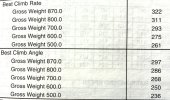
You inspired me to go on a little archeological excavation in the storage room, where I keep the useless (but weighty) detritus of past lives stashed-away in sealed boxes. After about a half-hour of digging I hit paydirt in the form of an old 747-400 manual. Sure enough, there is a table that provides Vx and Vy speeds for a range of weights, and for each weight listed, Vy = Vx + 25kts. Unfortunately, while I was assigned to the 747 I was never curious enough to ask the braintrust why that was so. Perhaps it was just a rule-of-thumb that proved close enough, and simple enough, to be useful in routine line operations.

In an attempt to keep this somewhat relevant to the OP and the possible interest of @Boom! and others, I have attached a pic of that table in order to illustrate the rather dramatic way in which weight affects Vx and Vy. Many light aircraft POH/AFMs list only one speed for Vx and/or Vy, yet aerodynamic theory tells us that those speeds vary with weight (based on the effect of weight on stall speed). Since the useful load of a 152 is about 1/3 of its maximum gross weight, the difference between Vx at its empty weight and at its maximum weight may be operationally insignificant (as would seem to be the opinion of the manufacturer). At the other extreme, the 747-400 has a useful load that is more than double its empty weight (Basic Operating Weigt of 400,000 lbs. vs Maximum Gross Takeoff Weight of 875,000). That wide spread in weight results in a proportionally wide spread of Vx and Vy speeds, as is shown--

1786294943462.jpeg

Note: While a discussion might be had regarding the effect of altitude and the difference between propeller and jet propulsion, this example is meant merely to illustrate the concept.

Now I have to clean up the mess I made in the storage room, with the hope that I haven't made a mess of this thread.
 
Most modern and most if not all high performance planes take off to a pitch angle. Usually set by the TOGA bars. Your airspeed will always lag the appropriate pitch attitude and appropriate power setting. pitch+power =performance. The TOGA is set by the OEM to give a safe pitch attitude to climb away from the earth. Chasing an airspeed down low could result in flying back to the ground or stalling if not careful. In a low powered aircraft without much in the way of technology, well you have what you have, and do your best. Some mental pitch attitude backed up with airspeed.
 
Most modern and most if not all high performance planes take off to a pitch angle.
Irrelevant as far as a CFI is concerned. Their job is to teach the student pilot the skills called for in the ACS.

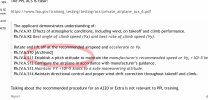
The PPL ACS is clear:


The applicant demonstrates understanding of:
PA.IV.A.K1 Effects of atmospheric conditions, including wind, on takeoff and climb performance.
PA.IV.A.K2 Best angle of climb speed (Vx) and best rate of climb speed (Vy).
Rotate and lift off at the recommended airspeed and accelerate to Vy.
PA.IV.A.S10 [Archived]
PA.IV.A.S11 Establish a pitch attitude to maintain the manufacturer’s recommended speed or Vy, +10/-5 knots.
PA.IV.A.S12 Configure the airplane in accordance with manufacturer’s guidance.
PA.IV.A.S13 Maintain VY +10/-5 knots to a safe maneuvering altitude.
PA.IV.A.S14 Maintain directional control and proper wind-drift correction throughout takeoff and climb.

Talking about the recommended procedure for an A320 or Extra is not relevant to PPL training.
 
IMG_4050.jpeg
Well, there’s your answer right there. Thanks for clearing this up Mr. “straightnlevel” using the ACS.
So, the instructor was right to suggest a ‘pitch attitude’
 
View attachment 154110
Well, there’s your answer right there. Thanks for clearing this up Mr. “straightnlevel” using the ACS.
So, the instructor was right to suggest a ‘pitch attitude’
....at Vy. There's no specific angle, but there are specific speeds.
 
Personally, I fly faster than Vy as it gives better cooling. However, Vy is not only best rate, for light GA it is also optimum energy addition. There is a lot that goes into this topic. How deep do you want to go? Anyway, optimization is a choice as to what are you optimizing. I would avoid Vx at all costs. If you have a short field, plan Vx but do a ground effect acceleration zoom climb. If long enough, accelerate to just above Vy and zoom only as much as needed but no slower than Vx climbing at Vx till no longer needed then recapture Vy. If insufficient length, you may not reach Vy, but still ground effect accel toward Vy zooming when you need to again only as much as you need to no slower than Vx… but the V speeds aren’t really speeds, they’re AOAs. And neither V speeds nor AOAs for these concepts is constant with increasing altitude. This gets really tricky if you want to really get into them. So best to just avoid anything you might want Vx towards but generally accelerate in ground effect to Vy and then either climb at Vy or faster if you have reason. For me, cooling, for you, perhaps visibility.


… but the V speeds aren’t really speeds, they’re AOAs.

The published V speed is specific to a max gross weight aircraft at forward cg and at sea level. For a jet, AOAx is constant, but AOAy is not. For a prop, neither AOAx nor AOAy are constant. This is because of propeller inefficiencies, otherwise, AOAy would occur at min power required AOA and be constant. Note the Fly Onspeed organization recommends using onspeed AOA in lieu of both Vx and minimum power required AOA. Unlike Vx and Vy, AOAx and AOAy account for weight, but all except AOAx specifically in jets change with altitude.
 
Last edited:
Personally, I fly faster than Vy as it gives better cooling. However, Vy is not only best rate, for light GA it is also optimum energy addition. There is a lot that goes into this topic. How deep do you want to go? Anyway, optimization is a choice as to what are you optimizing. I would avoid Vx at all costs. If you have a short field, plan Vx but do a ground effect acceleration zoom climb. If long enough, accelerate to just above Vy and zoom only as much as needed but no slower than Vx climbing at Vx till no longer needed then recapture Vy. If insufficient length, you may not reach Vy, but still ground effect accel toward Vy zooming when you need to again only as much as you need to no slower than Vx… but the V speeds aren’t really speeds, they’re AOAs. And neither V speeds nor AOAs for these concepts is constant with increasing altitude. This gets really tricky if you want to really get into them. So best to just avoid anything you might want Vx towards but generally accelerate in ground effect to Vy and then either climb at Vy or faster if you have reason. For me, cooling, for you, perhaps visibility.


In real short field situation, how are you calculating performance if you are zoom climbing and not following the procedure the AFM procedure?

Also what plane are you flying that you worry about engine temperature in a Vy or Vx climb to 1000 AGL after takeoff?

Me, I am getting though 1000 AGL on a normal takeoff as quickly as possible because an engine loss below that is really bad juju.
 
In real short field situation, how are you calculating performance if you are zoom climbing and not following the procedure the AFM procedure?

Also what plane are you flying that you worry about engine temperature in a Vy or Vx climb to 1000 AGL after takeoff?
You use the Vx calculation as the ground effect accel to zoom climb will always have more energy. But you may need to practice it so as to know your aircraft’s zoom and the circle is scribes.
 
Back
Top