Swap the G1000 for a 175 and a com, or 355, and a transponder, and steam gauges. Go with a carbureted engine instead of injected, which will also drop some weight (the newer 172s are pigs compared to vintage). Then ditch the upgraded upholstery and soundproofing and go with basic fabric seats (bring back the only adjustment being fore and aft) and minimal upholstery. All that would probably knock close a hundred grand off the price with no performance hit. Actually, there would be a useful load increase.
Steam gauges are full of tiny mechanical components that are all assembled by hand. Glass is full of microcircuitry that is all assembled by robotic machinery. Once enough companies are making it, the prices for glass will be cheaper than steam. We've already seen such shakeups when digital watches, at first really expensive, easily displaced the mechanical watches price-wise. Electronic calculators meant the almost-instant end of troublesome mechanical calculators. Televisions are far cheaper, once adjusted for inflation, due to their robot-assembled electronics, than the TVs of the 1960s and '70s.
A carb saves next to no weight at all over fuel injection. And it brings the risk of carb ice. About all one can say for a carb is that it's easier to start.
The FAR23 revisions of the early 1990s forced Cessna to build seats capable of withstanding 25G (front seats) and 19G (rear). THAT added a lot of weight. I have had the seats out of many 172s, and those restart seats are terribly heavy compared to the legacy stuff. But while they were at it, they also made the seat rails much (MUCH) sturdier and the locking mechanisms stronger and more stupid-proof. Much more crashworthy. They seem to have recognized that they had to build that stuff to work in spite of the poor maintenance so many airplanes get.
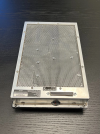
The leather upholstery is a little heavier than the fabric. It is thin stuff. The interior panels are considerably heavier. The larger engine adds weight. But Cessna beefed up a lot of weak areas in the structure, and beefing-up almost always adds weight. The G1000 stuff, taken together, weighs more, maybe a lot more, than the old steam gauges and radios. The PFD and MFD units (screens) alone are heavier than all the steam stuff and basic radios. I've had those out, too. Lots of stuff in them. Most would be surprised to pick one up off the bench. Weight. What it looks like from the backside. It's a couple of inches thick:
Out of sight ahead of that PFD is a 24-volt standby lead-acid battery, like so:
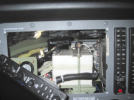
It's not light, either. The main battery is a 24-volt unit that weighs more than the old 25-amp-hour 12-volt battery the old 172s used.
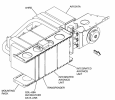
There is a raft of G1000 stuff under the rear baggage shelf. There are several remote-mounted boxes in a rack there that very few people know are there. There isn't room in or behind the instrument panel for all the necessary computing stuff, so it went into the tailcone. More weight. Thick cables run from that rack under the floor forward and up to the instrument panel. That installation looks like this:
By now I imagine that Dynon has an equivalent system suite that is more compact and lighter.
We bought a low-time 2006 172SP in 2008. Its empty weight was about 300 pounds more than the 172Ms we had, and its gross was only 250 pounds more, so we lost about 50 pounds of useful load.
It would be hard to reduce the 172S's weight. The heavier seats are mandated, but one could make them of titanium and save weight, but then nobody could afford the airplane at all.