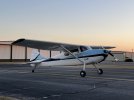
2025 C172

I would think that the G1000 + radios weighs less than a bunch of steam gauges and dual Dolly Partons with separate power supplies (tube radios!)
You would think. Well, you haven't had that Garmin stuff out of the airplane. I have, and it is heavier than the steam gauges and solid-state radios (1970 and on) I've had out. There is a lot of it, because there are a lot of features. I'd bet that the standby battery alone weighs nearly as much as the old six-pack flight instruments.

The G1000 can save weight in larger airplanes like King Airs and such. The G1000 replaces CRTs, which were not light at all. Think TV picture tube. Pick up an old TV from the 1990s and see.

Moreover, there are still three steam gauges in the G1000 172, legally required as backup. The airspeed indicator, attitude indicator and altimeter are there, and the vacuum pump and regulator are still there to drive the AI. In the early G1000 172s, the turn coordinator was there, hidden behind the panel, but mounted in the panel next to the other standbys. It was only there to drive the autopilot. Canadian law requires a turn coordinator or turn-and-bank instrument in any aircraft used in flight training, and I had to get Transport Canada involved to get an exemption to that rule, since the PFD had the turn rate arc displayed on it. That did not meet the definition of a turn coordinator, see? If they had not granted that exemption (they did) I would have taken the instrument out and cut the hole in the panel so that it would be visible with the others.

Tubes disappeared from aircraft radios a long time ago. Anyone still using them can't afford to own an airplane. Couple those things with the old 35-amp generators and a landing light, and you were electrically dead before you got off the ground at night.
 
Well, you haven't had that Garmin stuff out of the airplane. I have, and it is heavier than the steam gauges and solid-state radios (1970 and on) I've had out. There is a lot of it, because there are a lot of features.
Part of the problem is that in many cases the G1000 implements each feature as a separate LRU, which means extra aluminum, extra harnesses, extra power supplies, etc. I'm guessing a G3x, which is more integrated is a fair bit lighter than a G1000.
 
Part of the problem is that in many cases the G1000 implements each feature as a separate LRU, which means extra aluminum, extra harnesses, extra power supplies, etc. I'm guessing a G3x, which is more integrated is a fair bit lighter than a G1000.
Yes. But with a unified system, with everything in one box, that one box has to come out and be returned to Garmin (or whoever made it) for repair or replacement, and now the airplane has no instrumentation and can't fly even if it was just the OAT that was inop. OAT is part of the air data computer.

We had a Garmin multifunction display in the R182. It messed up, and we had to FedEx it to Garmin. No avionics shop can repair this stuff, not when it's all micro-soldered microcomponents on a circuit board that is then encapsulated in epoxy. First you'd have to get the epoxy off, and by the time you do that, half of the components are broken. Then you'd still have to troubleshoot the componentry. Gamin gets the old unit, tests it to see if its a software problem (fixable) or hardware problem (not fixable), and in our case it was hardware. We quickly got back a brand-new MFD that had the same serial number as the old one; in other words, their "repair" is to replace absolutely everything except the serial number. It was a $400 flat rate, but that was 16 or 18 years ago. Still better than buying a new one for $5K or whatever it was.

Garmin claims that their G1000NXi can save some King Air operators 200 pounds. I don't doubt that, since those old systems with CRTs and all the hardware to drive them adds up. But I also note that they don't make any weight saving claims for light airplanes. Light airplanes never had CRTs and remote gyros and dual everything, for both pilots, in them.
 
Last edited:
Part of the problem is that in many cases the G1000 implements each feature as a separate LRU, which means extra aluminum, extra harnesses, extra power supplies, etc. I'm guessing a G3x, which is more integrated is a fair bit lighter than a G1000.
Of course a G3X is lighter than a G1000. The G3X is a PFD or MFD (or both on one screen). The G1000 has separate PFD and MFD displays, audio panel, dual nav and com radios, dual GPS navigators, engine indication system, etc all built in by default. The G3X can have the EIS if you add the boxes for it, but in any case the G3X lacks many features of the G1000 and you have to fill up a radio stack with other stuff to equal the capability of the G1000.

I'm not sure where your assertion of the G3X being "more integrated" is coming from. What do you mean?

Garmin claims that their G1000NXi can save some King Air operators 200 pounds. I don't doubt that, since those old systems with CRTs and all the hardware to drive them adds up. But I also note that they don't make any weight saving claims for light airplanes. Light airplanes never had CRTs and remote gyros and dual everything, for both pilots, in them.
Garmin doesn't make any weight saving claims for light airplanes because they don't sell G1000 retrofit kits to the light airplane market due to cost. The retrofit kits are only for King Airs and jets where the cost of the upgrade isn't so crazy. I don't know what the upgrades run now, but 10-15 years ago it was in the neighborhood of $350K so I'm sure it's a fair bit more now. Most light airplanes that are worth $350K to start with probably already have the G1000, and for those worth less it'd be a bit silly to have more than half the value of your plane tied up in the panel. The upgrade doesn't make sense regardless of weight, so... No weight savings claims.

That said, I don't see anyone complaining about useful load on G1000 birds vs non-G1000 of similar vintage.
 
For the love of humanity, I feel I should wait on this request.

But if the interest is high, I will be happy to set up a gofundme account for those wishing to purchase such pictures of future me...
I think you meant Only Fans...
 
I'm not sure where your assertion of the G3X being "more integrated" is coming from. What do you mean?
G1000 has a separate ADC and AHRS. The standby instruments are separate AI, ASI and altimeter and powered by a separate vacuum pump. The standby battery is also separate.
 
Garmin doesn't make any weight saving claims for light airplanes because they don't sell G1000 retrofit kits to the light airplane market due to cost. The retrofit kits are only for King Airs and jets where the cost of the upgrade isn't so crazy. I don't know what the upgrades run now, but 10-15 years ago it was in the neighborhood of $350K so I'm sure it's a fair bit more now.
About 20 years ago I was in an avionics shop that was installing a G1000 system in a Seneca. They told me it was about $60K for the stuff, plus the installation costs. Jack that up by the rate of inflation and we get about $92K, far from $350K, and that assumes that the cost hasn't decreased due to further automation and tech improvements, as usually happens with electronics, like with computers. There's no way that a $500K 172 has $350K worth of glass in it.
 
About 20 years ago I was in an avionics shop that was installing a G1000 system in a Seneca. They told me it was about $60K for the stuff, plus the installation costs. Jack that up by the rate of inflation and we get about $92K, far from $350K, and that assumes that the cost hasn't decreased due to further automation and tech improvements, as usually happens with electronics, like with computers. There's no way that a $500K 172 has $350K worth of glass in it.
Even though the systems are both called "G1000" that's not really apples to apples. The King Air would have the larger displays, and three of them, and radar, and dual audio panels and all kinds of other things that wouldn't be on a Seneca or 172, plus the labor to put it in, and to pull out the literally hundreds of pounds of AC powered stuff from the King Air. Plus, the King Air requires a higher level of software testing that costs money and Garmin does charge for - As an example, Garmin charges an 88% premium for the GI 275 that goes in a Class III aircraft.

Taken right from King Air Magazine, July 8, 2015: "Garmin’s fully integrated system, the G1000 (pictured on page 8), is available for the King Air C90, 200, B200, 300 and 350 models. The system offers synthetic vision, WAAS/LPV, charts, weather, safe taxi, XM radio, ADS-B solutions, a 15-inch multi-function display and two 10-inch primary flight displays. A G1000 installation should take 15 working days and have an approximate baseline cost between $325,000 and $375,000."

The 172, as noted before, is "missing" an awful lot of the hardware present on the King Air upgrade, has lesser-tested software, and is being put in at the factory with nothing to rip out. Plus, surely Textron guarantees a certain volume and gets the associated discount from Garmin. I don't at all think a $500K 172 has $350K worth of glass - It's probably $75K all in at most, though we'll never know. A retrofit, however, is likely more like $150K which is at least part of why Garmin has never offered retrofits. I would guess that with the tighter integration of the G1000 with aircraft systems (stuff like flap position indicators, etc on screen) that the certification costs on G1000 retrofits would be a lot higher and not as easy to just do a big AML.

Also, how was it that you were doing a retrofit of a G1000 on a Seneca? They didn't get G1000 from the factory until 2013, and Garmin does not have an STC for retrofit of G1000 on a Seneca, only the G500 or G600. Maybe it was one of those?
 
Last edited:
Hard to believe that 50 years from now some flight school will still be flying it.
No. Not hard at all, actually. I just depends how far along you've progressed down the Nihilists' expectation ladder.
 
G1000 has a separate ADC and AHRS. The standby instruments are separate AI, ASI and altimeter and powered by a separate vacuum pump. The standby battery is also separate.
Ah, I see. You mean the system integrated within itself, I thought you meant with the airframe. G1000 does airframe stuff like flap indicators and such that the G3X type stuff doesn't, thus I think of the G3X as less integrated with the rest of the airplane.

I do think the LRU concept is better overall, though - That way you don't have to replace the entire system when one thing breaks, and you can swap in another LRU and be on your way rather than removing everything and sending it back to Garmin for repair.
 
A G1000 installation should take 15 working days and have an approximate baseline cost between $325,000 and $375,000."
Yes, and that would include a lot of labor, with several techs each putting in up to 15 days.
Also, how was it that you were doing a retrofit of a G1000 on a Seneca? They didn't get G1000 from the factory until 2013, and Garmin does not have an STC for retrofit of G1000 on a Seneca, only the G500 or G600. Maybe it was one of those?
I wasn't doing it. I was a customer at that shop, having flown a flight school airplane in for the 2-year pitot-static-transponder recert. The Seneca was in that shop and I asked about it. It was likely being done as a one-off LSTC (Limited Supplemental Type Certificate). Transport Canada's definition of that:

LSTC​

Limited Supplemental Type Certificate.

A document issued by the Minister to record the approval of a change to the type design of an aeronautical product. It is applicable only to those aeronautical products that are specified in the certificate by serial number or by some other identification that is unique to those products.


Some odd stuff gets done under that provision.

It wasn't a G500 or G600. I don't think those were available 20 years ago.
 
The Seneca was in that shop and I asked about it. It was likely being done as a one-off LSTC (Limited Supplemental Type Certificate). Transport Canada's definition of that:
Ah, interesting.
It wasn't a G500 or G600. I don't think those were available 20 years ago.
The G1000 came out in 2004, the WAAS G1000 in 2007. The G600 came out in 2008 and the G500 in 2009. I had thought those were a little earlier. :dunno:
 
Back
Top