Ed Haywood
Final Approach
Interesting in that is 180 degrees - no pun intended - from those Mike Busch videos.
Thank you!!

Interesting in that is 180 degrees - no pun intended - from those Mike Busch videos.
Could not disagree more. I don't think cht is meaningless. But he's never been able to sell me on why leaning to some random cht number with fuel flow is better than leaning to see when egt peaks. He claims egt changes based on settings and altitude. Ok. So what? Cht's don't. Also, What is peak? Is it peak cht? No. It's peak egt. So why not lean to that and montor cht's? EGT information is pretty instantaneous. Cht not so much. And the style of probe you use to gather cht data could vary wildly. Had to use 1 spark plug cht when the old probe broke when removing. That cylinder was drastically different until we put in the standard probe.CHT is everything, EGT is not meaningful.

OK - you are kind of making my point here. As I wrote: "Realistically, when the oil is above its minimum temperature, the engine is warm enough."Actually there is (for the 360 series) and it's listed here:
Operator’s Manual Lycoming O-360, HO-360, IO-360, AIO-360, HIO-360 & TIO-360 Series:
Several places in this manual read:
"At Bayonet Location For maximum service life of the engine maintain cylinder head temperature between150°F and 400°F during continuous operation."
Obviously this is only for the engines listed but it does give guidance as to what Lycoming likes for lower CHT limit.

OK - you are kind of making my point here. As I wrote: "Realistically, when the oil is above its minimum temperature, the engine is warm enough."
It would be hard to get the oil warm enough with CHTs below 150 deg F. On the other hand, it's very possible to have CHTs above 150 deg F but the oil too cold.
So for normal use, my recommendation remains to watch for a minimum oil temperature and a maximum CHT.
Regards,
Martin


The question for me is whether to worry about excessive ICP at a lower CHT in the winter than the 380 I treat as a personal yellow line in the summer. That is, does the colder air potentially mask red-zone ICP?As was said earlier, CHT is a proxy for ICP (internal cylinder pressure). In the winter months, the same ICP is results in lower CHTs than in the summer months, due to better cooling.

Appreciate your insight. BTW - that is Mike B statement, not mine that "CHT are everything" Something along the lines of "I don't care about EGT".Could not disagree more. I don't think cht is meaningless. But he's never been able to sell me on why leaning to some random cht number with fuel flow is better than leaning to see when egt peaks. He claims egt changes based on settings and altitude. Ok. So what? Cht's don't. Also, What is peak? Is it peak cht? No. It's peak egt. So why not lean to that and montor cht's? EGT information is pretty instantaneous. Cht not so much. And the style of probe you use to gather cht data could vary wildly. Had to use 1 spark plug cht when the old probe broke when removing. That cylinder was drastically different until we put in the standard probe.
If I run at peak egt my cht's are 310-335. I can lean further and save 1 gph. But still at peak I'm well below that "target".
It just seems he over complicates leaning for the sake of overcomplicating.

The question for me is whether to worry about excessive ICP at a lower CHT in the winter than the 380 I treat as a personal yellow line in the summer. That is, does the colder air potentially mask red-zone ICP?

Great post @Martin Pauly. Said a lot of what I was going to! I was just reading Deakin stuff last night and he said the liquid-cooled Contis were set for 240ºF, so it's OK to get them at least that cold. I think if you got much below that you'd have trouble maintaining a good oil temp, so maybe 220 or so could be considered a "lower limit". Good luck ever getting an air-cooled engine that cold though!As others have said, there isn't one. Realistically, when the oil is above its minimum temperature, the engine is warm enough.
A few years ago I discussed this with George Braly from GAMI. At the time, Mike Busch had just gone public with a recommendation to consider 350 deg F a minimum CHT to avoid deposit buildups. That was new information to me, and I wanted an expert opinion. George told me that Continental had worked on a liquid-cooled version of their IO-550 engine, and they were targeting to maintain a CHT around 250 deg F. That was all I needed to hear to dismiss Mike's recommendation for my Continental engine.
I do not consider CHT a target for anything. EGT can be a useful target; then CHT helps to make sure the engine is happy. Maybe a good analogy is the difference between control and performance instruments for instrument flying. Control the engine by reference to EGT; monitor its performance with CHT.
As was said earlier, CHT is a proxy for ICP (internal cylinder pressure). In the winter months, the same ICP is results in lower CHTs than in the summer months, due to better cooling. Naturally, during the winter months CHTs are usually colder anyway, so it's not really a practical issue AS LONG AS YOU DON'T AIM FOR A CONSTANT TARGET CHT (which would be hard to reach in the winter).
CHT trends are just as important than the absolute value. If you see a CHT rise unusually quickly and you don't know what pilot input let to this rise, it is possible you are experiencing detonation or (worse yet) pre-ignition. Lower the power, enrichen the mixture - do whatever it takes to stop the trend.
"Manifold Pressure Sucks" is the best description and explanation of what manifold pressure really is that I've ever seen. Every single person who's ever asked me questions when they first get interested in an airplane with a blue knob, I send them there first.Deakins articles are fantastic. Specifically "manifold pressure sucks", "those marvelous props", and "mixture magic"
Ambient, because it means that cylinder isn't firing.What then is your lower temp limit?

Yes. Book Best Economy numbers for my plane are LOP, and my IO-550 has a balanced induction so it runs great there with factory injectors.Been running my 200hp Lyc a little differently, but close to your methods. I believe you have one of the higher hp models (Ovation?) which is LOP friendly per engine manufacturer consent, so maybe you have some official guidelines beyond any unofficial recommendations from the gurus at Advanced Pilot Seminars.
I don't believe shock cooling is real, but it also doesn't hurt me to gently reduce power and act as if it is real, so I start pulling power about 20 miles/6-7 minutes out.One big advantage enjoyed while running cool is that I no longer bother (as compared to the old days of ROP operations) to slowly cool the engine down on descents by reducing MP an inch or two at a time. Now, I just remove a couple of handfuls of throttle (like a turbine) when needed to slow down to gear extension speed. Figuring the engine is running cool already, and shock cooling is no longer a concern. So far, so good...
EGT is most certainly useful for setting power - Specifically, in the climb, if you just keep your EGT right about where it was for takeoff, you'll get the best power for the climb. My factory EGT gauge even has a green "CLIMB" range on it to make this even easier, and it gives a significant advantage to climb performance to keep it there.IMO the only importance of EGT is finding one or all temperatures higher than normal. Indicating the likelihood of a magneto failure, exhaust valve or exhaust gas plumbing irregularity. Certainly nothing of value for setting power.
At any running temperature you're fine. This is why we preheat engines for start in the winter.Interesting. Food for thought. The engine needs to be a certain temperature for it to work as designed. Not only the oil to flow, but the metals need to get hot enough to expand and fit as designed.
None of these are significant once you get the engine warmed up to the point where your oil is warmed up sufficiently. My POH specifies a minimum oil temp of 75ºF for takeoff.I'll toss out for discussion that an engine can be too cold for longevity, too cold to work efficiently, not sealing, etc.
The reason for the 380 and 400 numbers you frequently see is metallurgy. The strength of the metals involved goes down pretty linearly with increasing temperature up to that point. Above 400, it becomes nonlinear and drops precipitously. That is why 380/400 are tossed around as the practical upper limits. If you run at CHTs that are within Continental (460) and Lycoming (475/500!) limits but significantly above 400, your engine is not going to last long.So maybe running my Continental between 360 and 380 on the hottest cylinder would give me good engine operation as well as long life. Yeah or Nah? Thoughts?
Not an issue at cruise.The issue with running too cold is the potential to build up lead deposits on valve stems and other areas. That can lead to a stuck valve.
For sure, but that's oil temp, not CHT.The other one is the oil needs to be hot enough to vaporize the water that is a combustion by product.
There's definitely a lot of variables involved in this stuff, and it's worth learning and understanding all of this.The one other issue with using absolute CHT #'s is that every plane is different. Baffling for one example. Excessively high CHTs can be poor baffling, timing (bad mag).
Hence my belief that EGT readings are only useful (to me and probably many other lower horsepower powered normally aspirated engines) when one or more cylinders shows an unusual increase (or in the case of a leaking exhaust seal or pipe, a decrease of EGT outside of the normal temperature range).
Absolute value of EGT isn't particularly important - Keeping it at roughly the takeoff value during the climb is, and the temperature relative to the peak is. Other than that, only major unexplained changes are useful.IMO EGT is far more useful than CHT.
Yes - But the good news is, at a good CHT the metal is still reasonably strong so you probably aren't hurting it quite as much as you would be with the same ICP in the summer (which would be at a hotter CHT).The question for me is whether to worry about excessive ICP at a lower CHT in the winter than the 380 I treat as a personal yellow line in the summer. That is, does the colder air potentially mask red-zone ICP?
I was just reading Deakin stuff last night and he said the liquid-cooled Contis were set for 240ºF, so it's OK to get them at least that cold. I think if you got much below that you'd have trouble maintaining a good oil temp, so maybe 220 or so could be considered a "lower limit". Good luck ever getting an air-cooled engine that cold though!

EGT is most certainly useful for setting power - Specifically, in the climb, if you just keep your EGT right about where it was for takeoff, you'll get the best power for the climb. My factory EGT gauge even has a green "CLIMB" range on it to make this even easier, and it gives a significant advantage to climb performance to keep it there.
EGT is also what you should be using to lean. When we say "ROP" or "LOP" the "Peak" we are talking about is peak EGT.
What monitor do you have, and how does it know where peak is that day, in those conditions, if you haven't leaned it yet?Interesting difference compared with your Continental, upon liftoff and Vy takeoff climb, the monitor shows ROP values of well into the 200's. Knowing that my engine's Red Zone maxes out comfortably under 100 degrees on the rich side of peak, I begin leaning (reducing fuel burn with the CHT's still low) into a cruise climb in the 130 - 160 degree ROP range after clean up and acceleration. Keeping the ROP value higher than the shrinking Red Zone, upon reaching 7500' (the Red Zone is gone) I keep it at peak for the remainder of the climb to any higher altitude.
This is why I don't agree with Busch's leaning method. The actual peak number is arbitrary. But if you don't monitor when egt actually peaks, how do you know that it has. How do you know how far LOP or ROP you actually are if you're looking at cht.EGT is also what you should be using to lean. When we say "ROP" or "LOP" the "Peak" we are talking about is peak EGT.

The actual peak number is arbitrary. But if you don't monitor when egt actually peaks, how do you know that it has. How do you know how far LOP or ROP you actually are if you're looking at cht.

If you want hotter CHTs in winter ops you are going to have to install a baffles. Otherwise I would lean to your EGTs target and fly on.I have a Continental 0470R, and manage the mixture to be LOP and hit 380 CHT.
In colder temps like yesterday when OAT was around 0 C at 7000 feet, it was hard to get it up to 380. I kept it around 370 because I didn't want to inadvertently get into the dreaded Red Box of death and instant engine destruction.
What do the wise people here do in colder months with their target CHT?
What monitor do you have, and how does it know where peak is that day, in those conditions, if you haven't leaned it yet?
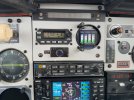
If you're talking about @Rick A I want to know too. If you're talking about my comment, it's my (Mooney) factory EGT gauge that has a green "Climb" range marked on it.What engine monitor do you have that gives a climb assist? That's pretty slick. Straight from "Mixture Magic" chasing takeoff EGT through climb.
Your factory gauge. Was it an actual Mooney piece of equipment. Or was it just standard equipment. The dynon has the lean assist once at cruise. But I often fail to check egt on takeoff.If you're talking about @Rick A I want to know too. If you're talking about my comment, it's my (Mooney) factory EGT gauge that has a green "Climb" range marked on it.
Interestingdifference compared with your Continental, upon liftoff and Vy takeoff climb, the monitor shows ROP values of well into the 200's. Knowing that my engine's Red Zone maxes out comfortably under 100 degrees on the rich side of peak, I begin leaning (reducing fuel burn with the CHT's still low) into a cruise climb in the 130 - 160 degree ROP range after clean up and acceleration. Keeping the ROP value higher than the shrinking Red Zone, upon reaching 7500' (the Red Zone is gone) I keep it at peak for the remainder of the climb to any higher altitude.
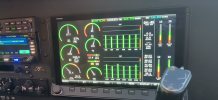
Yikes! You're going to want to change how you operate, because your monitor isn't telling you what you think it is. I say this because I have an Insight G3, which is the same as your G2 except it shows a few extra parameters.An Insight model G2. Don't really know how it calculates. The upper ROP readings don't display instantly, but typically around when the initial climb is transitioning into a cruise climb after everything is all cleaned up, and I'm beginning to lean for the climb. Here's the unit at altitude, in LOP cruise. I need to add +35 degrees onto cylinder #3's CHT reading for accuracy, due to a different style probe required by the FAA for the installation:
Standard Mooney equipment.Your factory gauge. Was it an actual Mooney piece of equipment. Or was it just standard equipment. The dynon has the lean assist once at cruise. But I often fail to check egt on takeoff.
I looked in the parts manual and it specifies either an Alcor 820202-501 or 503, or an "OEM-46178B" which is says is also an Alcor but I think maybe Alcor made it specifically for Mooney as when I Google that part number it takes me to LASAR, who now handles Mooney factory parts. 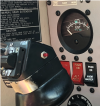
Yikes! You're going to want to change how you operate, because your monitor isn't telling you what you think it is. I say this because I have an Insight G3, which is the same as your G2 except it shows a few extra parameters.
So, the peak that it's calculating from isn't the real peak unless you're leaning the engine and leaving everything else (including your altitude) alone, and thus you should NOT expect that you can use it to keep yourself out of the red box.
For these reasons, I always set cruise power, then reset the ROP/LOP bars (Hold the lower left knob in for a sec), and THEN lean - And once it finds the peak while I'm leaning, I know that's the peak that I'm looking for.
Yeah, unfortunately they're not that smart yet. They give you lots of information to interpret and analyze on your own.Thanks for some important clarifications that I wasn’t aware. The interpretation and leaning process used during my cruise climbs mirrors what has been seen on the single probe factory EGT for many years. I assumed the modern monitor with fuel flow was smart enough to recognize engine parameters patterns established during prior takeoffs and climbs, calculate an estimated peak number to determine and display an estimated ROP amount to guide leaning as horsepower drops and mixture enriches with altitude. Sort of like the gear shifting memory in a nine-speed vehicle’s chips.
I also noticed when I was looking through some of my data for this thread that I had one EGT that was flat in cruise for a while, and then climbed up a bunch and I hadn't noticed it in flight. No idea what could have caused it, and with the time delta between when it happened and when I noticed it, not much I can glean from it at this point.
Probably. And it may be that there's enough of that sort of thing that a "smart" engine monitor that says "Hey, something just happened on your #3 cylinder!" would end up with a bunch of really expensive trips to the shop hunting for a problem that no longer exists.My guess would be one spark plug in that cylinder quit sparking. Maybe a chunk of carbon shorting it out? Then the carbon went away and the spark plug came back on line...
Probably. And it may be that there's enough of that sort of thing that a "smart" engine monitor that says "Hey, something just happened on your #3 cylinder!" would end up with a bunch of really expensive trips to the shop hunting for a problem that no longer exists.
But, I still think they could do more - *every* manufacturer. Frankly, Insight does a lot that nobody else does.
Yep, mine came from the factory (1997 airplane) and being able to reuse probes and wiring kept the cost down. There were new sensors and wiring to be installed because of all the extra features, but that was worth it.Installed a graphical (yellow on black?) Insight EGT monitor around 1989 that only had the extra capability of finding the first cylinder that peaked. It lasted around 25 years before the display died. I figured that's pretty good service, so didn't bother to shop around and compare features when installing the G2.
It's worth pulling the card periodically and downloading the data even if you don't have any issues, so that you know what to look for when you do! I upload my Insight data to flightdata.com which is free and graphs everything nicely.The big extra for me (besides 4 cylinder ROP/LOP indications) was gaining the fuel flow function, making leaning easier. Haven't gotten around yet to pulling out the history card (thankfully) to help diagnosis any issues.
It's worth pulling the card periodically and downloading the data even if you don't have any issues, so that you know what to look for when you do! I upload my Insight data to flightdata.com which is free and graphs everything nicely.

Appreciate your insight. BTW - that is Mike B statement, not mine that "CHT are everything" Something along the lines of "I don't care about EGT".