According to PHAK: "Either consciously or unconsciously, every good pilot thinks of the flight in terms of wind triangle." Which is why the OP wants to know more — he's preparing to teach it.
I think that's why I struggled with the concept. It's such an innate part of flying that I don't visualize the graphical triangle or vector math. I look at which direction I plan to fly, I look at the wind direction and speed, visualize/ballpark the correction angle, then use either the E6B or digital flight computer to run the actual numbers and solidify the planning process(fuel, ETE, etc). Knowing that once I'm in the air, no matter how many triangles I drew, reality will always be at least slightly different and require further "seat-of-the-pants" correction on the fly.
I will sit down and learn this method just to be familiar with it. But as far as teaching the concepts, I feel like I'll gravitate toward the way that I learned on the E6B:
-Set grommet at 100kts (just to have it at a round number)
-Spin the dial to wind direction
-Place a dot at wind speed(e.g. if it's 15kts place the dot at 115)
-Spin the dial to the true course
-Slide the dot to the planned TAS
-Read GS at the grommet
-Read the correction angle and add/subtract mag variation to get your mag heading.
Just thinking out loud here, I'm not sure how beneficial teaching the triangle method would be. It strikes me as abstract with a high potential for confusing students without a background knowledge in mathematics and trigonometry. If manually running the vector math is what works for you, fantastic. But I think it could be a distraction or barrier to effective learning for a lot of people. And yes, I realize that spinning the whizwheel is just doing the vector math. But the process is structured in a way that's much more conducive to learning to fly, rather than a re-flavored high school math class.
With that being said, I see tons of value in initially learning on the E6B. It gives you all the numbers you need, while still reinforcing the importance of each individual step/factor in the planning process. As opposed to digital flight computers and/or plugging your flight plan into a magic box that spits out full navlogs. Once a student has a strong working knowledge of what/where/why/how the numbers come into play, then modern calculators/apps become that much more powerful as tools in the bag.



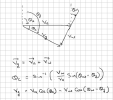

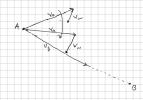

 Going from true to magnetic as he said, and/or using the chart's own scale vs. a ruler, to me, is a distinction without a difference.

 the OP could teach "carpenter geometry" instead of trig to set the scene with this analogy: Say an ultralight wants to fly 80 miles to the east with a wind from the north at 30 and a top cruising speed of 50. How long will it take? Ans.: By way of a 3/4/5 right triangle, the GS is 40, so it'll take 2 hrs. Therefore, if Google's Gemini is right, the WCA is 36.86° to the left of 090°, which also gives the TH (or he can use a protractor).


 , but once I'm on track I also update my paper log on my kneedboard with the correct heading, just in case of a GPS or electronics issue.