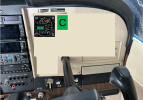
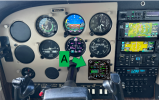
Where to put a GI 275 EIS

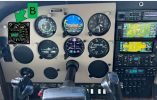
Where to put a Garmin EIS in a C182 panel?

  • A Pilot Side, lower right

    Votes: 7 38.9%
  • B Pilot Side, upper left

    Votes: 8 44.4%
  • C Passenger Side

    Votes: 3 16.7%

  • Total voters
    18
B has the advantage of being in the line of sight. A has the advantage of shorter wiring. Not a fan of C.
 
Last edited:
I would say A or C, i haven't seen many engine instruments on B (unless you're a FO on any kind of big iron)

Where are your current engine instruments located?
Then I would place the GI275 in that position.
You are trained to look there and that if you are close to be overloaded that would be the first place where you would look and might give an extra mental load to try to find it someplace else.
 
A or C.

A may be easier to read and scroll through menus. Nice tight scan with the other two as well

B would be hard for the copilot to help monitor. Also seems isolated from your traditional front-middle panel scan.

C is good because of traditional engine instruments location and copilot can help monitor. But you have to sweep your scan further across.
 
A or B is my vote, with B perhaps being preferred if you don't fly with an iPad in the manner that I usually do.

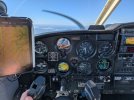
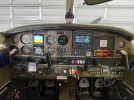
Below is my panel, although I recently upgraded the attitude indicator to a GI-275 as well. My Cherokee was made back when they were throwing instruments into the panel based on whatever mood they were in that day, so I had previously rearranged them into a standard six-pack. My panel and your panel are somewhat mirrored, with your extra row on the left side. All of my engine instruments were previously on the right side of the cockpit and I unequivocally do not miss having to look all the way over there. My EIS is within line of sight sufficiently that any warning flash gets my attention immediately. I'm also able to easily monitor my engine during my routine instrument scan.

Regardless of location though, the GI 275 EIS is an incredibly slick piece of kit. You'll be very happy with it.


Old Panel.jpg
 
I vote C. I had a JPI 830 mounted in that position in my 182. Easy to reach the buttons with my right hand while holding the control wheel with my left. I’ve flown a 172 with an older round engine monitor in the B position; I found it hard to visualize in that position and took my eyes from the runway sightline on takeoff. I have a Txi EIS in position C in my 210 and really like it there. I do have a 275 in position A as a b/u ADI and it is also very visible there.
 
I went with A, it's close enough for both the pilot and copilot to see and manipulate the instrument. B is high up in prime panel real estate, and I'd find it a little distracting, especially positioned next to the A/S indicator. C is out in right field with a closer and nicer view for the copilot, at the expense of the pilot's view.
 
Surprising / Interesting poll results. I like the comments, great food for thought.

No one voted for the right side panel, even though I've seen monitors there, especially the JPI. Perhaps because it is the size that forces it to that side.

More votes for the higher/left side panel position than for the more traditional lower right pilot side which is where I was leaning. Maybe I'll make a life size cutout and tape it to the different spots on the actual panel to get a better feel for what would work best.
 
Maybe I'll make a life size cutout and tape it to the different spots on the actual panel to get a better feel for what would work best.

That was going to be my suggestion.
I like the upper left but having the co-pilot or passenger be able to see it does also have merit in my opinion.
With the cutouts that could be tested a bit in the upper left position.
 
Co Pilot isn’t a concern, don’t have one. Most of the EIS monitoring time would be checking the cylinder head temps to work the mixture FWIW.
 
Most of the EIS monitoring time would be checking the cylinder head temps to work the mixture FWIW.
And being warned of unusual trends, readings, or flashing. I think it will become a very popular instrument for you.... you may find you view it a lot more than you anticipate. I'd venture to say my Insight engine monitor may be tops for viewing throughout a flight after everything else is all adjusted and set for traveling.
 
I'm not familiar with the GI 275 EIS, but a quick search suggests it uses a remote sensor module. If that is the case, should be easy enough to leave a service loop in the display module harness so it can be easily relocated between A and B.
 
Surprising / Interesting poll results. I like the comments, great food for thought.

No one voted for the right side panel, even though I've seen monitors there, especially the JPI. Perhaps because it is the size that forces it to that side.
I had suggested C but realized I didn’t cast a vote. Although I have/had EIS displays in the right panel on two planes and like it there, the JPI and the Txi both have larger displays than a 275. The suggestion to use a cutout replica to test the different positions is excellent.
 
Last edited:
Regardless of where you install it, be sure to download and review the data. That is one of the biggest benefits of an engine monitor.
 
Regardless of where you install it, be sure to download and review the data. That is one of the biggest benefits of an engine monitor.
This. If you happen to use GP, it will occur automatically every flight. Should you also happen to use Savvy and/or FlySto, the data can be automatically sent to them too. The second-by-second data has not just been interesting, but useful in troubleshooting a few times too.
 
Everybody is different. That's why the gambit of choices from wives, motor vehicles, aircraft makes and colors, and most everything else is different strokes for different folks.

I've found one of the most fun and rewarding things you can do with your own plane is to (if you have the time, behind the panel space, and money) is to modify the panel it to your own liking.

In my case, most Mooneys are so tight behind the panel, with many potential instrument positions limited by the steel cage proximity surrounding the cabin and panel, the depth of the instrument itself won't work where you first prefer (that has happened way too often).

A suggestion, before you get any deeper into this project, is to show an experienced avionics installer your work so far and learn what available positions will fit the monitor, and what possible positions won't.
 
"A" is where a 2nd CDI would most likely go. As a CFI, I hate "B". I know WDD said co-pilot isn't a concern, but still. :-) My vote is for "C". Still viewable by both seats and in the general area where normal engine gauges would be. That's my 1.5 cents...
 
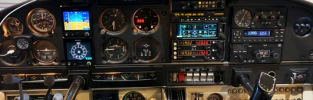
My JPI is just to the left of the tach. At the time, it was the only available spot on the 180. You can see the top of it. Guess I need new pics, maybe this weekend.

1762898247564.png
 
I spent extra to add a VOR Nav radio BTW. But as my HSI can switch to whatever source I want, you’re right in that I don’t see a need for a second HSI/CDI.

Just because a person predominately uses the “new fangled” GPS technology to fly RNAV doesn’t rise to the level of “Disdain” IMHO.
 
I spent extra to add a VOR Nav radio BTW. But as my HSI can switch to whatever source I want, you’re right in that I don’t see a need for a second HSI/CDI.

Just because a person predominately uses the “new fangled” GPS technology to fly RNAV doesn’t rise to the level of “Disdain” IMHO.

Good point! Since you're certainly not short of available panel space, there's no reason not to retain older instrumentation as backups.

After a round of panel improvements (i.e. 3 each GI-275's) I decided to keep the King KR-87 ADF, since that round hole wasn't needed for anything else. It provides AM radio to play with and listen to on long trips (sports, news, talk radio). In the event of a GPS and/or VOR shutdown the ADF still affords an opportunity to point at then home into (or away from) an AM radio transmitter antenna somewhere, which is a lost art.
 
  • Like
Reactions: WDD
In the event of a GPS and/or VOR shutdown the ADF still affords an opportunity to point at then home into (or away from) an AM radio transmitter antenna somewhere, which is a lost art.
Copy that. I do like back ups to back ups.

And....... nice value add, the idea of also keeping at least some of the old engine instruments. Maybe keep the old tach and MP. Something to think about.
 
I guess that's one less Flight Review for you. :)

giphy.gif


Sent from my iPhone using Tapatalk
 
I got to put 7 hours in the log book yesterday on a nice X country, had time to simulate / mock up different EIS locations. I think I'm unexpectedly warming up to the numerous suggestions for "B", upper left.

1) I found that for me, keeping it more eye level / on the same level as the other instruments seemed somewhat easier to read/scan than dropping my eyes to the lower position. The upper left placement would make the instruments only two rows tall, vs three rows if the EIS was on the lower right on pilot side. Maybe it has something to do with me living beyond 50 years of age and having to use progressive bifocals. :)

2) The right hand panel side where the current engine instruments are is still a pain in the tuchus to scan easily.

Appreciate the good thinking and comments - thanks.
 
Just because a person predominately uses the “new fangled” GPS technology to fly RNAV doesn’t rise to the level of “Disdain” IMHO.
"Disdain" meaning "you deem it unworthy of your consideration"?
 
Last edited:
Back
Top