Lindberg
Final Approach
I know I've said this before, but one of law school's most practical lessons was, "Never paraphrase the statute."I think one of the biggest issues is over-paraphrasing…probably a symptom of regulitis?

I know I've said this before, but one of law school's most practical lessons was, "Never paraphrase the statute."I think one of the biggest issues is over-paraphrasing…probably a symptom of regulitis?

First year. First course where we worked extensively with statutes or regulations (commercial law/UCC). Prof explicitly said, "Don't tell me what you think it says. Read it." That was about 53 years ago. Like you, a lesson I never forgot.I know I've said this before, but one of law school's most practical lessons was, "Never paraphrase the statute."
(c) Is very clear to determine if you are current you review your logbook for the prior 6 months to see if you meet the requirements to be instrument current.There is no need for a grace period, because the rule is the same whether your logbook never shows a lapse in currency or if you’ve been out of currency for years.

I’m sure I was taught the same as a 1L but my Insurance professor third year did a better job of pounding it into my feeble mind. On the first day, he wrote “Read the policy.” on the board and told us “Write this down. It will be the answer to at least one question on your final exam.”First year. First course where we worked extensively with statutes or regulations (commercial law/UCC). Prof explicitly said, "Don't tell me what you think it says. Read it." That was about 53 years ago. Like you, a lesson I never forgot.
I agree that it’s almost certainly practically moot. Even if I only owed one approach because of an unfortunate stretch of good weather, I would want the IPC I’m paying for to challenge me more than a single approach. But in the spirit of the thread…I've seen this question come up before, but I never thought that 61.57d was unclear at all. By my reading, it pretty simply says "if you don't meet instrument currency, you can only get it back by completing an IPC." Thereby, completing an IPC makes you current again. Number of approaches doesn't matter, as long as you complete the tasks required for the IPC.
Now, in reality, most people I work with who need an IPC end up needing far more than just the minimum, precisely because they are not only non current, they're non-proficient at this point as well. So we usually end up doing at least 2 flights or maybe more, and that usually means we're over 6 approaches by the time we're done anyway.
I imagine it's the same for most instructors. Most people coming for an IPC haven't been current in YEARS, let alone 6 months. And of course it's almost always because they have a big family trip coming up and "want to be ready" for any IMC that may occur.
The missing link here is to start with only (c). Pretend (d) isn’t there at all. Under what conditions would you be current? Get a safety pilot or simulator and fly until you can log 6 approaches, a hold, and a course intercept within the past 6 months. Now you’re current. It didn’t matter that you temporarily lost currency. And, under (c), you could have been out of currency for 20 years, much less 6 months.(c) Is very clear to determine if you are current you review your logbook for the prior 6 months to see if you meet the requirements to be instrument current.
(d) is very clear that if you don't meet the requirements for more than 6 months you must do an IPC.
What I don't find anywhere in the regs anymore is *specifically* what you CAN and MUST do, if anything, in the 6 months in the middle. Yes, I know what we've all been taught and read in publications. But I'm looking for it in the regs. It is possible it was removed in various rewrites.
You forgot getting the rating. These days when it's hard to schedule timely checkrides, you might not have 6 in the 6 calendar months before passing the ride and - in the spirit of this thread - might not be current the day you pass. Someone actually asked the Chief Counsel that one. The answer covered both the newly-minted and the recipient of an IPC. If anyone is wondering, yes you are.I’m sure I was taught the same as a 1L but my Insurance professor third year did a better job of pounding it into my feeble mind. On the first day, he wrote “Read the policy.” on the board and told us “Write this down. It will be the answer to at least one question on your final exam.”
I agree that it’s almost certainly practically moot. Even if I only owed one approach because of an unfortunate stretch of good weather, I would want the IPC I’m paying for to challenge me more than a single approach. But in the spirit of the thread…
61.57(d) says “a person who has failed to meet the instrument experience requirements of paragraph (c) of this section for more than six calendar months may reestablish instrument currency only by completing an instrument proficiency check.” There is no language here that allows a person who has not failed to meet the requirements of (c) for more than 6 months to become current by completing an IPC.
Going a step further, it also does not say that you are not subject to the currency requirements of (c) after you complete an IPC. The “only by” does imply “by” of course, but then we have this problem: What does the regulation say about how long your currency lasts after an IPC?
I think we all treat this as meaning an IPC completed at any time makes you current for 6 months without anything other than the IPC in your logbook, even if the regulation is silent or in conflict with that understanding. But I’ve seen plenty of cases where everyone thought a law meant something for ages only to have a court tell the world they were wrong the whole time. Sometimes it’s the same judge on the same court with the same question about the same words deciding that his first opinion years ago was wrong. So I’m probably above-average paranoid about unclear regulations.
Take a look at 61.57(a) for passengers, which is simpler. By your logic it tells you how you know if you're current, but it doesn't tell you what you need in order to get current. But everyone else seems to understand that those are the same thing.(c) Is very clear to determine if you are current you review your logbook for the prior 6 months to see if you meet the requirements to be instrument current.
(d) is very clear that if you don't meet the requirements for more than 6 months you must do an IPC.
What I don't find anywhere in the regs anymore is *specifically* what you CAN and MUST do, if anything, in the 6 months in the middle. Yes, I know what we've all been taught and read in publications. But I'm looking for it in the regs. It is possible it was removed in various rewrites.
(c) tells you that you can use certain flight experience to gain/maintain currency. (d) tells you the only time that you can’t, which is more than 6 calendar months after you were last current.(c) Is very clear to determine if you are current you review your logbook for the prior 6 months to see if you meet the requirements to be instrument current.
(d) is very clear that if you don't meet the requirements for more than 6 months you must do an IPC.
What I don't find anywhere in the regs anymore is *specifically* what you CAN and MUST do, if anything, in the 6 months in the middle. Yes, I know what we've all been taught and read in publications. But I'm looking for it in the regs. It is possible it was removed in various rewrites.

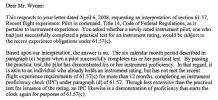
True, it doesn't, but the Chief Counsel apparently believes it is reasonable that an IPC resets the clock, as does a checkride. See especially the last sentence.What I don’t see is where it says you can take an IPC to regain currency within the 6 months after becoming non-current under (c).
Show me where it says this? Going with (c) only, you look back at the "preceding" 6 months. So you're good for 7 months. But (c) says nothing about what happens if you didn't fly in the 7th month and you're now in the 8th month. And if your currency all took place in what is now 7 months prior, so you are not current in the preceding 6 months. There is no *documented* way on how you get current again.Get a safety pilot or simulator and fly until you can log 6 approaches, a hold, and a course intercept within the past 6 months. Now you’re current.
I deliberately omitted it but it does fall into the same overall crack between the boards. And, while writing my response to @M20K in this post, I noticed yet another nonsensical pedantic thing to worry about: If you log approaches, holds, or course interceptions to regain currency, you can’t file IFR until the next calendar month. The currency-supporting tasks must be “within the 6 calendar months preceding the month of the flight.”You forgot getting the rating.
Thank you. I would have reached a different conclusion, but that’s the good thing about asking the Chief Counsel because they can employ common sense in ways an outsider might be laughed out of court for.2008 Wynne interpretation:
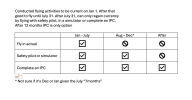
Let’s say I flew 6 approaches, a hold, and a course interception back in December 2025 but I haven’t flown since then. It’s now August 2026, so I have 0 approaches, 0 holds, and 0 course interceptions in the preceding 6 months. I am not current now under 61.57(c), but I was current within the past 6 months so 61.57(d) doesn’t apply.Show me where it says this? Going with (c) only, you look back at the "preceding" 6 months. So you're good for 7 months. But (c) says nothing about what happens if you didn't fly in the 7th month and you're now in the 8th month. And if your currency all took place in what is now 7 months prior, so you are not current in the preceding 6 months. There is no *documented* way on how you get current again.
Where does it says you can do that.... please show me.Now, tomorrow, August 10, I go out and fly (and log) 6 approaches, 1 hold, and 1 course interception. Assume that I want to file IFR on September 1. If you read only 61.57(c), does it say that I am current? If not, what do you think I’m missing under 61.57(c) only?

Show me the reg that says you can fly on Sundays.Where does it says you can do that.... please show me.
Again, not disputing this is what a lot of us were taught many decades ago. And not disputing it is in lots of articles. But this is a discussion about what the regs say, or don't say. So show me where it SAYS you are legal to go fly if you do that? Right now it says 6 months prior or after 12 months you do an IPC. If you find something else, that is exactly what I'm looking for. Again, not practical or common sense, but regulatory.
So do you now see what the question is? (Yes, this is an "in the weeds" discussion.)
I’ve seen the question all along. I’ve answered it in numerous ways. This one is not in the weeds. The post you quoted leads you to the water and, if you answer the questions in that post by reading the regulation, you’ll find yourself drinking.So do you now see what the question is? (Yes, this is an "in the weeds" discussion.)
Ah, the olden days!Probably the hardest part of being and flying in Florida was the 6 hours required.
Approaches were easy but that 6 hours actual was hard especially if you were being honest about it.
This is very true and I'm a firm believer in this as well!! But it used to say what to do, now it doesn't. So I'm just curious if they blew it or if there is somewhere else that it is <cough> allowed.Regulations generally restrict operations. If they don’t tell you that you can’t do something, it’s generally allowed.
Really? That’s not necessary. Just treat it as an academic discussion on over-parsing regulatory language until you get bored with it.
So your position is that when the FAA changes wording that doesn’t match general guidelines that they should add regulations that don’t match general guidelines?This is very true and I'm a firm believer in this as well!! But it used to say what to do, now it doesn't. So I'm just curious if they blew it or if there is somewhere else that it is <cough> allowed.