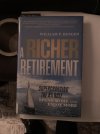
What's In Your Wallet?

Retired in 2011 downsized my boat and airplane.

Got rid of the boats years ago and downgraded the plane along the way... Guess I started a trend at our local field as few others have done the same.

:yeahthat:

Suggestion - start getting involved in those "retire to" things now, at whatever level you can manage, while retirement is still a few years away. Don't just think, "Yeah, I'll jump into that after I retire." You'll find it's easy to let things slide. Start doing some of it ahead of time, whether it's a hobby or a charity or a business or whatever. Once you find yourself getting deeply involved and you don't have time to go to work anymore, you'll know it's time to retire.

I was planning on doing this, but the gave me another batch of problem children accounts to get back into shape.... I will start weening out come fall for a 2/2027 exit. Thanks for the advice
 
Don’t think I could handle being retired, part time MAYBE.
This is exactly why I took a part-time teaching gig at a local university. The pittance pays for the airplane, I'm forced to get out of the house, and I deal with a lot of different people every day. The aviation dept is across the street, and if there's no class scheduled, I can practice instrument on the Frasca sims. Can't book the time, and not as spiffy as a Redbird, but it's free. Plus, once I retire for real, the university's pension plan kicks in every month.
 
I saw a blurb above about 3 years expenses held in cash. I disagree with this as cash is a negative equity. Now, I'm not talking about 30 year maturity bonds or anything, but jeez, at least put 3 years worth of expenses in some blue chip. These days, Etrade can turn blue chip investment getting dividends at least into cash in 24 hours. That's why god invented Amex.
 
When I retired I figured I’d do some consulting or contract work. It took a couple of months for me to recognize the fact that I really didn’t want to give up that kind of time, really, and unless it was for a “life altering” amount of money I just wasn’t interested.

Then I figured out that I just don’t have the time for it either. I have no idea how the hell I ever had time to work. I can’t even get to half my hobby projects as it is.
 
The average return on a dow fund for the past 30 years has been nearly 10%. Hiccups and all. If 30 years is the planning horizon, then paying off a 3% mortgage would be leaving a lot of money on the table.

You're absolutely correct given that horizon. The topic here, though, is transitioning into retirement, and surviving the first 5 years is critical (see the video in post #23). That long-term 10% return average might not hold in the first 5 years, and in that shorter period you could easily lose money.

I'm sure I'm just being more conservative, but consider if the market drops and inflation soars during those early years. If you have to pull more money than planned from stock holdings to service a large debt, it's very difficult to recover. Other expenses can be trimmed if necessary, to the point of eating beans and rice for a year while waiting for the market to recover, but the mortgage payment is a fixed obligation that must be met every month.

I'm less concerned with maximizing return than I am with bomb-proofing a retirement plan. You and others may be less risk averse than I am. To each his own. Personally, I'm living the retired life I wanted and I haven't lost a minute's sleep over financial worries. My goal is a happy retirement, not the wealthiest possible retirement, so there's a balancing act.
 
When I retired I figured I’d do some consulting or contract work. It took a couple of months for me to recognize the fact that I really didn’t want to give up that kind of time, really, and unless it was for a “life altering” amount of money I just wasn’t interested.

Similar here. I expected I'd go back to the company as a consultant after about six months, but when that time had passed so had the desire. I have plenty to do, including continuing engineering work, so there's not much attraction. Once in a while I consider returning to work, but when that happens I find that if I take some ibuprofen and lie down in a dark room with a cool, damp towel over my head, within an hour or so the tremors stop and my breathing returns to normal.
 
You're absolutely correct given that horizon. The topic here, though, is transitioning into retirement, and surviving the first 5 years is critical (see the video in post #23). That long-term 10% return average might not hold in the first 5 years, and in that shorter period you could easily lose money.

I'm sure I'm just being more conservative, but consider if the market drops and inflation soars during those early years. If you have to pull more money than planned from stock holdings to service a large debt, it's very difficult to recover. Other expenses can be trimmed if necessary, to the point of eating beans and rice for a year while waiting for the market to recover, but the mortgage payment is a fixed obligation that must be met every month.

I'm less concerned with maximizing return than I am with bomb-proofing a retirement plan. You and others may be less risk averse than I am. To each his own. Personally, I'm living the retired life I wanted and I haven't lost a minute's sleep over financial worries. My goal is a happy retirement, not the wealthiest possible retirement, so there's a balancing act.
Thanks for sharing your thoughts.
 
When I retired I figured I’d do some consulting or contract work.
I believe a good number of people think the same in certain fields where consulting or similar work is available to include me. Just after I gave my two weeks notice, I was hired to consult on a fatal helicopter accident which would allow me to hit the ground running with my new "retirement gig." The case ended up taking about 6 months to develop, but by then I had found my groove so to speak and any alteration to my schedule to meet those responsibilities for the client became more a hinderance than a welcomed change even though the money was really good.

The idea of still working lost its luster a lot faster than I had ever thought as I had consulted as a side job for many years prior. And while I still did consult after that initial job, the following agreements were all on my terms or I didn't accept it and a lot of potential work evaporated overnight. Which was okay. One of the main reasons I wanted to stay engaged in the industry was to keep my mind immersed in aviation as it has been a passion of mine since I was very young. So what I ended up doing was simply paying forward my knowledge wherever I could, like PoA, just as my mentors had done for me plus the odd mx consult assignment for beer money.
 
Similar here. I expected I'd go back to the company as a consultant after about six months, but when that time had passed so had the desire. I have plenty to do, including continuing engineering work, so there's not much attraction. Once in a while I consider returning to work, but when that happens I find that if I take some ibuprofen and lie down in a dark room with a cool, damp towel over my head, within an hour or so the tremors stop and my breathing returns to normal.
I took the route of working 4 days a week while my wife was still employed. After 2 years I transitioned to pure consulting. At this point 10 years after retirement at 57, most of the consulting has dried up. It has become very episodic with the last work back in Nov 2025. At this point I may end up just taking the shingle down.
 
I took the route of working 4 days a week while my wife was still employed. After 2 years I transitioned to pure consulting. At this point 10 years after retirement at 57, most of the consulting has dried up. It has become very episodic with the last work back in Nov 2025. At this point I may end up just taking the shingle down.

I've found that doing some pro bono work for www.emiworld.org scratches my engineering itch, and without all the corporate stress and daily ca-ca. Fun, interesting projects, great people, worldwide stuff.
 
Respectfully, 4.7% if that is an EBIT is a very low bar. I mentioned earlier I'm in high tech. Here's a sample of my past year EBIT not inc dividend:
Broadcom Inc
As of February 23, 2026 • 3:00 PM CST
NSQ: AVGO
330.34USD
+122.41(58.87%) 1YR.
I also have RE rental holdings. EBIT there is always over 17% and can be as low as 10-11% depending on property tax and maint. When the RE equity increase is factored in(once sold) the long term should be about 15% over the accelerated depr life of 22.5 years. I would be pulling my hair out at a 4.7%, even if that were after int and tax. Might have been correct in the 50s or 60s?
 
It is not EBIT...it is a safe withdrawal rate intended to determine your total retirement target.

"The 4% rule is a retirement guideline suggesting you can safely withdraw 4% of your initial portfolio balance in year one, then adjust that amount for inflation annually, to likely last 30 years."
 
It is not EBIT...it is a safe withdrawal rate intended to determine your total retirement target.

"The 4% rule is a retirement guideline suggesting you can safely withdraw 4% of your initial portfolio balance in year one, then adjust that amount for inflation annually, to likely last 30 years."
Ah. Thanks, and that makes some kind of sense I guess. That statement is literally quoted, but I dont see that stated anywhere in this thread. Obviously, I have not read the book. Anyway, I'm blowing through that amount so far too. See the boat..
 
It was a quote from a Google internet search "4% rule to retirement".
 
Back
Top