What is likely to happen (Post Accident) ?

Pilot-To-Be

Pre-Flight
Joined
Mar 18, 2024
Messages
68
Display Name
Pilot
A friend of mine who is a CFII was test flying a Just Aircraft Super STOL for some folks at a nearby airport that had an experimental turbine engine on it. Crazy I know. It was flight number 3 and he accidentally stalled it on short final and the aircraft is a total loss. He walked away. He likely didn’t have any turbine experience, but I’m curious what the FAA will do. Are they likely to request a 709 ride? Slap on the wrist? What is likely to occur in a situation like this?
 
Unless the FAA’s investigation reveals a FAR violation, nothing will happen.

If the aircraft was insured, the pilot might be sued by the insurance company for their loss paying the claim.
 
I would expect an investigation and anticipate the possibility of a 709 ride because of the stall. But that depends on what the investigation shows, what the ASI thinks is appropriate, and what corrective action the pilot does on their own.

Since I don’t have the full picture I can’t say what is most likely.
 
Like already mentioned it will depend on the exact situation and how the CFI responds to it.
if he responds with talk to my Lawyer, I would expect the FAA will aggressively investigate what happened and try to figure out what he might be hiding. Actually the investigators response will be fine, we will have our lawyer call your lawyer and lawyers will do what they do.

if he responds with this is what happened and this is why he did what he did. And is of the attitude what can I do to make sure something like this doesn't happen again probably not much will happen unless he was doing something that was illegal or dangerous that he should have know better.
Probably some discussion about his qualifications to be flying the airplane. I wonder a bit about Turbine Currency, but might not apply in this situation. Not my area of expertise.

Hopefully he has appropriate CFI insurance, that would be enough to keep insurance companies or the planes owner for going after him. But if like a lot of CFI's if he has no assets, it probably won't be an issue.

Brian aka some guy on the internet
 
I wonder a bit about Turbine Currency, but might not apply in this situation.
Yeah, the operating limitations, specifically the PIC requirements, may have some influence on the outcome.

Nauga,
in the blind
 
Probably some discussion about his qualifications to be flying the airplane. I wonder a bit about Turbine Currency, but might not apply in this situation.
“Turbine currency” doesn’t exist at the FAA level, but yes, if this was his very first turbine airplane, or he didn’t meet airplane-specific requirements, I’d expect a good preflight self-assessment to come up.
 
“Turbine currency” doesn’t exist at the FAA level, but yes, if this was his very first turbine airplane, or he didn’t meet airplane-specific requirements, I’d expect a good preflight self-assessment to come up.
The only reason I thought it might be an issue as I recall some of the Turbine Powered Self launching glider pilots were having an issue with one of the currency regulations, essentially requiring them to go do currency flights when there were no or very few turbine powered multi-place gliders available to do the currency flight in. If they were Airplane rated they could do it something like a PC12 or Citation, but that really had no bearing on flying a self launching glider.

Do you recall what the issue was?
Did they finally change the regulation?

Brian
I don’t recall the issue, and I don’t see anything other than maybe needing special training under 61.31(h). Is it possible that it was simply their first self-launching glider, and they needed an endorsement?
 
Unless the FAA’s investigation reveals a FAR violation, nothing will happen.
This isn't true. I've prepped people for 709 rides where there was no FAR violation. Crashing a plane is enough reason for a re-examination.
 
This isn't true. I've prepped people for 709 rides where there was no FAR violation. Crashing a plane is enough reason for a re-examination.
But…but…you mean there’s no reg that says you can’t crash?!? ;)

As a specific example, a ground loop accident can result in a 709 ride. They simply need to demonstrate landing (usually) proficiency.

Edit: for those in the know, can a 709 event be simply a counseling session with the FAA? I didn’t keep my paperwork to check, and since it’s been expunged, absolutely no record of it exists…other than the pictures the investigating inspector gave me when I was on the FSDO 15 years later. ;) And no, it wasn’t a ground loop.
 
Last edited:
Q: turbine or turboprop?
Q: PIC experience in type?
Q: PIC experience with engine type?
Q: PIC experience doing Phase 1 flyoffs?
 
But…but…you mean there’s no reg that says you can’t crash?!? ;)

As a specific example, a ground loop accident can result in a 709 ride. They simply need to demonstrate landing (usually) proficiency.

Edit: for those in the know, can a 709 event be simply a counseling session with the FAA? I didn’t keep my paperwork to check, and since it’s been expunged, absolutely no record of it exists…other than the pictures the investigating inspector gave me when I was on the FSDO 15 years later. ;) And no, it wasn’t a ground loop.

Yes, the 44709 can be just a discussion to determine competency.
 
if he responds with talk to my Lawyer,
I can't think of a worse initial response unless you did something truly awful. In fact, 90% of the time that response would tell the investigator that you had not spoken with a lawyer.
 
Edit: for those in the know, can a 709 event be simply a counseling session with the FAA? I
It's not really a "counseling" session if we are in the 709 world. It's a demonstration of competence.

But if you are asking whether it can be a ground discussion rather than a flight, yes. Definitely. I can give examples.
 
If the cfi has no turbine experience and they took on a phase one test program for a turbine…. I would be shocked if there isn’t close attention from the fsdo.

That is, to me, an indication of terrible judgment. Bad enough I would question whether or not they should be teaching.

Just this guys opinion.

For context I’m kicking around 10k hours with 4000 hours flying turboprops and lots of those in turbine tail wheel. I would not take a job doing phase one flights because I have zero experience doing phase one test flight operations.

One of the most important lessons as a pilot is knowing what you don’t know.
 
Did he feel a NASA report? That offers a little protection and might calm things down a bit.
 
Did he feel a NASA report? That offers a little protection and might calm things down a bit.
Depends on what they may or may not have violated. The criteria for protection includes that the violation must have been inadvertent and not deliberate. If everything is as described here the stall sounds like it was inadvertent but the phase I testing of a turbine with no prior experience was deliberate. This is all clearly hearsay but more information will certainly gathered by the FAA.

Nauga,
and Jimi Hendrix (not to mention Devo)
 
It's not really a "counseling" session if we are in the 709 world. It's a demonstration of competence.

But if you are asking whether it can be a ground discussion rather than a flight, yes. Definitely. I can give examples.
I know of one 709 evaluation where the inspector stood at the fuel pump watching her do 3 takeoff and landings as she did a couple warm up laps before meeting with the expect. When she taxied in the inspector told they looked good and she was done.
 
I know of one 709 evaluation where the inspector stood at the fuel pump watching her do 3 takeoff and landings as she did a couple warm up laps before meeting with the expect. When she taxied in the inspector told they looked good and she was done.

I don’t recall the issue, and I don’t see anything other than maybe needing special training under 61.31(h). Is it possible that it was simply their first self-launching glider, and they needed an endorsement?
You prompted me to look it up.
What I wasn't remembering is that it is Turbo-Jet aircraft not Turbine Aircraft.

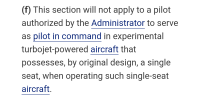
§ 61.58 Pilot-in-command proficiency check: Operation of an aircraft that requires more than one pilot flight crewmember or is turbojet-powered.

Looks like they really haven't fixed the issue. It does help that there are a few multi-place Jet sailplanes available, but still a pain for pilots with single place turbojet gliders that don't regularly fly turbojet aircraft other than the glider.
 
I know of one 709 evaluation where the inspector stood at the fuel pump watching her do 3 takeoff and landings as she did a couple warm up laps before meeting with the expect. When she taxied in the inspector told they looked good and she was done.
One know of was a CFI who crashed an airplane because it ran out of fuel. It was kind of an off-situation, but the 709 was, teaching the ASI how to do a preflight inspection.

Then there are the 709s that don't involve pilots, say a mechanic who might not have documented things properly.
 
You prompted me to look it up.
What I wasn't remembering is that it is Turbo-Jet aircraft not Turbine Aircraft.

§ 61.58 Pilot-in-command proficiency check: Operation of an aircraft that requires more than one pilot flight crewmember or is turbojet-powered.

Looks like they really haven't fixed the issue. It does help that there are a few multi-place Jet sailplanes available, but still a pain for pilots with single place turbojet gliders that don't regularly fly turbojet aircraft other than the glider.
Yeah, I forget about the “turbojet powered” part of 61.58…I think what happened is they changed the reg to include single-pilot jets.

So these are type certificated gliders, not experimental? Seems like there could be a pretty simple AMOC either way.
 
You prompted me to look it up.
What I wasn't remembering is that it is Turbo-Jet aircraft not Turbine Aircraft.

§ 61.58 Pilot-in-command proficiency check: Operation of an aircraft that requires more than one pilot flight crewmember or is turbojet-powered.

Looks like they really haven't fixed the issue. It does help that there are a few multi-place Jet sailplanes available, but still a pain for pilots with single place turbojet gliders that don't regularly fly turbojet aircraft other than the glider.

Screenshot_20251124-144356.png
 
It's not really a "counseling" session if we are in the 709 world. It's a demonstration of competence.

But if you are asking whether it can be a ground discussion rather than a flight, yes. Definitely. I can give examples.
Mine was specifically called a “counseling session,” IIRC. So probably not 709. (Might’ve even been 609 at that time.)
 
Q: turbine or turboprop?
Q: PIC experience in type?
Q: PIC experience with engine type?
Q: PIC experience doing Phase 1 flyoffs?
Q: How was it certified? and if ex/(whatever),
Q; What's in the operating limitations for the experimental airworthiness certificate regarding pilot qualifications?
Most home/kitbuilts have some qualification requirements, some are more restrictive than others. Sometimes just e.g. PP-ASL, sometimes more.

Wonder if the guy had an EAA flight advisor? :cool:

Nauga,
and his grandfather
 
As an occasional Ercoupe pilot, but not having deep familiarity with its systems, how can you get an Ercoupe uncoordinated to enter a spin?
An Ercoupe is naturally uncoordinated at high angles of attack. It’s set up to be coordinated at cruise speeds.

And stalls are only gentle if you approach them gradually.
 
Being an experimental, many things are different.

There's probably no hull insurance during the initial part of phase 1 testing, at any price.

The aircraft's operating limitations (which are part of the airworthiness certificate) spell what the pilot requirements are. It used to be that the limitations were pretty vague, so am ASEL pilot could, for example, solo a seaplane or gyrocopter without the appropriate rating. Nowadays they're more restrictive with language like, "the pilot must hold all required ratings or endorsements..."

Depending on the aircraft, it could be easy (potentially not the pilot's fault) to stall an untested experimental with unproven instrumentation. In this case (a stall during a go-around) could be related to turbine spool-up time? Especially if the pilot didn't have any turboprop time.

His CFI ticket is irrelevant; in this case he was acting as a private or commercial pilot, not instructing.
In my experience the cfi ticket is rarely irrelevant. Not even when you are sitting in the back seat going for a ride.
 
This isn't true. I've prepped people for 709 rides where there was no FAR violation. Crashing a plane is enough reason for a re-examination.
yes, and for an inquiry by the regional flight surgeon as well.
 
Back
Top