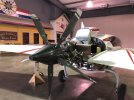
Velocity Twin Turboprop

BPM

Pre-Flight
Joined
Sep 2, 2018
Messages
98
Location
DFW, Texas
Display Name
BPM
Velocity's twin turboprop had its first flights this week. Love that the company continues to innovate and push the design further.

I don't mean this question/statement to be interpreted in anyway as a criticism...

...but I'm confused about the decision to make a twin turboprop before (maybe instead of?) a singe turbo prop. It would seem that a single turboprop would be so much more useful and economic. The twin TP has only 4 seats? Assume they make a 6 seat version. Is there a market for a 6-seat twin turboprop with all the corresponding Capex and opex?

Posting for perspective. Perhaps I am missing something.
 
Interesting question. Maybe ....... If you can afford a turboprop anything, chances are economics isn't a high factor. A twin turboprop vs single turboprop isn't going to be a large factor. And you get bigger bragging rights.
 
  • Like
Reactions: BPM
There was a Velocity XL-RG(single) with a turbo prop at Osh, it was in 2023 or 24, I saw it on YouTube. IMO the turbo prop version, single or twin doesn't make a lot of sense unless it's pressurised.
 
Interesting question. Maybe ....... If you can afford a turboprop anything, chances are economics isn't a high factor. A twin turboprop vs single turboprop isn't going to be a large factor. And you get bigger bragging rights.
I think the large number of folks who own a turbine single might disagree with you.

Multi-engine turbine isn;t worth the extra cost unless you truly need the payload.
 
Is there a video of the flight?
 
There have been a couple of turbo prop Velocity’s. They just haven’t been popular.

Videos of takeoff and landing are on the Facebook Velocity group.
 
  • Like
Reactions: BPM
There have been a couple of turbo prop Velocity’s. They just haven’t been popular.

Videos of takeoff and landing are on the Facebook Velocity group.
Appreciate everyone's thoughts and perspective.

I'm not surprised to hear a builder has modified a Velocity to be TP. I'm surprised the "factory" is making the calculated investment decision to skip single TP and jump to twin TP.

The costs of a single TP are massive. But I can see someone willing to pay those costs for increase in HP and reliability (perceived or otherwise) - lack of pressurization notwithstanding.

Again, I'm not a hater or troll. Love the company and love the effort and progress.
 
Remember the Beech Starship?

I have seen one owned by a successful corporation, fly into KLOU Louisville KY, and later depart.

I have also seen one at the Boeing museum, listed as the most advanced aircraft of its time.

Beechcraft bought most of them back when they quit supporting the aircraft, as they did not sell..........................

How can a much smaller company hope to sell such a radical, but only marginally better aircraft to deep pocketed customers? They did not get rich making high risk, low reward choices with their money.

YUM bought from a corporation with a long history of successful aircraft design and production.
 
My thoughts (I could be wrong):
I question the company's focus. They had the first velocity twin crash partly because of poor design/manufacturing. THey should focus on making that plane successful, before starting a new project.
 
I didn't know a V-Twin was lost. Yikes.


"Low yo yo maneuver" has now been added to my "stupid things to say to the NTSB" list. :oops:
 
Assume they make a 6 seat version. Is there a market for a 6-seat twin turboprop with all the corresponding Capex and opex?
The King Air 90-series is most popularly configured as a 6-seat aircraft (okay, there is a 7th potty seat). So there would appear that there is some market out there for a twin-engine 6-seat turboprop. Although one of the main appeals of the King Air is cabin size, which certainly the Velocity wouldn't be able to compete with.
 
The King Air 90-series is most popularly configured as a 6-seat aircraft (okay, there is a 7th potty seat). So there would appear that there is some market out there for a twin-engine 6-seat turboprop. Although one of the main appeals of the King Air is cabin size, which certainly the Velocity wouldn't be able to compete with.
My thought as well. There's not a problem with twin turboprop designs, even with the canard. The problem is that the Velocity isn't a large-enough aircraft to warrant the payload capability. The single-turboprop barely makes sense, but only from a coolness/speed perspective. If the Velocity were closer to a King Air 90 in size/capacity, then it wouldn't seem so absurd. It's like putting two turboprops on an unpressurized Cessna 337.
 
My thoughts (I could be wrong):
I question the company's focus. They had the first velocity twin crash partly because of poor design/manufacturing. THey should focus on making that plane successful, before starting a new project.
Please elaborate. Last time I checked, the first twin Velocity is still flying. And what was the “poor design/manufacturing” which caused this crash?
 
Please elaborate. Last time I checked, the first twin Velocity is still flying. And what was the “poor design/manufacturing” which caused this crash?
I believe that's in reference to the gear severing the ECU. Lots of photos of the plane at Sebastian. So it could be deduced it was built as a build assist. I don't know if that was the cause. More shotty workmanship than design. However, the gear issue on N13VT could have been what was being alluded. If my home drome was bigger, I'd think long and hard about a conventional vtwin.
I didn't know a V-Twin was lost. Yikes.


"Low yo yo maneuver" has now been added to my "stupid things to say to the NTSB" list. :oops:
N13VT was another.
 
Last edited:
I believe that's in reference to the gear severing the ECU. Lots of photos of the plane at Sebastian. So it could be deduced it was built as a build assist. I don't know if that was the cause. More shotty workmanship than design. However, the gear issue on N13VT could have been what was being alluded. If my home drome was bigger, I'd think long and hard about a conventional vtwin.

N13VT was another.
N13VT was kit number 20. So definitely not the first V-twin.

The Janesville crash had nothing to do with design or manufacturing. The pilot exceeded the gear extension speed for most of the first leg. Then on climbout after their first fuel stop, they misinterpreted a loss of signal indication on an oil pressure sender for as a loss of oil pressure and shut down an engine. Because they exceeded gear extension speed, the gear door departed and took out the prop of the remaining engine. Had they spent 5 minutes removing the gear doors before beginning the trip or not exceeded vLE the gear doors would not have departed. As for why the oil pressure sending unit wire broke, it sounds like it may have been improperly secured.
But why did the gear require maintenance to begin with?
 
I think that I recall they had an issue with the gear retracting at some point. That the owner got someone to ferry it to Sebastian rather than fix it themselves could mean a lot of things. Not comfortable troubleshooting or making the repair, too busy to do it themselves, didn't have a heated hangar to work in.
 
spending the couple hundred thousand dollars for a turbo prop to save about a dollar a gallon in fuel doesn't really break even for about 20 to 30 years of normal private flying. since the velocity is an experimental it's not like it could be used in charter or commercial flights ( IIRC).

I guess if you're at the twin turbo prop velocity level of EAB ownership then that dollar per gallon savings doesn't really matter to you
 
Not to mention reduced range (I’m guessing those turbines use a lot more fuel than the IO360’s or 390’s that are commonly used on the V-twins). And that probably means less useful load too.
 
I've been doing a little research. Here's what I found. I believe the turbine engine being used is a PBS TS100A. Approximately 250 HP. Fuel burn is potentially slightly less than comparable lycoming/continentals. Weight is much less. Can only assume the acquisition price is much higher.

Here's a video interview with a builder from a couple years ago. Believe Velocity is using the same engine on the TP.
 
I've been doing a little research. Here's what I found. I believe the turbine engine being used is a PBS TS100A. Approximately 250 HP. Fuel burn is potentially slightly less than comparable lycoming/continentals. Weight is much less. Can only assume the acquisition price is much higher.
Last I heard (quite a few years ago) they were trying to determine a low torque issue. IIRC, they couldn't get above 70% torque at 100% N1. At that setting they were burning about 22GPH. Other than that, all I know is that it doesn't fly very often.


349999718_1_4.jpg
 
I thought the TP100 burned in the neighborhood of 30-35gph for its 240hp?
PBS thinks so too, and publishes identical power and SFC specs for the TS100. They're around 1/3 the weight of an O540, which is both good (weight) and bad (balance).

Nauga,
conceptually
 
Test flights have shown fuel burn a side as 15 gal/hr. That appeared to be at a reduced power setting equating to 214 KTAS. They’ve taken it up to the Vne if 200 KIAS with a 228 true.
 
Back
Top