
Flying Keys
Cleared for Takeoff
- Joined
- Jul 2, 2021
- Messages
- 1,027
- Display Name
- Flying Keys
The approach 414BA flew into SAN the day prior to the accident, as referenced in the VASAviation video above: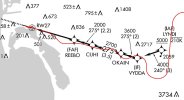
Occam.
Occam.


I was just watching this. Glad someone posted the link. It seems like proficiency is definitely a question here.The story gets longer and possibly more revealing as to proficiency or lack thereof:
Frustrating.

Yes. This was the "never let them see you sweat" school with was sooo part of the culture.Once whilst flinging out of control in a A-4 (apparently caused by a stuck slat) I heard myself calmly key the mic and respond in a deep sexy voice, “I’m fine…” when queried.
To be CLEAR, I was NOT fine. I was on the verge of EJECTING. Nonetheless, I was solo, and that transmission came from my jet… pretty sure it was me…
Haha. Or the fake it until you make it…Yes. This was the "never let them see you sweat" school with was sooo part of the culture.

The approach 414BA flew into SAN the day prior to the accident, as referenced in the VASAviation video above:View attachment 141828
Occam.

He was under the layer, 3 nm from NAS North Island, plenty of altitude to clear the peninsula. Yeah, a bit of a PITA to land at a .mil facility without prior clearance, but it's been done.Viewed the video, and it was painful to listen to the audio following the first 360 degree excursion and realizing he survived. At that point, not hearing a Mayday Mayday Mayday "I'm having control issues now level and climbing above the clouds (or descending below the clouds) to visual conditions... please standby", this bad situation only got worse.
Screaming passengers not accustomed to acceleration and G forces may have been a clue he was in deep trouble and now was a golden opportunity time to ignore ATC instructions and their offers for help, and get visual ASAP.
What kind of impairments are you guessing? There’s a lot of supporting information in this thread. It’s weird that the excursions only happen when flying IFR and/or in IMC.My guess is pilot incapacitation. I'm not very familiar with the weather at the time, but what I've read there was a marine layer about 600'-800' thick. He should have been above the layer at some time during the flight, or could have asked and gotten above the layer without much difficulty. The main things that could explain that flight track are impairments to the aircraft's control system or impairments to the pilot. The pilot was asked whether he was having difficulty, and he answered in the affirmative, yet he was unable to describe it.
Sounds like a classic description of spatial disorientation. Yes, that's a form of pilot incapacitation in the broad sense, but a very specific one.My guess is pilot incapacitation. I'm not very familiar with the weather at the time, but what I've read there was a marine layer about 600'-800' thick. He should have been above the layer at some time during the flight, or could have asked and gotten above the layer without much difficulty. The main things that could explain that flight track are impairments to the aircraft's control system or impairments to the pilot. The pilot was asked whether he was having difficulty, and he answered in the affirmative, yet he was unable to describe it.

Here’s an old ad for the plane: https://www.aircraft.com/aircraft/201079373/n414ba-1970-cessna-414Sounds like a classic description of spatial disorientation. Yes, that's a form of pilot incapacitation in the broad sense, but a very specific one.
These are called accident chains for a reason. I don't know squat about the useful load of a 414, but others in this thread have indicated based on the pax count that this flight may have been flirting with max gross. A 600'-800' layer could easily require 30+ seconds of climb if the plane was heavy. For a pilot whose instrument skills are rusty or underdeveloped, spatial disorientation could easily set in more quickly than that. Even if he fully broke out, would he have had adequate time and skill to recover a heavy airplane in an unusual attitude before plunging back in?
This would be basic unusual attitude recovery, and since nobody said, “put your head down and close your eyes,” I doubt that his mind grasped that.My guess it is some sort of sudden, acute neurological event, most likely not spatial disorientation, unless the pilot was not nearly as capable as I assume. The reason I say that is by judging what I would do and how I would react in similar circumstances.
If the pilot was experiencing spatial disorientation, when he dipped below the marine layer the first time, when VMC he should have recovered before reentering the layer, seeing as how he didn't contact the water. I would think that a reasonably competent pilot, when he busted out of the layer would have 1) struck the water, or 2) been able to re-orient himself in VMC. Likewise, I think but am not sure that during the high altitude portion of the flight he might have been above the layer. If so, he should have been able to recover. My experience in SD is limited, but I don't know how you can have SD for long after acquiring a visible horizon. Now, maybe combinations of speed and inertia hampered or precluded recovery, but I think the ADSB track would have shown more of a struggle to stay in VMC.
I think he lost effective control of 414BA, and he was just along for the ride.

As mentioned earlier by a familiar with the San Diego area, CRQFlyer (post #21), 10 vis reported beneath the overcast may have offered very little visual clues. I'll add that looking straight down at a grey ocean should be seen, but without much wave/swell action (the winds were nearly calm) or surface craft (with wake), there's not much contrast. Any definitive view of a horizon out front beneath the cloud base could be wishful thinking.Even if he fully broke out, would he have had adequate time and skill to recover a heavy airplane in an unusual attitude before plunging back in?

Brutal. RIP.Local news report about the pilot's family:
The pilot was from eastern Arizona, 28 years old. His wife (pregnant and due in "weeks") was on board the plane. They leave behind two young children.
