Turning Stall opposite of a spin

Jon Wilder

Line Up and Wait
Joined
Oct 19, 2015
Messages
613
Display Name
Jwylde
I flew with a pilot a few times that liked to do a certain type of turning stall where the raised wing stalls first, causing the plane to roll away from a spin and fall back to wings level. Anyone here know what the name of that type of stall is and the control inputs required to do one?
 
The raised wing usually stalls first in a turning stall, because it is at a higher AOA. That is a surprise to many pilots - a stall in a left turn typically breaks to the right.
 
The raised wing usually stalls first in a turning stall, because it is at a higher AOA. That is a surprise to many pilots - a stall in a left turn typically breaks to the right.
It's a surprise to me as that's not what happened when I stalled working on MCA skills. The inside wing is moving slower. I'm open to cool physics explanations, but it is counter to my (single) experience.
 
I had that happen with a student who unintentionally put us into a spin. Just incipient - maybe a half turn. I saw it coming a mile away.

But the raised wing didn't drop because
The raised wing usually stalls first in a turning stall, because it is at a higher AOA.
It dropped because the student never released all that right rudder he was holding before the break and pretty much flipped the airplane into the spin. Coordinated stall, whether turning or not, is not going to inherently cause the high wing to drop without pilot input making it do that.
 
the control inputs required to do one?

Put aircraft into a banked turn at MCA, cut power, apply rudder away from turn, elevator back to stall. Center rudder and stick forward to break the stall, then recover. Or hold the stall and pick up falling wing with opposite rudder. That exercise is called falling leaf.

Plenty of variants, but the basic point is that when an aircraft stalls while uncoordinated, the wing in direction of yaw usually drops first.

If you want to play around with this, recommend you get an hour of spin training, just so you recognize what comes next if you keep holding the controls in.

If the aircraft does weird things, center all controls and cut power. It will start flying again. Then recover from the dive.
 
Consider from which direction the relative airflow is coming during an uncoordinated turn (slip or skid) and how would that affect the AoA on the high and low wing, respectively. Also consider the effect of any non-neutral aileron that might remain input (perhaps to counter over-banking tendencies at higher turn rates), and how that also affects AoA on each wing.
 
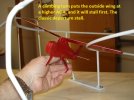
A climbing turn stall (departure stall) is what you are talking about here. The outside wing will drop. Its AoA is higher than the inside wing's.

The descending turn stall is opposite to that.

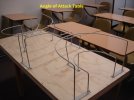
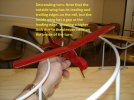
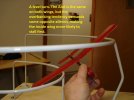
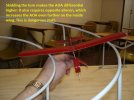
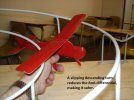
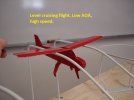
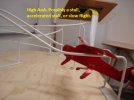
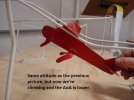
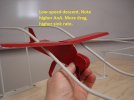
When I was an instructor I built an "AoA Table" to demonstrate. It has three sets of rails to show the AoA in different maneuvers. The angles and radii are all extreme so that the differences in AoA are visible; the actual differences in flight are small but significant. These rails represent the relative wind for the two wings.

1780677389649.jpeg

Here's the descending turn:

1780677432128.jpeg

The climbing turn:

1780677469201.jpeg

Level banked turn:

1780677541964.jpeg

Skidding in a descending turn:

1780677598396.jpeg

Slipping in the descending turn:

1780677663041.jpeg

Cruise:

1780677697286.jpeg

High AoA:

1780677780087.jpeg

Climb:

1780677810691.jpeg

High sink rate:

1780677937188.jpeg

I have one more but I'm limited here to 10 files. The normal descent has the nose lower and so the AoA is lower.

 
A climbing turn stall (departure stall) is what you are talking about here. The outside wing will drop. Its AoA is higher than the inside wing's.

The descending turn stall is opposite to that.

When I was an instructor I built an "AoA Table" to demonstrate. It has three sets of rails to show the AoA in different maneuvers. The angles and radii are all extreme so that the differences in AoA are visible; the actual differences in flight are small but significant. These rails represent the relative wind for the two wings.

View attachment 152521

Here's the descending turn:

View attachment 152522

The climbing turn:

View attachment 152523

Level banked turn:

View attachment 152524

Skidding in a descending turn:

View attachment 152525

Slipping in the descending turn:

View attachment 152526

Cruise:

View attachment 152527

High AoA:

View attachment 152528

Climb:

View attachment 152529

High sink rate:

View attachment 152531

I have one more but I'm limited here to 10 files. The normal descent has the nose lower and so the AoA is lower.

Wow, that is fantastic! If someone didn't make you CFI of the year, the system is broken.
 
The raised wing usually stalls first in a turning stall, because it is at a higher AOA. That is a surprise to many pilots - a stall in a left turn typically breaks to the right.
It would surprise me too since that's never happened to me during a turning stall.

Airplane Flying Handbook, FAA-H-8083-3A

“An airplane will stall during a coordinated steep turn exactly as it does from straight flight, except that the pitching and rolling actions tend to be more sudden. If the airplane is slipping toward the inside of the turn at the time the stall occurs, it tends to roll rapidly toward the outside of the turn as the nose pitches down because the outside wing stalls before the inside wing. If the airplane is skidding toward the outside of the turn, it will have a tendency to roll to the inside of the turn because the inside wing stalls first. If the coordination of the turn at the time of the stall is accurate, the airplane’s nose will pitch away from the pilot just as it does in a straight flight stall, since both wings stall simultaneously.”
 
What people also miss is that a power-on stall in a single engine airplane is normally asymetric…at higher angles of attack, the descending blade (right side, normally) has a higher angle of attack, and is producing more thrust, so just like on a multi, ball in the center doesn’t indicate zero sideslip. That’s why the right wing will usually drop in a power-on stall.
 
It's worth mention that when turning, if the outside / upper wing stalls first, because it's higher it must pass through wings level as it drops. This gives the pilot a bit more reaction time to recover, compared to when the inside/lower wing stalls - you can be sideways or upside down in an instant.
 
I flew with a pilot a few times that liked to do a certain type of turning stall where the raised wing stalls first, causing the plane to roll away from a spin and fall back to wings level. Anyone here know what the name of that type of stall is and the control inputs required to do one?
If the high wing stalls first, the aircraft will roll level initially but if not corrected it can continue rolling to stall/spin in the other direction. When I did spin training, we called that an "outside" or "over" spin. It's harder to induce than the opposite, an "inside" or "under" spin.

BTW, Cessna wrote a document on spins in the 150 and 170 series aircraft. It's a good read - see attached.
 

Attachments

What people also miss is that a power-on stall in a single engine airplane is normally asymetric…at higher angles of attack, the descending blade (right side, normally) has a higher angle of attack, and is producing more thrust, so just like on a multi, ball in the center doesn’t indicate zero sideslip. That’s why the right wing will usually drop in a power-on stall.
I usually had the left wing stall in power-on stalls. The spiralling slipstream off the prop produces a higher AoA on the inboard end of the left wing, starting the stall there sooner. Once started, it tends to move outboard fairly quickly and the left wing falls. In a 172, that wing will fall long before the wing totally stalls as lift is lost. The outboard areas of the wing are still flying.
 
I usually had the left wing stall in power-on stalls. The spiralling slipstream off the prop produces a higher AoA on the inboard end of the left wing, starting the stall there sooner. Once started, it tends to move outboard fairly quickly and the left wing falls. In a 172, that wing will fall long before the wing totally stalls as lift is lost. The outboard areas of the wing are still flying.

The phenomenon described by Mauleskinner will also result in the left wing stalling before the right with the ball centered in an airplane with conventional dihedral. How do you separate the spiral slipstream contribution from the contribution of dihedral and asymmetric thrust due to p-factor as described earlier?

Nauga,
stepping on his old footprints
 
What people also miss is that a power-on stall in a single engine airplane is normally asymetric…at higher angles of attack, the descending blade (right side, normally) has a higher angle of attack, and is producing more thrust, so just like on a multi, ball in the center doesn’t indicate zero sideslip. That’s why the right wing will usually drop in a power-on stall.

Exactly right. I didn't fully appreciate this until I got into a multi and did the math myself. The ball is nothing more than a simple pendulum. It simply aligns with the net acceleration. If the thrust and drag are exactly co-located, then indeed a ball being centered is equivalent to zero lateral movement. But no propeller produces perfectly aligned centerline thrust. There is a clean math behind this, but the bottom line is that the more tilted the thrust line, the the more the ball has to be off-center in order to achieve zero side slip. I've been misled for 25 years thinking that the ball being centered was some magical condition of coordination.
 
The phenomenon described by Mauleskinner will also result in the left wing stalling before the right with the ball centered in an airplane with conventional dihedral. How do you separate the spiral slipstream contribution from the contribution of dihedral and asymmetric thrust due to p-factor as described earlier?

Nauga,
stepping on his old footprints

Also the spiral slipstream presses against the left side of the fuselage as the aircraft slows, yawing it left. This is felt most strongly at very slow airspeeds, such as at the top of a hammerhead.

IMO it is impossible to generalize aircraft behavior at MCA. Too many input variables in actual flight conditions. Find me two GA aircraft of same type rigged precisely the same.

Best you can do is know what to expect and fly the plane as it presents itself. One wing might drop this time, the other one next time.

Competition spin entry is instructive. I used to get slow, then bleed off speed until it stalled and rudder into a spin. But that results in really ugly entries. Yaw before or after break, wrong wing dropping, nose bobbles, etc.

Then I watched how the big boys do it. Pull vertical, hold several seconds, then cap off level. You'll usually be below stall speed, but you won't stall right away if you are gentle with the stick. Pause one second then chop power, stick back and full rudder. Results in a very decisive drop, roll, and yaw all at once in the right direction. Also gets past the aircraft preference for a particular spin direction.

Fun stuff.
 
Last edited:
What people also miss is that a power-on stall in a single engine airplane is normally asymetric…at higher angles of attack, the descending blade (right side, normally) has a higher angle of attack, and is producing more thrust, so just like on a multi, ball in the center doesn’t indicate zero sideslip. That’s why the right wing will usually drop in a power-on stall.
Power on stall the torque and p-factor will typically roll the plane to the left if coordinated. At least with a standard right turning prop p-factor and torque spins the aircraft the opposite direction of the prop rotation. High power planes will usually have a maximum torque outlined in the POH for power on stall practice to prevent flipping over on its back. My M600 I think lists 600 ft.lbs of Torque which is only 38% power. Run out of rudder above that at high AoA. Planes like the PC12 will have a stick shaker to prevent the stall. Here is an interesting video of PC12 stalls with the shaker turned off. Most of the time it rolls to the left. Not sure what they are doing the times that it rolls to the right, but I imagine trying to stay upright with aileron or uncoordinated.

 
Power on stall the torque and p-factor will typically roll the plane to the left if coordinated. At least with a standard right turning prop p-factor and torque spins the aircraft the opposite direction of the prop rotation. High power planes will usually have a maximum torque outlined in the POH for power on stall practice to prevent flipping over on its back. My M600 I think lists 600 ft.lbs of Torque which is only 38% power. Run out of rudder above that at high AoA. Planes like the PC12 will have a stick shaker to prevent the stall. Here is an interesting video of PC12 stalls with the shaker turned off. Most of the time it rolls to the left. Not sure what they are doing the times that it rolls to the right, but I imagine trying to stay upright with aileron or uncoordinated.

That is one of the hazards of flying a high powered airplane like a PC-12, TBM, or P-51. If you cobb the power on during a go around, it will torque roll you right into the ground. Has killed quite a few pilots over the years.
 
Somewhat related. When you need to lose altitude on final, you slip. High wing is behind you. If you get into a stall, that trailing high wing will stall first, dropping you to level to give you a little time to recover.

If you skid in final - low wing behind you - and you stall, that trailing low wing will stall first. It's already low, will get lower, and put you in a spin.
 
Last edited:
When you need to lose altitude on final, you slip. High wing is behind you. [...] If you skis in final - low wing behind you...
What's the difference between a skid and a slip on final? If you're not turning and you're in an airplane with geometric dihedral the 'forward' wing will have a higher angle of attack when uncoordinated.

Nauga,
with wing down, top rudder
 
A skid puts your low wing behind you.

A slip puts your high wing behind you.

Another way to think of it is to just put your high wing behind you.
 
On final? How does one "skid" when flying a straight final leg?

Nauga,
beta blocking

He’s describing two different uncoordinated conditions, one in which rudder and ailerons are in different directions (slip) and one in which they’re going the same way but with excessive rudder (a skidding turn). But I don’t know why you’d be turning (skidding) while on final; more likely when turning base to final.
 
  • Like
Reactions: WDD
What he said…….

Better than how I said it I guess. Slip on final good. Skid on final bad.

And yeah, you over shoot base, turn too hard to get back to lined up, skid, bad thing happen. .
 
Better than how I said it I guess. Slip on final good. Skid on final bad.

And yeah, you over shoot base, turn too hard to get back to lined up, skid, bad thing happen. .
I get the slip/skid difference and the worse outcome from a skid when *turning* final, not *on* final, but you lost me at 'skid on final' when talking about slipping to lose altitude. Maybe our difference is a matter of what we each consider "on final."

The typical case for the skidding departure on base-to-final is using rudder to correct an overshoot and opposite aileron to reduce bank angle close to the ground, and any comprehensive spin syllabus will present it this way. I'm not a fan of presenting the slipping departure as a better alternative since you roll towards wings-level...I think *any* departure from controlled flight in the pattern is really bad form.

Nauga,
and his guns defense
 
Back
Top