And yet the Voyager spacecraft are still operational after 48 years in space. Have we lost our touch?
One program I worked on was designed for an eighteen-month life; it was still going and doing operational missions ten years later.
One way it worked was to design the EPS (electrical power subsystem) to fail in such a way that the system would keep charging power to the batteries, and to select batteries that were very tolerant of overcharging. In our case, they were COTS C-cells (from Sanyo) that were used normally used in RC cars.
There's the difference in simplicity, as well. A simple vehicle just has to be able to point its antenna (which might have a very wide beam) in the direction it needs to transmit (ours were omnidirectional) and have enough oomph left to get a signal back home.
A "combat" satellite is in the different condition. Not only would it be far more complex, there's the issue of ensuring its operational when you actually need it. Voyager just sails off into the cosmos squirting data back home; a Space Combat vehicle has to not only respond to ground commands, but acquire targets and power whatever it is they're shootin' with. PLUS, of course, it's important that the vehicle remain 100% operational. People will be sad when Voyager quits transmitting, but if WWIII comes a'calling, you want to be sure it's ready to go.
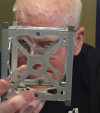
(Speaking of sadness when a space vehicle dies, there's a great documentary about the Mars Opportunity rover called, "Good Night, Oppy." It's one of the few shows that reflect how emotionally attached we get to our vehicles. It was on Prime, probably still there. A second good depiction of the spacecraft-construction biz was the episode in "From the Earth to the Moon" depicting the design and construction of the Lunar Module. Every space engineers feels a little tug when the baby leaves for the launch site. Here's one of mine...)

(what, you thought I only worked on Battlestar Galactica-sized spacecraft?)
Anyway, it's actually not a bad speculation that modern spacecraft don't last as long as the older ones. More and more microprocessors, carrying more and more gates, etc., are being used in modern spacecraft. These often aren't as tolerant of radiation in space. The old program I referred to used chips from early cell phones; we used a test facility to bombard them with radiation to see how they'd take it. Twenty years later, another small-satellite program, and we were doing the same thing and irradiating the heck out of them to see how they'd take it. Dunno the long term effect (was debriefed when I was retired) but they'd been working a half-decade or so at the time I left.
Though they did occasionally have glitches in the
South Atlantic Anomaly....

In contrast, for my last program, we performed no radiation testing at all. But then, they were test vehicles only needing to be operational for two weeks or so. Microsats, about the size of half a carton of saltine crackers.
Ron Wanttaja



 www.defenseone.com