Talk to me about Heim Joints on Mooney flight control rods

Rick A

Line Up and Wait
PoA Supporter
Joined
Sep 25, 2019
Messages
828
Location
Lancaster, Pennsylvania
Display Name
Rick A
Home Airfield
KLNS
Seems in 5900+ airframe hours only a handful of heim joints (all screw on type) have been replaced as needed in the push / pull flight control system used in the 1982 Mooney.

There's a bunch of originals we're getting ready to take a good look at. Some of them have the heim joints welded onto the rods on both ends and I've been told that would require completely new rods rather than replaceable screwed on bearing endings. Are the welded end joints stronger that the screw on heims? If not, I don't understand why screw on joints weren't used in the first place.

How is a rod ending heim joint considered bad enough to replace immediately? Any play detected at all? And if only no play is acceptable, how much play would be considered OK? How would it be determined to be bad enough to require replacement?

Any information is greatly appreciated.
 
Welded rod ends aren't necessarily stronger than threaded ones. They're often used to maintain fixed geometry and reduce adjustment points. For replacement, the big things are play, roughness, binding, or corrosion. If a rod-end bearing has noticeable slop or doesn't move smoothly, it's time to take a closer look and likely replace it.
 
Welded rod ends aren't necessarily stronger than threaded ones. They're often used to maintain fixed geometry and reduce adjustment points. For replacement, the big things are play, roughness, binding, or corrosion. If a rod-end bearing has noticeable slop or doesn't move smoothly, it's time to take a closer look and likely replace it.

Assuming no corrosion, binding or roughness, is a small amount of play acceptable (maybe 1mm?)
 
1mm (0.04" if you don't think metric) feels like too much.

My first thought is no more than a quarter of that.
 
I always lubed the ones I could get to with LPS or Fluid Film. Seemed to smooth them out on a 201.
 
Are the welded end joints stronger that the screw on heims?
That is usually done to insure a specific offset or length vs strength. You'll also see fork-end fittings on one side and an adjustable rod end on the other side for similar reasons.

How is a rod ending heim joint considered bad enough to replace immediately? Any play detected at all? And if only no play is acceptable, how much play would be considered OK? How would it be determined to be bad enough to require replacement?
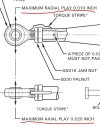
Unfortunately, there is no single answer for this as it depends on the rod end bearing type and size. You'll also find, in general, OEMs for these smaller aircraft tend to put more importance on control surface free-play than on the individual control system components like OEMs for larger aircraft and helicopters. However, all is not lost and the quickest route I found is to contact the OEM Tech Support and inquire on the axial and/or radial free-play allowed on the rod end bearings by part number. Another option is to determine the rod end mfgr and contact them as well. And to note, Heims is brand name for rod end bearings.

Assuming no corrosion, binding or roughness, is a small amount of play acceptable (maybe 1mm?)
It would depend if that measurement is in an axial or radial direction. However, even in extreme cases that would be too much provided the bearing itself hasn't popped out of the rod end. Look below for an example.

1788985730496.jpeg
 
Some of them have the heim joints welded onto the rods on both ends and I've been told that would require completely new rods rather than replaceable screwed on bearing endings. Are the welded end joints stronger that the screw on heims? If not, I don't understand why screw on joints weren't used in the first place.
Welding the rod end to the rod eliminates one part: the threaded fitting that is welded into the rod. Leaving that out saves money and reduces weight. The engineers that designed these things never anticipated that they would still be flying 50 or 60 years later.

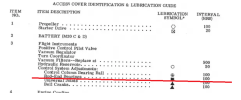
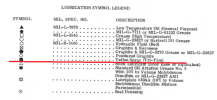
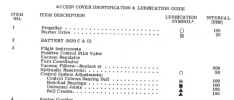
Rod ends will wear when they're not properly lubricated, and the instructions for that will be found in the service manual. From a Mooney service manual:

1789055171485.png
1789055254492.png

They want Teflon spray lube every 100 hours, not LPS or anything else every five years or maybe even less often. That will be because oil of any sort will attract dirt and grit and accelerate wear. Those joints are not sealed.

Cessna specifies a light Mil-spec oil for hinges and bearings. It's an oil that will not dry out and leave a waxy residue. But I often found a lot of stuff gunked up and filthy from too much of the wrong stuff.
 

Attachments

  • 1789055144437.png
    1789055144437.png
    179.8 KB · Views: 7
The Mooney 100 hour/Annual Inspection checklist has all the points that should be lubricated.

What is used to lubricate each one has changed over the years.
 
Back
Top