
- Joined
- Oct 16, 2019
- Messages
- 8,988
- Location
- Atlanta / Marietta
- Display Name
- Vintage Snazzy (so my adult children say)
- Home Airfield
- KPUJ
Meridian?

One note - the training isn't inexpensive and it's somewhat burdensome depending on your provider, job, etc. It's basically a week initial, and a few days a year recurrent. Depending on what one does for work, that can be really challenging (not to mention expensive). Training costs in the vicinity of $10k, plus expenses, plus fuel for 12+ hours of flying. Certainly not saying the training isn't beneficial, good, etc., but for working professionals with high stress/demanding non-pilot jobs, it's a factor.The training was also very good. There are a number of providers, and the thing that struck me was that everyone was happy with who they used.

One note - the training isn't inexpensive and it's somewhat burdensome depending on your provider, job, etc. It's basically a week initial, and a few days a year recurrent. Depending on what one does for work, that can be really challenging (not to mention expensive). Training costs in the vicinity of $10k, plus expenses, plus fuel for 12+ hours of flying. Certainly not saying the training isn't beneficial, good, etc., but for working professionals with high stress/demanding non-pilot jobs, it's a factor.

My estimate is 80-120 hours per year. That's based on my history with the 310, my family's needs, etc. In reality, I'll do more long trips in a turbine that my family is comfortable in (which, with two Samoyeds, a wife who doesn't want to face backwards, and so on, generally narrows the SETP market to unreasonably expensive purchase prices) but fewer short trips. For example, the alternator in my RV-14 died this year and I ended up flying the 310 solo for a few things I would have just skipped if they meant rolling coal in a Conquest or MU-2. I even did a poker run fly-in with a couple legs under 40 miles. Other people I know who have stepped up from piston to turbine have talked about not going to casual fly-ins like they used to.@iamtheari How many hours a year would you be flying if you had a 421 vs if you had the capabilities of a single turboprop, how many hours?
I know you did the calculations based on 100 hours per year, but that realistically changes based on speed/flight time and all the other flying you’d be doing because you now can get there faster, cheaper variable cost, more availability / less time in the shop, etc.
Reported for trolling. You sold the MU-2 yesterday, or maybe early last week, but I don't believe that since you only bought the thing and got out of the 414 earlier this month. There's absolutely no way it's been 6 years. (What on earth has happened to the time?)The MU-2 has been out of my care for over 6 years now
"Buy a cheap jet" - always sound advice! I've only been inside a CJ4 and Latitude so I don't know how the 501's cabin compares to the 400-series planes.I'll also throw out looking at a Citation 501 within the price range you're considering.
If you're flying part 91, does the FAA require recurrent training in any other type of plane? I think the MU-2's legal training requirements go beyond those to earn and maintain a type rating. Probably because most type-rating-required planes are easier to fly, harder to mess up, and/or require a second pilot.All correct. The training amounts to a type rating, with the cost and time burden associated.

My estimate is 80-120 hours per year. That's based on my history with the 310, my family's needs, etc. In reality, I'll do more long trips in a turbine that my family is comfortable in (which, with two Samoyeds, a wife who doesn't want to face backwards, and so on, generally narrows the SETP market to unreasonably expensive purchase prices) but fewer short trips. For example, the alternator in my RV-14 died this year and I ended up flying the 310 solo for a few things I would have just skipped if they meant rolling coal in a Conquest or MU-2. I even did a poker run fly-in with a couple legs under 40 miles. Other people I know who have stepped up from piston to turbine have talked about not going to casual fly-ins like they used to.
Even without frivolous legs like those, though, my actual mission includes shorter hops. Would I burn kerosene to go to my frequent 85-mile and 120-mile destinations? What about the 250-mile one? Thanks to MyFlightBook, I can tell you that I've logged 118 flights that visit one of those three airports since the beginning of 2022.
I feel like a 421 is a less unreasonable plane to fly short legs where most of the trip is below 10,000 feet. And while we take long trips (Arizona, Alabama, etc.), we'd have to take one of those a month to add up to 100 hours in a 250-knot plane, so I don't see us hitting 200 hours per year at those speeds.
Reported for trolling. You sold the MU-2 yesterday, or maybe early last week, but I don't believe that since you only bought the thing and got out of the 414 earlier this month. There's absolutely no way it's been 6 years. (What on earth has happened to the time?)
"Buy a cheap jet" - always sound advice! I've only been inside a CJ4 and Latitude so I don't know how the 501's cabin compares to the 400-series planes.
I've been in an MU-2 Marquise a few times and when I look at pictures of the short-body planes I am just amazed at how much shorter they must be than the long-body. All the short-body planes I see are 2+3 club seating. The long-body planes tend to be a couch and seat, followed by a 4-seat club, followed by a potty, followed by some cargo space. Maybe I need to get eyes on a short-body to understand the cabin better.
The Cheyenne I or II is on the shopping list, although for the purposes of this thread I listed the 425 because it's the easiest plane to compare similar airframes with different engines. Your experiences going from a 414 to MU-2 (very recently, as mentioned above), as shared in other threads, informed the question.

If you're flying part 91, does the FAA require recurrent training in any other type of plane? I think the MU-2's legal training requirements go beyond those to earn and maintain a type rating. Probably because most type-rating-required planes are easier to fly, harder to mess up, and/or require a second pilot.
Yeow, do ya really need all those seats?Real time comparisons for my milk run flight on Saturday of 312nm per Foreflight.
c421 - 1.5 hours and 84 gallons of fuel at 17500'
c310 - 1.8 hours and 50 gallons of fuel at 7500'
c560 - 0.8 hours and 224 gallons of fuel at FL190
Comparing seat miles probably evens things out a bit. My 310 and RV-14 cruise about the same speed. The 310’s fuel burn is 24 in cruise and the RV’s is about 8.5. But the 310 has 3 times the seating, or 5 times if you don’t count the pilot.Real time comparisons for my milk run flight on Saturday of 312nm per Foreflight.
c421 - 1.5 hours and 84 gallons of fuel at 17500'
c310 - 1.8 hours and 50 gallons of fuel at 7500'
c560 - 0.8 hours and 224 gallons of fuel at FL190
Yeow, do ya really need all those seats?
Lancair 360 - 1.8 hours and 14 gallons of fuel at 8000-12000'

I'll also throw out looking at a Citation 501 within the price range you're considering. Your fuel burn will be higher, but you will also be going faster and they're simpler to fly. A friend of mine owned one for a while (after having owned a Cheyenne, couple Navajos, and other aircraft) and he really enjoyed it, commenting especially on how easy it was to operate. As a jet, a 501 isn't a great one. But as a single pilot go places plane, I've had multiple friends who've strongly enjoyed them.
"Buy a cheap jet" - always sound advice! I've only been inside a CJ4 and Latitude so I don't know how the 501's cabin compares to the 400-series planes.
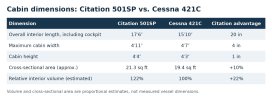

| Dimension | Cessna 501SP (Citation I/SP) | Cessna 421C (Golden Eagle) |
|---|---|---|
| Cabin Length | ~11.3 – 12.7 ft | 11 ft 4 in |
| Cabin Width | ~4.7 – 4.9 ft (~56–59 in) | 4 ft 7 in (55 in) |
| Cabin Height | ~4.3 – 4.7 ft (51–56 in) | 4 ft 3 in (51 in) |
| Cabin Volume | ~205 – 230 cu ft | 207 cu ft |
| Baggage Volume | ~57 cu ft total (internal & nose) | ~84 cu ft total (39 internal + 45 external) |
Thanks for that PIREP. My wife is afraid of jets and I’m afraid of owning one. I also suspect the insurance market will be afraid of me flying one but I haven’t asked.I can echo that experience - I’ve had my 501 for about a year now (following 3000 hours in two SR22s then about 500 hours in dry leased Citation Mustangs, M2s and a Phenom 100) and I like how you summarized it. It’s pretty weak in performance by jet standards (and I really wish it had 20-30% more range) but it is a phenomenal family travel airplane. I don’t use mine for work (we have a bigger CItation for that) but I fly about 150 hours a year on my 501 criss-crossing the country and Caribbean with family and it is comfortable, easy to fly (especially with the jet tech panel that most have at this point) and relatively economical.
Thanks for that PIREP. My wife is afraid of jets and I’m afraid of owning one. I also suspect the insurance market will be afraid of me flying one but I haven’t asked.
Have you had any maintenance issues come up so far? Any trips you would have done in a Cirrus but decided were too short or frivolous for the 501?
Why is that?I have to have the FBO tow me in/out of the hangar...

I’m guessing he’s in a large shared FBO hangar.Why is that?
I’m guessing he’s in a large shared FBO hangar.
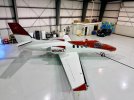
She gets a little overwhelmed when I talk about the options. She is afraid of jets being unforgiving and eating us out of house and home. She also doesn't like rear-facing seats but I see your layout has more forward-facing than in the listings I was looking at.Interesting - first time I’ve heard of someone more comfortable with pistons/props than jets - especially a spouse!
I have an AC Air Technology tug for the 310. Mine says it's good for planes up to 8,000 gross. I've towed the 310 across the ramp with full fuel and bags, so about 4700 lbs, no problem. I should find a way to test if it can move a Conquest (gross is higher than 8,000 but unloaded it would be less than that). Their next size up is good to 12,500 lbs. I love this tug because I can walk my own wingtip, which really helps solve the jigsaw puzzle in my hangar, especially at night with those tip tanks.I may get a Best Tugs

 acairtechnology.com
That beautiful airplane right in the center of the shot certainly helps the setup!My hangar setup is pretty sweet actually.

It's been interesting to read the replies from others who have actual ownership experience with these airplanes. I considered mentioning the Citation SP in my previous post but chose not to as it was not listed among the options under consideration. You may recall from that post that I have a little experience flying 421s and MU-2s, but none in 425s. I also have about 1k hours in Citations--500, 501, and 550--about equal left & right seats. I have not flown any Citation single-pilot, and I have no idea how the numbers would pencil-out for your specific circumstances. Based on my experience, I suggest that the Citation is the most forgiving of the airplanes mentioned. It's the one that I would prefer to by flying, as a single-pilot operation in challenging weather.I think in our mission the 425 and Cheyenne are the top contenders, in that order. For our amount of flying, a more forgiving plane is a good thing. So the MU-2 and jets come out behind on that comparison.
She gets a little overwhelmed when I talk about the options. She is afraid of jets being unforgiving and eating us out of house and home. She also doesn't like rear-facing seats but I see your layout has more forward-facing than in the listings I was looking at.

I had a 551 for 7 years, the type rating was tough, but the airplane was pretty simple to fly. I’ve owned 3 414’s, a 421B, a 425, a 441 as well as the 551. The 551 was the easiest as a single pilot, my family loved it, my bank account, not so much!Great read. I never would have thought a jet could be more forgiving than a piston.
 I sold my 425 about 5 years ago, fuel costs on similar trips wasn’t a lot more than the 421B that I had before. Not as many unscheduled maintenance issues on turbines, but they tend to be expensive!!
