Stupid oil filler tube

Ed Haywood

Final Approach
Joined
Jul 12, 2020
Messages
7,624
Location
Tampa FL
Display Name
Ed
Home Airfield
FD77
Can't get the dang thing to stop leaking.
Engine is an AEIO-360 with 170 hours SMOH. Filler tube is plastic with paper gasket. I have tightened and safety wired 3 times. Seems to make it worse.

This has nothing to do with over tightening the dipstick. I am the only person who touches it. I tighten with one finger and thumb until I feel the o ring start to compress, no further. Never takes more than fingertip pressure to remove.

I ordered several new gaskets. Here are my options to correct:

1. Install new paper gasket with a bit of oil to swell.
2. Install new paper gasket with Permatec High Tack.
3. Install silicone rubber gasket dry.

I have enough parts to do all 3. Votes on which to try first?

Also, does anyone know torque for the plastic tube?
 
1. Install new paper gasket with a bit of oil to swell.
2. Install new paper gasket with Permatec High Tack.
3. Install silicone rubber gasket dry.
A good gasket won't absorb oil. Very few gaskets are just paper anymore; most are a composition that includes neoprene.

#2 is what I did to stop both leaks and movement of that tube when students and instructors insisted on overtightening the dipsticks.

The silicone gasket will extrude with too much torque on the tube. So I would use minimum torque, and lots of lockwire to hold that tube in both directions.

I wish Lycoming would upgrade that tube to take an O-ring in a groove at the bottom of the tube, and to use a bayonet-style dipstick cap that makes 1/4 turn to a positive stop and detent.
 
The good thing about #3 is that if it fails you can then go to #2. If you do #2 first and it fails then you might have some cleanup of gasket surfaces to do first before trying #3.

Went with #3 as advised. Easy to do, easy to undo.
 
Had the same issue years back, went with #3, no issues since.
Agree. Silicone gasket. Proper torque. And have your mechanic safety wire in both directions to prevent over torquing and squeezing out the gasket, or loosening, allowing seeping. My gasket had deteriorated and started to extrude from the base due to overtightening. It would seep oil which would then wind up all over the bottom of the engine. No issues since.
 
I suspect the tube is damaged from over tightening either from the dip stick tube during installation or over tightening the dip stick.

It appears the part number for your engine is 75767. The Superior Air Parts metal oil level tube part number SL75767 is a replacement for the Lycoming part number. $97.
 
Last edited:
My 540 uses an aluminum gasket....for a plastic filler tube.... figure that one out. We coated both sides of the "gasket" with silicone; no leaks. My dipstick doesn't screw in though, it just pushes in and is retained by the friction of an o-ring with a cam lever to remove it.

Let me know what works for yours so I can do the same on my 390. It might be hard to get it clean enough to use RTV after it's already leaked. I'd be inclined to try the silicone rubber gasket in your case. I like the suggestion of safety wiring it both directions so it can't move.

I would be afraid to use RTV. Have been told never ever use on engines ... little chunks can break off and block oil passages.

I installed a silicone gasket yesterday, dry per instructions. Cleaned surfaces with acetone. Tightened the filler tube hand tight, being careful not to extrude the gasket.

Going to give it an acro workout today. If it doesn't leak during inverted flight, it's probably good.

If that fails, will try Dan's method of paper gasket with high tack.
Well, at the filler neck, the worst thing that could happen would be a piece drops into the sump and gets caught in the suction screen or oil filter.

Lycoming actually specs a couple RTV products as options for sealing case halves now. I opted for the permatex and silk though, partly because I was afraid of the squeeze out. Generally speaking, I would agree there's not many places RTV belongs in an aircraft engine.
 
Last edited:
Dangit, still some seepage.

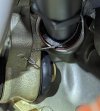
PXL_20250803_212900053~3.jpg

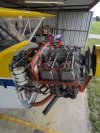
It is possible the seepage is coming from the exposed bolt end just above and aft of the tube. There is definitely oil in the threaded hole. It looks like it may be coming from the oil filler tube and just accumulating in that recess, but it could be the opposite. I don't know how to tell.
 
Ed, I wonder if the surfaces are true? A slightly mis-cast (or mis-threaded) part might lead to what you're seeing. Maybe there's some plasti-gauge in your future.
 
The milled flat on the case for the gasket looks like it might not have been cut deep enough. It runs off the casting at the 9:00 position. Did you notice, when the tube was off, if there was adequate milled surface for that gasket?
 
The milled flat on the case for the gasket looks like it might not have been cut deep enough. It runs off the casting at the 9:00 position. Did you notice, when the tube was off, if there was adequate milled surface for that gasket?

I did not notice anything. The next time I decowl it, I'll pull the tube off and post some pics.
 
I’m with Dan. You can see sand cast at the edge of the gasket.

Quit flying upside down.
 
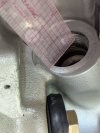
Took a closer look. That could be the problem. Looks like the edge is rounded. Maybe 1/8" width of milled surface is flat at the most narrow point. Probably not enough to properly compress the silicone gasket.

Next step is probably the Lycoming paper gasket with or without high tack. Thoughts?

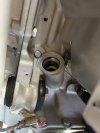
PXL_20250804_222905102.jpg
 
Installed Lycoming paper gasket with fuel lube. I torqued it more than usual, then safetied. I have another paper gasket to try more aggressive sealant if this doesn't work.
 
If that through-stud just above the dipstick tube hole is leaking, you might squirt a little brake cleaner on it and blow it out with compressed air to get most of the oil out of it. Do that two or three times. Use the non-chlorinated brake cleaner. Stuff a rag into the dipstick tube hole to keep the cleaner and its fumes out. Then wick Loctite 290 into the stud's threads. 290 is designed for stuff like that.

I think I see a helicoil in that dipstick tube hole. It may have been repaired at some time and the installer didn't get the helicoil tap exactly perpendicular to the gasket face so that now the tube's flange isn't sealing well against it. You might screw the tube in without a gasket and get a close look all around to see if there is misalignment. If so, I would be tempted to use a non-hardening plastic-pipe compatible thread sealant on the upper half of the tube's threads (stay positively away from the end of the threads!) and install it with a gasket and lockwire it. Don't use teflon sealant or tape. The sealants can damage the plastic pipe threads and the tape can get into places it should not.

The only problem with such a solution will be bits of sealant that break off and fall into the crankcase if the tube is removed again. That's not good either.

The flat gasket face around the hole looks adequate.
 
I admit, I can't exactly discern the extent of the malformation from the photo.
Could a bit of Dremel work smooth out the casting imperfection?

Or better yet install the tube with the silicone gasket. Do not safety wire. While the gasket is compressed trim the section near the casting imperfection with a scalpel or Exacto knife. Loosen the tube and reinstall with safety wire.
 
Buy a metal tube. Get a silicone gasket. Enjoy life.

I tried the silicone gasket. It did not work. The gasket bearing surface on the crankcase is not wide enough. An aluminum tube would not be any better. If you over tighten the silicone gasket, it just squishes out.

An aluminum tube might work better for a paper gasket though, by allowing more compression without risk of stripping the threads. Which is probably why Superior sells a paper gasket, not a silicone one.

I think I see a helicoil in that dipstick tube hole.

That's just baked on oil.

If that through-stud just above the dipstick tube hole is leaking, you might squirt a little brake cleaner on it and blow it out with compressed air to get most of the oil out of it. Do that two or three times. Use the non-chlorinated brake cleaner. Stuff a rag into the dipstick tube hole to keep the cleaner and its fumes out. Then wick Loctite 290 into the stud's threads. 290 is designed for stuff like that.

Good tip, I will do that, thanks!

I admit, I can't exactly discern the extent of the malformation from the photo.

The gasket mating surface is flat and true. There is no malformation. The only issue is width. At the point where I place the ruler, the exterior casting surface rounds off away from the gasket surface, so the mating surface is only 1/8" wide. The silicone gasket is 1/4" wide, with 50% of the width unsupported at that point. That makes it too easy for the gasket to extrude out when tightened.

That's probably why Lycoming and Superior do not make or sell a silicone gasket for this application. Both of them specify a paper gasket which is a tad over 1/8" wide. Lycoming p/n 72059.

Could a bit of Dremel work smooth out the casting imperfection?

:eek: :eek: :eek: :eek:
 
Superior’s metal tube and silicone gasket work great on my engine. I’m 99.9% sure Lycoming provided the silicone gasket in the parts bag with the new engine. I used the Superior tube and dipstick because I knew it worked with my cold air induction sump.
 
Last edited:
Still has a leak. I think it might be from another source. Tonight I sealed the exposed stud end with penetrating sealant. Will let it cure overnight.

Tomorrow I will tighten the oil pressure regulator, which might also be a source. I think that is a crush gasket. It is possible I disturbed it when I adjusted the pressure nut back during break in.
 
Last edited:
Tomorrow I will tighten the oil pressure regulator, which might also be a source. I think that is a crush gasket. It is possible I disturbed it when I adjusted the pressure nut back during break in.
That pressure regulator has a nylon piston with an O-ring on it. That ring might be leaking. Who did the overhaul?
 
That pressure regulator has a nylon piston with an O-ring on it. That ring might be leaking. Who did the overhaul?

A reputable engine shop in Florida.

If the O-ring leaked, where would it come out of the housing ... small end or large end?

There is a small amount of wetness under the base (large end) when I check it after flight. It did not seem enough to cause the accumulation at the oil filler tube base and bottom corner of the case. However, it is possible gravity is doing its thing.

When I adjusted the nut during break in, I did not realize it was a crush gasket. I thought it was torqued down on a paper gasket, so I probably did not use a wrench to hold the housing still. Those things are finnicky. Would not be at all surprised if I accidentally tightened the housing a bit when adjusting the nut. That would compress the gasket, then cause a leak when it loosened over time.

I ordered a few crush gaskets. For now, I'm going to tighten it about 10 more degrees and rewire it, then take a test flight.

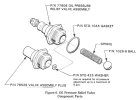
Oil Pressure Relief Components.jpg
 
I amend my statement. The regulator was installed by Godzilla. The crush washer is so crushed that it appears to be a regular washer.

I got about 5 degrees more turn in it. Will replace and tighten correctly when the parts come in a few days from now.
 
Further testing and inspection confirmed the leak is from the oil pressure regulator. The dipstick tube was fine all along.

Glad you found it. Years ago my old car had an oil leak from the OP sender located on the rear of the intake manifold. That allowed oil to run down the back of the engine. I almost tore it apart to replace the rear main seal ... :eek:
 
Last edited:
I gota tell you, your engine looks pretty clean considering you are looking for an oil leak. Nice job!
 
I gota tell you, your engine looks pretty clean considering you are looking for an oil leak. Nice job!
Thanks. Yeah, I am somewhat obsessive about it. I wash it with mineral spirits at every oil change.

PXL_20250802_222745362.jpg
 
Further testing and inspection confirmed the leak is from the oil pressure regulator. The dipstick tube was fine all along.
I feel your pain. It is incredibly frustrating when you misdiagnose something then repeatedly fix the wrong thing while the problem rocks on. BTDT too many times.
 
I amend my statement. The regulator was installed by Godzilla. The crush washer is so crushed that it appears to be a regular washer.

I got about 5 degrees more turn in it. Will replace and tighten correctly when the parts come in a few days from now.
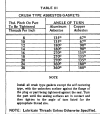
From the Lycoming Direct-Drive engine Overhaul Manual:

1754530803806.png
From http://www.monticellofc.org/aircraft/Lycoming-OH-Manual 2002 ed.pdf Page 1-37.

Most get way overtightened.

Those gaskets are 1920s technology. They used to have asbestos in them. Both Continental and Lycoming use them, and in many places they should have been replaced with o-rings in a groove. But aviation seems to be the last industry to use the "new" 1940s technology, o-rings. All this would need is a regulator housing with a thicker flange and an o-ring groove machined into its underside. But, Noooo.....

Look what the homebuilder gets to use: http://www.sdsefi.com/sdsaero.htm
Scroll down to see some of the stuff that uses o-rings instead of seepy gaskets.
 
Back
Top