
You are using an out of date browser. It may not display this or other websites correctly.
You should upgrade or use an alternative browser.
You should upgrade or use an alternative browser.
Sticky for SP mosaic planes
- Thread starter Tony R
- Start date

Half Fast
Touchdown! Greaser!
- Joined
- May 7, 2016
- Messages
- 21,189
- Location
- Central Florida
- Display Name
- Half Fast
- Home Airfield
- KGIF
Do you mean VS1?
- Joined
- Jul 29, 2011
- Messages
- 1,466
- Display Name
- MountainDude
- Home Airfield
- KPDX
The list would need to be specific for models, as not all models have the same stall speed.Is there any list of planes that have a CAS of <= 59 knots? It seems like a useful list.
Yup, sorry forgot to say that.Do you mean VS1?

Kenny Phillips
Final Approach
- Joined
- Jul 29, 2018
- Messages
- 6,572
- Display Name
- Kenny Phillips
I wrote to Textron about the current 182, they never responded.
The POH plainly says 56KCAS flaps up at 3100lbs with the most forward CG (54KCAS most rearward). Where is the doubt?I wrote to Textron about the current 182, they never responded.

Kiddo's Driver
Pattern Altitude
Socata TB9, yes. 58 knots Vs1.
TB10, no. 60 knots Vs1.
TB20 & 21, forget about it.
I don't know if it helped, but I commented on the NPRM for MOSAIC specifically asking for > 58 knots. The TB9s were brought into the USA by Parks College and Embry Riddle in the 90s as primary and instrument trainers. They are WAY overbuilt and can take a ton of punishment. I said something about it being a shame something that was built for training and couldn't go faster than 110 knots without going into a dive wouldn't qualify under MOSAIC.
Maybe I should have asked for higher...
I still think they should have made all of it 61 knots or less dirty instead of having two different standards.
Last edited:

- Joined
- May 25, 2006
- Messages
- 22,001
- Location
- KTTA, North Carolina
- Display Name
- Who you kiddin?
- Home Airfield
- KTTA
You can find similar distinctions elsewhere. The Diamond DA40 is one of four airplanes I'm using for examples in a MOSAIC presentation I'm doing next month. In this case, completely identical airframes but the DA40 comes in two different weight flavors. 2535 lbs and 2646 lbs. No major performance differences between them, but a 1-KT difference in Vs1. 59 KIAS on the nose for the lighter one; 60 for the heavier one.Socata TB9, yes. 58 knots Vs1.
TB10, no. 60 knots Vs1.
TB20 & 21, forget about it.
I don't know if it helped, but I commented on the NPRM for MOSAIC specifically asking for > 58 knots. The TB9s were brought into the USA by Parks College and Embry Riddle in the 90s as primary and instrument trainers. They are WAY overbuilt and can take a ton of punishment. I said something about it being a shame something that was built for training and couldn't go faster than 110 knots without going into a dive wouldn't qualify under MOSAIC.
Maybe I should have asked for higher...
I still think they should have made all of it 61 knots or less dirty instead of having two different standards.

Dana
Final Approach
I suspect they deliberately made them different to emphasize the fact that the two numbers (SP eligibility speed and LSA certification speed) are different and unrelated. Or two different working groups wrote the different parts. It may well be that in the future one or the other number (or both) will be adjusted.I still think they should have made all of it 61 knots or less dirty instead of having two different standards.

wanttaja
Final Approach
- Joined
- Jun 7, 2008
- Messages
- 5,667
- Location
- "War-Torn" Portland
- Display Name
- Ron Wanttaja
- Home Airfield
- Twin Oaks Airpark
When EAA and the FAA were going back and forth on this, I set up a spreadsheet with a lot of common (and not so common) GA aircraft. I dug up as many official manuals as I could to establish their stall speeds per the anticipated MOSAIC limits.Is there any list of planes that have a CAS of <= 59 knots? It seems like a useful list.
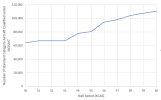
As it was, most of the limits I anticipated went away, so my spreadsheet wasn't that much use. I've attached the version for the 58 knot stall speed and four-seat limit. This plot shows the relationship between stall speed limit and the number of aircraft that qualified. At the time, it was assumed the limit was going to be 58 knots, so I didn't dig too deeply into the aircraft with stall speeds higher than that.
Ron Wanttaja
Attachments
Half Fast
Touchdown! Greaser!
- Joined
- May 7, 2016
- Messages
- 21,189
- Location
- Central Florida
- Display Name
- Half Fast
- Home Airfield
- KGIF
Somewhat related question: the VS1 limit is without adding any aerodynamic devices like vortex generators. BUT, for planes that have a VS1 that's slightly too high, is it legal to reduce the max allowed weight, thus trimming back the stall speed a bit? Some planes have had STC weight increases over the years (I know there are a couple available for Ercoupes), but I've never seen an STC for a reduction.
Since SP rules would limit a pilot to a single passenger anyway, it might not be too big a hit to placard the plane to a lower weight and drop the stall speed enough to fall inside MOSAIC limits.
Thoughts?
Since SP rules would limit a pilot to a single passenger anyway, it might not be too big a hit to placard the plane to a lower weight and drop the stall speed enough to fall inside MOSAIC limits.
Thoughts?
wanttaja
Final Approach
- Joined
- Jun 7, 2008
- Messages
- 5,667
- Location
- "War-Torn" Portland
- Display Name
- Ron Wanttaja
- Home Airfield
- Twin Oaks Airpark
The Sport Pilot rules specifically required that a given aircraft meet the requirements and the time of *original* certification; I believe MOSAIC is the same.Somewhat related question: the VS1 limit is without adding any aerodynamic devices like vortex generators. BUT, for planes that have a VS1 that's slightly too high, is it legal to reduce the max allowed weight, thus trimming back the stall speed a bit? Some planes have had STC weight increases over the years (I know there are a couple available for Ercoupes), but I've never seen an STC for a reduction.
Since SP rules would limit a pilot to a single passenger anyway, it might not be too big a hit to placard the plane to a lower weight and drop the stall speed enough to fall inside MOSAIC limits.
Thoughts?
Ron Wanttaja
Half Fast
Touchdown! Greaser!
- Joined
- May 7, 2016
- Messages
- 21,189
- Location
- Central Florida
- Display Name
- Half Fast
- Home Airfield
- KGIF
The Sport Pilot rules specifically required that a given aircraft meet the requirements and the time of *original* certification; I believe MOSAIC is the same.
Ron Wanttaja
Well that sucks, but maybe it's something that can be tweaked in the future.
Where does one find the "official" VS1? It's not part of the TC for my plane.
wanttaja
Final Approach
- Joined
- Jun 7, 2008
- Messages
- 5,667
- Location
- "War-Torn" Portland
- Display Name
- Ron Wanttaja
- Home Airfield
- Twin Oaks Airpark
I downloaded the POHes for all the planes I could. Surprising, how many are out there. Quick check, I found about 45 of them.Well that sucks, but maybe it's something that can be tweaked in the future.
Where does one find the "official" VS1? It's not part of the TC for my plane.
Then at that point, you have to check if the give the speeds in MPH or knots, whether it's indicated or CAS, etc.
Why, yes, it WAS a lot of work. Pretty much negated when the FAA said, "What the heck...EVERYBODY can play!"

Ron Wanttaja
- Joined
- May 25, 2006
- Messages
- 22,001
- Location
- KTTA, North Carolina
- Display Name
- Who you kiddin?
- Home Airfield
- KTTA
The “original certification” requirement is still here under MOSAIC.The Sport Pilot rules specifically required that a given aircraft meet the requirements and the time of *original* certification; I believe MOSAIC is the same.
Ron Wanttaja
- Joined
- May 25, 2006
- Messages
- 22,001
- Location
- KTTA, North Carolina
- Display Name
- Who you kiddin?
- Home Airfield
- KTTA
You may have to dig. Hopefully, at worst you have something in the aircraft manual that shows it in IAS and has an IAS to CAS conversion table. The DA40 difference I mention earlier was worse. The IAS to CAS table was a poorly designed graph. It “looked like” one was below 60 and one a little higher. Someone ended up writing to the company to confirm the correct numbers.Where does one find the "official" VS1? It's not part of the TC for my plane.
Not to sure about tweaking. The retention of the original certification rule was intentional, not one of those oversights.