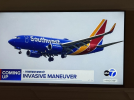
Southwest flight plummets, injuring flight attendants
The drastic manoeuvre was necessary to avoid collision with another plane, according to reports.
 www.bbc.com
 www.bbc.com


If there wasn’t, there will be shortly…Invasive? Was probing involved????

Yeah, was the fighter a faux foe for US fighters, or some pay-to-play operation?


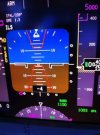
When Southwest reported the RA to the Center he said he had the traffic in sight. Can’t tell for sure if he had already seen it, or acquired it during the RA. This didn’t start with Southwest level, he was in a climb. The traffic was above and in a descent. Maybe he wasn’t paying real close attention to the panel while he was nosing it over. Maybe, I dunno. But it brings up some questions. The pic you show is the I’ll call it the Flight Director, probably wrong word. I wonder if maybe it told him to just stop climbing, is the TCAS wired into the Flight Director thing? Maybe it was his decision to descend. And while we’re there on that, what about throttles. By that time on that departure maybe he’s doing a coupla thou a minute. Would ya pull the throttles back when you nosed it down? And what about the auto pilot? Does it get involved in this? Auto throttle?On the 737, a TCAS RA displays pitch guidance to fly to comply with the RA. It should not be a violent manuever.
View attachment 143315
2.5 seconds to react and no more than .35g change isn’t violent.It can be with a late minute reversal from climb to descend.
The flight director and autopilot are disengaged in the picture.The pic you show is the I’ll call it the Flight Director, probably wrong word. I wonder if maybe it told him to just stop climbing, is the TCAS wired into the Flight Director thing? Maybe it was his decision to descend. And while we’re there on that, what about throttles. By that time on that departure maybe he’s doing a coupla thou a minute. Would ya pull the throttles back when you nosed it down? And what about the auto pilot? Does it get involved in this? Auto throttle?

Invasive? Was probing involved????

Thx.The flight director and autopilot are disengaged in the picture.
The TCAS RA command is the red lines. It is commanding that you keep the pitch attitude outside of the areas defined by the red lines. In the picture, the commanded range is between about 2º AND and 12º ANU.
When an RA is received, the flying-pilot disconnects the autothrottle and autopilot and hand-flies the RA. Pitch to the commanded range and adjust power as required to maintain the desired airspeed.
TCAS software calculates the RA with the expectation that the pilot will respond within 5 seconds with a g-load change of 0.25g. In a reversal or increase rate RA that increases to 0.35g with a response time of 2-1/2 seconds.