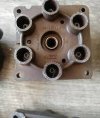
Shorted Sparkplug disables magneto.

Crashnburn

Pattern Altitude
Joined
Aug 8, 2018
Messages
1,971
Location
Erie, CO
Display Name
Crashnburn
Home Airfield
KLMO
One of our planes 724EQ was stranded today at KGXY. One magneto was completely dead. An A&P fixed it by replacing a shorted spark plug. It was a mystery to us, and maybe the mechanic/pilot I ferried there this morning.

But thinking about it, I think I figured out the reason. Please let me know if I'm on the right track, or all wet.

If I remember correctly, our airplane engines don't have distributors, so each spark plug fires on each stroke. So, if a sparkplug shorts out, it essentially disables the magneto that it's attached to.
 
There is a distributor; it's inside the magneto.
 
If I remember correctly, our airplane engines don't have distributors, so each spark plug fires on each stroke. So, if a sparkplug shorts out, it essentially disables the magneto that it's attached to.

Sorry, but your thoughts are all wet.

The Lycoming and Continental engines are four stroke engines. The strokes are 1) intake, 2)compression, 3) power, and 4) exhaust. It takes two revolutions of the engine to complete all four strokes. The ignition fires once (mid to late compression stroke, or during starting with an impulse coupling, early in the power stroke) during these 4 cycles. It does not fire once each stroke. It does not fire once each revolution. It fires once every other revolution.

-Skip
 
Last edited:
A shorted plug causes an RPM drop on the mag check. Engine roughness also occurs, but the engine continues to run.
 
Sorry, but your thoughts are all wet.

The Lycoming and Continental engines are four stroke engines. The strokes are 1) intake, 2)compression, 3) power, and 4) exhaust. It takes two revolutions of the engine to complete all four strokes. The ignition fires once (mid to late compression stroke, or during starting with an impulse coupling, early in the power stroke) during these 4 cycles. It does not fire once each stroke. It does not fire once each revolution. It fires once every other revolution.

-Skip
Ok. Thanks for the correction. I don’t know why the plug shorted.

Still, why would one plug shorting disable the magneto?
 
Only your mechanic knows, and he is not going to tell you.

Something was wrong that embarrassed him, he replaced a plug and fixed the real problem.

If you ask around, you will make a permanent enemy of the mechanic, but will not find out what really happened. Only he knows.

More than 40 years of learning this kind of realities.
 
Last edited:
When you say “dead” mag, did the engine shut down when that mag was selected?
 
Sorry, but your thoughts are all wet.
The Lycoming and Continental engines are four stroke engines. The strokes are 1) intake, 2)compression, 3) power, and 4) exhaust. It takes two revolutions of the engine to complete all four strokes. The ignition fires once (mid to late compression stroke, or during starting with an impulse coupling, early in the power stroke) during these 4 cycles. It does not fire once each stroke. It does not fire once each revolution. It fires once every other revolution. ...
True. Another way to put it is that each spark plug fires every other/alternating time the cylinder reaches the top of its stroke.

The OP's thoughts are not applicable to most 4-stroke engines including those from Lyco/Conti - but they aren't all wet in theory. Some production 4-stroke engines have had spark plugs that fire every time the cylinder reaches the top of the stroke. For example many of the Honda/Kawi/Suzuki air cooled 4 cylinder inline motorcycle engines from the 1970s had dual condensers, dual points, dual coils, and no distributor. The spark plugs always fired together in pairs: for example 1 & 3 and 2 & 4. Every time the piston reached the top of the stroke the spark plug fired. Of course that is unnecessary and makes the spark plugs wear out faster, but it simplified the ignition system.
 
The spark plugs always fired together in pairs: for example 1 & 3 and 2 & 4. Every time the piston reached the top of the stroke the spark plug fired. Of course that is unnecessary and makes the spark plugs wear out faster, but it simplified the ignition system.
An awful lot of auto engines do that even now. And their sparkplugs last a very long time anyway. My Ford Ranger, with its 4-litre 6-cylinder engine, has three ignition coils, and each end of each coil fires a plug. When that coil fires, both plugs spark. One plug is in the cylinder that is near the top of its compression stroke, and the other is near the top of its exhaust stroke, where there is nothing to fire. But if one plug or its lead fails open, both plugs don't fire because the circuit isn't complete.
 
One of our planes 724EQ was stranded today at KGXY. One magneto was completely dead. An A&P fixed it by replacing a shorted spark plug. It was a mystery to us, and maybe the mechanic/pilot I ferried there this morning.
I bet the A&P himself doesn't understand the magneto. Many don't. Way too many such folks just start replacing stuff until the problem goes away. A mechanic who doesn't understand a system cannot intelligently troubleshoot it.
 
Wasted spark is the name for systems that fire on the exhaust cycle, pretty common as others have pointed out.
To the OP's problem, I wonder if p-lead and plug got confused in the telling/listening to what was fixed. i.e. Mech said p-lead was shorted, and OP heard plug was shorted.
 
Wasted spark is the name for systems that fire on the exhaust cycle, pretty common as others have pointed out.
To the OP's problem, I wonder if p-lead and plug got confused in the telling/listening to what was fixed. i.e. Mech said p-lead was shorted, and OP heard plug was shorted.
This is all third hand. Both the mechanic I flew to KGXY and my CFI told me spark plug. And, from what I remember them telling me, the engine wouldn't run at all on the shorted spark plug's magneto.
 
This is all third hand. Both the mechanic I flew to KGXY and my CFI told me spark plug. And, from what I remember them telling me, the engine wouldn't run at all on the shorted spark plug's magneto.
The story is garbled, insensible and incomplete. What more can we say? Replacing a shorted plug will not fix a dead magneto, period. And a shorted plug will not kill the magneto either.
 
To the OP's problem, I wonder if p-lead and plug got confused in the telling/listening to what was fixed. i.e. Mech said p-lead was shorted, and OP heard plug was shorted.
This. For the OP, I have a very good writeup on how ignition systems work in my recent novel, “How to Hotwire an Airplane.” Its a kind of jokey title and it is about other things too, but people have said they came away from it with a very good understanding of planes. As a pilot, you really need to know how ignition systems work; an open p-lead could kill somebody.
 
shorted plug generally means damaged insulator. either dropped of some other damage to the ceramic insulation
 
All four plugs could have been shorted, but was only one actually replaced?
Hillbilly maintenance. Have to replace all four before your figure out which one is bad.
 
Hillbilly maintenance. Have to replace all four before your figure out which one is bad.
I don't know. Just pull the ignition lead off one spark plug at a time, and you'll find the culprit.
 
I believe that shorted spark plug might have been divine intervention. Considering what's been going on in my house recently (that's thread all its own), I can't dismiss it out of hand.

It hasn't been that long that EQ had its 100-hour inspection and everything was fine. They flew it down to Rocky Mountain to their maintenance shop. He looked at the oil and the engine is making metal.

The plan is to replace the 160 HP engine with a brand-new loaner 160 HP until AeroSphere's 180 HP comes in from Timbuktu.

I was scheduled to fly EQ next week, and if this problem hadn't been caught, I might have had a real engine out emergency.
 
I don't know. Just pull the ignition lead off one spark plug at a time, and you'll find the culprit.
Works in cars. Doesn't work so well in airplanes.

With the engine running, that propeller is just waiting to chop you apart when you're fooling with the engine.

The plug leads don't "pull off." They are attached to the plugs by a nut that has to be undone, and they are physically hot. If you get a shock and jump, that propeller is waiting for you.

There are two plugs per cylinder, so when one plug is dead, not much happens until you disconnect the good plug.

Most of us mechanics do it in a much saner manner. With the cowl off, we run the engine on the "bad" mag, with the engine miss being pretty obvious. Run it like that for a minute or so, shut it down, and use either a laser infrared thermometer on the exhaust stacks to find the cold one, or, if you're too cheap to own one of those, a wet finger. Once you've burned a finger or two you'll buy the thermometer. The cold stack will be one the cylinder with one bad plug, and the plug that is connected to the mag that was being used is the bad plug.
Thanks for the clarification. Considering the whole bank of spark plugs was disabled, that wouldn't work so well. You could disconnect one ignition lead with the engine off, then try running it on the suspect mag. If it runs, that was the bad plug. If not, continue on.
 
I honestly don't see how one spark plug (open or short) could disable an entire magneto. To convert a 4 cylinder mag to a 2 cylinder mag for a 1/2 VW you short the unwanted cylinders to ground to let the spark energy go somewhere and avoid arcing inside the distributor.

Plus, given that the magneto distributor directs the spark to only one spark plug at a time - to kill all the plugs, it would have to be totally dead - like an open coil - so how would you find the one bad plug with a dead magneto?

Am I missing something?
No the data provided are not correct, you are not missing a thing. If the mag was dead it was not the fault of the plug; if the plug was dead it did not kill the mag. I guess it's possible both were true at the same time, but that's unlucky.
 
No the data provided are not correct, you are not missing a thing. If the mag was dead it was not the fault of the plug; if the plug was dead it did not kill the mag. I guess it's possible both were true at the same time, but that's unlucky.
This is a mystery that won't be solved. The issue is moot, anyway, as the engine is making metal and will be/is/or has been replaced.

Let's argue about how many angels can dance on the head of a pin.
 
You could disconnect one ignition lead with the engine off, then try running it on the suspect mag. If it runs, that was the bad plug. If not, continue on.
Please have a CFI or mechanic teach you about how these engines operate, especially the ignition system. You exhibit a high misunderstanding of how it works and as a soon to be pilot, it is imperitive that you know this stuff cold.
 
I posted on an unrelated thread, how much smarter you are if you read the instructions for the equipment, rather than insist that what you THINK is true is actually true. The plane functions in accordance with the instruction book. The issue is not moot, you still do not know how a magneto works, and worse, seem not interested in learning.

There are a lot of other aspects of aircraft function that are hard to learn, but essential to know when an inflight malfunction occurs.

Even if you have the money for a Cirrus, if you leave the ground safety pin in, your cannot use it for the ultimate last way out of trouble.
 
Please have a CFI ..... teach you about how these engines operate, especially the ignition system. You exhibit a high misunderstanding of how it works and as a soon to be pilot, it is imperitive that you know this stuff cold.

A CFI? As someone who's had to suffer through 8 CFIs during my PPL training I would not rely on a CFI for this information (aka 99% of CFIs are trash).
 
A CFI? As someone who's had to suffer through 8 CFIs during my PPL training I would not rely on a CFI for this information (aka 99% of CFIs are trash).
The first part of the sentence is completely understandable. The second is a gross exaggeration.
 
, I wonder if p-lead and plug got confused in the telling/listening to what was fixed. i.e. Mech said p-lead was shorted, and OP heard plug was shorted.
I'm putting my money on this.

And as others have mentioned, take the time to understand how mags work, what the heck a P Lead is, how it would shut down a mag, how a spark plug wouldn't, etc.

How many electrical systems does your plane have? What happens if your alternator and battery die when flying?
When you know and understand the answers you'll be in a better spot.
 
I'm putting my money on this.
If the P lead was shorted, it wouldn't have passed the mag check when leaving home base. On the other hand, if the pilot didn't return the mag switch all the way to "Both", the mag check could pass, but one mag's plugs could all get fouled over the course of the trip leaving the plane stranded. One of us is lucky I don't bet. :)
 
He said a mag was dead. Hence, it had to have died when at the away airport. He couldn’t have left the home airport with a dead mag.

No data presented that all the plugs on one mag were fouled.

A mag was dead. A shorted P lead would kill the mag. A shorted plug would not.
 
Please have a CFI or mechanic teach you about how these engines operate, especially the ignition system. You exhibit a high misunderstanding of how it works and as a soon to be pilot, it is imperitive that you know this stuff cold.

:yeahthat:

The DPE might explore this area during the oral and they expect that the applicant has a working knowledge of aircraft systems. When flying alone and something seems amiss it's really good to have a proper understanding of how things work in order to work the problem ...
 
One of our planes 724EQ was stranded today at KGXY. One magneto was completely dead. An A&P fixed it by replacing a shorted spark plug. It was a mystery to us, and maybe the mechanic/pilot I ferried there this morning.

But thinking about it, I think I figured out the reason. Please let me know if I'm on the right track, or all wet.

If I remember correctly, our airplane engines don't have distributors, so each spark plug fires on each stroke. So, if a sparkplug shorts out, it essentially disables the magneto that it's attached to.
1753846134363.jpeg
 
Back
Top