Russian satellite jams GPS on a continental scale

If only we could have a robust RNAV technology, one that is simple, uses higher power transmitters and cannot easily be jammed.

I have an idea for such a system - it would use a chain of transmitters, timed together, that could yield a position solution with a reasonably-priced panel mounted device.

We could call it "LORAN."
 
Bring back LORAN
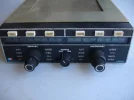
Loved this thing
View attachment 154969
Yep.

In all the time I flew with my Northstar, it never, ever failed to give me an accurate position solution. Farmin 430W GPS would on occasion lose position for various (and unidentifiable) reasons, but the LORAN never skipped a beat.

So, they turned the system off.
 
Yep.

In all the time I flew with my Northstar, it never, ever failed to give me an accurate position solution. Farmin 430W GPS would on occasion lose position for various (and unidentifiable) reasons, but the LORAN never skipped a beat.

So, they turned the system off.
Yep had that and a KNS80, Storm Scope pretty much go anywhere except icing.
 
We had a ARNAV brand. It had 2 modes, approach, and cruise. In approach, we could taxi to within 200 feet of our stored tiedown site using guidance from the LORAN.

Database had all navaids, we could fly direct to a low power ADF or VOR from any distance. ALL airports wee there, and the nearest button gave the nearest 10, with list of runway numbers and length. Selecting one, the frequencies all came up, including approaches.

LORAN direct was great circle, shortest distance, and a significant time and gas saver on long east west routes. File direct, and when near time for fuel, hit nearest. Back in the air, hit direct again.
 
ocd-spaceballs-radar-technician--20080305054918145-000.jpg
 
one caution with loran - the signals are adversely effected by ground moisture. In maritime applications this is not a problem.

(or at least that's my recollection from an article in the AOPA mag way way WAY long ago)
 
It would be naive to not understand many nations have heavily studied and invested in gps jamming as a war preparation - ours included. Didn’t we just kill a medivac crew in NM while testing ours?
I definitely agree alternatives which are immune to attack would be welcome… but have to wonder if that is even possible.
 
It appears they did that themselves.

https://web.ntsb.gov/investigations/?ntsbnumber=WPR26FA186

At 0008:06, while maintaining the northwest heading and about 31 mi northeast of SRR, the flight crew reported they had “a visual on Ruidoso,” but their radio transmission was stepped on by other radio traffic. The flight crew again reported they “[have] a visual on Ruidoso” at 0008:30 and that they could “go visual.” The ARTCC controller subsequently cleared the flight to SRR, cleared the flight for a visual approach, and informed them they could cancel IFR in the air above 9,000 ft msl or they could cancel their clearance via the flight service station after landing.

The NOTAMs informed pilots that the SRR automated weather observation system (AWOS)
was out of service and that military GPS jamming was scheduled at the time of the accident
flight that encompassed the area and altitudes of the accident flight.
The Foreflight weather briefing stated “No METAR (Meteorological Aerodrome Report)” and
“No TAF (Terminal Aerodrome Forecast)” for SRR.

Destination Airport
SRR is serviced by two instrument approaches, the ILS or LOC RWY 24 and the RNAV (GPS)
RWY 24. Both instrument approach plate notes section contain the following statement: “When
local altimeter setting not received, procedure NA (Not Authorized).”
 
It appears they did that themselves.

In the end, yes their visual, night approach in the mountains backup plan did not work out, but I posit their first plan was to do the rnav approach (which was denied due to Holloman actions), and I suggest they would be still with us if that approach had been available.

“The pilot requested the RNAV approach to runway 24 at SRR.“
 
If only we could have a robust RNAV technology, one that is simple, uses higher power transmitters and cannot easily be jammed.

I have an idea for such a system - it would use a chain of transmitters, timed together, that could yield a position solution with a reasonably-priced panel mounted device.

We could call it "LORAN."
There is an existing backup system, DME/DME RNAV. This is why when many VORTACs are decommissioned, the DME transmitter is kept, and the chart symbol changed to a square. I don't know of any light GA receivers that implement it, but it's very much used by business turboprops/jets and above. Usually combined with an IRU and known as DME/DME/IRU (look at most RNAV SIDS and STARS and you'll see that term in the notes), but could work reasonably well without the IRU component.
 
There is an existing backup system, DME/DME RNAV.
As you mentioned, nothing exists that can be used in smaller aircraft.
Also, DMEs can serve a limited number of interrogators. With each aircraft using DME/DME interrogating a few of them, one has to wonder how quickly the system would get saturated if everyone went DME/DME? A VOR/VOR RNAV wouldn't have this problem.

wrt DME saturation... at least some of the DMEs I was familar with were sized to be able to able handle LA basin traffic... which was a LOT of traffic. I'm sorry that I don't remember the number. It's been too long since I had access to the specs.
 
wrt DME saturation...
DMEs are limited to 1350 pulse pairs per second.

An airborne unit sends 150 pps in search mode (when first tuning to the station) and 25 pps in track mode. Typical assumption is max 100 users per DME, 95% of them in track mode, 5% in search mode.

If more pulses arrive the DME will reduce its sensitivity (thus max range) until the transmit rate drops below 1350 pps.

So... 100 max users, each hits three DMEs. Averages to 33 max users per DME. It might be ok enroute, but I wonder if things would saturate in a terminal environment.
 
In the end, yes their visual, night approach in the mountains backup plan did not work out, but I posit their first plan was to do the rnav approach (which was denied due to Holloman actions), and I suggest they would be still with us if that approach had been available.

“The pilot requested the RNAV approach to runway 24 at SRR.“
So the pilot was unaware of the NOTAMs making the approach N/A for two separate reasons?
 
So the pilot was unaware of the NOTAMs making the approach N/A for two separate reasons?

C'mon MauleSkinner - you deal with professional pilots all the time. NOTAMs???

:p
 
We could call it "LORAN."
There has been talk of bringing back the new eLORAN (enhanced) for a while now. But I think the other option, possibly the front runner is a DME/DME system.

The DME/DME would require more stations, but LORAN... or Long Range... also has the potential to be jammed. Not that DME/DME can't be jammed to, but you can't do it as easily to larger blocks of the country.

And then there is Quantum Magnetic Navigation (MagNav), but from what I've read, that may be the next thing after whatever replaces or augments GPS.
 
I don't know of any light GA receivers that implement it, but it's very much used by business turboprops/jets and above.
Nothing yet. But since we're not reinventing the wheel, something could be easily released. Wouldn't shock me if Garmin already has the plans drawn up and they're just waiting for the GA market to develop.

Hey Garmin if you're listening.... I'd love the box to be a plug-in replacement to my GNC-355. They I'd keep my GTN, assuming there were still ILS and VOR Approaches.:D But I, and a lot of GA, would dump my backup GPS-Comm for the new DME/DME-Comm.
 
DMEs are limited to 1350 pulse pairs per second.

no. Even the MMLS DME was capable of 7000 pulses per second (3500 pulse pairs) - actually that wasn't a physical limit, the spec required a minimum of 7000 pulses per second... that much I remember about the MMLS DME.

Which DMEs can only do 1350 pulse pairs? (edit to add: you might be thinking about how the transponder creates the morse code ident)
 
Last edited:
If we could have an INS, it wouldn't be subject to jamming. A low-drift INS with the occasional augmentation from something like DME-DME or LORAN or something, would be awesome.
 
Even if an adversary has credible evidence of being able to send drones into our country, the GPS system is getting taken down. We need to preserve our radio based infrastructure. The system that is tried and true, and that every cross country aircraft possesses is VOR better yet with VOR/DME. Why entertain a system that requires reconfiguring almost every aircraft in the inventory like Loran. Our government needs to stop the insanity of decommissioning VOR's when our GPS system is so fragile.
 
Just got caught up on some reading and apparently there was a 4:23 flight from the Seattle area up to AK out over the Pacific (no land references) using MagNav with excellent results.

Now they just need to get it into the a box the size of my GNC355 so I can do a direct swap out. :D
 
And then there is Quantum Magnetic Navigation (MagNav), but from what I've read, that may be the next thing after whatever replaces or augments GPS.
Woah. Thanks. I was not aware of that. I always figured chip-scale RLG / atomic clocks would be the future. Then again, why not both?
 
I wonder if the quantum system had to be cooled with liquid helium.


Of particular interest is the Atomic Magnetometers which operate at room temp.
 
Yep. PFM.
The older Tomahawk cruise missiles used magnetic resonance as part of their guidance systems. We studied that in passing in the late 1980's in applied quantum mechanics classes (mostly studies in magnetic resonance applications). IIRC, it worked with the inertial navigation to keep the vehicle on course.
 
Back
Top