
Rough running engine on takeoff

dcat127

Pre-takeoff checklist
Joined
Jun 30, 2020
Messages
205
Display Name
Electro
1982 Saratoga with a dual ElectroAir Electronic Ignition
1. 5 hours since annual inspection

Sequence of Events
1. I was doing a flight review with my CFI. We were doing air work for about 1 hour, during which we were running various throttle settings, full rich.
2. We went back to the airport to practice some takeoffs and landings. After the first landing we were on the ground for about 5 minutes at idle.
3. We did 1 takeoff and touch and go.
4. On climb out from the touch and go at 300 ft agl, the engine starting running rough, I would describe it initially as surging, after a few seconds it settled into a rough running engine.
5. We were still producing enough power to continue climbing, at about pattern altitude my cfi observed that the EIS #2 status LED was “yellow.” I shut off the #2 ignition, there was no change to rough running engine. The #2 ignition was turned back on after several seconds.
6. Once back on the ground we did a runup mag-check. The engine runs fine on both, runs rough on the #1 EIS.
7. We observed that the #2 status LED is not yellow nor could it have been yellow, as it is a single color LED. However it is very dim. The backup battery in use LED is right beside the EIS#2, Is it possible that was on, and that is what my cfi saw? However he seems certain he was looking at the EIS#2, and thinks it is more likely that the dim green LED looked yellow from his position.
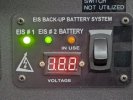
dimled.jpg
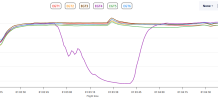
8. It is fairly clear from looking at the engine logs, that the issue was with the #4 cylinder.
unnamed.png
1. Nothing unusual, is noted in the logs before the observed engine issue.​
2. It appears the cylinder did come back around the time when we were on down-wind, I remember that the engine smoothed out, but I presumed it was simply the lower power setting. After the cylinder came back, the EGT is about 100f higher than the other cylinders. (Could this mean that only one plug was firing at that time?​

9. The engine should run just fine with only one ignition. There is no single failure of the ignition system that could cause this.
10. Electroair tech support does not believe the dim LED is likely to be related to the problem experienced.
11. My concern is that we will find a fouled sparkplug or something similar, and everything will test just fine after that. But that failure could not by itself have caused this issue. And we will be left with some other undetectable problem.

Does the POA brain have any ideas while a wait for my mechanic to have time to work on it?
 
Not familiar with that ignition system. The higher EGT on the #4 would indicate (as you mentioned) that one spark plug in that cylinder was temporary off line, or the fuel flow was interrupted. The temporary aspect is the head scratcher.

You did a lot of full rich flying which could have lead to gunk deposits building up in the cylinders, and a chunk of something broke lose and fouled a plug. However, one fouled plug and the corresponding higher EGT should not have caused engine roughness unless the other plug in the #4 cylinder wasn't firing either doing the period of roughness.

The other possiblity is gunk causing a fuel injector to become clogged. Had that experience once on a take off that followed a low altitude cross country trip in very cold weather at full rich. Later in the day during takeoff the engine went very rough around 300' and I returned and landed on another runway. However, the engine never ran any better after flying a low altitude abbreviated pattern, as following the landing it was necessary to pump the throttle to keep the engine running during the taxi back to the FBO.

Upon diagnosis the 4 cylinder Lycoming had one fully clogged injector, and one partially clogged injector. Ran great after the injectors and spark plugs all were cleaned up. Good luck with yours!
 
Last edited:
Just skimming through, can you fairly easily pull & inspect the plugs on #4? That’s a fair amount of time running full rich. Type of plugs? Hours?

A few years ago I had a bit of a rough engine I didn’t like, fuel injected. Before I flew again I cleaned every fuel injector and checked the plugs, fine wire. After that I did a more extensive full power ground run. It was a ‘fly it like you stole it’ type check, ‘Italian tune-up’. My engine has behaved well since.
 
Just skimming through, can you fairly easily pull & inspect the plugs on #4? That’s a fair amount of time running full rich. Type of plugs? Hours?
Yes, and I believe that is where my mechanic is intending to start. I don't disagree with the likelihood of a fouled spark plug, in fact I think it is quite likely. However that does not explain the rough engine, absent some other unknown failure. That is the part that is keeping me up at night.

A plugged injector might be a possibility, the main reason I believe it is not that, is the engine currently runs rough on the one ignition. So this theory also requires a simultaneous failure of 2 different systems.

Good point regarding the injector and rough running on the ground check when switching ignition sources. A little off topic, but since I started "leaning the crap" out of my engine, especially on the ground, fouling any spark plugs became an unpleasant and distant memory...
 
Why would not a fouled plug result in a rough running engine at wide-open throttle, when all the other cylinders are firing on both plugs? Especially if the second plug in that foul-plug cylinder is also somewhat fouled?

Start with simple. Air, spark, fuel. Make sure your induction hoses (if any) are snug.
 
However that does not explain the rough engine, absent some other unknown failure.
One plug fouls first, and you don't notice it. Then the second one does. You DO notice that.

Could be some oil fouling them, either getting there through a valve guide or past the rings.
Definitely inspect the plugs first.
 
The backup battery in use LED is right beside the EIS#2, Is it possible that was on, and that is what my cfi saw?
If the backup battery did engage its possible that switching over could have created a momentary degrade condition that was picked up in the #4 system leg only due to other issues?

9. The engine should run just fine with only one ignition. There is no single failure of the ignition system that could cause this.
Yes and no. If that were the case there would be no difference during a mag check. As to single failures there could be several in the #4 wire system.

Is the engine fuel injected?
 
Yes and no. If that were the case there would be no difference during a mag check. As to single failures there could be several in the #4 wire system.

Is the engine fuel injected?
Under normal conditions the electronic ignition does not produce a noticeable drop during a mag check. My understanding is this is due to the much higher voltage and longer spark.

And yes it is fuel injected.
 
One plug fouls first, and you don't notice it. Then the second one does. You DO notice that.
It is possible. But in that case I would likely see a higher EGT on that cylinder before the event. It also requires that one of the plugs un-fouled themselves sometime before we did the post flight run-up.

I'm also still very puzzled at the dim EIS LED. I'm fairly certain that it's brightness matched the other one before this flight. I just find it to be a very remarkable coincidence, that something unrelated went wrong with the LED, in the same time frame as the main issue.
 
Under normal conditions the electronic ignition does not produce a noticeable drop during a mag check.
But there still is a drop. And sometimes it only takes a slight anomaly to make that small drop more noticeable. As to the light, are you now certain it was the #2 LED that dimmed or was it the battery light illuminated?

And yes it is fuel injected.
As noted above, an injector issue could possibly give you the same result as well. Regardless, I'd start with the plug and wire as its possible during the annual when the plugs were cleaned or the wires disturbed it may have caused the issue you see.
 
But there still is a drop. And sometimes it only takes a slight anomaly to make that small drop more noticeable. As to the light, are you now certain it was the #2 LED that dimmed or was it the battery light illuminated?

I suppose there is no way for me to know with absolute certainty what the LEDs were showing in flight. But after the flight the #2 eis led is very dim. (See the posted photo). Honestly it looks brighter in the photo than it appears when viewing directly.
 
I heard back from my mechanic. He did not find any mechanical issues with the engine or plugs. He confirmed that the #1 coil pack is bad by swapping it with the #2, the #4 cylinder not firing moves with the swapped coil pack...

This still does not really answer why did the #2 ignition not simply take over? The plot thickens...
 
Not really. If you're runninflg on one plug for a cylinder, good chance of that plug fouling (especially if running rich) and ending up with it not firing at all.
Maybe, but I'm not convinced it was based on the engine monitor data. Regardless, I will have to know what is going on with the dim led on the #2 eis before I will fly it again.
 
Unless using full power, not clear why you'd have the mixture full rich. Although the fuel is moderated by the RSA injector based on the air going into the impact tubes, full rich is often too rich except when climbing out. No idea how those LEDs are driven or if a dimmer one tells one anything - they should be binary, especially if it's a single color LED as stated. So if it's on, it should mean that whatever part of the circuit that it is indicating is energized is in fact energized. Alternatively, it does not seem that more on is more better. But have your mechanic check it out - did the brighter LED move with the coil pack exchange? Could tell you something.
 
Giving an update, in case anyone finds this thread in the future. I got my plane back and have about 3 hours on it by now. The only issue that was found was the failed coil pack. The dim LED was a burned out LED and a replacement LED solved the issue.
 
Back
Top