Post-crash fire prevention

Would you consider installing a fire suppression system for your plane?


  • Total voters
    21

AV8R_87

En-Route
Joined
Feb 1, 2024
Messages
3,624
Location
NE USA
Display Name
OC
I was looking at the fire suppression system in a turbine aircraft the other day, and started thinking about the practicalities of having such a system retrofitted in a GA plane.
Seems like a good number of survivable accidents end up not survivable because of post-crash fires, with most fires started by fuel spilling over hot engine components as fuel lines and tanks get ruptured during the impact.

If there was an option to install a fire suppression system in your airplane that would automatically discharge into the engine compartment after a crash, would you install it? Assume about 15 lbs of additional weight and around $2000 installed cost.
 
I would have thought that the suppression system was for engine fires, not the post crash spill of tanks. I think they are of a very localized effect and dissipate quickly as they are gaseous. You would need to foam or skin/skim over the fuel to prevent volatilization which is what burns, not the liquid fuel itself, and you need 94-97% water for that.
 
The best post-accident fire protection is the same as for ditching. Maintain consciousness and exit the airplane. That’s why many pilots wear helmets when they fly. It’s become the norm for Cub pilots I know.
 
You must not have lost friends who survived the accident but died in the post-accident fire. Your comment isn’t funny to those of us who have.
Comment deleted, sorry for my insensitivity. Bad humor.
 
I would have thought that the suppression system was for engine fires, not the post crash spill of tanks.
Some smaller turbine airframes do it for post-crash fire prevention. Cooling the hot parts and preventing fuel vapors from igniting.
I think they are of a very localized effect and dissipate quickly as they are gaseous. You would need to foam or skin/skim over the fuel to prevent volatilization which is what burns, not the liquid fuel itself, and you need 94-97% water for that.
The data I've seen was showing that your typical engine fire bottle had enough in it to cool the parts and prevent vapors from igniting post-crash.
I think the cooling effect of a liquefied gas (halotron or CO2) plays a big part in this.
 
In a crash the tanks often rupture and spread fuel everywhere. Any electrical sparking will set it off. Even skidding down a runway can create sparks.

And somewhere I once read that rapidly bent or torn aluminum can generate enough heat for ignition.

So how does one create a fire suppression system for that?

Engine fires are often the result of cheapskate maintenance. Lousy inspection practices, old hoses that should have been replaced long ago, frayed wiring, improperly routed and supported/restrained lines and tubing. Fix the maintenance and and you eliminate most of the fire risk.

Edit: Add tired old exhaust systems to that. When something breaks, there is flame everywhere.
 
Last edited:
High wing airplane wings bend and deform
With sudden stops. A pilot getting a fuel shower isn’t unusual. Cub wings are particularly vulnerable. Know your systems, plan your exit, brief your passengers.
 
I have thought about it. Putting a halon bottle with nozzles routed forward the firewall would be easy enough to do. Same system we used in race cars.
 
I suggest OP extinguish the pipe he is smoking that has him believing someone could install a fire suppression system in a certified aircraft for $2amu!

It’s probably almost $2amu to pay an A/P to screw down a handheld bottle mount on the floor of the cabin.
 
It’s probably almost $2amu to pay an A/P to screw down a handheld bottle mount on the floor of the cabin.
I had a cylinder removed, sent for overhaul and re-installed for less than that. I think you're overpaying for maintenance...

Engine fires are often the result of cheapskate maintenance.
Except in this case the hot engine components would be the source of ignition, nothing to do with maintenance.
Any electrical sparking will set it off.
That's why most emergency landing checklists have you turning the master off before landing. And the fuel valve.
So how does one create a fire suppression system for that?
You discharge the fire extinguisher in a spot that prevents the flame front from traveling back to the tanks and their immediate area. Nobody cares about potential sparks left behind at 60mph. It's all about fuel (and vapors) spending time around a source of ignition after all the major components have stopped moving.
The main cause of ignition is still a hot engine compartment, not sparks trailing behind faster than what a flame front can travel.

Mythbusters did an episode on gas tanks catching fire and such, worth watching.
 
I had a cylinder removed, sent for overhaul and re-installed for less than that. I think you're overpaying for maintenance...
I’m not the best at picking up sarcastic humor and even I got this one.

Except in this case the hot engine components would be the source of ignition, nothing to do with maintenance.

Except in this case the reference was not to the source of ignition but to the cause of the source of fuel being able to be ignited.
That's why most emergency landing checklists have you turning the master off before landing. And the fuel valve.

You don’t think there’s any other source of ignition other than the aircraft electrical system???
You discharge the fire extinguisher in a spot that prevents the flame front from traveling back to the tanks and their immediate area. Nobody cares about potential sparks left behind at 60mph. It's all about fuel (and vapors) spending time around a source of ignition after all the major components have stopped moving.
The main cause of ignition is still a hot engine compartment, not sparks trailing behind faster than what a flame front can travel.
If it’s that easy and inexpensive, why isn’t it available on every aircraft?
 
Except in this case the hot engine components would be the source of ignition, nothing to do with maintenance.
See this:
Except in this case the reference was not to the source of ignition but to the cause of the source of fuel being able to be ignited.
Exactly. Old hoses start leaking and spraying fuel or oil, and that red-hot exhaust (and it does get red-hot at full power) sets it off. With oil, you can't shut it off, either. The windmilling prop turns the oil pump and keeps it coming. You will run out of halon before you run out of oil.
 
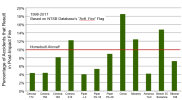
Interesting - Cubs and Champs with the fuel tank mounted in front of the cockpit have the lowest incidents of fire. Does it have anything to do with the design, because landing speed is so slow, or some other factor?
 
Interesting - Cubs and Champs with the fuel tank mounted in front of the cockpit have the lowest incidents of fire. Does it have anything to do with the design, because landing speed is so slow, or some other factor?
Speed at impact is probably the major factor.

The other factor, possibly, is crush space. Not every accident pushes the engine straight back into the fuel tank. If that doesn't happen, there's plenty of open space below the tank that could see intrusion of broken components that don't quite reach the tank to breech it.
1752994592889.png
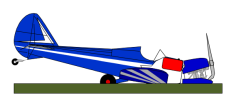
Of course, that "open space" includes the pilot's lower torso. About 25 years ago, a Fly Baby lost the engine on takeoff and crashed. The pilot was pinned in the wreckage, and about half the fuel in the tank (about six gallons) spilled out, including onto him.
1752994942273.png
(apologies for the small image)

Fortunately, a fire didn't start, and he'd had the accident at an airport. Folks rushed out and got him out of the airplane.

In contrast, many aircraft types have the fuel in the wings. This is probably safer...but not as much as some people think. If the plane hits hard enough to strip the wings completely away from the fuselage, that's good. Otherwise, there's fuel lines running from the tank through the cabin to the engine; it doesn't take much of a knock to displace the wing slightly and potentially cause a failure of a fuel line or outright shattering of a wing-mounted tank. There's no protection.

Any spilled fuel is, at least, further from an ignition source.

Here's a Kitplanes article on this subject that I wrote a few years back.....

Ron Wanttaja
 
"We hate the thought of in-flight fires‭, ‬but they’re rare‮—‬one or two a year‭, ‬at most‭, ‬across a 27,000-airplane fleet of‭ ‬homebuilts‭. ‬That’s not bad odds‭."

Thank you for your typically thorough fact-based analysis.
 
About 25 years ago, a Fly Baby lost the engine on takeoff and crashed. The pilot was pinned in the wreckage, and about half the fuel in the tank (about six gallons) spilled out, including onto him.
There's a point that needs to be made here. How much time did he have to turn the master off before impact?
 
There's a point that needs to be made here. How much time did he have to turn the master off before impact?
Lost the engine at 150 feet, stalled in the turn (might have been trying the impossible turn). Not a lot of time. Considering it was a Fly Baby, it's quite possible it didn't HAVE a master switch (no electrical system).

Do have the write-up on my Fly Baby page.

Ron Wanttaja
 
Two data points:

1 - FWIW, when I was first flying, and mostly flying a cub, I had great concern about that 12 gallon gas tank just above my lap. So I read every NTSB report on loss of hull cub crashes that I could find. From my memory, the only post impact fires were from cubs that had been modified with an electrical system, or one poor guy that hit power lines on the way in. Based on this, and the low number of cub fires in general, I believe that the source of ignition is normally the electrical system.

2 - Based on my experience with auto engines and oil/fuel leaks, I don't know that a hot manifold will reliably ignite fuel or oil. I did have it happen once, with oil when the exhaust was restricted. Given that one of the leading causes of otherwise survival crashes or off-airport landings in a piston single is engine failure, I'd think securing an engine that can't maintain level flight would allow parts to cool a bit before the landing, and reduce the chances of hot parts causing a fire. Mostly speculation on all of this.

I wouldn't invest in a fire suppression system for a piston single primarily because I don't think it would work. As everyone knows, gasoline is way easier to ignite than jet fuel, and halon systems can't suppress combustion for very long in open air. Now if there were a way to drop the battery out, after you were committed to stop the engine and land? That may seem comical, but I'd bet it would reduce the chances of post impact fires quite a bit. But...it may make things overall less safe, given that there would necessarily be a risk of that system activating when you don't want it to.

One thing I do, though, is avoid wearing or having passengers wear synthetic clothing. I might not be able to avoid the fire, but I'm not going to go through the horrors of people who have been burned and had the injuries made far more severe by their clothes becoming additional sticky fuel. There was a wing walker who suffered through that, years ago, and the account is still stuck in my head.
 
Lost the engine at 150 feet, stalled in the turn (might have been trying the impossible turn). Not a lot of time. Considering it was a Fly Baby, it's quite possible it didn't HAVE a master switch (no electrical system).
I asked in relation to this:

That's why most emergency landing checklists have you turning the master off before landing. And the fuel valve.

So many accidents are accidents because they were accidents. An unforeseen "landing" at a completely unexpected time that gives no time for the stuff we trained for: mixture to ICO, fuel off, master off, mags off, doors cracked open, and so on. I used to teach it "MMMT," master-mixture-mags-tanks. But the guy that stalls on takeoff or spins out of a low-altitude steep turn or loses control on the runway and goes into the rhubarb and flips it over? No time. Little more time than the guy that flies VFR into IMC and meets a big rock.
 
Based on my experience with auto engines and oil/fuel leaks, I don't know that a hot manifold will reliably ignite fuel or oil.
Once again, cars are not airplanes.

An aircraft exhaust is made of thin steel or stainless steel or Monel. That engine is running at 100% for takeoff and climb, 75% in cruise. These power levels are far beyond the usual auto operation, and so there is far more waste heat leaving via the exhaust. EGTs can be 1400-1500°F or even higher; I have seen 1700. Steel starts glowing at around 1100°F, and gets brighter as it gets hotter. One can sometimes see it on a brief ground run, cowling off, at night.

One fellow says this:

My case – TSIO 360.
I usually climb at 75% about 150-200F rich of peak on the leanest cylinder. TIT about 1400F on JPI, 1200-1250F on my primary TIT.
At that setting, at night you can clearly see an exhaust and turbo assembly glowing red under left and right cowling – visible via the top ventilation bracket on the engine nacelles.
That’s normal. I saw it in couple other Senecas. I’m pretty sure it happens in all aircrafts but we just can’t see it as in Seneca you have that vent just above your turbo.

https://www.euroga.org/forums/egt-rise-lycoming-io-360-b1f/12599?page=3

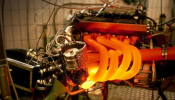
Somewhere I have seen picture of an aircraft with red-hot pipes in a test cell. Those test cells have air movement in them for cooling. Can't find it now. But here's an auto engine at high power:

1753115577006.png
 
I am all for safety. But not hysteria. Look at the data. How do accidents occur? Why do injuries and fatalities occur? What is the statistical likelyhood for any occurrence? What is the cost?

Most of the people I know are
1753116178455.png
". . . . simple . . . people of the land. The common clay of the new West. You know . . . morons".

People hate to admit it, but economics constrains everything. As a society we place a numerical value on human effort.

In making anything safer, we need to look at likelyhood, typical outcomes, and worst-case scenarios. $2000 for a certified, installed, under-cowling fire-suppression system seems low to me. But say that it is do-able. Is it the best way to spend $2000? Is $2000 even available? $2000 / engine may be a bargain for a high performance turboprop. But is it for a non-electric A-65 powered Porterfield?
 
People hate to admit it, but economics constrains everything. As a society we place a numerical value on human effort.
Yep.
In making anything safer, we need to look at likelyhood, typical outcomes, and worst-case scenarios. $2000 for a certified, installed, under-cowling fire-suppression system seems low to me. But say that it is do-able. Is it the best way to spend $2000? Is $2000 even available? $2000 / engine may be a bargain for a high performance turboprop. But is it for a non-electric A-65 powered Porterfield?
This is the kind of conversation worth having on the topic. You're absolutely right, not cost-effective for a Cub or a Taylorcraft. But for your typical C-172/PA-28? Maybe. And a definite maybe for a Bonanza/Comanche class.
Would I consider it if the price was 5k, for example? No, I'd look for other options. A BRS kit for a 172 was around 15k last time I looked (probably more now), and I could definitely install it at a reasonable cost by working with my A&P.
 
The subject of this thread has been on my mind since a good friend died by fire recently (https://www.pilotsofamerica.com/community/threads/geneva-ohio-fatal-5-25-2025.151416/ ).

His death was at least the fourth fifth person I've known in at least three four crashes, one in a Casa, one in an Aerostar, two in a Super Cub and Alan in the Zenith 701.

It makes me wonder whether a blowout plug, plumbed via an exit tube to, say, the wingtip could use the force of the impact on the tank to eject the contents away from the crash? Engineering comments, anyone?
 
Last edited:
1) Don't crash :)

2) If you are going to crash, do by running out of fuel :D

JOKING.

Seriously, it would take a lot of fire suppressant to deal with post crash fires. I carry over 100 gallons usable with full fuel.
 
Seriously, it would take a lot of fire suppressant to deal with post crash fires.
Agreed. That's why the goal is not to put the fire out, but to prevent it from starting.
Remove the source of ignition before the fuel has a chance to reach it.

It makes me wonder whether a blowout plug, plumbed via an exit tube to, say, the wingtip could use the force of the impact on the tank to eject the contents away from the crash? Engineering comments, anyone?
I'm usually the optimist around here, but I don't see a viable way to do that.
 
It makes me wonder whether a blowout plug, plumbed via an exit tube to, say, the wingtip could use the force of the impact on the tank to eject the contents away from the crash? Engineering comments, anyone?

I'm usually the optimist around here, but I don't see a viable way to do that.
I'm not an engineer. But, I see several issues with "ejecting" fuel. Isn't that what happens in a crash if the tank is ruptured? Sending a tank load of fuel onto the ground seems so much less safe than containing it and preventing it from leaking out or pouring out for the length of time required to evacuate after a crash. Keeping the contained fuel away from ignition sources also seems to me to be a better use of resources than "ejecting" fuel . . . into the unknown. So is preventing preventable crashes.
 
A local 172 crashed in a remote area. Took searchers a few days to find it. Looked like it had spun in and was in the recovery when it hit. Airspeed indicator needle left a mark on the instrument face at over 170 MPH. The wing tanks had ruptured so violently that the wing skins were peeled off the rear spars and forward over the leading edges. There is no hope of ever directing fuel like that out of any outlet line. Didn't burn; if it had, it would have been found a lot sooner.

Airplanes are built light for a very good reason, and it's difficult to build them so as to retrain fuel in violent crashes without making them so heavy that flight is impossible. And if you do succeed in making it both strong and still flyable, it might be so heavy that control is easily lost and it crashes anyway.

There is no substitute for training and good judgement. None. If you build an idiot-proof airplane, a better idiot comes along and finds a way to kill himself.
 
Maybe just wrap the tank in a big condom? :D
Self-sealing fuel tanks, like they had in WWII.

The problem is, this is a lot of effort for a very-low-probability event. It's only viable if the plane crashes in that narrow range where a conventional tank would have burst, vs. the point where the protected tank is going to break anyway.

We once had a large antenna where we wanted to make a cover for the feed to hide the frequency range. Our design engineer built one out of fiberglass...it was six feet long, pointed at the top, with a flange at the base. Our design engineer twisted the language enough to make an acronym spelling "CONDOM". Our manager refused to let him put a label with the acronym on the cover.

Me, being a guy used to developing compromises, came up with a good alternative. It was proudly labeled on the base:

MEDIUM

Ron Wanttaja
 
Back
Top