Portable vs Installed

Ed Haywood

Final Approach
Joined
Jul 12, 2020
Messages
7,624
Location
Tampa FL
Display Name
Ed
Home Airfield
FD77
Has the FAA published any specific guidance on what constitutes portable vs Installed?

For example, if I Velcro my Stratux to the glare shield and plug it into a USB port, clearly it is portable. If I mount it behind the panel with screws and hard wire into ships power, I would assume it is installed.

So how about if I zip tie it under the panel, where it is out of sight but I can reach it? What if I connect it to ships power with a 12-to-5v converter, but use quick disconnect spade terminals or similar? Does it need its own fuse if the circuit is breaker protected?
 
Has the FAA published any specific guidance on what constitutes portable vs Installed?
Yes. There are several guidance docs based on what it is.

So how about if I zip tie it under the panel, where it is out of sight but I can reach it?
Depends on if what you are securing connects to an aircraft systems, etc.

What if I connect it to ships power with a 12-to-5v converter, but use quick disconnect spade terminals or similar?
Better to use a standard AUX port or similar and make that a permanent installation. Then whatever you plug into it would be considered "loose equipment" unless you mounted that device as well.

Does it need its own fuse if the circuit is breaker protected?
Yes.
 
Yes. There are several guidance docs based on what it is.

Stratux and Bluetooth adapter. Stratux connects to AV-30 via WiFi to provide traffic. Bluetooth adapter connects to AV-30 serial port to provide Nav data from EFB on phone.

Both are currently zip tied under the panel for heat management. Would be easy enough to replace zip tie with Velcro strap.

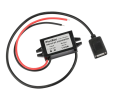
Both are plugged into USB charger. But that takes up both of my ports, so I don't have a way to charge my phone and tablet. Am running out of panel space to add another charger. TSO chargers are pricey too. Was thinking of adding something like this to each device to free up the USB charger.

Screenshot_20250504-125207.png

Better to use a standard AUX port or similar and make that a permanent installation.

Do you have an example of the type port you recommend?

Then whatever you plug into it would be considered "loose equipment" unless you mounted that device as well.

Does Velcro or zip ties constitute mounted?
 
Both are plugged into USB charger. But that takes up both of my ports, so I don't have a way to charge my phone and tablet.
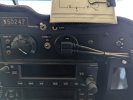
Post pic of your USB charger on the panel with those items plugged in.
Do you want your extra USB ports to be in same general area as this charger, or would you prefer them somewhere else?
 
Post pic of your USB charger on the panel with those items plugged in.
Do you want your extra USB ports to be in same general area as this charger, or would you prefer them somewhere else?
PXL_20250504_184028997.jpg

Don't much care where they are, as long as they fit. I don't plan to disconnect the Stratux and Bluetooth between flights, so I'm fine if the added ports are inaccessible, eg under the panel.
 
Don't much care where they are, as long as they fit. I don't plan to disconnect the Stratux and Bluetooth between flights, so I'm fine if the added ports are inaccessible, eg under the panel.
If it were me, I'd keep your panel USB ports open for your phone, etc. and install separate USB ports under the panel for stratux/bluetooth. However, instead of the ports you mentioned above I'd go with a simple marine USB port as marine items tend to meet some sort of standard or spec like this one. You could even add a small angle under the panel and mount the USB port for a clean install. To power this 2nd USB port I'd use an inline fuse holder connected at your main bus and run separate wires to it. Or you could use a panel mounted fuse holder and add near your CBs?? Just be sure with all your electrical additions since your refurb you haven't come close to the max load of 80% of your rated electrical system load.
 
Last edited:
If it were me, I'd keep your panel USB ports open for your phone, etc. and install separate USB ports under the panel for stratux/bluetooth. However, instead of the ports you mentioned above I'd go with a simple marine USB port as marine items tend to meet some sort of standard or spec like this one. You could even add a small angle under the panel and mount the USB port for a clean install. To power this 2nd USB port I'd use an inline fuse holder connected at your main bus and run separate wires to it. Or you could use a panel mounted fuse holder and add near your CBs?? Just be sure with all your electrical additions since your refurb you haven't come close to the max load of 80% of your rated electrical system load.

I like that plan. If I remove the speaker to add a CB for the AV-30, I'll have room for 2 more, so I could add a CB for the extra USB port also.

An angle under the panel would work well. I already have one for my Hobbs.

What's the legal rationale for using the marine USB instead of a $300 TSO one? Installer determined minor alteration and marine spec is acceptable for non flight critical equipment? Another option would be a TSO cigar lighter socket for $99.

System is 60A, so 80% would be 48A. Right now I have 53A in breakers and fuses on the bus. If I add 2A for the AV-30 and 3A for USB, I am at 58A protected. I've got the last load analysis I did with actual loads somewhere. I know draw for the lights and gauges is nowhere near the breaker limit.
 

Attachments

  • PXL_20250504_203850463.jpg
    PXL_20250504_203850463.jpg
    1.7 MB · Views: 13
Has the FAA published any specific guidance on what constitutes portable vs Installed?
I'm not sure if it's official guidance, but the interpretation I've seen is that it's portable if it doesn't require tools to install.
What's the legal rationale for using the marine USB instead of a $300 TSO one? Installer determined minor alteration and marine spec is acceptable for non flight critical equipment? Another option would be a TSO cigar lighter socket for $99.
I prefer to have a cigarette lighter socket instead of a permanent USB port. My experience is that USB adapters seem to fail after a few years, and with the cigarette lighter socket it's easy to replace, even if you're away from home. Also quick charge standards keep changing, so with a plugin adapter it's easy to replace when your new device uses a different standard.

Low profile USB adapters, that fit completely inside the socket, and cables with right angle ends are your friends.

This is the new electrical panel in my Parrakeet:

1746393093214.png
 
What's the legal rationale for using the marine USB instead of a $300 TSO one?
I place the USB charger and similar items under a standard parts. And the definition of a standard part is one that is manufactured to an established industry or government specifications. In general, marine parts tend to be mfg'd to or meet an industry specification, ie., standard part. For example, the one I linked meets several industry specs, but there are others. While I don't know if there is a TSO for USB chargers, some instances would require the use of an "approved" charger. But if your mechanic is good with the standard part route......

I am at 58A protected. I've got the last load analysis I did with actual loads somewhere.
You don't add up the CBs to calculate that. Remember circuit protection is there primarily to protect the wire. If you do have a current load analysis around look for it. Then get a DVM that can read up to 60A and checked the load of the items not included in the previous analysis and add those actual amp readings to the analysis. Or perform another load analysis.

I'm not sure if it's official guidance, but the interpretation I've seen is that it's portable if it doesn't require tools to install.
The rule of thumb is if it requires tools, however, there are a number of temporary installations that require tools that would not qualify as a "permanent" installation. For example, mounting an exterior camera mount to a tiedown ring is one. The actual guidance is more toward how the item materially alters the aircraft as to whether it is a temporary or permanent installation.
 
What are you trying to solve with permanent vs portable? If your plane is certified/non experimental, then what you're permanently adding has to be certified as well, have an STC, etc. along with a nice log book sticker signed by the avionics guy.
 
For example, if I Velcro my Stratux to the glare shield and plug it into a USB port, clearly it is portable. If I mount it behind the panel with screws and hard wire into ships power, I would assume it is installed.
No, still portable since it is not a Certified device. Assuming we're not talking about an Experimental Aircraft.

And I'm not an AP, but there could be some issues if you "permanently" attach/install it into the aircraft and attach it directly to the ship's power. Again, because it is not a Certified/Approved device.
 
  • Like
Reactions: WDD
And I'm not an AP, but there could be some issues if you "permanently" attach/install it into the aircraft and attach it directly to the ship's power. Again, because it is not a Certified/Approved device.
Not really. You can permanently install any "device" on a certified aircraft you want provided you follow the proper regulatory route. For example, I can legally install an off-the-shelf, non-approved, Cobra marine radio in a Cessna 182 as a minor alteration. Where the separate approval of a device comes more into play is when comparing replacement parts to alteration parts as a "replacement part" must have some sort of Part 21 approval to meet that definition. Alteration parts on the other hand, can be anything one wants to install with a willing mechanic and/or IA.
 
If you mount your Stratux under the panel there is going to be an issue in that you wont be able to see the status lights. To fix that I super-glued a couple of 0.75mm fiber optic strands off Amazon on to the Stratux LED's and ran them up to a little circular plate on the panel about the size of a toggle switch mount hole. Works great.
 
What are you trying to solve with permanent vs portable? If your plane is certified/non experimental, then what you're permanently adding has to be certified as well, have an STC, etc. along with a nice log book sticker signed by the avionics guy.
nothing more than an AnP that can read is required.
 
If you mount your Stratux under the panel there is going to be an issue in that you wont be able to see the status lights. To fix that I super-glued a couple of 0.75mm fiber optic strands off Amazon on to the Stratux LED's and ran them up to a little circular plate on the panel about the size of a toggle switch mount hole. Works great.
That did turn out to be a problem. My data card was corrupted, so the Stratux was not booting fully sometimes. I had no clue because I mounted it with the lights facing away from me.
 
I haven't been keeping up on this thread, so forgive me if it has been addressed. The status lights might be one thing, but I'd be more concerned about the Stratux not picking up data. Stick in down behind the panel with all those shielded radios, shielded cables, metal supports, behind the engine, etc., etc., etc.... Not the best place to put a GPS/ADS-B receiver.
 
What are you trying to solve with permanent vs portable? If your plane is certified/non experimental, then what you're permanently adding has to be certified as well, have an STC, etc. along with a nice log book sticker signed by the avionics guy.
totally wrong
 
I haven't been keeping up on this thread, so forgive me if it has been addressed. The status lights might be one thing, but I'd be more concerned about the Stratux not picking up data. Stick in down behind the panel with all those shielded radios, shielded cables, metal supports, behind the engine, etc., etc., etc.... Not the best place to put a GPS/ADS-B receiver.

Remote antennas and GPS puck.
 
My Aera is in a panel dock, which is both hardwired for power and flight plan changes. But I can still remove it without tools, so it’s portable.
 
Then why can’t I buy and install an experimental G3X vs paying more for a certified version?
Except you can legally install that version in your TC'd aircraft. Now whether you can complete that installation within the cost difference between the certified G3X version will depend on your resources. Garmin is required by regulation to ID which parts or versions are for TC'd aircraft even though all versions are made on the same production line.
 
Back
Top