
Because they aren't pilots/aircraft owners who understand the engine blows out the first 1/3 of the oil.On the topic of oil usage, why do maintenance shops insist on putting 8 quarts in the engine when doing the oil change?

Because they aren't pilots/aircraft owners who understand the engine blows out the first 1/3 of the oil.On the topic of oil usage, why do maintenance shops insist on putting 8 quarts in the engine when doing the oil change?
They're not the ones cleaning it....or they also offer a detailing service that needs the work.On the topic of oil usage, why do maintenance shops insist on putting 8 quarts in the engine when doing the oil change?

On the topic of oil usage, why do maintenance shops insist on putting 8 quarts in the engine when doing the oil change?

So they can bill you for the extra oil.On the topic of oil usage, why do maintenance shops insist on putting 8 quarts in the engine when doing the oil change?
Simply to stay in line with the requirements of Part 43.13 and its associated references. Its also the same guidance owners are required to use when they perform their own oil changes via prevent mx.why do maintenance shops insist on putting 8 quarts in the engine when doing the oil change?
So, legally, when I change my own oil I am required to put 8 quarts in, even if I know that two of them will be blown out of the breather in the first couple hours?Its also the same guidance owners are required to use when they perform their own oil changes via prevent mx.
Yes. Performing the oil change is considered maintenance which requires following a reference per Part 43.13. You could use the catch all reference of “…other methods, techniques, and practices acceptable to the Administrator,” to make your case for using 2 quarts less, but you leave yourself open when the OEM states otherwise as shown below.So, legally, when I change my own oil I am required to put 8 quarts in, even if I know that two of them will be blown out of the breather in the first couple hours?
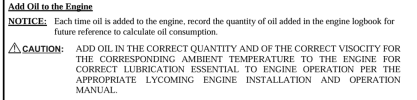

Exactly this. It says "correct quantity" not "maximum quantity". Unless the OEM has some guidance somewhere specifying that the oil sump must be filled to maximum capacity, common sense says that the "correct quantity" is the one that exceeds the minimum quantity without negative side-effects (like blowing it out of the engine). I've never maximum filled after an oil-change in my life and if an A&P does the oil change, I specify as the owner/operator how much oil goes in (usually 7qts, to allow for oil filter capacity). My bird is max 8qts, minimum 2 qts, and happiest at 6-6.5qts. If the A&P wants to specify "7qts added per owner specifications" to cover themselves, I'd be fine with that. Doesn't seem necessary though.The engine manual gives you the max capacity of the sump and a minimum oil level. You are to add the appropriate amount of oil, not the max capacity of the sump. If you don't change your own oil just specify how much you want in it. If some joker insists on filling to sump capacity go to somebody else. I have never actually had a mechanic argue that he needed to fill to sump capacity.
So given the “correct quantity” reference is from a Lycoming bulletin applicable to all its direct drive engines, in the context of signing off an oil change, how would you determine what the "correct quantity" will be for an O-235 vs a GO-480?Exactly this. It says "correct quantity" not "maximum quantity".
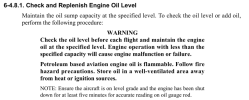
Here’s TCMs guidance. They use “specified capacity” vs “correct capacity” but it means the same. Same drill. Determine specified capacity for an A-65 vs an O-200?Unless the OEM has some guidance somewhere specifying that the oil sump must be filled to maximum capacity, common sense says that the "correct quantity" is the one that exceeds the minimum quantity without negative side-effects (like blowing it out of the engine).
Well, since I'm an owner/operator and not an A&P (but trying to do the right thing), I'd go to the guidance I'm aware of. The POH for my 1966 Cherokee 180C just says to check that "the engine oil is at the proper level" on preflight, and in the general maintenance section only specifies the maximum sump capacity and minimum safe quantity, without any reference to needing to fill to maximum capacity during maintenance. Section 2-73 in the Piper Cherokee Service Manual says "The oil sump should normally be filled with oil to the mark on the engine dipstick" but doesn't specify *which* mark. Minimum? Maximum? The only reference I can find in AC 43.13-1B to oil capacity is for weighing purposes, which notes that full oil is used for the weight calculations.So given the “correct quantity” reference is from a Lycoming bulletin applicable to all its direct drive engines, in the context of signing off an oil change, how would you determine what the "correct quantity" will be for an O-235 vs an GO-480?
Here’s TCMs guidance. They use “specified capacity” vs “correct capacity” but it means the same. Same drill. Determine specified capacity for an A-65 vs an O-200?

When you as owner/operator exercise your ability to perform prevent mx, ie., an oil change, you have to follow the same rules as an A&P. And for an oil change that starts at Part 43.13(a) and requires the use of the OEMs maintenance manual or ICAs. So that excludes the use of the POH for mx.Well, since I'm an owner/operator and not an A&P (but trying to do the right thing), I'd go to the guidance I'm aware of.
Fair enough. I'm not intending to be argumentative; just giving my thoughts on it. I agree that para. 2-73 references Table II-I, which in turn states 8 quarts is the sump capacity. I just don't like that at no point do they ever say plainly "fill the sump to capacity", instead saying "fill to the dipstick line". Seems needlessly obtuse from the OEMs. If the standard is to fill to sump capacity following an oil change, just say so plainly in the guidance. Appreciate your expertise and explanations.While you may still not agree with this explanation that’s fine. But in the context of my original answer, this is the reason why mechanics, in general, service oil levels to the “correct or specified quantity” as listed by the OEMs to remain in line with 43.13(a).
Rather than always having the oil at "minimum", should one not consider the oil consumed on the next flight?
Ie, the oil should not be lower than minimum upon landing?
So if minimum is 6qts and your consumption is as high as 0.5qts/hr (as allowed by Lyc SB 480F, in some engines) does that not mean for a 3hr flight, to not depart with less than 7.5qts?
Over the years I’ve learned to be thankful for anything the OEMs would put out there considering they weren’t required formally to provide mx manuals and ICAs until 1981. Was a time when all a mechanic had were an OEM owners manual/drawings, parts manual, AC43.13-1, and the Aircraft Specifications (TCDS) to provide any references. And some are still that way like a Super Cub.Seems needlessly obtuse from the OEMs.
This is my specialty!like a bumbling idiot

When you as owner/operator exercise your ability to perform prevent mx, ie., an oil change, you have to follow the same rules as an A&P. And for an oil change that starts at Part 43.13(a) and requires the use of the OEMs maintenance manual or ICAs. So that excludes the use of the POH for mx.
Since you referenced Piper’s oil change process above, we’ll follow that one for your 180 which meets the requirements for 43.13(a). Working our way down through that process we come to the para. 2-73 you mentioned above. In that same 2-73 paragraph “the quantity of oil required” is referenced in Table II-I. And that Table gives us 8 quarts which is the same “correct quantity” referenced by Lycoming in their oil change process bulletin I posted.
Now, with your oil change signed-off as servicing with 8 qts, your Part 43 mx responsibilities are done, and your POH comes back into play. And as I mentioned earlier, the FAA does not consider certain pre-flight items to be “maintenance” and you can service your oil level as you see fit.
While you may still not agree with this explanation that’s fine. But in the context of my original answer, this is the reason why mechanics, in general, service oil levels to the “correct or specified quantity” as listed by the OEMs to remain in line with 43.13(a).
Well, this all just sent me down a rabbit hole of digging through all the maintenance documentation for my aircraft and engine, and finding...Yes. Performing the oil change is considered maintenance which requires following a reference per Part 43.13. You could use the catch all reference of “…other methods, techniques, and practices acceptable to the Administrator,” to make your case for using 2 quarts less, but you leave yourself open when the OEM states otherwise as shown below.
However, once the aircraft is back flying and during a pre-flight you notice you need oil, you can service it to whatever level you want, legally, as “preflight” items like refueling and servicing engine oil are not considered to be maintenance at that time. It’s the same reason you can have the line-boy add a quart of oil and refuel the aircraft with no regulatory issues.
Now how you blur the line between the above paragraphs is totally up to you. From my standpoint, I put in 8 quarts or whatever the OEM states, enter it as such in the record, and call it a day.
View attachment 139241


Its usually listed in the engine owner/operators manual. However, if the engine was certified under Part 33 it may have "usable oil" limits vs a static min oil level and possibly its in the TCDS as well. Can't get anything to download at the moment but can look later if you dont find it.Somewhere, I've seen that you can be as low as 2 quarts, but I can't find that to save my life now.
FYI: adding more than the stated certified capacity can cause internal damage just as not enough oil can.One odd thing I found is that some people have said that on the IO-550 they have lowered consumption by putting MORE oil in than specified.
And thats totally within your ability on how you interperate the rule under your sign off. Based on my experiences, I defer to the OEM requirements unless I can substantiate a difference.But, I think if I'm required to put 8 quarts in the airplane at the oil change,
