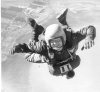
My 8 jumps were all done ~35 years ago. I only intended to do one, but the first jump resulted in a "mae west" and I had to cut away and descend on the reserve chute. That was a bit unnerving, so I decided to keep jumping until I wasn't afraid.

I wouldn't hesitate to do it if were still on my bucket list. It is a LOT safer now than it was decades ago. When I jumped, there were no tandem jumps, so your very first jump was all on your own. It was static line, but as in my case, static doesn't mean there can be no problems.
One thing that surprised me (but probably shouldn't have): when you exit the aircraft, you are FALLING. It is nothing like how it appears on TV or in the movies. It is exactly like stepping off the high dive - only with thousands of feet of nothing between you and the end of the ride. Doing a tandem jump, you'll quickly get through the "falling" portion and before you know it the air will feel like it's supporting you a bit. But that first portion of the jump... yup. you're just dropping through the air.

I did seven jumps when I was in college, some 35 years ago. Back then, you had to do five successful static line jumps, then you could do a short free fall, or as we called it, a "hop and pop". My last jump was one of these, and even on that short free fall, I could feel the acceleration. It was quite impressive. Shortly after that, I decided to go back to power plane flying. I didn't really like freefall all that much, and the harness ride down was just painful with a nice view. Plus it was a lot of waiting around for not much airtime. The dropzone where I was going (Bardstown, KY) had two Cessna 180's and a DeHavilland Beaver for aircraft, and as a beginning jumper, the thing you feared most was when a "Beaver load" was being put together, as it shut the entire drop zone down for more than an hour.
The Beaver lived at the far end of the runway. You'd see the pilot walk out, and spend about 30 minutes preflighting the beast. Then you'd hear the inertial starter rev up. Inevitably, when the pilot engaged the starter, the propeller would turn about three blades and stop. The pilot would get out, and you'd see him walking back to the hangar. He'd go in and get this cart that was about 3 feet square and was covered with RV batteries. Then he'd walk out all the way to the Beaver, plug it in, get it started and warmed up, and then he had to bring the battery cart back in. Then, he could taxi it in to the loading area and fill it up with meat bombs. Since the Beaver load was kind of a big deal, they'd get every experienced jumper in the DZ together, and fill both Cessnas and the Beaver. Included in one of these loads were the jumpmasters that we inexperienced jumpers needed, so we knew we weren't going to jump for a long while.
When they finally got this assemblage airborne, they started up. I don't know what the rate of climb is for a Beaver loaded with skydivers is, but it wasn't much. IIRC, it was at least a 45 minute climb. They'd disappear from sight, all you could do was to hear the radial engine. Then you'd see a few dots in the sky, and then those dots turned to parachute canopies. After another 20 minutes or so, they'd be packed up and things returned to normal for a while, at least until another Beaver load materialized. Inexperienced jumpers were lucky to jump twice in one day, and there were a number of days I got one, after being there sunup to sundown.
Anyway, if anyone of us in the over 50 crowd was thinking of doing a static line jump, I'd recommend trying some parachute landing falls and seeing how your lower body tolerated that. You might want to start at chair height, and eventually move up to four feet or so. If that doesn't bother you, your jump should go fine. I rather like weilke's suggestion that you go for an AFF. Yeah, it's going to be around $300, but you'll get the full experience and when you're done, you'll know whether or not you'd want to continue.



 I had a headset on and the guy was talking me down but I was soo light that my forward motion didn't get me to the heart of the DZ. I hear "dude, you're going behind a hill and I can't see you, gonna have to flare on your own. Good luck." I flared didn't hit hard but didn't do a stand up landing either. I was soo amped with adrenalin but at the same time I was thinking I'm never doing that again. Took me a month before I had the courage to go back. Can't get my money back so I might as well complete the 6 jumps. I had some violent porpoising issues for 2 more jumps but then got the hang of it and was having a blast. After 5 jumps I was exiting on my own, doing turns and even backflips!