No flap landings.

I did commercial training in an M20J. A couple guys warned me before starting that Mooneys are difficult to land, keep your speed up, they’re a handful and need a long runway. They recommended 75 to 80 knots on final. So I start training, and the actual data says 69 knots if I recall correctly. Yep, fly it at the proper speed - that is, the speed the smart people who designed and tested the plane say to fly - and it doesn’t float, doesn’t need a mile of runway, make our exit every time problem.

Easy plane to fly and land. Just a bit cramped for me and hard to get in and out of with a bad knee. (Yes, I know that Al Mooney stood seven feet tall and slid the seat all the way forward.)
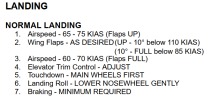
I think what happens is that too many CFIs teach padding the recommended airspeed in the POH checklist. If you look at at Cessna 172 checklist, it's giving a range.
1748694666850.png
That 65-75 with no flaps/60-70 with flaps is not only a range rather than a target, but it's already padded! If you calculate 1.3 Vs0, it's 60 KIAS with full flaps at max gross weight, basically, the short field max gross target. Add in CFIs who teach the middle or the upper end of that range and those who go even higher if there is the slightest breath of wind ,and the result is that many pilots end up flying the approach at least 5-10 KIAS too fast. It's pretty much irrelevant in a aerodynamically dirty 172 which slows down very quickly when power is reduced to idle (unless its' a really short field), but the pilots end up carrying that lesson over to a slicker airframe get a lot of float.
 
when did no flap landings become rare ?

I think no flap landings should definitely be taught. It helps to be comfortable with them if a flap failure occurs.

But other than to occasionally practice them, they should be rare. Remember that energy goes up as the square of the increase in velocity. So even a small increase in landing speed can result in a significant increase in energy carried at landing. Which is NOT your friend if things go sideways at touchdown. I even made a little spreadsheet to calculate that effect:

23659991808_0230491531_w.jpg


Stipulated than on most landings on most days it won’t make any difference. But on that one rare event - hitting a deer, gear or brake failure, loss of control, whatever - a pilot might be very grateful NOT to have been carrying any extra energy into that event.
 
I think no flap landings should definitely be taught. It helps to be comfortable with them if a flap failure occurs.

But other than to occasionally practice them, they should be rare.
Interesting.

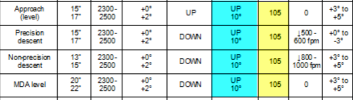
I think this may have been debated in another thread, but the “by the numbers” instruction for Bonanzas defaults to no flaps, maximum of 10 degrees. My ABS instructor leans towards working with no flaps, as there are no intermediate “step” settings on the older V-tails.

I also think it makes landing in gusts or crosswinds easier - assuming, of course, that you have plenty of runway to work with.


:stirpot:
 
I think this may have been debated in another thread, but the “by the numbers” instruction for Bonanzas defaults to no flaps, maximum of 10 degrees. My ABS instructor leans towards working with no flaps, as there are no intermediate “step” settings on the older V-tails.

I also think it makes landing in gusts or crosswinds easier - assuming, of course, that you have plenty of runway to work with.

I once watched a Bonanza land at Copperhill airport - 1A3 - with no flaps. And use up practically every inch of the 3,500’ runway to get stopped. I asked him why he chose no flaps, and his answer was something like “I just don’t care for them”.

As an aside, this is the recommendation in the Cirrus SR22 POH:

11465390255_d82810e0b2_o.jpg


As a CSIP, I did include no flap landings in transition training, and I’m pretty sure that training was in the syllabus.
 
Interesting.

I think this may have been debated in another thread, but the “by the numbers” instruction for Bonanzas defaults to no flaps, maximum of 10 degrees. My ABS instructor leans towards working with no flaps, as there are no intermediate “step” settings on the older V-tails.

I also think it makes landing in gusts or crosswinds easier - assuming, of course, that you have plenty of runway to work with.


:stirpot:
The numbers in the PAC chart are instrument flight target numbers and the recommendation for no more than 10° flaps is for instrument approaches. They are not landing recommendations. Unless you are also saying that you should land still carrying 105 KIAS :D.

1748698489250.png
 
I once watched a Bonanza land at Copperhill airport - 1A3 - with no flaps. And use up practically every inch of the 3,500’ runway to get stopped. I asked him why he chose no flaps, and his answer was something like “I just don’t care for them”.

As an aside, this is the recommendation in the Cirrus SR22 POH:

11465390255_d82810e0b2_o.jpg


As a CSIP, I did include no flap landings in transition training, and I’m pretty sure that training was in the syllabus.
No different for Bonanzas. Normal, crosswind, short field, soft field and no-flap landings are in the Bonanza transition training syllabus. And POH checklist normal landings are "Flaps ... Down."
 
Back
Top