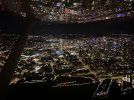
Night Engine Failure

Therookguy

Pre-Flight
Joined
Mar 6, 2022
Messages
92
Display Name
Therookguy
I fly at night a lot so I just wanted to post this one mostly for fun.

I'm sure we've all heard the saying "Find the darkest spot you can see and on final switch on the landing light, if you like what you see keep it on, if you don't turn it back off."

Still I'm a nervous flyer so here's the strategy I've come up with over the years. Let me know what you guys do.

Familiar terrain (I've seen it in the day):

I'll land at a location based off what I remember being there previously. Ideally an airport or empty road. Then generally flat unoccupied terrain.

Unfamiliar Terrain (No clue what's actually down there):

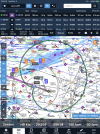
I turn on the roads feature in foreflight and zoom in within my glide advisor range. If the engine quits I'll head for that road and just pray the road is landable or there is clear terrain near it.

I suppose a better method might be the topo or satellite map on Foreflight or Foreflight synthetic vision? Has anyone played with this and found any comfort in it? (I don't have garmin or panel based synthetic vision).
 
My GPS moving map display is set at Track-Up with a 35 mile screen range and airports displayed. Depending upon altitude, I've gotten a feel for what airports could be reached if the engine acts up or quits. If that happens, it's quick and easy to immediately turn towards a suitable airport, then stop the turn once the airport is centered at 12 o'clock. Then just fly straight at it.

Knowing this procedure is available at all times is comforting. Especially at night or IMC.
Interesting. I often look at airports that are just out of or a few miles out of glide range based on foreflight glide advisor and wonder if I'd try to stretch my glide to make it there or pick something closer. I guess it depends on what is between me and the airport.

I haven't heard of any success or failure stories using foreflight glide advisor. All it uses is winds aloft forecasts and the glide ratio you plug in, so I wouldn't be surprised if you can do better than what it says, or worse.

I've never considered using the Glide Advisor function on Foreflight, and wasn't aware that winds aloft forecasts (which would need to include the wind aloft's forecast altitude for additional accuracy) were even a component of the jagged circle displayed.

Flying along with pilots who use it I've never noticed much of a difference in the circle that I'd expect to see while flying along on a windy day. Always assumed the circle was based strictly on terrain height and the programmed glide ratio.

I do use Firelight's "Hazard Advisor" when flying near or over mountainous terrain, which I find very useful. At night, and in IMC, when over rural or unpopulated area where having any airport nearby within gliding distance is not available, I use Foreflight on the iPad map display and watch the "Aerial Map" and Aeronautical presentation. This displays highways, towns, valley's, forests, etc., to help with pointing the plane in the right direction if the engine goes south...
 
Last edited:
Check moon phase and rise/set times, and only fly nights with 50% or more illum. Dim your panel and turn off unnecessary device displays, to reduce glare so you can see outside. Preserve your night vision by using a small red or green flashlight in the cockpit when needed.
 
I fly at night a lot so I just wanted to post this one mostly for fun.

I'm sure we've all heard the saying "Find the darkest spot you can see and on final switch on the landing light, if you like what you see keep it on, if you don't turn it back off."

Still I'm a nervous flyer so here's the strategy I've come up with over the years. Let me know what you guys do.

Familiar terrain (I've seen it in the day):

I'll land at a location based off what I remember being there previously. Ideally an airport or empty road. Then generally flat unoccupied terrain.

Unfamiliar Terrain (No clue what's actually down there):

I turn on the roads feature in foreflight and zoom in within my glide advisor range. If the engine quits I'll head for that road and just pray the road is landable or there is clear terrain near it.

I suppose a better method might be the topo or satellite map on Foreflight or Foreflight synthetic vision? Has anyone played with this and found any comfort in it? (I don't have garmin or panel based synthetic vision).

Night flying does have risks, but please consider that the leading cause of accidents at night is loss of control and CFIT. Within engine failure, fuel exhaustion is the leading cause. While mechanical failures outside of the pilot's control should not be dismissed, it is far lower on the list. Statistics show that engine failure at night has a high survivable rate.

If an engine failure occurs at night, in flat farmland, I would head for the dark areas. In hilly areas, I would look for a road. Most importantly, I would make sure the airplane is in great shape, has plenty of fuel, pilot is well rested and the weather is good.
 
I always have a pretty good idea of surface winds, but at night especially. Monitor AWOS/ATIS at nearby airports as you pass by. A controlled landing into the wind is much better than a tail wind or quartering tail wind landing, thus losing control.
 
I thought the other engine was to take you to the scene of the crash ... :biggrin:
Hey hey, now. @Zeldman 's landings aren't that bad. :biggrin:

On dark nights, tune in airfields along your path and turn on their runway lights.
I was doing that one evening and got a "Knock that off!". I think I might have dimmed one instead of turning it on.
 
I turn on the roads feature in foreflight and zoom in within my glide advisor range. If the engine quits I'll head for that road and just pray the road is landable or there is clear terrain near it.
The problem is that dark spot might be an empty field, or it might be trees.

I generally have the aerial map under the sectional when I'm using ForeFlight, whether IFR or VFR - The low enroutes are great for planning but don't tell me much when flying, even IFR, that I can't get to with a couple taps if I need it.

Generally, I do pay attention to where airports and roads are while flying at night just by looking out the window if it's VMC. If the engine quit, once I got pointed toward a promising area and did the first few things to try and get the engine going again, I think I'd just get rid of the sectional and see if I could ascertain where an empty area is. One issue with roads is that they often have power lines next to them, which you won't be able to see at night, so I think I'd try for a field if I'm confident in where it is.

Things like starlight, moonlight, snow, etc all help. Tech is a last resort on a truly dark or overcast night.

Interesting. I often look at airports that are just out of or a few miles out of glide range based on foreflight glide advisor and wonder if I'd try to stretch my glide to make it there or pick something closer. I guess it depends on what is between me and the airport.
You're only really going to be able to stretch if you have a nice tailwind and you can fly at minimum sink instead of Vg.

I haven't heard of any success or failure stories using foreflight glide advisor. All it uses is winds aloft forecasts and the glide ratio you plug in, so I wouldn't be surprised if you can do better than what it says, or worse.
Glide ratio, winds aloft, and terrain.

I've played around with it a fair amount when we were testing it, and it seemed that I could easily exceed where it said I could go, but I expect that's because I didn't cut the engine off. Idle thrust is a much better situation than a prop that's stopped, or worse, windmilling. I expect the Glide Advisor would be right on if your engine was actually dead.

I've never considered using the Glide Advisor function on Foreflight, and wasn't aware that winds aloft forecasts (which would need to include the wind aloft's forecast altitude for additional accuracy) were even a component of the jagged circle displayed.

Flying along with pilots who use it I've never noticed much of a difference in the circle that I'd expect to see while flying along on a windy day. Always assumed the circle was based strictly on terrain height and the programmed glide ratio.
Nope, it's got winds aloft at all altitudes. At NA piston altitudes in areas without much terrain, you'll mainly see this manifest as the Glide Advisor just being a circle that's offset in the direction of the winds.

Where it gets really fun is when you're in a turboprop up high in the winter. As the winds approach your Vg, it kinda starts to look like a butt.
IMG_0681.PNG
 
There is a pilot that has made a layer for Foreflight that attempts to display suitable landing options. My plane is currently down for annual so I have not had time to try it from the air. I'm not sure how useful this particular version is, but I think the idea has merit.

 
More and more, at night I’m flying higher for longer glide distance as well as deliberately planning the route to include as many airport options as possible. I no longer deliberately fly in IMC at night although I do file.
 
Synthetic vision on Foreflight is actually pretty amazing. Try it one night with a safety pilot while landing and note terrain and obstacles. I think it would increase the odds of a safer crash’.
 
wonder if I'd try to stretch my glide
Glides are not rubber bands. They do not stretch.
Ignoring wind - slower than best glide brings you up short - faster brings you up short.
With wind - you want to be a bit faster when gliding into the wind and a very little bit slower downwind.
 
Ok, this is risk buy-down drill.

X-2 on flying higher to maximize glide time and distance. This might mean packing O2, even for sub 12.5K altitudes. Also might mean eating headwinds for a path that maximizes time over highways and airfields. Although, this does nothing if the terrain underneath is hazardous anyway, but it at least buys time to make the call and get the squawk noticed.

Reconsider the current plane to make sure it meets the mission and reduces risk.

Other possibilities are improving survive-ability such as adding air bags to the seat belts, wearing a helmet, and wearing reflective gearing that will make you shiny when the helo's spotlight beam hits. Sure, all these things add cost and might look a bit dorky. But we are looking to improve survive-ability, right?


As fate has it, I actually know somebody who exercised the common joke about turning the lights on to check, and then back off if it did not look friendly. He turned them back off. Survived, but it was not a "good" landing and ended his ability to work any job. Based on injuries, I still feel that a helmet would have allowed him to work again. YMMV.
 
I just stopped flying at night. I have a single engine plane based in an area that is heavily forested. There are precious few places where an off-field landing could be successful. Many of the roads in the area have tree canopies that extend over the roads. The same hazards exist in the day time, but at least you can actually see your off-airport target options. Besides, I fly for fun and for the view of the ground below me. Night flight always made me nervous and there was no view of unlit areas on the ground. The air was often smoother than during the day, it was normally cooler and that helped with performance, but the added risk stopped being worthwhile as I aged up. I 'm retired now, so only flying during daylight isn't much of a restriction for me. Before going on a long X/C flight, I often get night current by staying in the pattern at my home field and shoot the requisite 3 landings to a full stop. That prepares me for unexpected delays that keep me in the air as daylight fades away. Even then, I try to change my flight plan to be on the ground before the end of nautical twilight.
 
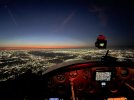
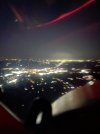
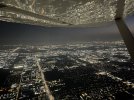
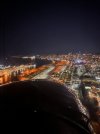
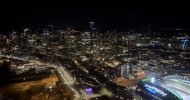
Seattle on the "scenic route" from KBFI. The route is flown at like 800 AGL to avoid traffic into KSEA. Only place to land in engine failure - ditching in the water!

IMG_7054.jpegIMG_7049.jpegIMG_7680.jpgIMG_7059.jpeg
 
Last edited:
+100 on theflying high at night. I used to do it all the time, often flying home from a business trip or from a long day at a football game (perhaps not an act of genius). I love how quiet and relaxed things are at night, the controllers mellow and the views amazing.

And, yes: a "burp" from the engine is... focusing.
 
In the mid 90s I had a stumbling engine 25E of Red Table@ 15000. Made it into BJC with spouse and two middle school daughters aboard (M20J), fire trucks and all.

The Hunt for the Seneca began!
 
Last edited:
I fly at night a lot so I just wanted to post this one mostly for fun.

I'm sure we've all heard the saying "Find the darkest spot you can see and on final switch on the landing light, if you like what you see keep it on, if you don't turn it back off."

Still I'm a nervous flyer so here's the strategy I've come up with over the years. Let me know what you guys do.

Familiar terrain (I've seen it in the day):

I'll land at a location based off what I remember being there previously. Ideally an airport or empty road. Then generally flat unoccupied terrain.

Unfamiliar Terrain (No clue what's actually down there):

I turn on the roads feature in foreflight and zoom in within my glide advisor range. If the engine quits I'll head for that road and just pray the road is landable or there is clear terrain near it.

I suppose a better method might be the topo or satellite map on Foreflight or Foreflight synthetic vision? Has anyone played with this and found any comfort in it? (I don't have garmin or panel based synthetic vision).
Day or night, every flight has associated risk. Is the risk of flying a lot at night justified or risk you are needlessly accepting?

Today, I only fly at night in SE aircraft when necessary.
 
In the mid 90s I had a stumbling engine 25E of Red Table@ 15000. Made it into BJC with spouse and two middle school daughters aboard (M20J), fire trucks and all.

The Hunt for the Seneca began!
Wow! There aren't many places worse than that to have a stumbling engine.
 
I don't mind flying XC at night, but I do have some caveats:

1. The aircraft must be well-maintained, and in excellent maintenance condition to minimize the chance of mechanical failure.
2. Fuel planning is very conservative.
3. MVFR or better only. We're not going in conditions that might include fog or 500 foot ceilings. Or ice.
4. Routing is over friendly terrain with airports within gliding distance for most of the route. No shortcuts over the Catskills. ATC always helpfully wants to get me to cut the corner on my way home. Nope.
5. No visual approaches at night at non-towered, especially unfamiliar airports. IFR approach only, even in VFR conditions. The approach will keep you away from terrain you can't see and don't know about from experience. My home airport is in a black hole at night with hills all around.
6. Cruise at high altitudes for maximum gliding range in practical. I like to fly at 8000-10000 MSL anyway even in daytime just for a better ride.

No doubt night flying entails extra risk. But risk can be minimized by not tempting fate.
 
Back
Top